rss rss
Subscribe

Share/Save/Bookmark

Sunday, May 13, 2007

Abraham

Abraham was commanded by God to offer his son up as a sacrifice in the land of Moriah. Proceeding to obey, he was prevented by an angel as he was about to sacrifice his son, and slew a ram which he found on the spot.Abraham (אַבְרָהָם "Father/Leader of many", (circa 1900 BCE) Standard Hebrew Avraham, Arabic ابراهيم) is regarded as the founding patriarch of the Israelites whom God chose to bless out of all the families of the earth. He is a critical figure in both Judaism and Christianity, and is a very important prophet in Islam. Accounts of his life are given in the Book of Genesis and also in the Qur'an.

Judaism, Christianity, and Islam are sometimes referred to as the "Abrahamic religions", because of the role Abraham plays in their holy books and beliefs. In the Hebrew Bible and the Qur'an, Abraham is described as a patriarch blessed by God (the Jewish people called him "Father Abraham"), and promised great things. Jews and Christians consider him father of the people of Israel through his son Isaac; Muslims regard him as the father of the Arabs through his son Ishmael. In Christian belief, Abraham is a model of faith, and his intention to obey God by offering up Isaac is seen as a foreshadowing of God's offering of his son, Jesus. In Islam, Abraham obeyed God by offering up Ishmael and is considered to be one of the most important prophets sent by God.

His original name was Abram (אַבְרָם "High/Exalted father/leader"); he was the foremost of the Biblical patriarchs. Later in life he went by the name Abraham.

more...

Friday, May 11, 2007

The emerging church

1 + 1 = 1Emergent Christians are predominantly found in Western Europe, North America, and the South Pacific. Some attend local independent churches that specifically identify themselves as being "emergent", while many others contribute to the conversation from within existing mainline denominations.

During recent centuries Western Christianity, like all of Western civilization, has been influenced significantly by modernism. In the 19th century modernist Protestant theologians sought to examine the individual narratives of the Bible and from them extract a set of underlying truths or "meta-narratives". By using methods borrowed from scientific reductionism it was hoped that a grand truth and worldview would be attained. In practice, however, the modernist approach led to additional schism within the Church (cf. Christian liberalism, Christian fundamentalism).

Postmodern church expression, on the other hand, encourages followers to deconstruct each element of their faith experience and reassemble the pieces according to his or her own unique journey of deconstruction.

More...


Thursday, May 10, 2007

social action

In sociology, social actions refer to any action that takes into account actions and reactions of other individuals and is modified based on those events.

Social Action"Doing a '180' is putting others before yourself and also a willingness to be counter cultural." -ginkworld.net

In England in the 1830s, many poor children had no time for school or play. They worked in coal mines under inhuman conditions. But these children had a friend in high places: Anthony Ashley Cooper, seventh Earl of Shaftesbury and a member of parliament. He was also a devoted Christian who believed God had called him to help the downtrodden. Shaftesbury fought for years to end the abusive child labor practices, although at times he felt “every hand is against me.” But he stood firm, and Parliament abolished child slavery in the mines. ©bible.org


more...

authenticity

In the arts, history, archaeology, the study of antiques, and similar fields involving unique or scarce artifacts from the past, and, with regard to documents in law, authenticity (Greek: αυθεντικός, from 'authentes'='author') is the truthfulness of origins, attributions, commitments, sincerity, and intentions; not a copy or forgery.

People in the postmodern culture seek real and authentic experiences in preference over scripted or superficial experiences. Emerging churches strive to be "relevant" to today's culture and daily life, whether it be through worship or service opportunities. The core Christian message is unchanged but emerging churches attempt, as the church has throughout the centuries, to find ways to reach God's people where they are to hear God's message of unconditional love.

Authenticity is also a technical term in existentialist philosophy. In this philosophy, the conscious self is seen as coming to terms with being in a material world and with encountering external forces, pressures and influences which are very different from, and other than, itself. Authenticity is the degree to which one is true to one's own personality, spirit, or character, despite these pressures. Existentialists see this process in different ways.

more...

Wednesday, May 09, 2007

Christlike

Christ in Gethsemane, Carl Heinrich BlochTo be like Christ; showing the spirit of Christ.

Very early in the morning, while it was still dark, Jesus got up, left the house and went off to a solitary place, where he prayed. Simon and his companions went to look for him, and when they found him, they exclaimed: “Everyone is looking for you!” —Mark 1:35-37, NIV


  • we know about Jesus healing the sick and raising the dead;

  • we know about Jesus throwing the money-changers out of the House of God;

  • we know about Jesus' mercy on the woman caught in the act of adultery;

  • we know about Jesus feeding the five thousand from a few pieces of bread and a few fish;

  • we know about Jesus' many miracles


However, in the above passage we see Jesus in the fullness of His character.

We see Him as one who not only carried out the will of God, but one who sought God's Will during times of solitude in prayer. Jesus sacrificed Himself to carry out the will of God. He could have stopped it at any time, but He allowed it to happen because it was God'w Will and because He loves us that much.

More...

Monday, May 07, 2007

Narrative theology

Wisembach, Commune des Vosges, Copyright © Christian AmetNarrative theology was a late 20th century theological development which supported the idea that the Church's use of the Bible should focus on a narrative presentation of the faith, rather than on the development of a systematic theology. The Christian faith is thus also to be interpreted by the Christian community, and not by outside scholars or explorers.


Narrative theology has also been referred to as post-liberalism. It shares much in common with Biblical theology; meaning that theology which attempts to understand the progressive revelation of God towards Man as history developed throughout the Old and New testaments, rather than jumping from one section of scripture to another in a topical manner.

More...

missional living

Children of the Eastern Cape of South AfricaThe Oxford English Dictionary defines "missional" as "Relating to or connected with a religious mission; missionary." In contemporary usage "missional" is an adjectival alternative to "missionary." Although both words are related to "missio" (Latin: sending), some scholars, including Darrell Guder et. al. in The Missional Church believe "missional" focuses on the the Church's indigenous, rather than cross-cultural context, with the church contextualizing its methods, morality, and message to fit this indigenous culture.

In this usage "missional" has rapidly entered the lexicon of the growing emerging church movement whose participants have popularized the term, enabling participants in this movement to recognize each other across denominational lines.

More...

Friday, May 04, 2007

Intelligent design

Time magazine cover,  August 15, 2005 Intelligent design (ID) is the concept that "certain features of the universe and of living things are best explained by an intelligent cause, not an undirected process such as natural selection." Its leading proponents, all of whom are affiliated with the Discovery Institute, say that intelligent design is a scientific theory that stands on equal footing with, or is superior to, current scientific theories regarding the origin of life.

More and more of the scientific community are beginning to view intelligent design as a valid scientific theory.
  • The Evidence in Cosmology
    The Kalam cosmological argument is espousing a more powerful and compelling impetus.
  • The Evidence in Physics
    The "Anthropic principle" lead Patrick Glynn to abandon atheism. He says, "Today the concrete data point strongly in the direction of the God hypothosis. It is the simplist and most obvious solution to the anthropic puzzle."
  • The evidence in Astronomy
    "If the universe had not been made with the most exacting precision we could never have come into existance. It is my view that these circumstances indicate the universe was created for man to live in." -John A. O'Keefe of NASA
  • The evidence in Biochemistry
    Michael Behe has demostrated that Darwin's theory has broken down, through his description of "irreducibly complex" machines.
  • The evidence in Biological Information
    Stephen C. Meyer (Cambridge) has demonstrated that no hypothosis explains how information got into biological matter through naturalistic means.
  • The evidence in Consciousness
    "You can't get something from nothing. If the universe began with dead matter having no consciousness, how, then, do you get something totally different--consciousness, living, thinking, feeling, believing, creatures--from materials that don't have that?" -J. P. Moreland

More...

Thursday, May 03, 2007

cosmological argument

Modern thinkers sometimes cite evidence for the Big Bang to support the claim that the universe began to exist a finite time ago.The cosmological argument is a metaphysical argument for the existence of God, or a first mover of the cosmos. It is traditionally known as an "argument from universal causation," an "argument from first cause," and also as an "uncaused cause" argument. Whichever term is used, there are three basic variants of this argument, each with subtle but important distinctions: the argument from causation in esse, the argument from causation in fieri, and the argument from contingency. The cosmological argument does not attempt to prove anything about the first cause or about God, except to argue that such a cause must exist. This cause is known in Latin as "causa sui."

Origins of the argument
Plato and Aristotle both posited first cause arguments, though each had certain notable caveats. Plato (c. 427–c. 347 BCE) posited a basic cosmological argument in The Laws (Book X). He argued that motion in the world and in the cosmos was "imparted motion" that would have required some kind of "self-originated motion" to set it in motion and to maintain the motion. Plato also posited a "Demiurge" of supreme wisdom and intelligence as the creator of the cosmos in his work Timaeus.

More...

Wednesday, May 02, 2007

anthropic principle

The NGC 2440 Nebula, courtesy ©NASA
In physics and cosmology, the anthropic principle is an umbrella term for various dissimilar attempts to explain the structure of the universe by way of coincidentally balanced features that are necessary and relevant to the existence on Earth of biochemistry, carbon-based life, and eventually human beings to observe such a universe. The common (and "weak") form of the anthropic principle is a truism or tautology that begins with the observation that the universe appears surprisingly hospitable to the emergence of life, particularly complex multicellular life, that can make such an observation and concludes with that premise that in only such a fine-tuned universe can such living observers be.

Given the extreme simplicity of the universe at the start of the Big Bang, the friendliness of the universe to complex structures such as galaxies, planetary systems, and biology is unexpected by any normal model of turbulence driven structuring that science has been able to derive.

The idea evolved from the so-called "Dicke's coincidence", and has subsequently been reinforced by the discovery of many more anthropic coincidences since Robert Dicke first noted that the evolution of the universe is not random, but is coincidentally constrained by biological factors that require that the age of the universe had to be roughly this "golden-age". Much younger, and there would not have been time for sufficient interstellar levels of carbon to build up by nucleosynthesis, but much older, and the golden age of main sequence stars and stable planetary systems would have already come to an end.

More...

Tuesday, May 01, 2007

watchmaker analogy

Hooke’s drawing of a flea. The watchmaker analogy, or watchmaker argument, is a teleological argument for the existence of God. By way of an analogy the argument states that design implies a designer. In the 17th and 18th centuries, the analogy was used (by Descartes and Boyle, for instance) as a device for explaining the structure of the universe and God's relationship to it. Later, the analogy played a prominent role in natural theology and the "argument from design," where it was used to support arguments for the existence of God and for the intelligent design of the universe.

The most famous statement of the teleological argument using the watchmaker analogy was given by William Paley in 1802. Paley's argument was seriously challenged by Charles Darwin's formulation of the theory of natural selection, and how it combines with mutation to improve survivability of a species, even a new species. In the United States, starting in the 1980s, the concepts of evolution and natural selection (usually referred to as "Darwinism") became the subject of a concerted attack by Christian creationists (see creationism). This attack included a renewed interest in, and defense of, the watchmaker argument by the intelligent design movement.

The Watchmaker argument
The watchmaker analogy consists of the comparison of some natural phenomenon to a watch. Typically, the analogy is presented as a prelude to the teleological argument and is generally presented as:

  1. If you look at a watch, you can easily tell that it was designed and built by an intelligent watchmaker.

  2. Similarly, if you look at some natural phenomenon X (a particular organ or organism, the structure of the solar system, life, the entire universe) you can easily tell that it was designed and built by an intelligent creator/designer.

More...

Monday, April 30, 2007

Ex nihilo

artistic view of creationismEx nihilo is a Latin term meaning "out of nothing". It is often used in conjunction with the term creation as in Creatio ex Nihilo, "Creation out of nothing". God created merely by speaking it into existence.

Due to the nature of this, the term is often used in creationistic arguments, as some religions believe that God created the universe from nothing. It has also been argued that this concept cannot be deduced from the Hebrew and that the Book of Genesis, chapter 1, speaks of God "making" or "fashioning" the universe. However, Rabbi Schneur Zalman of Liadi (1745-1812) refuted these arguments in section II of his book titled "Tanya".

Arguments in Favor
Typical verses from the Christian scripture (i.e. the Bible) cited in support of Ex nihilo creation by God are the following:


  • Genesis 1:1-2 - In the beginning when God began to create the heavens and the earth, the earth was a formless void...

  • Proverbs 8:22-24 “Jehovah himself produced me as the beginning of his way, the earliest of his achievements of long ago. 23 From time indefinite I was installed, from the start, from times earlier than the earth. 24 When there were no watery deeps I was brought forth as with labor pains, when there were no springs heavily charged with water.

  • Psalm 33:6 - By the word of the LORD were the heavens made, their starry host by the breath of his mouth.

  • John 1:3 - Through him all things were made; without him nothing was made that has been made.

  • Romans 4:17 - ... the God who gives life to the dead and calls things that are not as though they were.

  • 1 Corinthians 1:28 - He chose the lowly things of this world and the despised things—and the things that are not—to nullify the things that are,

  • Hebrews 11:3 - By faith we understand that the universe was formed at God's command, so that what is seen was not made out of what was visible.

More...

Creation

Orion Nebula taken by the Hubble Space Telescope.
The act of creating; especially, in a theological sense, the original act of God in bringing the world or universe into existence.

Creation is a doctrinal position in many religions and philosophical belief systems which maintains that a single God, or a group of gods or deities is responsible for creating the universe. Creationism affirms this belief, but the doctrinal belief is not necessarily synonymous with creationism.


Judaism & Christianity
Genesis 2:4-25


Mainstream Biblical scholarship maintains that the creation story found in Genesis 2 is the earlier of the two Genesis accounts. Filled with ancient and rich imagery, it is believed that the basic story once circulated among the early nomadic Hebrews, told perhaps around simple, intimate campfire settings, answering questions about life and the origins of humankind. The story also reflects Israel's belief in its covenant relationship with God. The concern in Genesis 2 is not in the creation of the cosmos but in the origins of humankind and their environment. There is a clear connection between humans and the land (Gen. 2:7) and the notion that people are a special creation of God. "Jehovah" is that name of God, which plainly means that he alone has His being of himself, and that He gives being to all creatures and things.


More...

Saturday, April 28, 2007

Irreducible complexity

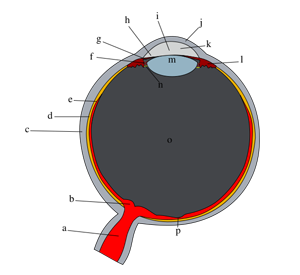
Schematic diagram of the human eye -- click for details ---Irreducible complexity (IC) is the argument that certain biological systems are too complex to have evolved from simpler, or "less complete" predecessors, and are at the same time too complex to have arisen naturally through chance mutations. An "irreducibly complex" system is defined by the term's originator, biochemistry professor Michael J. Behe, as one "composed of several well-matched, interacting parts that contribute to the basic function, wherein the removal of any one of the parts causes the system to effectively cease functioning". These examples are said to demonstrate that modern biological forms could not have evolved naturally. The argument is used in a broader context to support the idea that an intelligent designer was involved, at some point, in the creation of life, against the theory of evolution which argues no designer is required. In a manner of speaking, the IC argument is a definition of the "designer", or at least "what was designed", a definition that has proven elusive in the past. The most common examples used in argument are the complexity of the eye (right), the Blood clotting cascade, or the motor in a cell's flagellum.

The examples offered to support the irreducible complexity argument have generally been found to fail to meet the definition and intermediate precursor states have been identified for several structures purported to exhibit irreducible complexity.

More...

William Lane Craig

William Lane CraigWilliam Lane Craig (born August 23, 1949) is an American philosopher, theologian, and Christian apologist. He is a prolific author and lecturer on a wide range of issues related to the philosophy of religion, the historical Jesus, the coherence of the Christian worldview, and Intelligent Design. He is married and lives in Atlanta, Georgia, and is currently a Research Professor of Philosophy at Talbot School of Theology, Biola University in La Mirada, California. Craig is a fellow of the Discovery Institute's Center for Science and Culture, which is the hub of the Intelligent Design movement.


Craig became a Christian believer in high school at the age of 16. His vocation and academic studies reflect his religious commitment to Christian beliefs within the Protestant Evangelical tradition.

In theological commitments he holds to an Arminian (specifically, Molinist) view concerning the grace of God and the role of the human will in conversion. He has had friendly connections with para-church ministries such as Campus Crusade for Christ and Christian International Ministries (Europe).

In his early reading and studies, Craig was influenced by the writings of Francis Schaeffer and Edward John Carnell. He studied philosophy under Stuart Hackett.
More...

Friday, April 27, 2007

F. F. Bruce

Frederick Fyvie BruceFrederick Fyvie Bruce (1910-1990) (more commonly known as F. F. Bruce) was a Bible scholar, and one of the founders of the modern evangelical understanding of the Bible.

He was born in Elgin, Morayshire and was educated at the University of Aberdeen, Cambridge University and the University of Vienna. After teaching Greek for several years first at the University of Edinburgh and then at the University of Leeds he became head of the Department of Biblical History and Literature at the University of Sheffield in 1947. In 1959 he moved to the University of Manchester where he became professor of Biblical Criticism and Exegesis. In his career he wrote some thirty-three books and served as editor of The Evangelical Quarterly and the Palestine Exploration Quarterly. He retired from teaching in 1978.

Bruce was a dedicated member of the Open Plymouth Brethren, though he did not affirm the dispensationalism usually associated with that movement.

Bruce was a distinguished scholar on the life and ministry of the Apostle Paul, and wrote several studies the best known of which is Paul: Apostle of the Free Spirit. He also wrote commentaries on several biblical books including Acts of the Apostles, 1 & 2 Corinthians, and the Epistle to the Hebrews.

His work New Testament Documents: Are They Reliable? is considered a classic in the discipline of apologetics.

More...

Thursday, April 26, 2007

Justin Martyr

Justin MartyrJustin Martyr (Justin the Martyr a.k.a Justin of Caesarea) (100 – 165) was an early Christian apologist. His works represent the earliest surviving Christian apologies of notable size.

Life
Most of what is known about the life of Justin Martyr comes from his own writings. He was born at Flavia Neapolis (modern Nablus) in Palestine. The city had been founded by Vespasian in the aftermath of the destruction of Jerusalem in AD 70.


Justin suffered martyrdom at Rome under Marcus Aurelius when Rusticus was prefect of the city (between 162 and 168).

He calls himself a Samaritan, but his father and grandfather were probably Greek or Roman, and he was brought up a pagan. It seems that he had property, studied philosophy, converted to Christianity, and devoted the rest of his life to teaching what he considered the true philosophy, still wearing his philosopher's gown to indicate that he had attained to the truth. He probably travelled widely and ultimately settled in Rome as a Christian teacher.

More...

Wednesday, April 25, 2007

Christian apologetics

Title page for the 1582 Douai-Rheims New TestamentChristian apologetics is the field of study concerned with the systematic defense of Christianity. The term "apologetic" comes from the Greek word apologia, which means in defense of; therefore a person involved in Christian or Bible Apologetics is a defender of Christianity. Someone who engages in Christian apologetics is called a "Christian apologist". Christian apologetics have taken many forms over the centuries, starting with Paul of Tarsus, including renowned writers such as Augustine of Hippo and Thomas Aquinas, and continuing today with the modern Christian community through authors such as Karl Keating and Jimmy Akin. Apologists have based their defense of Christianity on favoring interpretations of historical evidence, philosophical arguments, scientific investigation, and other avenues.

This Classical Greek term appears in the Koine Greek (i.e. common Greek) of the New Testament. The apostle Paul employed the term "apologia" (a speaking in defense) in his trial speech to Porcius Festus and Agrippa when he said, "I make my defense" (Acts 26:2). In the English language, the word apology, derived from the Greek word "apologia", usually refers to asking for forgiveness for an action that is open to blame. Christian apologetics are meant, however, to argue that Christianity is reasonable and in accordance with the evidence that can be examined, analogous to the use of the term in the Apology of Socrates, written by Plato.


More...

Tuesday, April 24, 2007

Presuppositional apologetics

Image of Gordon Haddon Clark  ©John W. Robbins, 1989.Presuppositional apologetics is a school of Christian apologetics, a field of Christian theology that attempts to present a rational basis for the Christian faith, defend the faith against objections, and attack the alleged flaws of other worldviews. Presuppositional apologetics is especially concerned with the third aspect of this discipline, though it generally sees the trifold distinction as a difference in emphasis rather than as delineating three separate endeavors. Presuppositional apologetics developed in and is most commonly advocated within Reformed circles of Christianity.

The key discriminator of this school is that it maintains that the Christian apologist must assume the truth of the supernatural revelation contained in the Bible (that is, the Christian worldview) because there can be no set of neutral assumptions from which to reason with a non-Christian. In other words, presuppositionalists say that a Christian cannot consistently declare his belief in the necessary existence of the God of the Bible and simultaneously argue on the basis of a different set of assumptions (presumably those of the non-Christian) in which God may or may not exist.

Presuppositionalists contrast their approach with the other schools of Christian apologetics by describing them as assuming the world is intelligible apart from belief in the existence of God and then arguing exclusively on (purportedly) neutral grounds to support trusting the Christian Scriptures. Specifically, presuppositionalists describe Thomistic (also "Traditional" or "Classical") apologetics as concentrating on the first aspect of apologetics with its logical proofs for the existence of God. Aquinas himself insists that many crucial truths can only be known through scripture, and none of his arguments are intended to show the entire Christian picture. Presuppositionalists, however, consider his arguments unglorifying to God, because they ignore even a part of revelation for the sake of argument. The goal is to argue that nonbelievers' assumptions require believing in some things about God that they don't believe (e.g. that an eternal, perfectly good, designer created the universe), but presuppositionalists consider any argument that stops short of the full biblical revelation is dishonoring to God.

More...

Monday, April 23, 2007

Christian Worldview

Christian WorldviewChristian worldview refers to a collection of distinctively Christian philosophical and religious beliefs. The term is typically used in one of three ways:

  1. A set of worldviews voiced by those identifying themselves as Christian;
  2. Common elements of worldviews predominant among those identifying themselves as Christian;
  3. The concept of a single "Christian worldview" on a range of issues.

There are some rather startling statistics, based upon the following definition of "worldview," including a firm belief in six specific religious views.

  1. Jesus Christ lived a sinless life;
  2. God is the all-powerful and all-knowing Creator of the universe and He stills rules it today;
  3. salvation is a gift from God and cannot be earned;
  4. Satan is real;
  5. a Christian has a responsibility to share their faith in Christ with other people; and
  6. the Bible is accurate in all of its teachings.

Based upon the above definition, Barna and other polling organizations have observered a decline in Christian beliefs. A recent study indicates that only 4% of American adults have a biblical worldview as the basis of their decision-making -- while at the same time "spirituality" has been on the rise.


More...

Sunday, April 22, 2007

Kalam cosmological argument

M 17 Omega Nebula,  © NASA / HubbleThe Kalam cosmological argument is a version of the cosmological argument derived from the Islamic Kalam form of dialectical argument. It attempts to prove the existence of God by appealing to the principle of universal cause. Similar arguments are found in the theologies of Judaism (for example, in the work of Maimonides) and Christianity (for example in Thomas Aquinas), where it is known as the "uncaused cause" or "first cause" argument.

The origin of the word "kalam" (علم الكلم) is Islamic and is one of the 'religious sciences' of Islam. In Arabic the word means "discussion", and refers to the Islamic tradition of seeking theological principles through dialectic. A scholar of kalam is referred to as a mutakallam (Muslim theologian; plural mutakallamin).

The original scholars of kalam were recruited by Hunayn Ibn Ishaq (d. 873) for the House of Wisdom under the Abbasid Caliph in Baghdad. They collected, translated, and synthesised everything that the genius of other cultures had accumulated before undertaking to augment and expand it. From their translations of Greek, Iranian, and Indian works, they formed the basis of Muslim falsafa (philosophy) in the 9th and 10th centuries.

The word means "speech" or "doctrine," however "kalam" came to identify the entire movement of highly academic Islamic theology of the Middle ages, which later faded away.

The origin of the Kalam cosmological argument dates to fourth century Egypt. John Philoponus of Alexadria, Egypt, argued that the universe had a beginning. This view was contrary to that of the Greek philosopher, Arisotle, who believed that Godwas not the creator of the universe, but rather He interspersed order into it. Aristotle believed that God and the universe were eternal. Arisotle's view was/is contradictory with the Hebrew and Christian belief that God is the creator of the universe.

More...

Saturday, April 21, 2007

Babylonia

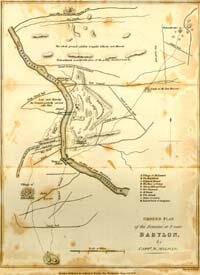
From Travels in Chaldaea, including a journey from Bussorah to Bagdad, Hillah, and Babylon, performed on foot in 1827, published by Henry Colburn and Richard Bentley, London, 1829.Babylonia, named for its capital city, Babylon, was an ancient state in the south part of Mesopotamia (in modern Iraq), combining the territories of Sumer and Akkad. The earliest mention of Babylon can be found in a tablet of the reign of Sargon of Akkad, dating back to the 23rd century BC.

History
Historically, two ethnic groups, the Sumerians and Akkadians, had dominated the region. An area rich in natural resources, and strategically located for trade routes and commerce, it was often under threat from outsiders throughout the region's history.

Old Babylonian period
At around 1900 BC, following the Sumerian revival under Ur-III, Semitic Amorites from west of the Euphrates gained control over most of Mesopotamia. During the first centuries of their rule, Mesopotamia was not unified, and the most powerful city state was Isin. Some Amorites eventually formed a monarchical government in the city-state of Babylon, which would ultimatly take over the Amorite kingdoms and form the first Babylonian empire. The three centuries of their rule is known as the Old Babylonian Period. The Babylonians engaged in regular trade and influence with Western city-states; with Babylonian officials and troops passing to Syria and Canaan. Further, "Amorite" colonists were established in Babylonia for the purposes of trade.

More...

Friday, April 20, 2007

Assyria

Assyrian EmpireAssyria in earliest historical times referred to a region on the Upper Tigris river, named for its original capital, the ancient city of Assur. Later, as a nation and Empire, it also came to include roughly the northern half of Mesopotamia (the southern half being Babylonia). The capital is Nineveh.


Assyria proper was located in a mountainous region, extending along the Tigris as far as the high Gordiaean or Carduchian mountain range of Armenia, sometimes called the "Mountains of Ashur".

The Assyrian kings controlled a large kingdom at three different times in history. These are called the Old, Middle, and Neo-Assyrian kingdoms, or periods. The most powerful and best-known nation of these periods is the Neo-Assyrian kingdom, 911-612 BC.

More...

Wednesday, April 18, 2007

Garden of Eden

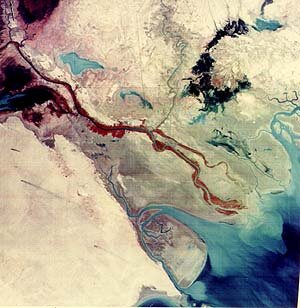
Eden, possibly located in this vecinity where the Tigris and Euphrates terminate into the GulfThe Garden of Eden (from Hebrew Gan Ēden, "גַּן עֵדֶן") is described by the Book of Genesis as being the place where the first man - Adam - and woman - Eve - lived after they were created by God. The past physical existence of this garden forms part of the creation belief of the Abrahamic religions.

The Genesis account (specifically, the Jahwist version of the creation story) supplies the geographical location of Eden in relation to four major rivers. However, because the identification of these rivers has been the subject of much controversy and speculation, a substantial consensus now exists that the knowledge of the location of Eden has been lost.

Suspected locations
There have been a number of claims as to the actual geographic location of the Garden of Eden, though many of these have little or no connection to the text of Genesis. Most put the Garden somewhere in the Middle East near Mesopotamia. Locations as diverse as Ethiopia, Java, Sri Lanka, the Seychelles, Brabant, and Bristol, Florida have all been proposed as locations for the garden. Some Christian theologians believe that the Garden never had a terrestrial existence, but was instead an adjunct to heaven as it became identified with Paradise.

The text asserts that from Eden the river divided into four branches: Hiddekel a.k.a. Tigris, Euphrates, Pishon and Gihon. The identity of the former two are commonly accepted, though the latter two rivers have been the subject of endless argument. But if the Garden of Eden had really been near the sources of the Tigris and the Euphrates, then the original narrators in the land of Canaan would have identified it as located generally in the Taurus Mountains, in Anatolia. Satellite photos reveal two dry riverbeds flowing toward the Persian Gulf near where the Tigris and Euphrates also terminate. While this accounts for four rivers in the vicinity, that area is the mouth of those rivers rather than their source.


More...

Tuesday, April 17, 2007

Ur

Ur seen across the Royal tombs, with the Great Ziggurat in the background, January 17, 2004Ur was an ancient city in southern Mesopotamia, located near the original mouth of the Euphrates and Tigris rivers on the Persian Gulf and close to Eridu. Because of marine regression, the remains are now well inland in present-day Iraq, south of the Euphrates on its right bank , and named Tell el-Mukayyar, near the city of Nasiriyah south of Baghdad.
6Abram believed the LORD, and he credited it to him as righteousness. 7He also said to him, "I am the LORD, who brought you out of Ur of the Chaldeans to give you this land to take possession of it." 8But Abram said, "O Sovereign LORD, how can I know that I will gain possession of it?" -Genesis 15:6-8
The site is marked by the ruins of a ziggurat (right), still largely intact, and by a settlement mound. The ziggurat is a temple of Nanna, the moon deity in Sumerian mythology.

It has has two stages constructed from brick: in the lower stage the bricks are joined together with bitumen, in the upper stage they are joined with mortar. Ur at its height had around 30,000 residents.

More...

Monday, April 16, 2007

Euphrates

Tigris and Euphrates Rivers empties through a delta into the Persian Gulf in southeastern IraqThe Euphrates (the traditional Greek name, Arabic: الفرات; Al-Furat, Hebrew: פְּרָת) is the westernmost of the two great rivers that define Mesopotamia (the other being the Tigris).

Etymology
The name Euphrates may have originated from Old Persian Ufratu, as it were from Avestan *hu-perethuua, meaning "good to cross over" (from hu-, meaning "good", and peretu, meaning "ford"). Alternatively, some suggest that the name Euphrates is possibly of Kurdish origin.

Euphrates in the Bible
The river Euphrates is one of the four rivers that flow from the Garden of Eden according to Genesis 2:13-15. It is the fourth river, after the Pishon, the Gihon, and the Tigris, to form from the river flowing out of the garden. The river also marked one of the boundaries of the land promised by God to Abraham and his descendants. In the Hebrew Bible, it is often referred to simply as "The River" (ha-nahar).

The word Euphrates is a translation for the word "Gush forth" or "break forth". It has always been assumed to mean "river" but this is not explicitly stated. It literally means "breaking forth of liquid". The river Euphrates was named from this root word, "To gush forth".
In the Book of Revelation, it is prophesied that in the "near future the Potamos Euphrates or "breaking forth like water" of the middle east will dry up in preparation for the Battle of Armageddon.

More...

Mesopotamia

Overview map of ancient MesopotamiaMesopotamia refers to the region now occupied by modern Iraq, eastern Syria, and southern Turkey. The name comes from the Greek words μέσος "between" and ποταμός "river", referring to the area between the Euphrates and the Tigris (the Arabic term is بين نهرين Bayn Nahrain "between two rivers"). The fertile area watered by these two rivers is known as the "Cradle of Civilization," (see also cradle of humanity) and it was here that the first literate societies developed.

The biblical Patriarch Abraham was from Ur in Mesopotamia.


Acts 7:22 To this he replied: "Brothers and fathers, listen to me! The God of glory appeared to our father Abraham while he was still in Mesopotamia, before he lived in Haran.


Genesis 11:28-3128 While his father Terah was still alive, Haran died in Ur of the Chaldeans (see Chaldea), in the land of his birth. 29 Abram and Nahor both married. The name of Abram's wife was Sarai, and the name of Nahor's wife was Milcah; she was the daughter of Haran, the father of both Milcah and Iscah. 30 Now Sarai was barren; she had no children. 31 Terah took his son Abram, his grandson Lot son of Haran, and his daughter-in-law Sarai, the wife of his son Abram, and together they set out from Ur of the Chaldeans to go to Canaan. But when they came to Haran, they settled there.


More...

Techledo Consulting

Techledo Consulting, LLC

Prevail Magazine

My Photo
Timothy Ministries
View my complete profile