Philo (20 BCE - 40 CE), known also as Philo of Alexandria and as Philo Judeaus, was a Hellenized Jewish philosopher born in Alexandria, Egypt. The few biographical details concerning him are found in his own works, especially in Legatio ad Caium, ("embassy to Caius") and in Flavius Josephus.
The only event that can be determined chronologically is his participation in the embassy which the Alexandrian Jews sent to the emperor Caligula at Rome for the purpose of asking protection against the attacks of the Alexandrian Greeks. This occurred in the year 40 CE.
Philo included in his philosophy both Greek wisdom and Judaism, which he sought to fuse and harmonize by means of the art of allegory that he had learned as much from Jewish exegesis as from the Stoics. His work was not widely accepted. "The sophists of literalness," as he calls them (De Somniis, i. 16-17), "opened their eyes superciliously" when he explained to them the marvels of his exegesis. Philo's works were enthusiastically received by the early Christians, some of whom saw in him a Christian. Eusebius speculated that the Therapeutae, the Jewish group of ascetic hermits in the Egyptian desert that Philo describes in De vita contemplativa ("Contemplative Life") was in fact a Christian group.
We have a brief reference to Philo by the first century Jewish historian Josephus. In Antiquities of the Jews, Josephus tells of Philo's selection by the Alexandrian Jewish community as their principal representative before the Roman emperor Gaius Caligula. He says that Philo was sent to represent the Alexandrian Jews in regard to civil disorder that had arisen between the Jews and the Greeks in Alexandria (in Egypt). Josephus tells us also that Philo was skilled in philosophy, and that he was brother to an official called Alexander the alabarch. According to Josephus, Philo and the larger Jewish community refused to treat the emperor as a god, to erect statues in honor of the emperor, and to build altars and temples to the emperor. Josephus says Philo believed that God actively supports this refusal. This portrait of Philo matches the character of Philo that is expressed in his own writings, as discussed below.
More...
Friday, July 23, 2010
Thursday, July 22, 2010
Gehenna
Gehenna (Hebrew:גַּיְא geenna, or Gehenom or Gehinom), in Jewish eschatology, is a fiery place where the wicked are punished after they die or on Judgment Day. Gehenna also appears in the New Testament and early Christian writing, and appears in Islam as Jahannam.
The word traces to Greek, ultimately from Hebrew: גי(א)-הינום Gêhinnôm (also Guy ben-Hinnom (Hebrew: גיא בן הינום) meaning the Valley of Hinnom's son. The valley forms the southern border of ancient Jerusalem and stretches from the foot of Mount Zion, eastward, to the Kidron Valley. It is first mentioned in Joshua 15:8.
Originally it referred to a garbage dump in a deep narrow valley right outside the walls of Jerusalem (in modern-day Israel) where fires were kept burning to consume the refuse and keep down the stench. It is also the location where bodies of executed criminals, or individuals denied a proper burial, would be dumped. In addition, this valley was frequently not controlled by the Jewish authority within the city walls; it is traditionally held that this valley was used as a place of religious child-sacrifice to Moloch by the Canaanites outside the city.
More...
The word traces to Greek, ultimately from Hebrew: גי(א)-הינום Gêhinnôm (also Guy ben-Hinnom (Hebrew: גיא בן הינום) meaning the Valley of Hinnom's son. The valley forms the southern border of ancient Jerusalem and stretches from the foot of Mount Zion, eastward, to the Kidron Valley. It is first mentioned in Joshua 15:8.
Originally it referred to a garbage dump in a deep narrow valley right outside the walls of Jerusalem (in modern-day Israel) where fires were kept burning to consume the refuse and keep down the stench. It is also the location where bodies of executed criminals, or individuals denied a proper burial, would be dumped. In addition, this valley was frequently not controlled by the Jewish authority within the city walls; it is traditionally held that this valley was used as a place of religious child-sacrifice to Moloch by the Canaanites outside the city.
More...
Wednesday, July 21, 2010
Wernher von Braun
Dr. Wernher Magnus Maximilian Freiherr von Braun (March 23, 1912 – June 16, 1977) was one of the leading figures in the development of rocket technology in Germany and the United States. The German scientist, who led Germany's rocket development program (V-2) before and during World War II, entered the United States at the end of the war through the then-secret Operation Paperclip. He became a naturalized U.S. citizen and worked on the American ICBM program before joining NASA, where he served as director of NASA's Marshall Space Flight Center and the chief architect of the Saturn V launch vehicle, the superbooster that propelled the United States to the Moon. He is generally regarded as the father of the United States space program. Wernher von Braun received the National Medal of Science in 1975. He was tall, articulate and spoke English with a distinctive German accent.
(see also Founders of modern science)
After von Braun's death, Major General John Medaris commented,
More...
(see also Founders of modern science)
After von Braun's death, Major General John Medaris commented,
“ His imagination strolled easily among the stars, yet the farther out into the unknown and unknowable vastness of Creation his thoughts went, the more he was certain that the universe, and this small garden spot within it, came from no cosmic accident, but from the thought and purpose of an all-knowing God. ”Concerning the teaching of evolution in public schools, Wernher von Braun said:
“ To be forced to believe only one conclusion—that everything in the universe happened by chance—would violate the very objectivity of science itself. Certainly there are those who argue that the universe evolved out of random process, but what random process could produce the brain of a man or the system of the human eye? Some say that science has been unable to prove the existence of a Designer.. They challenge science to prove the existence of God. But, must we really light a candle to see the sun? ”
More...
Tuesday, July 20, 2010
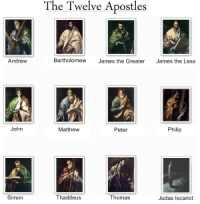
The Twelve Apostles
The Twelve Apostles (in Koine Greek "απόστολος" apostolos: "messenger from God, LXX 3 Ki.14.6; esp. of the Apostles, Ev.Matt.10.2, al." (Henry George Liddell, Robert Scott), G652: "a delegate, messenger, one sent forth with orders a) specifically applied to the twelve apostles of Christ) in a broader sense applied to other eminent Christian teachers" (Strong's Concordance) were men that according to the Synoptic Gospels and Christian tradition, were chosen from among the disciples of Jesus for a mission (see also: Seventy Disciples). According to the Bauer lexicon, Walter Bauer's Greek-English Lexicon of the New Testament: " Judaism had an office known as apostle (שליח)".
The Gospel of Mark states that Jesus initially sent out these twelve in pairs (Mark 6:7-13, cf. Matthew 10:5-42, Luke 9:1-6), to towns in Galilee.
Literal readings of the text state that their initial instructions were to heal the sick and drive out demons, but some scholars read this more metaphorically as instructions to heal the spiritually sick and thus to drive away wicked behavior.
More...
The Gospel of Mark states that Jesus initially sent out these twelve in pairs (Mark 6:7-13, cf. Matthew 10:5-42, Luke 9:1-6), to towns in Galilee.
Literal readings of the text state that their initial instructions were to heal the sick and drive out demons, but some scholars read this more metaphorically as instructions to heal the spiritually sick and thus to drive away wicked behavior.
More...
Monday, July 19, 2010
Wahhabism
Wahhabism (Arabic: Al-Wahhābīyya الوهابية) or Wahabism is a conservative form of Sunni Islam attributed to Muhammad ibn Abd-al-Wahhab (1703–91), an 18th century scholar from what is today known as Saudi Arabia, who advocated a return to the practices of the first three generations of Islamic history.
Wahhabism is the dominant form of Islam in Saudi Arabia, and is also popular in Kuwait and the United Arab Emirates. It is often referred to as a "sect" or "branch" of Islam, though both its supporters and its opponents reject such designations. It has developed considerable influence in the Muslim world through the funding of mosques, schools and other means from Persian Gulf oil wealth.
The primary doctrine of Wahhabism is Tawhid, or the uniqueness and unity of Allah (the deity Muslims worship). Ibn Abdul Wahhab was influenced by the writings of Ibn Taymiyya and questioned medieval interpretations of Islam, claiming to rely on the Qur'an and the Hadith. He preached against a "perceived moral decline and political weakness" in the Arabian Peninsula and condemned idolatry, the popular cult of saints, and shrine and tomb visitation.
More...
Wahhabism is the dominant form of Islam in Saudi Arabia, and is also popular in Kuwait and the United Arab Emirates. It is often referred to as a "sect" or "branch" of Islam, though both its supporters and its opponents reject such designations. It has developed considerable influence in the Muslim world through the funding of mosques, schools and other means from Persian Gulf oil wealth.
The primary doctrine of Wahhabism is Tawhid, or the uniqueness and unity of Allah (the deity Muslims worship). Ibn Abdul Wahhab was influenced by the writings of Ibn Taymiyya and questioned medieval interpretations of Islam, claiming to rely on the Qur'an and the Hadith. He preached against a "perceived moral decline and political weakness" in the Arabian Peninsula and condemned idolatry, the popular cult of saints, and shrine and tomb visitation.
More...
Sunday, July 18, 2010
teleological argument
A teleological argument (or a design argument) is an argument for the existence of God or a creator based on perceived evidence of order, purpose, design and/or direction in nature. The word "teleological" is derived from the Greek word telos, meaning "end" or "purpose." Teleology is the supposition that there is purpose or directive principle in the works and processes of nature.
More...
The argument
The teleological argument is consistent with Romans 1:20:"For since the creation of the world God's invisible qualities—His eternal power and divine nature—have been clearly seen, being understood from what has been made, so that men are without excuse."Although there are variations, the basic argument can be stated as follows:
- X is too (complex, orderly, adaptive, apparently purposeful, and/or beautiful) to have occurred randomly or accidentally.
- 2. Therefore, X must have been created by a (sentient, intelligent, wise, and/or purposeful) being.
- God is that (sentient, intelligent, wise, and/or purposeful) being.
- Therefore, God exists.
More...
Saturday, July 17, 2010
Oral Tradition
The Oral Torah or Oral Law (Hebrew: תורה שבעל פה, Torah she-be-`al peh), according to Rabbinic Judaism, is an oral tradition received in conjunction with the written Torah (and the rest of the Hebrew Bible), which is known in this context as the "Written Torah" (Hebrew: תורה שבכתב, Torah she-bi-khtav). The traditions of the Oral Torah are believed to be the same as those recorded in the Mishnah and Talmud during the 2nd-5th centuries CE.
According to classical Judaism and the tenets of Orthodox Judaism, Moses and the Jews at Mount Sinai received an Oral as well as a written Torah ("teaching") from God. The books of the Tanakh (Hebrew Bible) were relayed with an oral tradition passed on by the scholarly and other religious leaders of each generation, and according to classical Rabbinic interpretation, the teachings of the Oral Law are a guide to that interpretation of the Written Law which is considered the authoritative reading. Jewish law and tradition thus is not based on a strictly literal reading of the Tanakh, but on combined oral and written traditions. Further, the basis of halakha (הלכה, (nf. law, rule, dogma; theory; Jewish religious laws) includes the premise that the Written Law is inherently bound together with an Oral Law.
The "Oral Law" was ultimately recorded in the Talmud and Midrash.
More...
According to classical Judaism and the tenets of Orthodox Judaism, Moses and the Jews at Mount Sinai received an Oral as well as a written Torah ("teaching") from God. The books of the Tanakh (Hebrew Bible) were relayed with an oral tradition passed on by the scholarly and other religious leaders of each generation, and according to classical Rabbinic interpretation, the teachings of the Oral Law are a guide to that interpretation of the Written Law which is considered the authoritative reading. Jewish law and tradition thus is not based on a strictly literal reading of the Tanakh, but on combined oral and written traditions. Further, the basis of halakha (הלכה, (nf. law, rule, dogma; theory; Jewish religious laws) includes the premise that the Written Law is inherently bound together with an Oral Law.
The "Oral Law" was ultimately recorded in the Talmud and Midrash.
More...
Friday, July 16, 2010
Dispensationalism
Dispensationalism is a branch of Christian theology that
More...
- teaches Biblical history as best understood in light of a number of successive economies or administrations under God, which it calls "dispensations," and
- emphasizes prophecy of the end-times and the pre-tribulation rapture view of Christ's second coming.
- specifically, the management, oversight, administration, of other's property
- the office of a manager or overseer, stewardship
- administration, dispensation.
More...
Thursday, July 15, 2010
Hayah-‘asher-Hayah
The name Hayah (Hebrew: היה) denotes God's potency in the immediate future, to be, exist, be present; happen, occur, take place: become, turn into, and is part of YHVH. The phrase "Hayah-'asher-Hayah" (Hebrew: אהיה אשר אהיה) comes from the word Hayah and is used a total of 43 places in the Old Testament, where it is usually translated as "I will be" -- as is the case for its first occurrence, in Exodus 3:14:
More...
14 God said to Moses, "I AM WHO I AM." And he said, "Say this to the people of Israel, 'I AM has sent me to you.'"or "I shall be," as is the case for its final occurrence in Zechariah 8:8. This stems from the Hebrew conception of monotheism—that God exists within each and everyone and by himself, the uncreated Creator who does not depend on anything or anyone; therefore "I AM WHO I AM." Some scholars state the Tetragrammaton itself derives from the same verbal root, but others counter that it may simply sound similar as intended by God, such as Proverbs 8:34 and the Hebrew words "shaqad" (Hebrew: שקד, to bow, bend) and "shaqed" (Hebrew שקד, almond branch) found in Jeremiah 1:11-12.
More...
Wednesday, July 14, 2010
Damascus
Damascus (Arabic: دمشق) is the capital and largest city of Syria, with close ties to Israel. Founded approximately 2500 BCE, it is thought to be the oldest continuously inhabited city in the world, before Al Fayyum, and Gaziantep. Its current population is estimated at about 4.5 million.
In Arabic, the city is called دمشق الشام Dimashq ash-Shām.
Although this is often shortened to Dimashq by many, the citizens of Damascus, and of Syria and some other Arab neighbors, colloquially call the city ash-Shām. Ash-Shām is an Arabic term for North and for Syria. (Syria — particularly historical Greater Syria — is called Bilād ash-Shām — بلاد الشام, 'country of the north' — in Arabic.) The English name for Damascus is taken from the Greek Δαμασκός, via Latin. This comes from the old Aramaic name for the city — דרמשק Darmeśeq, which means "a well-watered place". However, pre-Aramaic tablets unearthed at Ebla refer to a city to the south of Ebla named Damaski. It is possible that the name 'Damascus' pre-dates the Aramaic era of the city. Damascus is designated as having been part of the ancient province of Amurru in the Hyksos Kingdom, from 1720 to 1570 BC. (MacMillan, pp. 30-31).
More...
In Arabic, the city is called دمشق الشام Dimashq ash-Shām.
Although this is often shortened to Dimashq by many, the citizens of Damascus, and of Syria and some other Arab neighbors, colloquially call the city ash-Shām. Ash-Shām is an Arabic term for North and for Syria. (Syria — particularly historical Greater Syria — is called Bilād ash-Shām — بلاد الشام, 'country of the north' — in Arabic.) The English name for Damascus is taken from the Greek Δαμασκός, via Latin. This comes from the old Aramaic name for the city — דרמשק Darmeśeq, which means "a well-watered place". However, pre-Aramaic tablets unearthed at Ebla refer to a city to the south of Ebla named Damaski. It is possible that the name 'Damascus' pre-dates the Aramaic era of the city. Damascus is designated as having been part of the ancient province of Amurru in the Hyksos Kingdom, from 1720 to 1570 BC. (MacMillan, pp. 30-31).
More...
Tuesday, July 13, 2010
The Cambridge Declaration
The Cambridge Declaration is a statement of faith written in 1996 by the Alliance of Confessing Evangelicals, a group of Reformed and Lutheran Evangelicals who were concerned with the state of the Evangelical movement in America, and throughout the world.
While not a best seller, the book was critically acclaimed by a number of important Evangelical leaders. In 1994 a number of these leaders formed the Alliance of Confessing Evangelicals. Since much of Wells' thesis stemmed from the modern church's abandonment of historical confessions of faith (such as the Westminster Confession of Faith and the 1689 Baptist Confession of Faith), the Alliance was based upon Evangelicals who not only adhered to these Reformed confessions of faith, but were able to direct their ministries accordingly.
More...
Beginnings
"No Place for Truth"
Both the conference and the eventual declaration came about as a result of David F. Wells' 1993 book No Place for Truth or Whatever Happened to Evangelical Theology? (ISBN 0-8028-0747-X). This book was highly critical of the Evangelical church in America for abandoning its historical and theological roots, and instead embracing the philosophies and pragmatism of the world.While not a best seller, the book was critically acclaimed by a number of important Evangelical leaders. In 1994 a number of these leaders formed the Alliance of Confessing Evangelicals. Since much of Wells' thesis stemmed from the modern church's abandonment of historical confessions of faith (such as the Westminster Confession of Faith and the 1689 Baptist Confession of Faith), the Alliance was based upon Evangelicals who not only adhered to these Reformed confessions of faith, but were able to direct their ministries accordingly.
More...
Sunday, July 11, 2010
Shahada
The Shahada, also spelled shahadah, (Arabic: الشهادة aš-šahāda from the verb šahida "to testify") is the Islamic creed. The Shahada is the Muslim declaration of belief in the oneness of Allah and acceptance of Muhammad as his prophet. The declaration reads: Lā ilaha illa al-Lāh, Muhammadun rasūlu l-Lāh “There is no allah but Allah, Muhammad is the Messenger of Allah" (in English). This declaration is called the Kalima, which literally means "words." Recitation of the Shahadah is the most important of the "Five Pillars of Islam," for Muslims, and is performed daily.
Narrated Ibn Umar: Allah's apostle said: Islam is based on (the following) five (principles):
More...
Narrated Ibn Umar: Allah's apostle said: Islam is based on (the following) five (principles):
- To testify that none has the right to be worshipped but Allah and Muhammad is Allah's apostle.
- To offer the (compulsory congregational) prayers dutifully and perfectly.
- To pay Zakat (i.e. obligatory charity).
- To perform Hajj (i.e. Pilgrimage to Mecca).
- To observe fast during the month of Ramadan.
(Sahih al-Bukhari, Vol. 1, p. 17).
More...
Saturday, July 10, 2010
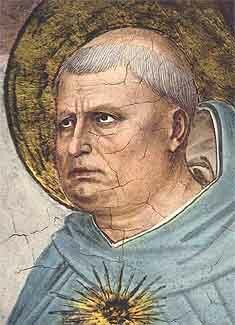
Thomas Aquinas
Saint Thomas Aquinas [Thomas of Aquin, or Aquino] (c. 1225 – 7 March 1274) was an Italian Catholic philosopher and theologian in the scholastic tradition, known as Doctor Angelicus, Doctor Universalis. He is the most famous classical proponent of natural theology. He gave birth to the Thomistic school of philosophy, which was long the primary philosophical approach of the Catholic Church. He is considered by the Catholic Church to be its greatest theologian and one of the thirty-three Doctors of the Church. There have been many institutions of learning named after him.
The life of Thomas Aquinas offers many interesting insights into the world of the High Middle Ages. He was born into a family of the south Italian nobility and was through his mother, Countess Theadora of Theate, related to the Hohenstaufen dynasty of Holy Roman emperors.
He was probably born early in 1225 at his father Count Landulf's castle of Roccasecca in the kingdom of Naples (which is today in the Province of Frosinone, belonging to the Regione Lazio).
More...
The life of Thomas Aquinas offers many interesting insights into the world of the High Middle Ages. He was born into a family of the south Italian nobility and was through his mother, Countess Theadora of Theate, related to the Hohenstaufen dynasty of Holy Roman emperors.
He was probably born early in 1225 at his father Count Landulf's castle of Roccasecca in the kingdom of Naples (which is today in the Province of Frosinone, belonging to the Regione Lazio).
More...
Friday, July 09, 2010
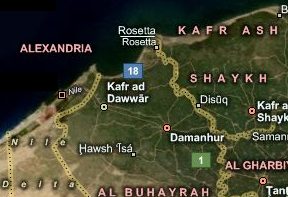
Alexandria
Alexandria (Greek: Αλεξάνδρεια), (population of 3.5 to 5 million), is the second-largest city in Egypt, and its largest seaport. Alexandria extends about 20 miles (32 km) along the coast of the Mediterranean sea in the northwest of Egypt. It is home to the Bibliotheca Alexandrina, the New Library of Alexandria, and is an important industrial centre because of its natural gas and oil pipelines from Suez.
In ancient times, the city was known for the Lighthouse of Alexandria (one of the Seven Wonders of the Ancient World) and the Library of Alexandria (the largest library in the ancient world). Ongoing maritime archaeology in the harbour of Alexandria (which began in 1994) is revealing details of Alexandria both before the arrival of Alexander, when a city named Rhakotis existed there, and during the Ptolemaic dynasty.
The city of Alexandria was named after its founder, Alexander the Great and as the seat of the Ptolemaic rulers of Egypt, quickly became one of the greatest cities of the Hellenistic civilization — second only to Rome in size and wealth.
However, upon the founding of Cairo by Egypt's mediæval Islamic rulers, its status as the country's capital ended, and fell into a long decline, which by the late Ottoman period, had seen it reduced to little more than a small fishing village. The current city is Egypt's leading port, a commercial and transportation center, and the heart of a major industrial area where refined petroleum, asphalt, cotton textiles, processed food, paper, and plastics are produced.
More...
In ancient times, the city was known for the Lighthouse of Alexandria (one of the Seven Wonders of the Ancient World) and the Library of Alexandria (the largest library in the ancient world). Ongoing maritime archaeology in the harbour of Alexandria (which began in 1994) is revealing details of Alexandria both before the arrival of Alexander, when a city named Rhakotis existed there, and during the Ptolemaic dynasty.
The city of Alexandria was named after its founder, Alexander the Great and as the seat of the Ptolemaic rulers of Egypt, quickly became one of the greatest cities of the Hellenistic civilization — second only to Rome in size and wealth.
However, upon the founding of Cairo by Egypt's mediæval Islamic rulers, its status as the country's capital ended, and fell into a long decline, which by the late Ottoman period, had seen it reduced to little more than a small fishing village. The current city is Egypt's leading port, a commercial and transportation center, and the heart of a major industrial area where refined petroleum, asphalt, cotton textiles, processed food, paper, and plastics are produced.
More...
Thursday, July 08, 2010
Levi
Levi/Levy (Hebrew: לוי Leviy, n. Levi, Levite, "joining") was, according to the Book of Genesis, the third son of Jacob and Leah:
Many scholars suspect that it simply means priest, either by being a loan word originating from the Minaean word lawi'u, meaning priest, or by referring to those people who were joined to the Ark of the Covenant. Some scholars believe that the Levites were not originally Israelite, instead originating as migrants, and consequently consider the name to refer to the Levites joining with either the Israelites in general, or the earlier Israelite priesthood in particular. It has also been suggested that the term Levi may just be a corruption of the name Leah (or vice versa), or cognate with the word leviathan, whose exact translation remains highly debated.
More...
Again she conceived and bore a son, and said, "Now this time my husband will be attached to me, because I have borne him three sons." Therefore his name was called Levi. —Gen 29:34 ESVLevi is also known the progenitor of the Israelite tribe of Levi (the Levites); however some Biblical scholars view this as postdiction, an eponymous metaphor providing an Etiology of the connectedness of the tribe to others in the Israelite confederation. Certain religious and political functions were reserved for the Levites, and, according to textual scholars, the early sources of the Torah - the Jahwist and Elohist - appear to treat the term Levi as just being a word meaning priest; scholars suspect that "levi" was originally a general term for a priest, and had no connection to ancestry, and that it was only later, for example in the priestly source and Blessing of Moses, that the existence of a tribe named Levi became assumed, in order to explain the origin of the priestly caste.
The sons of Leah: Reuben (Jacob's firstborn), Simeon, Levi, Judah, Issachar, and Zebulun. —Gen 35:23 ESV
Many scholars suspect that it simply means priest, either by being a loan word originating from the Minaean word lawi'u, meaning priest, or by referring to those people who were joined to the Ark of the Covenant. Some scholars believe that the Levites were not originally Israelite, instead originating as migrants, and consequently consider the name to refer to the Levites joining with either the Israelites in general, or the earlier Israelite priesthood in particular. It has also been suggested that the term Levi may just be a corruption of the name Leah (or vice versa), or cognate with the word leviathan, whose exact translation remains highly debated.
More...
Jihad
Jihad (Arabic: جهاد), an Islamic term, is a religious duty of Muslims. In Arabic, the word jihād is a noun meaning "struggle." Jihad appears frequently in the Qur'an and common usage as the idiomatic expression "striving in the way of Allah (al-jihad fi sabil Allah)". A person engaged in jihad is called a mujahid, the plural is mujahideen.
A minority among the Sunni scholars sometimes refer to this duty as the sixth pillar of Islam, though it occupies no such official status. In Twelver Shi'a Islam, however, Jihad is one of the 10 Practices of the Religion.
According to scholar John Esposito, Jihad requires Muslims to "struggle in the way of God" or "to struggle to improve one's self and/or society." Jihad is directed against Satan's inducements, aspects of one's own self, or against a visible enemy. The four major categories of jihad that are recognized are Jihad against one's self (Jihad al-Nafs), Jihad of the tongue (Jihad al-lisan), Jihad of the hand (Jihad al-yad), and Jihad of the sword (Jihad as-sayf). Islamic military jurisprudence focuses on regulating the conditions and practice of Jihad as-sayf, the only form of warfare permissible under Islamic law, and thus the term Jihad is usually used in fiqh manuals in reference to military combat.
More...
A minority among the Sunni scholars sometimes refer to this duty as the sixth pillar of Islam, though it occupies no such official status. In Twelver Shi'a Islam, however, Jihad is one of the 10 Practices of the Religion.
According to scholar John Esposito, Jihad requires Muslims to "struggle in the way of God" or "to struggle to improve one's self and/or society." Jihad is directed against Satan's inducements, aspects of one's own self, or against a visible enemy. The four major categories of jihad that are recognized are Jihad against one's self (Jihad al-Nafs), Jihad of the tongue (Jihad al-lisan), Jihad of the hand (Jihad al-yad), and Jihad of the sword (Jihad as-sayf). Islamic military jurisprudence focuses on regulating the conditions and practice of Jihad as-sayf, the only form of warfare permissible under Islamic law, and thus the term Jihad is usually used in fiqh manuals in reference to military combat.
More...
Tuesday, July 06, 2010
Tribe of Benjamin
The Tribe of Benjamin (בִּנְיָמִין "son of my right hand" but in some rabbinical Judaism traditions "son of the south") is one of the Hebrew tribes of Israel, founded by Benjamin, son of Jacob.
The book of Judges 19-21 describes an episode in which all of the rest of Israel attacks and defeats the Benjamites in the battle at Gibeah, in retaliation following a disgraceful incident. To complete the defeat, all the civilians, including women and children, in the Benjamite towns and villages are then killed, and the other tribes vow that they will never allow their women to marry benjamites ever again. however, so as to not exterminate a tribe of Israel, they then provide four hundred virgins, spoil from another town they have massacred, as wives to the Benjamites, and also allow them to raid a festival and carry off some of the women.
More...
The book of Judges 19-21 describes an episode in which all of the rest of Israel attacks and defeats the Benjamites in the battle at Gibeah, in retaliation following a disgraceful incident. To complete the defeat, all the civilians, including women and children, in the Benjamite towns and villages are then killed, and the other tribes vow that they will never allow their women to marry benjamites ever again. however, so as to not exterminate a tribe of Israel, they then provide four hundred virgins, spoil from another town they have massacred, as wives to the Benjamites, and also allow them to raid a festival and carry off some of the women.
More...
Monday, July 05, 2010
Sheol
Sheol (pronounced "Sheh-ole"), in Hebrew שאול (Sh'ol), is the "abode of the dead", the "underworld", or "pit". Sheol is the common destination of both the righteous and the unrighteous dead, as recounted in Ecclesiastes and Job.
Sheol is sometimes compared to Hades, the gloomy, twilight afterlife of Greek mythology. The word "hades" was in fact substituted for "sheol" when the Hebrew bible was translated into Greek. The New Testament (written in Greek) also uses "hades" to refer to the abode of the dead.
By the second century BC, Jews who accepted the Oral Tradition had come to believe that those in sheol awaited the resurrection either in comfort (in the bosom of Abraham) or in torment. This belief is reflected in Jesus' story of Lazarus and Dives. At that time Jews who rejected the Oral Tradition believed that Sheol meant simply the grave.
Anglicans, who do not share a concept of "hades" with the Eastern Orthodox, have traditionally translated "sheol" (and "hades") as "hell" (for example in the King James Version). However, to avoid confusion of what are separate concepts in the Bible, modern English versions of the Bible tend either to transliterate the word sheol or to use an alternative term such as the "grave" (e.g. the NIV). Roman Catholics generally translate "sheol" as "death."
More...
Sheol is sometimes compared to Hades, the gloomy, twilight afterlife of Greek mythology. The word "hades" was in fact substituted for "sheol" when the Hebrew bible was translated into Greek. The New Testament (written in Greek) also uses "hades" to refer to the abode of the dead.
By the second century BC, Jews who accepted the Oral Tradition had come to believe that those in sheol awaited the resurrection either in comfort (in the bosom of Abraham) or in torment. This belief is reflected in Jesus' story of Lazarus and Dives. At that time Jews who rejected the Oral Tradition believed that Sheol meant simply the grave.
Anglicans, who do not share a concept of "hades" with the Eastern Orthodox, have traditionally translated "sheol" (and "hades") as "hell" (for example in the King James Version). However, to avoid confusion of what are separate concepts in the Bible, modern English versions of the Bible tend either to transliterate the word sheol or to use an alternative term such as the "grave" (e.g. the NIV). Roman Catholics generally translate "sheol" as "death."
More...
Sunday, July 04, 2010
C.S. Lewis
C.S Lewis's surviving
BBC radio address: Part 1
Clive Staples Lewis (29 November 1898 – 22 November 1963), commonly referred to as C. S. Lewis was a Northern Irish author and scholar, born into a Church of Ireland family in Belfast, although mostly resident in England in adulthood. Lewis is known for his work on medieval literature, for his Christian apologetics and for his fiction, especially the children’s series entitled The Chronicles of Narnia and his science fiction Space Trilogy. He was also a leading figure in an Oxford literary group called the Inklings.BBC radio address: Part 1
Clive Staples Lewis was born in Belfast, Northern Ireland, to Albert James Lewis and Flora Augusta Hamilton Lewis on November 29th, 1898. At the age of 4, shortly after his dog 'Jacksie' was run over by a car, Lewis announced that his name was now Jacksie. At first he would answer to no other name, but later accepted Jacks which became Jack, the name by which he was known to friends and family for the rest of his life. When he was six his family moved into a new house called Leeborough or Little Lea in Strandtown.
C.S Lewis's surviving
BBC radio address: Part 2...
Saturday, July 03, 2010
Liberty
#Liberty, the #freedom to act or believe without being oppressed.
According to Rousseau, by joining together into civil society through the social contract and abandoning their claims of natural right, individuals can both preserve themselves and remain free. This is because submission to the authority of the general will of the people as a whole guarantees individuals against being subordinated to the wills of others and also ensures that they obey themselves because they are, collectively, the authors of the law.
video: Youtube, Air Force Concert Band Play Stars & Stripes/Air Force Song
More...
freedom
- the state of being free, esp. to enjoy political and civil liberties
- exemption or immunity: freedom from government control
- liberation, such as from slavery
- the right or privilege of unrestricted access: freedom of the skies
- self-government or independence
- the power to order one's own actions
- ease or frankness of manner
oppression
- to burden with cruel or unjust impositions or restraints; subject to a burdensome or harsh exercise of authority or power: a people oppressed by totalitarianism.
- to lie heavily upon (the mind, a person, etc.): Care and sorrow oppressed them.
- to weigh down, as sleep or weariness does.
- Archaic. to put down; subdue or suppress.
- Archaic. to press upon or against; crush.
According to Rousseau, by joining together into civil society through the social contract and abandoning their claims of natural right, individuals can both preserve themselves and remain free. This is because submission to the authority of the general will of the people as a whole guarantees individuals against being subordinated to the wills of others and also ensures that they obey themselves because they are, collectively, the authors of the law.
video: Youtube, Air Force Concert Band Play Stars & Stripes/Air Force Song
More...
Thursday, July 01, 2010
Bono
Paul David Hewson (born 10 May 1960), nicknamed Bono Vox (stage name) and Bono (pronounced Bonn-oh), is the lead singer and occasional rhythm guitarist of the Irish rock band U2. Bono lives south of Dublin with his family and shares a villa in Èze in the Alpes-Maritimes in the South of France with The Edge, as well as an apartment at The Dakota in Manhattan.
Bono doesn't attend church on a regular basis. However, he does pray regularly, usually before meals and he tries to have a "Sabbath hour" as often as he can. He likes Eugene Peterson's bible paraphrase, The Message. Sometimes he hangs out with Bruce Springsteen and the Rolling Stones, and sometimes he hangs out with Michael W. Smith and Amy Grant.
In a beliefnet.com interview, Bono said,"I often wonder if religion is the enemy of God. It's almost like religion is what happens when the Spirit has left the building."
In an article titled, "HIV, Bono, and Christianity Today" by Fayola Shakes, Bono said,
More...
Bono doesn't attend church on a regular basis. However, he does pray regularly, usually before meals and he tries to have a "Sabbath hour" as often as he can. He likes Eugene Peterson's bible paraphrase, The Message. Sometimes he hangs out with Bruce Springsteen and the Rolling Stones, and sometimes he hangs out with Michael W. Smith and Amy Grant.
In a beliefnet.com interview, Bono said,"I often wonder if religion is the enemy of God. It's almost like religion is what happens when the Spirit has left the building."
In an article titled, "HIV, Bono, and Christianity Today" by Fayola Shakes, Bono said,
"Shouldn't the focus be on meeting the person's where they're at? Isn't that what Jesus did? He didn't shout "Repent, you little hussy!" to the woman caught in the act of adultery. As far I recall, it went more like this:
"Then Jesus stood up again and said to her, 'Where are your accusers? Didn't even one of them condemn you?' 'No, Lord,' she said. And Jesus said, 'Neither do I. Go and sin no more.'"
So why does the church still have a pocket full of stones? I could see if it were 1984. Back then everyone -- scientists, doctors, HIVers -- was searching for answers.
More...
Labels:
AIDS Awareness,
Bible,
Bono,
Bono Vox,
Christianity,
Jesus,
Paul David Hewson,
U2
0 comments
0 comments
Wednesday, June 30, 2010
Christian anarchism
Christian anarchism is any of several traditions which combine anarchism with Christianity. Christian anarchists believe that freedom is justified spiritually through the teachings of Jesus. This has caused them to be critical of government and Church authority. Leo Tolstoy's The Kingdom of God Is Within You is a key text in modern Christian anarchism. Although Tolstoy never actually used the term "Christian anarchism" in The Kingdom of God Is Within You, reviews of this book following its publication in 1894 coined the term.
Many Christian anarchists say that Jesus opposed the use of government power, even for supposedly good purposes like welfare point to Luke 22:25, which says:
More...
History
The Life and Teaching of Jesus
More than any other text, the four Gospels provide the basis for Christian anarchism. Dorothy Day, Ammon Hennacy, Leo Tolstoy and others constantly refer back to the words of Jesus in their social and political texts. For example, the title "The Kingdom of God is Within You" is a direct quote of Jesus from Luke 17:21. Dorothy Day and the Catholic Worker Movement particularly favored the Works of Mercy (Matthew 25:31–46), which were a recurring theme in both their writing and art.Many Christian anarchists say that Jesus opposed the use of government power, even for supposedly good purposes like welfare point to Luke 22:25, which says:
25 Jesus said to them, "The kings of the Gentiles lord it over them; and those who exercise authority over them call themselves Benefactors. 26 But you are not to be like that.
Jesus antagonised the "system" ruled by Satan:
18 "The Spirit of the Lord is on me, because he has anointed me to preach good news to the poor. He has sent me to proclaim freedom for the prisoners and recovery of sight for the blind, to release the oppressed, 19 to proclaim the year of the Lord's favor." (Luke 4:18-19)
31 Now is the time for judgment on this world; now the prince of this world will be driven out. (John 12:31)
30 I will not speak with you much longer, for the prince of this world is coming. He has no hold on me, (John 14:30)
11 and in regard to judgment, because the prince of this world now stands condemned. (John 16:11)
16 They are not of the world, even as I am not of it. (John 17:16)
36 Jesus said, "My kingdom is not of this world. If it were, my servants would fight to prevent my arrest by the Jews. But now my kingdom is from another place." (John 18:36)
More...
Tuesday, June 29, 2010
Tower of David
The Tower of David is Jerusalem's "citadel", a historical and archaeological (see Biblical archaeology) site of world importance.
Following the destruction of Jerusalem by the Romans in 70 AD, the site served as barracks for the Roman troops. When the Roman Empire adopted Christianity as the imperial religion in the 4th century, a community of monks established itself in the citadel.
This is a medieval fortress, with later additions. Its towers and ramparts offer splendid views of that part of Jerusalem where Old and New meet, and East meets West. The site of the citadel has always been the weak point in the city's defenses, compelling its rulers throughout history to fortify the site.
This important historical and archeological site was built in the First Temple Period (960-586 BCE). Parts of a tower and the city wall were built by the Hasmonean (first century BCE).
The base of the tower was built by Herod the Great (37-34 BCE).
More...
Following the destruction of Jerusalem by the Romans in 70 AD, the site served as barracks for the Roman troops. When the Roman Empire adopted Christianity as the imperial religion in the 4th century, a community of monks established itself in the citadel.
This is a medieval fortress, with later additions. Its towers and ramparts offer splendid views of that part of Jerusalem where Old and New meet, and East meets West. The site of the citadel has always been the weak point in the city's defenses, compelling its rulers throughout history to fortify the site.
This important historical and archeological site was built in the First Temple Period (960-586 BCE). Parts of a tower and the city wall were built by the Hasmonean (first century BCE).
The base of the tower was built by Herod the Great (37-34 BCE).
More...
Monday, June 28, 2010
Remembering Auschwitz
Never Forget and Never Again.Auschwitz (Konzentrationslager Auschwitz) was the largest of the German Nazi concentration and extermination camps. Located in southern Poland, it took its name from the nearby town of Oświęcim (Auschwitz in German), situated about 50 kilometers west of Kraków and 286 kilometers from Warsaw. Following the German occupation of Poland in September 1939, Oświęcim was incorporated into Germany and renamed Auschwitz.
The complex consisted of three main camps:
1. Auschwitz I, the administrative center;
2. Auschwitz II (Birkenau), an extermination camp or Vernichtungslager; and
3. Auschwitz III (Monowitz), a work camp.
The first two of them have been on the World Heritage List since 1979. There were also around 40 satellite camps, some of them tens of kilometers from the main camps, with prisoner populations ranging from several dozen to several thousand.
The camp commandant, Rudolf Höss, testifed at the Nuremberg Trials that 3 million people had died at Auschwitz during his stay as a commandant. Later he decreased his estimate to about 1.1 million. The death toll given by the Soviets and accepted by many was 4,000,000 people. This number was written on the plaques in the Auschwitz-Birkenau State Museum. The Museum revised this figure in 1990, and new calculations by Dr. Franciszek Piper now place the figure at 1.1 million about 90 percent of them Jews from almost every country in Europe. Most of the dead were killed in gas chambers using Zyklon B; other deaths were caused by systematic starvation, forced labor, lack of disease control, individual executions, and so-called medical experiments.
Beginning in 1940, Nazi Germany built several concentration camps and an extermination camp in the area, which at the time was under German occupation. The Auschwitz camps were a major element in the perpetration of the Holocaust; about 1.1 million people were killed there, of whom over 90% were Jews.
More...
Sunday, June 27, 2010
Mighty To Save
Michael W. Smith "Mighty To Save" A New Hallelujah Live DVD
Michael Whitaker Smith (born October 7, 1957, to Paul and Barbara Smith in Kenova, West Virginia), often nicknamed "Smitty", is an American singer, songwriter, guitarist, and keyboardist.Since his first solo project in 1983, Smith has become one of the most popular artists in the Contemporary Christian music world, while also finding considerable success in the mainstream.
"Life's not all about the stuff we can accumulate or the honors people heap on us. Serving people in the name of Jesus is what really matters in the world. We have to step into peoples' lives so that they can be changed by God.
But we really have to start believing this is our mission - that this is the authority that is ours as children of God. Simple acts can start to change thousands of peoples' lives.
So I'm taking a stand - and I hope others will - to stand outside of the walls of the church, rubbing shoulders with the lost and to really live what I believe and embrace who I am in Jesus Christ. We are called to share our joy by serving the lost. The poor. The sick. The brokenhearted. The least of these. In Christ, we are given the courage and strength to change the world."
-ONE Music: Michael W. Smith
Official Website: michaelwsmith.com
More...
Saturday, June 26, 2010
Love
Love (Greek: άγάπη agape) is a primary characteristic of God's nature (1 John 4:8, 16) and the highest expression of Christian faith and action (1 Cor. 13:13; Gal. 5:14; Eph. 5:2; 1 John 4:7-21). In the New Testament, agape is charitable, selfless, altruistic, and unconditional.
More...
Love-1 Corinthians 13:4-13
4 Love is patient and kind; love does not envy or boast; it is not arrogant 5 or rude. It does not insist on its own way; it is not irritable or resentful; 6 it does not rejoice at wrongdoing, but rejoices with the truth. 7 Love bears all things, believes all things, hopes all things, endures all things.It is parental love seen as creating goodness in the world, it is the way God is seen to love humanity, and it is seen as the kind of love that Christians aspire to have for others. (Greek: Philia) - also used in the New Testament, Philia is a human response to something that is found to be delightful. Also known as "brotherly love".
8 Love never ends. As for prophecies, they will pass away; as for tongues, they will cease; as for knowledge, it will pass away. 9 For we know in part and we prophesy in part,
10 but when the perfect comes, the partial will pass away. 11 When I was a child, I spoke like a child, I thought like a child, I reasoned like a child. When I became a man, I gave up childish ways.
12 For now we see in a mirror dimly, but then face to face. Now I know in part; then I shall know fully, even as I have been fully known.
13 So now faith, hope, and love abide, these three; but the greatest of these is love.1 John 4:16
16 We have come to know and have believed the love which God has for us God is love, and the one who abides in love abides in God, and God abides in him.
More...
Labels:
1 Cor. 13:4-13,
altruistic,
charitable,
faith,
love,
philia,
selfless,
unconditional,
άγάπη agape
0 comments
0 comments
Friday, June 25, 2010
The history of Ancient Israel
The history of Ancient Israel and Judah is known to us from classical sources including Judaism's Tanakh or Hebrew Bible (known to Christianity as the Old Testament), the Talmud, the Ethiopian Kebra Nagast, the writings of Nicolaus of Damascus, Artapanas, Philo of Alexandria and Flavius Josephus supplemented by ancient sources uncovered by biblical archaeology including Egyptian, Moabite, Assyrian, Babylonian as well as Israelite and Judean inscriptions.It was also subject to domination by adjacent empires, beginning with Egypt in the late 3rd millennium BCE.
Traditions regarding the early history found in later works such as the Kebra Nagast and commentaries of Rashi, Philo of Alexandria, and numerous others, (besides of course, the Tanakh) refer to the early inhabitants as the sons of Shem and also speak of an invasion by the people known as Canaanites (see Canaan) descended from Ham.
The Book of Jubilees states that the land was originally allotted to Shem and Arphaxad (ancestor of the Hebrews) when it was still vacant, but was wrongfully occupied by Canaan and his son Sidon. Jubilees makes this, then, the true justification for the later war to drive out the Canaanites.
The Kebra Nagast, however, speaks of the Canaanites invading existing cities of Shem and Ibn Ezra, similarly notes that they had seized land from earlier inhabitants. Rashi mentions that the Canaanites were seizing land from the sons of Shem in the days of Abraham.
The patriarchal period
The patriarchal period begins with Abraham. The Bible places the events surrounding Abraham (originally Abram) circa 1800 BCE, give or take 100 years. The account of his life is found in Genesis 11, at the close of a genealogy of the sons of Shem (which includes among its members Eber, the eponym of the Hebrews).His father Terah came from Ur Kasdim. His father moved his family, including his son Abram, from Ur Kasdim to the city of Haran.
More...
Thursday, June 24, 2010
Achaemenid Empire
The Achaemenid (uh-kee-muh-nid) Empire (Old Persian: Hakhāmanishiya) was a dynasty in the ancient Persian Empire with high cultural and economical achievements during its highest power [After Achaemenes, legendary ancestor of Cyrus II the Great, founder of the dynasty.] At the height of their power, around 500 BC, the Achaemenid rulers of Persia ruled over territories roughly encompassing today's Iran, Iraq, Armenia, Afghanistan, Turkey, Bulgaria, eastern parts of Greece, Egypt, Syria, much of what is now Pakistan, Jordan, Israel, Palestine, Lebanon, Caucasia, Central Asia, Libya, and northern parts of Arabia. The empire ruled by Persia eventually became the largest empire of the ancient world.Darius I was the first to speak of Achaemenes, who he claimed was an ancestor of Cyrus the Great, (ca. 576 - 529 BC) and therefore the progenitor of the entire line of Achaemenid rulers. However, some scholars hold that Achaemenes was a fictional character used to legitimize Darius' rule, and that Darius the Great usurped the Persian throne.
More...
Wednesday, June 23, 2010
British Mandate of Palestine
The Palestine Mandate, was a set of protocols or articles that formed a multilateral legal and administrative agreement. They were part of the Laws of Nations, and thus were not a mere geographical territory or area. The territorial jurisdiction of the mandate was subject to change by treaty, capitulation, grant, usage, sufferance or other lawful means.The mandate is sometimes referred to as the The Mandate for Palestine, the British Mandate for Palestine, or the British Mandate of Palestine, etc. It was a League of Nations Mandate that had been created by the Principle Allied and Associated Powers after the First World War. The Ottoman Empire was split up by the Treaty of Sèvres. That treaty never officially entered into force. The terms of the original settlements were significantly remodeled by the subsequent Treaty of Lausanne, after the Chanak Crisis. The provisions regarding Palestine remained unchanged, but many of the other provisions regarding Wilsonian Armenia and the proposed autonomous region of Kurdistan were eliminated.
The purported objective of the League of Nations Mandate system was to administer parts of the recently defunct Ottoman Empire, which had been in control of the Middle East since the 16th century, "until such time as they are able to stand alone." The terms of the Sykes-Picot Agreement involved such things as ports, tariffs, and trade. In the case of Syria and Palestine, the mandatory power actually used armed force to overthrow the indigenous government.
More...
Tuesday, June 22, 2010
Reductionism
Reductionism in philosophy describes a number of related, contentious theories that hold, very roughly, that the nature of complex things can always be reduced to (explained by) simpler or more fundamental things. This is said of objects, phenomena, explanations, theories, and meanings.Roughly, this means that chemistry is based on physics, biology is based on chemistry, psychology and sociology are based on biology. The first two of these reductions are commonly accepted but the last step is controversial and therefore the frontier of reductionism: evolutionary psychology and sociobiology versus those who claim that such special sciences are inherently irreducible. Reductionists believe that the behavioral sciences should become a "genuine" scientific discipline by being based exclusively on genetic biology.
In the painting (right) by the Spanish artist Pablo Picasso (1881-1973), titled "The Lovers," painted in 1923, we see that the two figures are rendered realistically and that they have the appearance of being a loving couple. But, the hands and the faces have been innately simplified and are presented as simple lines rather than circumspectly imitated models.
We still read them as hands and faces, but they have been simplified from the natural forms. This simplification of the image allows Picasso freedom with line and paint, rather than to be entirely involved in painting reality.
A very typical reductionistic book is The Selfish Gene by atheist and self-proclaimed secular humanist, sceptic, "scientific" rationalist, supporter of the Brights movement, and critic of creationism and intelligent design, Richard Dawkins. It argues that because genes are the fundamental elements of life, all life and all natural behavior can best be understood by studying genetic mechanisms. This way all life is best regarded as temporary accommodation and a reproduction device for the genes.
In his book The Blind Watchmaker, Dawkins introduced the term "hierarchic reductionism". This means that reductionism can only work when it is used one level at a time. For example: when you throw Stephen Jay Gould out of a window, his fall can be explained by classical mechanics. But you should not try to understand his work from such elementary principles.
More...
Monday, June 21, 2010
Original sin
According to Christian tradition, Original sin is the general and non-personal condition of sinfulness (lack of holiness) into which human beings are born. It is also called hereditary sin or birth sin. Used with the definite article ("the original sin"), it refers to the first sin committed by humans, seen as the seed of future evil effects for the whole human race. Christians usually refer to this first sin as "the Fall".By analogy the term is used in fields other than religion to indicate a pervading inherent flaw.
The original sin (the Fall)
Classical Biblical viewAdam and Eve's sin, as recounted in the Book of Genesis is sometimes called in Hebrew החטא הקדמון (the original sin), on the basis of the traditional Christian term. But the term used in classical Jewish literature is חטא אדם הראשׁון, (the first sin of man, or of Adam).
The account in Genesis 2-3 implies that Adam and Eve initially lived in a state of intimate communion with God. The narrative reads that God "made various trees grow that were delightful to look at and good for food, with the tree of life in the middle of the garden and the tree of the knowledge of good and bad (Genesis 2:9, ESV)." God then forbid Adam to eat the fruit of the tree of knowledge warning him that he would surely die if he did so. Man was not forbidden to eat from the tree of life initially, but was after breaking the commandment to not eat of the tree of knowledge. God said "The man has now become like one of us, knowing good and evil. He must not be allowed to reach out his hand and take also from the tree of life and eat, and live forever." (Genesis 3:22-23). See "The Tree of Life and "The Tree of Knowledge of Good and Evil" (Genesis 2:15-17). The serpent persuaded Eve to eat from the tree and "she also gave some to her husband, who was with her, and he ate it (Genesis 3:6b, NAB)." After eating the fruit Adam became aware of his nakedness (Genesis 3:1-7). God bestowed a curse upon each of the active participants. First the earth is cursed with thorns. Next the serpent's physical form is altered and God sets up an eternal enmity between Eve and the serpent and all their offspring (Genesis 3:9-15). God then pronounces two curses upon Eve. First, she is to suffer the difficulties of pregnancy. Second, her husband will henceforth rule over her. God then tells Adam that he will now struggle for his sustenance
16 To the woman he said,(Genesis 3:16-21 ESV)
"I will surely multiply your pain in childbearing; in pain you shall bring forth children. Your desire shall be for your husband, and he shall rule over you."
17 And to Adam he said, "Because you have listened to the voice of your wife and have eaten of the tree of which I commanded you, 'You shall not eat of it,' cursed is the ground because of you; in pain you shall eat of it all the days of your life; 18 thorns and thistles it shall bring forth for you; and you shall eat the plants of the field. 19 By the sweat of your face you shall eat bread, till you return to the ground, for out of it you were taken; for you are dust, and to dust you shall return."
20 The man called his wife’s name Eve, because she was the mother of all living. 21 And the LORD God made for Adam and for his wife garments of skins and clothed them.
More...
Sunday, June 20, 2010
Ezra
The historical Ezra (Hebrew עזרא `Ezra', "help") was a priestly sofer (scribe) who is thought to have led about 5,000 Israelite exiles living in Babylon to their home city of Jerusalem in 459 BCE. Many scholars credit him as the author of the Book of Ezra and the Book of 1 Chronicles in the Bible. Ezra is also believe to have led the reforms of the returned exiles in Jerusalem, and was a co-worker with Nehemiah.Sources
Unless otherwise specified, all historical information about Ezra in this article is derived from the last four chapters of the Book of Ezra, and Chapter 8 of the Book of Nehemiah. More general historical information about the people and places Ezra would have interacted with is available at Israelites.
Ezra was either the son or grandson of the Biblical character Seraiah (2 Kings 25:18-21), and a lineal descendant of Phinehas, the son of Aaron (Ezra 7:1-5). In the seventh year of the reign of Artaxerxes Longimanus, Ezra obtained leave to go to Jerusalem and to take with him a company of Israelites (Ezra 8). Artaxerxes showed great interest in Ezra's undertaking, granting him "all his requests," and giving him gifts for the house of God. Ezra assembled a band of approximately 5,000 exiles to go to Jerusalem. They rested on the banks of the Ahava for three days and organized their four-month march across the desert.
More...
Saturday, June 19, 2010
The Second Temple
The Second Temple was the reconstructed Temple in Jerusalem which stood between 515 BCE and 70 CE. During this time, it was the center of Jewish worship, which focused on the sacrifices known as the korbanot. Solomon's Temple, also known as the First Temple, was destroyed in 586 BCE when the Jews were exiled into the Babylonian Captivity. The Romans destroyed Jerusalem and its Second Temple circa 70 CE, ending the Great Jewish Revolt that began in 66 CE.After the return from captivity, under Zerubbabel and the high priest Jeshua, arrangements were almost immediately made to reorganize the desolated Kingdom of Judah after its demise seventy years earlier.
The accession of Cyrus the Great of Persia in 538 BCE made the re-establishment of the city of Jerusalem and the rebuilding of the Temple possible. According to the Bible, when the Jewish exiles returned to Jerusalem following a decree from Cyrus the Great (Ezra 1:1-4, 2 Chron 36:22-23), construction started at the original site, which had remained a devastated heap during the approximate 70 years of captivity (Dan. 9:1-2). After a relatively brief halt, brought about by peoples who had filled the vacuum during the Jewish captivity (Ezra 4), work resumed circa 521 BCE under the Persian King Darius (Ezra 5) and was completed during the sixth year of his reign (circa 515 BCE), with the temple dedication taking place the following year.
More...
Friday, June 18, 2010
Religious Pluralism
Religious pluralism (rel. comparative religion) is a loosely defined term concerning peaceful relations between different religions, and is also used in a number of related ways:- As a synonym for religious relativism; that one's religion is not the sole and exclusive source of truth, and that some level of truth and value exists in at least some other religions. As a synonym for ecumenism. At a minimum, ecumenism is the promotion of unity, co-operation, or improved understanding between different denominations within the same religion, or sometimes between different religions. The latter is sometimes called Macro-ecumenism.
- As a synonym for religious tolerance, which is a condition of harmonious co-existence between adherents of different religions or religious denominations.
- Pluralism as the belief that more than one religion can teach truths
- In its strongest sense, religious pluralism holds that no single religion can claim absolute authority to teach absolute truth. The word of God is not literal religion. On the contrary, religion attempts to describe God's utterances. Given the finite and fallible nature of human beings, no religious text written by Man can absolutely describe God, God's will, or God's counsel, since it is God apart from Man who reveals the divine thoughts, intentions and volition perfectly.
"Just as microsurgery proves more effective than the amputation of a limb, there are better ways to deal with religious pluralism than removing religion from public life. In short, there are good reasons to question whether secularism is the enlightened path to living together." Hunter Baker's The End of Secularism (pg 23).Religious pluralists point out that nearly all religious texts are a combination of an assortment of human observations documented, for example, as historical narratives, poetry, lections, and morality plays. Accordingly, a distinction exists between what may be claimed as literal in a religious text and what may be metaphorical. The text, therefore, is open to interpretation. In this light, no religion is able to comprehensively capture and communicate all truth. Although all religions attempt to capture reality, their attempts occur within particular cultural and historical contexts that affect the writer's viewpoint.
Believers in religious pluralism, in this sense, hold that their own, self-made syncretistic belief system is "true". In other words, their religion is the most complete and accurate interpretation of the divine, though they also accept that other religions teach many truths about the nature of God and man, and that it is possible to establish a significant amount of common ground across all belief systems.
Dr N. T. Wright Bishop of Durham, in his lecture titled, Paul in Different Perspectives has this to say regarding religious pluralism:
More...
Thursday, June 17, 2010
Cave of Machpelah
The Cave of Machpelah (a.k.a. Cave of the Patriarchs) is considered to be the spiritual center of the ancient city of Hebron . It lies in the southwest part of the West Bank, in the heart of ancient Judea.In Hebrew it is called Me'arat HaMakhpela (Hebrew: מערת המכפלה, Me'arat HaMachpela, Trans. "Cave of the Double Tombs"; Arabic: المغارة Al Magharah, "the Cave") because according to Jewish tradition its hidden twin caves are the burial place of four Biblical couples:
- Adam and Eve
- Abraham and Sarah;
- Isaac and Rebekah;
- Jacob and Leah.
According to Midrashic sources, it also contains the head of Esau.
More...
Wednesday, June 16, 2010
Horatio Gates Spafford
Horatio Gates Spafford (October 20, 1828, Troy, New York - October 16, 1888, Jerusalem) was a prominent American lawyer, best known for penning the Christian hymn It Is Well With My Soul, following a family tragedy in which four of his daughters died.Life
On September 5, 1861, in Chicago, he married Anna Larsen, of Stavanger, Norway.On October 8, 1871, the Great Chicago Fire swept through the city. Horatio was a prominent lawyer in Chicago, and had invested heavily in the city's real estate, and the fire destroyed almost everything he owned.
The wreck of the Ville Du Havre
Two years later, in 1873, Spafford decided his family should take a holiday somewhere in Europe, and chose England knowing that his friend D. L. Moody would be preaching there in the fall. Delayed because of business, he sent ahead of him his family: his wife and their four children, daughters Anna “Annie” (born June 11, 1862), Margaret Lee “Maggie” (born May 31, 1864), Elizabeth “Bessie” (born June 19, 1868), and Tanetta (born July 24, 1871).More...
Monday, June 14, 2010
Antiochus IV Epiphanes
Antiochus IV Epiphanes (Greek: Αντίοχος Επιφανής, "The Shining One") (ca. 215–164 BC) ruled the Hellenistic Seleucid Empire from 175 BC until his death.He was a son of Antiochus III the Great and brother of Seleucus IV Philopator. He was originally named Mithradates, but renamed Antiochus, either upon his ascension, or after the death of his elder brother Antiochus. Notable events during his reign include the near-conquest of Egypt, which was halted by the threat of Roman intervention, and the beginning of the Jewish revolt of the Maccabees.
Antiochus took power after the death of Seleucus Philopator. He had been hostage in Rome following the Treaty of Apamea in 188 BC, but had recently been exchanged for the son and rightful heir of Seleucus IV, the later Demetrius I Soter. Antiochus took advantage of this situation, and proclaimed himself co-regent with another of Seleucus' sons, the infant Antiochus, whose murder he orchestrated a few years later.
More...
Sunday, June 13, 2010
Chuck Colson
Charles (Chuck) Wendell Colson (born October 16, 1931, in Boston, Massachusetts) was the chief counsel for President Richard Nixon from 1969 to 1973 and while he was commonly named as one of the Watergate Seven, he was never charged with, or prosecuted, for any crime related to the Watergate break-in or its cover-up. After extensively investigating Colson's activities relating to Watergate, Special Prosecutor Leon Jaworski attempted to make a deal with Colson in which Colson would agree to plead guilty to a misdemeanor charge relating to Watergate, in exchange for which Jaworski agreed to recommend that he not be sentenced to prison. Colson felt doing so would be pleading guilty to a crime he did not commit. Instead, Colson counter-offered. Colson told Jaworski that he would agree to plead guilty to the crime of obstruction of justice, not in relation to Watergate, but in relation to the planning of the break-in at the office of Daniel Elsberg's psychiatrist. This was a crime of which Jaworski had no knowledge. Colson insisted also that Jaworski would not be constrained to recommend no prison time. At the sentencing, Judge Sirica sentenced Colson to the maximum prison term permitted under federal law.Colson's later life has been spent working with his non-profit organization devoted to prison ministry called Prison Fellowship. Colson is also a public speaker and author. He is founder and chairman of the Wilberforce Forum, which is the "Christian worldview thinking, teaching, and advocacy arm of" Prison Fellowship, and includes Colson's daily radio broadcast, BreakPoint, now heard on a thousand outlets. The ministry conducts justice reform efforts through Justice Fellowship.
More...
Thursday, June 10, 2010
Shi‘ite Islam
Shī‘a Islam, also Shi‘ite Islam or Shi‘ism (Arabic شيعة šīʿa), is the second largest denomination of the Islamic faith after Sunni Islam. Shias adhere to the teachings of Muhammad and the religious guidance of his family (who are referred to as the Ahl al-Bayt) or his descendents known as Shi'a Imams. Muhammad's bloodline continues only through his beloved daughter Fatima Zahra and cousin Ali which alongside the prophet's grandsons are the Ahl al-Bayt. Thus, Shi'as consider Muhammad's descendents as the true source of guidance while considering the first three ruling Sunni Caliph (the head of state in a Caliphate) a historic occurrence and not something attached to faith. The singular/adjective form is šīʿī (شيعي.) and refers to a follower of the faction of Imam Ali according to the Shia ideology.Shia Islam, like Sunni Islam, has at times been divided into many branches; however, only three of these currently have a significant number of followers. The best known and the one with most adherents is the Twelvers (اثنا عشرية iṯnāʿašariyya) which have a large percentage in Iran 90% and Iraq (see also: Iraq Maps); the others are Ismaili, Sevener, and Zaidiyyah. Alawites and Druzes consider themselves Shias, although this is sometimes disputed by mainstream Shias. The Sufi orders among the Shias are the Alevi, Bektashi, Kubrawiya, Noorbakhshi, Oveyssi, Qizilbashi, Hamadani and Fatimid orders and denominations. Twenty percent of Turkey's population is Alevi while Lebanon and Syria have a large presence of Druze and Alawites.
More...
Tuesday, June 08, 2010
El Shaddai
El Shaddai (Hebrew: אל שדי) is one of the Judaic names of God.The name Shaddai (Hebrew: שַׁדַּי), which occurs both independently and in combination with El, is used as a name of God chiefly in the Book of Job. According to Exodus 6:2, 3, this is the name by which God was known to Abraham, Isaac, and Jacob. In the Septuagint and other early translation it was translated with words meaning 'Almighty'.
The root word "shadad" (שדד) means "to overpower" or "to destroy". This would give Shaddai the meaning of "destroyer" as one of the aspects of God. Compare to "Shiva," the destroyer in the Hindu trinity, "creator, preserver, destroyer".
Another theory is that 'Shaddai' is a derivation of a Semitic stem that appears in the Akkadian shadû, 'mountain', and shaddā`û or shaddû`a, 'mountain-dweller'. This theory was popularized by W. F. Albright but was somewhat weakened when it was noticed that the doubling of the medial d is first documented only in the Neo-Assyrian period. However, the doubling in Hebrew might possibly be secondary. In this theory God is seen as inhabiting a mythical holy mountain: a concept not unknown in ancient near eastern mythology, and also evident in the Syriac Christian writings of Ephrem the Syrian, who places Eden on an inaccessible mountaintop.
More...
Monday, June 07, 2010
caliphate
The term caliphate (from the Arabic خلافة or khilāfa, khilafah) refers to the first system of governance established in Islam, and represented the political authority and unity of the Muslim Ummah. It was initially led by Muhammad's disciples as a continuation of the political authority the prophet established, known as the 'Rashidun Caliphate'. It represented the political unity of the Muslim Ummah, not the theological unity as this was a personal matter, and was the world's first major welfare state. A "caliphate" is also a state which implements such a government.Sunni Islam dictates that the head of state, the caliph, should be selected by Shura - elected by Muslims or their representatives. Followers of Shia Islam believe the caliph should be an imam descended in a line from the Ahl al-Bayt. After the Rashidun period until 1924, caliphates, sometimes two at a single time, real and illusory, were ruled by dynasties. The first dynasty was the Umayyad. This was followed by the Abbasid, the Fatimid, and finally the Ottoman Dynasty.
The caliphate was "the core political concept of Sunni Islam, by the consensus of the Muslim majority in the early centuries."
More...
Sunday, June 06, 2010
Mount Ararat
Mount Ararat is the tallest peak in modern Turkey. This snow-capped, dormant volcanic cone is located in the Ağrı Province, near the northeast corner of Turkey, 16 km west of the Iranian and 32 km south of the Armenian borders.During the time of Noah, this mountain was completely covered with water:
17 The flood continued forty days on the earth. The waters increased and bore up the ark, and it rose high above the earth. 18 The waters prevailed and increased greatly on the earth, and the ark floated on the face of the waters. 19 And the waters prevailed so mightily on the earth that all the high mountains under the whole heaven were covered. 20 The waters prevailed above the mountains, covering them fifteen cubits deep. (Genesis 7:17-20 ESV)During the time of Sennacherib, was the son of Sargon II, whom he succeeded on the throne of Assyria (705 BC–681 BC), Adrammelech and Sharezer, his sons, struck him down with the sword and escaped into the land of Ararat. (cf. 2 Kings 19:36-37. The same story is mentioned in Isaiah 37:38).
More...
Saturday, June 05, 2010
Islam and anti-semitism
Islam and anti-semitism relates to Islamic theological teaching against Jews and Judaism and the treatment of Jews in Muslim countries.
With the origin of Islam in the 7th century AD and its rapid spread in the Arabian peninsula and beyond, Jews (and many other peoples) came to be subject to the rule of Muslim rulers. The quality of the rule varied considerably in different periods, as did the attitudes of the rulers, government officials, clergy and general population to various subject peoples from time to time, which was reflected in their treatment of these subjects. Reuven Firestone notes that, negative assessments and even condemnation of prior religions and their adherents occur in all three scriptures of Judaism, Christianity, and Islam. This article looks at the Muslim attitude to, and treatment of, Jews in Islamic thought and societies throughout history, and explores the ramifications of these attitudes in the contemporary world.
The nature and extent of anti-semitism in Islam and the Muslim world are hotly-debated issues among students of the Middle East and Islam. However the use of the word anti-semitism in the context of Islam is somewhat inaccurate in etymological terms, since Islam and Arabic, its language, is essentially semitic itself. The more appropriate term to describe this phenomena would be "anti-judaism".
More...
With the origin of Islam in the 7th century AD and its rapid spread in the Arabian peninsula and beyond, Jews (and many other peoples) came to be subject to the rule of Muslim rulers. The quality of the rule varied considerably in different periods, as did the attitudes of the rulers, government officials, clergy and general population to various subject peoples from time to time, which was reflected in their treatment of these subjects. Reuven Firestone notes that, negative assessments and even condemnation of prior religions and their adherents occur in all three scriptures of Judaism, Christianity, and Islam. This article looks at the Muslim attitude to, and treatment of, Jews in Islamic thought and societies throughout history, and explores the ramifications of these attitudes in the contemporary world.
The nature and extent of anti-semitism in Islam and the Muslim world are hotly-debated issues among students of the Middle East and Islam. However the use of the word anti-semitism in the context of Islam is somewhat inaccurate in etymological terms, since Islam and Arabic, its language, is essentially semitic itself. The more appropriate term to describe this phenomena would be "anti-judaism".
More...
Thursday, June 03, 2010
Ezekiel
The book of Ezekiel is a book of the Jewish Hebrew bible as well as the Christian Old Testament, attributed to the prophet Ezekiel (Hebrew:יחזקאל, Yeheskel or Yehezkel).Biography of Ezekiel
The Book of Ezekiel gives little detail about Ezekiel's life. In it, he is mentioned only twice by name: 1:3 and 24:24. Ezekiel is a priest, the son of Buzi (my contempt), and his name means "God will strengthen". He was one of the Israelite exiles, who settled at a place called Tel-abib, on the banks of the Chebar, "in the land of the Chaldean dynasty." The place is thus not identical to the modern city Tel Aviv-Yafo, which is, however, named after it. He was probably carried away captive with Jeconiah (a.k.a Jehoiachin) (2 Kings 24:14-16) about 597 BC.
13 Thus says the Lord GOD: "This is the boundary by which you shall divide the land for inheritance among the twelve tribes of Israel. Joseph shall have two portions. 14 And you shall divide equally what I swore to give to your fathers. This land shall fall to you as your inheritance.
15 "This shall be the boundary of the land: On the north side, from the Great Sea by way of Hethlon to Lebo-hamath, and on to Zedad, 16 Berothah, Sibraim (which lies on the border between Damascus and Hamath), as far as Hazer-hatticon, which is on the border of Hauran. 17 So the boundary shall run from the sea to Hazar-enan, which is on the northern border of Damascus, with the border of Hamath to the north. This shall be the north side.
18 "On the east side, the boundary shall run between Hauran and Damascus; along the Jordan between Gilead and the land of Israel; to the eastern sea and as far as Tamar. This shall be the east side.
19 "On the south side, it shall run from Tamar as far as the waters of Meribah-kadesh, from there along the Brook of Egypt to the Great Sea. This shall be the south side.
20 "On the west side, the Great Sea shall be the boundary to a point opposite Lebo-hamath. This shall be the west side. –Ezekiel 47:13-20 (ESV)
More...
Wednesday, June 02, 2010
Shahid
Shahid (Arabic: شَهيد šahīd, plural: شُهَداء šuhadā', also romanized as shaheed) is an Arabic word meaning "witness". It is a religious term in Islam, literally meaning "witness", but practically means a "martyr." It is used as a honorific for Muslims who have laid down their life fulfilling a religious commandment, or waging war (jihad) for Islam.The Arabic word 'shahid', meaning one who is present as a witness, is translated into English as martyr. Through its usage in the Qur'an and through the manner in which it has been employed in early Islamic history, shahid has come to mean one who bears witness to the truth. This definition sets the ground rules for deciding who qualifies as a martyr and who does not. To attain the status of a martyr it is necessary to die or be slain in the course of defending and upholding the principles of the Qur'an, so martyrdom became valid only under certain specific circumstances.
The term suicide attack is misleading. In the eyes of the attacker and his community this phenomenon has nothing to do with committing suicide … Committing suicide is forbidden in Islam but instead, he is seen as a shahid—a martyr who fell in the process of fulfilling the religious commandment of jihad."
More...
Tuesday, June 01, 2010
West Bank
The West Bank (Hebrew: הגדה המערבית), also referred to in Israel and by Jews as "Judea and Samaria", is a landlocked territory on the west bank of the Jordan River in the Middle East. To the west, north, and south the West Bank shares borders with the mainland Israel. To the east, across the Jordan River, lies the country of Jordan. The West Bank also contains a significant coast line along the western bank of the Dead Sea. Since 1967 most of the West Bank has been under Israeli military occupation.Prior to the First World War, the area now known as the West Bank was under Ottoman rule as part of the province of Syria. In the 1920 San Remo conference, the victorious Allied powers allocated the area to the British Mandate of Palestine. The 1948 Arab-Israeli War saw the establishment of Israel in parts of the former Mandate, while the West Bank was captured and annexed by Jordan, who destroyed any existing Jewish villages. The 1949 Armistice Agreements defined its interim boundary. From 1948 until 1967, the area was under Jordanian rule, and Jordan did not officially relinquish its claim to the area until 1988. Jordan's claim was never recognized by the international community.
The West Bank was captured by Israel during the Six-Day War. With the exception of East Jerusalem, the West Bank was not annexed by Israel. Most of the residents are Arabs, although a large number of Israeli settlements have been built in the region since 1967.
More...
Subscribe to:
Posts (Atom)
LifeNews.com
Desiring God Blog
Youth for Christ International
related
- Follow Jesus
- Timothy Ministries News
- Dallas Willard
- Christian Resources
- Missional Church dot Org
- Between Two Worlds
- GinkWorld
- New Tribes Mission
- Prime Time Jesus
- All Things Aramaic
- Blogging the New Testament
- Campus Crusade for Christ International
- Bible.org
- Vineyard South Africa
- AnswersInGenesis
- Allelon Movement of Missional Churches
- Billy Graham
- Christian Classics Ethereal Library
- Christian answers
- Christian Worldview
- Historical Jesus Studies
- Monergism
- Christians Unite