Showing posts with label Muslim. Show all posts

Monday, November 28, 2011

Jerusalem

The holiest city of Judaism (since the 10th century BCE) and some denominations of Christianity (since the 5th century CE) is the city of Jerusalem.

A heterogeneous city, Jerusalem represents a wide range of national, religious, and socioeconomic groups. The section called the "Old City" is surrounded by walls and consists of four quarters: Armenian, Christian, Jewish, and Muslim.

37 "O Jerusalem, Jerusalem, you who kill the prophets and stone those sent to you, how often I have longed to gather your children together, as a hen gathers her chicks under her wings, but you were not willing. 38 Look, your house is left to you desolate. 39 For I tell you, you will not see me again until you say, Blessed is he who comes in the name of the Lord."
—Matthew 23:37-39
Jerusalem has long been embedded into the religious consciousness of the Jewish people. Jews have always studied and personalized the struggle by King David to capture Jerusalem and his desire to build the Jewish temple there, as described in the Book of Samuel and the Book of Psalms. Many of King David's yearnings about Jerusalem have been adapted into popular prayers and songs.

יְהוֹשׁוּעַ Yĕhowshuwa` Joshua or Jehoshua = "Jehovah is salvation" (A Hebrew name for Jesus, contracted in Aramaic to Yeshua. Variant spellings יהושוע and יהושע
—Matthew 23:37-39

The status of the united Jerusalem as Israel's capital is not widely recognized by the international community, and Israel's annexation of East Jerusalem is particularly controversial.
Only two countries have embassies in Jerusalem — Costa Rica and El Salvador. Of the 184 nations with which America has diplomatic relations, Israel is the only one where the United States does not recognize the capital or have its embassy located in that city. The U.S. embassy, like most others, is in Tel Aviv, 40 miles from Jerusalem. The United States maintains a consulate in east Jerusalem that deals with Palestinians in the territories and works independently of the embassy, reporting directly to Washington. While Congress has voted to recognize Jerusalem as Israel's capital, successive Presidents, the final arbiters of the nation's foreign policy, have refused to do so.[1]

More...

Sunday, May 29, 2011

Islam

Islam (Arabic: الإسلام, "submission (to the will of Allah") has long been considered a monotheistic faith–one of the Abrahamic religions, and the world's second-largest religion. Followers of Islam are known as Muslims. Muslims believe that Allah revealed his divine word directly to mankind through many prophets and that Muhammad was the final prophet of Islam.

In Arabic, Islām derives from the three-letter root Sīn-Lām-Mīm (س-ل-م), which means "submission; to surrender; to obey; peace". Islām is a verbal abstract to this root, and literally means "submission/obedience," referring to submission to Allah.
There can be little doubt that one of the most contentious propositions that may be encountered across the broad spectrum of Muslim-Christian debate is the suggestion that, rather than being the omnipotent God of creation, the God of Abraham, the sole and all-powerful Ruler of the universe, Allah might merely be instead the evolutionary development of a native Arab god from being a high god in a previously polytheistic, or at best henotheistic, religious environment to being the monotheistic deity now worshipped by over a billion Muslims the world over. As a theological system, Islam has invested quite a lot of emotional and spiritual capital into the belief that it is the final revelation of Allah, the return to the true religion of the only God from the apostate departures which are represented by every other system on earth. Therefore, any suggestion that the god of Islam may have merely been elevated to his present exalted status from a previous position of being one among many in the pagan system found in the Jahiliya, the so-called “Times of Ignorance”, will naturally meet with a negative response from Muslims. The venerable Carleton Coon observed:
“Moslems are notoriously loath to preserve traditions of earlier paganism, and like to garble what pre-Islamic history they permit to survive in anachronistic terms.”
So it is with the object of our present inquiry. In their article entitled, “Is Hubal the Same as Allah?”, Saifullah and David attempt to counter the charge that Allah’s origin lies in the pre-Islamic god Hubal, a deity who was worshipped in the Ka’bah in Mecca according to the traditions. As will be shown below, however, much of their argumentation is erroneous, and much more of it is simply irrelevant because it does not truly investigate the issue. I will present a refutation of their claims, and also provide what I hope to be some insights which will encourage further scholarly investigation into the subject of pre-Islamic religious history.

More...

On May 12, 2011, Bill Warner spoke at the Cornerstone Church in Nashville, TN. His speech was part of Geert Wilders’ event, "A Warning to America", sponsored by the Tennessee Freedom Coalition.

Sunday, July 11, 2010

Shahada

The Shahada, also spelled shahadah, (Arabic: الشهادة aš-šahāda from the verb šahida "to testify") is the Islamic creed. The Shahada is the Muslim declaration of belief in the oneness of Allah and acceptance of Muhammad as his prophet. The declaration reads: Lā ilaha illa al-Lāh, Muhammadun rasūlu l-Lāh “There is no allah but Allah, Muhammad is the Messenger of Allah" (in English). This declaration is called the Kalima, which literally means "words." Recitation of the Shahadah is the most important of the "Five Pillars of Islam," for Muslims, and is performed daily.

Narrated Ibn Umar: Allah's apostle said: Islam is based on (the following) five (principles):
  1. To testify that none has the right to be worshipped but Allah and Muhammad is Allah's apostle.
  2. To offer the (compulsory congregational) prayers dutifully and perfectly.
  3. To pay Zakat (i.e. obligatory charity).
  4. To perform Hajj (i.e. Pilgrimage to Mecca).
  5. To observe fast during the month of Ramadan.

    (Sahih al-Bukhari, Vol. 1, p. 17).
Non-Muslims wishing to convert to Islam do so by a public recitation of the creed. Technically the Shi'a do not consider the Shahadah to be a separate pillar, but connect it to the beliefs. Those wishing to leave Islam also have options available.

More...

Saturday, June 05, 2010

Islam and anti-semitism

Islam and anti-semitism relates to Islamic theological teaching against Jews and Judaism and the treatment of Jews in Muslim countries.

With the origin of Islam in the 7th century AD and its rapid spread in the Arabian peninsula and beyond, Jews (and many other peoples) came to be subject to the rule of Muslim rulers. The quality of the rule varied considerably in different periods, as did the attitudes of the rulers, government officials, clergy and general population to various subject peoples from time to time, which was reflected in their treatment of these subjects. Reuven Firestone notes that, negative assessments and even condemnation of prior religions and their adherents occur in all three scriptures of Judaism, Christianity, and Islam. This article looks at the Muslim attitude to, and treatment of, Jews in Islamic thought and societies throughout history, and explores the ramifications of these attitudes in the contemporary world.

The nature and extent of anti-semitism in Islam and the Muslim world are hotly-debated issues among students of the Middle East and Islam. However the use of the word anti-semitism in the context of Islam is somewhat inaccurate in etymological terms, since Islam and Arabic, its language, is essentially semitic itself. The more appropriate term to describe this phenomena would be "anti-judaism".

More...

Tuesday, May 18, 2010

Radical Islam

Radical Islam or "Islamism" is a term with definitions that sometimes vary. Leading Islamist thinkers emphasized the desire to apply many aspects of sharia (Islamic law) to modern society; of pan-Islamic political unity; and of the elimination of non-Muslim, particularly western, military, economic, political, social, or cultural influences in the Muslim world, which they believe to be incompatible with Islam.

Some observers suggest Islamism's tenets are less strict and can be defined as a form of identity politics or "support for [Muslim] identity, authenticity, broader regionalism, revivalism, [and] revitalization of the community". Still others define it as "an Islamic militant, anti-democratic movement, bearing a holistic vision of Islam whose final aim is the restoration of the caliphate".

Attributes of sharia law supported by many Islamists include "enforcement of Islamic punishments, including prohibitions on charging interest on loans, playing music, showing television", and enforcing traditional dress and prayer attendance.


More...

Tuesday, March 09, 2010

Sharia

Sharia (Arabic: شريعة) is the body of Islamic religious law. The term means "way" or "path to the water source"; it is the legal framework within which the public and private aspects of life are regulated for those living in a legal system based on Islamic principles of jurisprudence and for Muslims living outside the domain. Sharia deals with many aspects of day-to-day life, including politics, economics, banking, business, contracts, family, sexuality, hygiene, and social issues — essentially, a way of life.

According to Religion News Blog published by Apologetics Index:
The Sharia (Islamic law) specifies the obligatory acts (fardh), the omission of which constitutes sin, and forbidden acts (haram), the practice of which constitutes sins. Everything else, not derived from these principles, are said to be permissable (mubah).

Throughout the world, Sharia has led — and still leads – to human rights violations — including cruel and unusual punishments (e.g. death penalty by stoning, hanging, or beheading. Amputations of hands and/or feet. Public executions, and etcetera).

Islamism is an ideology in Islam that wants to use the Sharia to its full extent, meaning that secular forms of governments and institutions are considered foreign to a true Muslim society.

By its very nature, Islam makes it extremely difficult for Muslims to integrate. Islam means submission, and the Quran makes it clear that Muslims expect non-Muslims to submit to Islam.

Therefore, Sharia has no place in a modern, free and civilized society.


More...

Thursday, January 28, 2010

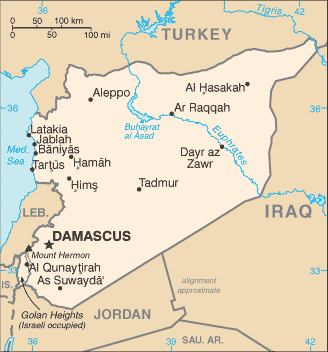
Syria

Syria (Arabic: سوريا ‎or سورية ), officially the Syrian Arab Republic (Arabic: الجمهورية العربية السورية ), is a country in the Middle East, bordering Lebanon to the west, Palestine to the southwest, Jordan to the south, Iraq to the east (see also: Iraq Maps), and Turkey to the north. The modern state of Syria attained independence from the French mandate of Syria in 1946, but can trace its historical roots to the fourth millennium BC; its capital city, Damascus, was the seat of the Umayyad Empire and a provincial capital of the Mamluk Empire.

Syria has a population of 19 million, of whom the majority are Arabic-speaking Sunni Muslims, as well as 16% other Muslim groups, including the Alawi, Shiite, and Druze, and 10% Christian.

Since 1963 the country has been governed by the Baath Party; the head of state since 1970 has been a member of the Assad family. Syria's current President is Bashar al-Assad, son of Hafez al-Assad, who held office from 1970 until his death in 2000.

More...


Subscribe


LifeNews.com

Desiring God Blog

Youth for Christ International