Showing posts with label C.S. Lewis. Show all posts

Monday, March 07, 2011

The Four Loves

The Four Loves is a book by C. S. Lewis which explores the nature of love from a Christian perspective through thought-experiments and examples from literature. The content of the examination is prefaced by Lewis' admission that he initially mistook John the Apostle's words "God is Love" (1 John 4:7-9, 1 John 4:15-17) for a simple inroads to his topic. By distinguishing need-love (such as the love of a child for its mother) from gift-love (epitomized by God's love for humanity), Lewis happens upon the contemplative that the natures of even these basic categorizations of love are more complicated than they, at first, seem. As a result, he formulates the foundation of his topic ("the highest does not stand without the lowest") by exploring the nature of pleasure, and then divides love into four categories, based in part on the four Greek words for love: affection, friendship, eros, and charity. It must be noted, states Lewis, that just as Lucifer — a former archangel—perverted himself by pride and fell into depravity, so too can love— commonly held to be the arch-emotion—become corrupt by presuming itself to be what it is not ("love begins to be a demon the moment he begins to be a god").

As with other languages, it has been historically difficult to separate the meanings of these words for love. Nonetheless, the senses in which these words were generally used are given below.

More...
Sunday, July 04, 2010

C.S. Lewis

C.S Lewis's surviving
BBC radio address: Part 1
Clive Staples Lewis (29 November 1898 – 22 November 1963), commonly referred to as C. S. Lewis was a Northern Irish author and scholar, born into a Church of Ireland family in Belfast, although mostly resident in England in adulthood. Lewis is known for his work on medieval literature, for his Christian apologetics and for his fiction, especially the children’s series entitled The Chronicles of Narnia and his science fiction Space Trilogy. He was also a leading figure in an Oxford literary group called the Inklings.

Clive Staples Lewis was born in Belfast, Northern Ireland, to Albert James Lewis and Flora Augusta Hamilton Lewis on November 29th, 1898. At the age of 4, shortly after his dog 'Jacksie' was run over by a car, Lewis announced that his name was now Jacksie. At first he would answer to no other name, but later accepted Jacks which became Jack, the name by which he was known to friends and family for the rest of his life. When he was six his family moved into a new house called Leeborough or Little Lea in Strandtown.

C.S Lewis's surviving
BBC radio address: Part 2
...

Wednesday, January 03, 2007

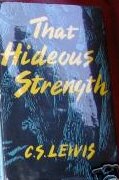
That Hideous Strength

That Hideous Strength, First edition coverThat Hideous Strength is a novel by C. S. Lewis first published in 1945. It is the third in Lewis's theological science fiction series, the Space Trilogy which features the philologist Elwin Ransom. This novel follows Out of the Silent Planet and Perelandra (a.k.a. Voyage to Venus). It is heavily influenced by the writing of Lewis's friend Charles Williams. The book is heavily dystopian in style (A dystopia (alternatively, cacotopia, kakotopia or anti-utopia) is a fictional society that is the antithesis of utopia.).

Plot summary
This final novel in the trilogy is a parable of the battle between man’s sinful pride and God’s will. It is set in post-war England in a small university town in which a research agency called N.I.C.E. (National Institute for Coordinated Experiments), led by fallen eldila, attempts to destroy the true nature of mankind.


More...

Tuesday, November 28, 2006

Narnia

The Land of Narnia, artwork from the 2005 movieNarnia is a fantasy world created by C. S. Lewis as a location for his Chronicles of Narnia, a series of seven fantasy novels for children.

In Narnia, some animals can talk, mythical beasts abound, and magic is common. The series tracks the story of Narnia from its creation to its end, and especially the stories of those humans, usually children, who enter the land from 'our world'.

Geography
The name "Narnia" refers to not only the Narnian world, but especially to the country of Narnia within it, which its creator, Aslan the great lion, filled with talking animals and mythical creatures. C.S.Lewis may have got the name from the Italian town of Narni, whose latin name was in fact Narnia. Narnia is a land of rolling hills rising into low mountains to the south, and is predominantly forested except for marshlands in the north. The country is bordered on the east by the Eastern Ocean, on the west by a great mountain range, on the north by the River Shribble, and on the south by a continental divide.

More...

Monday, September 04, 2006

Chronicles of Narnia

The Chronicles of Narnia is a series of seven fantasy novels for children written by C. S. Lewis. It is considered a classic of Children's literature and is the author's best known work. Written by Lewis between 1949 and 1954 and illustrated by Pauline Baynes, The Chronicles of Narnia present the adventures of children who play central roles in the unfolding history of the realm of Narnia, a place where animals talk, magic is common, and good is fighting evil. In the majority of the books, children from our world find themselves transported to Narnia by a magical portal. Once there, they are quickly involved in setting some wrong to right with the help of the lion Aslan who is the central character of the series.

The Chronicles of Narnia contain many allusions to Christian ideas which are easily accessible to younger readers; however, the books are not weighty, and can be read for their adventure, colour, and mythological ideas alone. Because of this, they have become favourites with both children and adults, Christians and non-Christians. In addition to Christian themes, Lewis also borrows characters from Greek and Roman mythology as well as traditional British and Irish fairy tales.

More...
 

Subscribe


LifeNews.com

Desiring God Blog

Youth for Christ International