The West Bank (Hebrew: הגדה המערבית, Hagadah Hamaaravit, Arabic: الضفة الغربية, aḍ-Ḍiffä l-Ġarbīyä), also referred to in Israel and by Jews as "Judea and Samaria", is a landlocked territory on the west bank of the Jordan River in the Middle East. To the west, north, and south the West Bank shares borders with the mainland Israel. To the east, across the Jordan River, lies the country of Jordan. The West Bank also contains a significant coast line along the western bank of the Dead Sea. Since 1967 most of the West Bank has been under Israeli military occupation.
Prior to the First World War, the area now known as the West Bank was under Ottoman rule as part of the province of Syria. In the 1920 San Remo conference, the victorious Allied powers allocated the area to the British Mandate of Palestine. The 1948 Arab-Israeli War saw the establishment of Israel in parts of the former Mandate, while the West Bank was captured and annexed by Jordan, who destroyed any existing Jewish villages. The 1949 Armistice Agreements defined its interim boundary. From 1948 until 1967, the area was under Jordanian rule, and Jordan did not officially relinquish its claim to the area until 1988. Jordan's claim was never recognized by the international community.
The West Bank was captured by Israel during the Six-Day War. With the exception of East Jerusalem, the West Bank was not annexed by Israel. Most of the residents are Arabs, although a large number of Israeli settlements have been built in the region since 1967.
More...
Showing posts with label Six-Day War. Show all posts
Showing posts with label Six-Day War. Show all posts
Sunday, April 24, 2011

Tuesday, June 01, 2010
West Bank
 The West Bank (Hebrew: הגדה המערבית), also referred to in Israel and by Jews as "Judea and Samaria", is a landlocked territory on the west bank of the Jordan River in the Middle East. To the west, north, and south the West Bank shares borders with the mainland Israel. To the east, across the Jordan River, lies the country of Jordan. The West Bank also contains a significant coast line along the western bank of the Dead Sea. Since 1967 most of the West Bank has been under Israeli military occupation.
Prior to the First World War, the area now known as the West Bank was under Ottoman rule as part of the province of Syria. In the 1920 San Remo conference, the victorious Allied powers allocated the area to the British Mandate of Palestine. The 1948 Arab-Israeli War saw the establishment of Israel in parts of the former Mandate, while the West Bank was captured and annexed by Jordan, who destroyed any existing Jewish villages. The 1949 Armistice Agreements defined its interim boundary. From 1948 until 1967, the area was under Jordanian rule, and Jordan did not officially relinquish its claim to the area until 1988. Jordan's claim was never recognized by the international community.
The West Bank was captured by Israel during the Six-Day War. With the exception of East Jerusalem, the West Bank was not annexed by Israel. Most of the residents are Arabs, although a large number of Israeli settlements have been built in the region since 1967.
More...
Thursday, March 25, 2010
Jerusalem
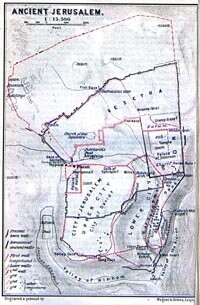 Jerusalem is the holiest city of Judaism (since the 10th century BCE) and some denominations of Christianity (since the 5th century CE) and, after Mecca and Medina, the third holiest city of Islam
A heterogeneous city, Jerusalem represents a wide range of national, religious, and socioeconomic groups. The section called the "Old City" is surrounded by walls and consists of four quarters: Armenian, Christian, Jewish, and Muslim.
37 "O Jerusalem, Jerusalem, you who kill the prophets and stone those sent to you, how often I have longed to gather your children together, as a hen gathers her chicks under her wings, but you were not willing. 38 Look, your house is left to you desolate. 39 For I tell you, you will not see me again until you say, Blessed is he who comes in the name of the Lord.—Jesus, Matthew 23:37-39
More...
Tuesday, December 30, 2008
Six-Day War
 The Six-Day War (Hebrew: מלחמת ששת הימים), also known as the 1967 Arab-Israeli War, Six Days' War, or June War, was fought between Israel and its Arab neighbors Egypt, Jordan, and Syria. It began when Israel launched what it described as a pre-emptive attack against Egypt, following the latter's closure of the Straits of Tiran to Israeli shipping and the deployment of troops in the Sinai near the Israeli border, and after months of increasingly tense border incidents and diplomatic crises. At its end, Israel controlled the Gaza Strip, the Sinai Peninsula, the West Bank, and the Golan Heights. The results of the war affect the geopolitics of the region to this day.
For Egypt, the 1956 Suez War was a military defeat but a political victory.
Heavy diplomatic pressure forced Israel to withdraw its military from the Sinai Peninsula and the Gaza Strip. After the 1956 war, Egypt, although not Israel, agreed to the stationing of a UN peacekeeping force in the Sinai, UNEF, to keep that border region demilitarized, and prevent guerrillas from crossing the border into Israel. As a result the border between Egypt and Israel quieted for a while.
More...
Subscribe to:
Posts (Atom)
Subscribe

