Tuesday, April 20, 2010

Cain and Abel

According to the biblical book of Genesis, Cain (meaning "acquisition") and Abel (a biblical forename which may derive from the Hebrew Hebel, itself derived from hevel (breath or vapour), or from the Assyrian for son. In reference to the biblical story, the name Abel often occurs with that of his brother, as Cain and Abel. Cain and Abel were the first and second sons of Adam and Eve, born after the Fall of Man. Their story is told in Genesis 4:1-16. Cain, a farmer, commits the first murder by killing his brother Abel, a shepherd, after God rejects Cain's sacrifice but accepts Abel's.

The oldest known copy of the biblical narration is from the Dead Sea Scrolls (4QGenb = 4Q242, mid 1st century), inspected using infra-red photography and published by Jim R Davila as part of his doctoral dissertation in 1988. Cain and Abel appear in a number of other texts, and the story is the subject of various interpretations. Abel, the first murder victim, is sometimes seen as the first martyr; while Cain, the first murderer, is sometimes seen as a progenitor of evil. A few scholars suggest the pericope may have been based on a Sumerian story representing the conflict between nomadic shepherds and settled farmers.

More...

Monday, April 19, 2010

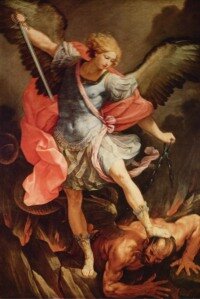
Michael (archangel)

Michael (Hebrew: Miyka'el, Strong's H317 מיכאל) one of, the chief, or the first archangel who is described as the one who stands in time of conflict for the children of Israel is the archangel mentioned in the Book of Revelation 12:7:
7 And there was war in heaven. Michael and his angels fought against the dragon, and the dragon and his angels fought back. (Revelation 12:7)
in the Hebrew Bible Michael is mentioned by name in the Persian context of the post-Exilic Book of Daniel. There in Daniel does Michael appear—as "one of the chief princes" (Daniel 10:13) who in Daniel's vision comes to the angel Gabriel's aid in his contest with the angel of Persia, and is also described there as the advocate of Israel and "great prince who stands up for the children of your (Daniel's) people" (Daniel 10:21, 12:1). The Talmud tradition rendered his name as meaning "who is like El" (God)? (but literally "El's Likeness")" (compare the late prophet Micah), but according to Rabbi Simeon ben Lakish (AD 230–270), all the specific names for the angels were brought back by the Jews from Babylon, and many modern commentators would agree.

Michael is one of the principal angels in Abrahamic tradition; his name was said to have been the war-cry of the angels in the battle fought in heaven against Satan and his followers

More...

Sunday, April 18, 2010

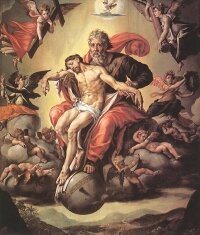
Trinity

Within Christianity, the doctrine of the Trinity states that God is a single "Being" who exists, simultaneously and eternally, as a communion of three persons (personae, prosopa): Father (the Source, the Eternal Majesty); the Son (the eternal Logos or Word, incarnate as Jesus of Nazareth); and the Holy Spirit. Since the 4th Century AD, in both Eastern and Western Christianity, this doctrine has been stated as "One God in Three Persons," all three of whom, as distinct and co-eternal "persons" or "hypostases," share a single Divine essence, being, or nature.

The word Trinity comes from the Latin noun Trinitas, meaning the state or condition of being three, or a group of three persons or things. The first recorded application of this Latin word to Father, Son and Holy Spirit was by Tertullian in about 200 where he probably combined Latin words for three and one. Although the word Trinity is not found in Scripture, the principle is:
19 Therefore go and make disciples of all nations, baptizing them in the name of the Father and of the Son and of the Holy Spirit (Matt. 28:19)

More...

Saturday, April 17, 2010

Tree of Jesse

The Tree of Jesse (Hebrew:ישי Yishay) refers to a passage in the biblical Book of Isaiah which metaphorically describes the descent of the Messiah and is accepted by Christians as pertaining to Jesus, and is often represented in art, particularly in that of the Medieval period, the earliest dating from the 11th century.
1 There shall come forth a shoot from the stump of Jesse, and a branch from his roots shall bear fruit.

2 And the Spirit of the LORD shall rest upon him, the Spirit of wisdom and understanding, the Spirit of counsel and might, the Spirit of knowledge and the fear of the LORD.

3 And his delight shall be in the fear of the LORD. He shall not judge by what his eyes see, or decide disputes by what his ears hear,” (Isaiah 11:1-3 ESV)

More...

Friday, April 16, 2010

Arab-Israeli War (1948)

The 1948 Arab-Israeli War, referred to as the "War of Independence" (Hebrew: מלחמת העצמאות) or as the "War of Liberation" by Israelis, is the first in a series of armed conflicts fought between Israel and its Arab neighbors in the ongoing Arab-Israeli conflict. For Palestinians, the war marked the beginning of the events they refer to as "The Catastrophe" ("al Nakba", Arabic: النكبة‎). After the United Nations proposed to partition the territory of the British Mandate of Palestine into two states, Jewish and Arab, the Arabs refused to accept it and the armies of Egypt, Syria, Transjordan, Lebanon and Iraq, supported by others, attacked the newly established State of Israel which they refused to recognize. As a result, the region was divided between Israel, Egypt and Transjordan.

Abraham

4 "As for me, this is my covenant with you: You will be the father of many nations. 5 No longer will you be called Abram; your name will be Abraham, for I have made you a father of many nations. 6 I will make you very fruitful; I will make nations of you, and kings will come from you. —Gen. 17:4-6

More...

Thursday, April 15, 2010

Imputation

Imputation (also imputed righteousness) is a concept in Christian theology proposing: the righteousness of Jesus Christ satisfies all criteria necessary to share in God's grace. Those who trust in the promise that the death of Jesus on the cross atones for their sins believe in this type of righteousness as opposed to imparted righteousness and sanctification. The teaching of imputed righteousness is a signature doctrine of the Lutheran, and Calvinist/Reformed traditions of Christianity.

The case for imputed righteousness
Imputed righteousness is the Protestant solution to a "divine predicament." On the one hand, God is infinitely merciful, "not wishing for any to perish, but for all to come to repentance." (2 Peter 3:9). On the other, God is infinitely holy and just, which means that he cannot approve of or even look upon evil (Habakkuk 1:13), neither can he justify a wicked person (Prov. 17:15). Because the Bible describes all men as sinners and says that there are none who are righteous (Rom. 3:23, 10), these two "competing" traits in God's nature appear to put him in a dilemma.

More...

Wednesday, April 14, 2010

Jacob's Ladder

Jacob's Ladder refers to a ladder to Heaven described in the Genesis 28:11-19 which the biblical patriarch Jacob envisioned during his flight from his brother Esau:

10 Jacob left Beersheba and set out for Haran. 11 When he reached a certain place, he stopped for the night because the sun had set. Taking one of the stones there, he put it under his head and lay down to sleep. 12 He had a dream in which he saw a stairway resting on the earth, with its top reaching to heaven, and the angels of God were ascending and descending on it. 13 There above it stood the LORD, and he said: "I am the LORD, the God of your father Abraham and the God of Isaac. I will give you and your descendants the land on which you are lying. 14 Your descendants will be like the dust of the earth, and you will spread out to the west and to the east, to the north and to the south. All peoples on earth will be blessed through you and your offspring. 15 I am with you and will watch over you wherever you go, and I will bring you back to this land. I will not leave you until I have done what I have promised you."

16 When Jacob awoke from his sleep, he thought, "Surely the LORD is in this place, and I was not aware of it." 17 He was afraid and said, "How awesome is this place! This is none other than the house of God; this is the gate of heaven."

18 Early the next morning Jacob took the stone he had placed under his head and set it up as a pillar and poured oil on top of it. 19 He called that place Bethel, though the city used to be called Luz.

20 Then Jacob made a vow, saying, "If God will be with me and will watch over me on this journey I am taking and will give me food to eat and clothes to wear 21 so that I return safely to my father's house, then the LORD will be my God 22 and this stone that I have set up as a pillar will be God's house, and of all that you give me I will give you a tenth." (Gen. 28: 10-22)

More...

Tuesday, April 13, 2010

Fine-tuned Universe

The term fine-tuned universe refers to the idea that conditions that allow life in the universe can only occur with the tightly restricted values of the universal physical constants, and that small changes in these constants would correspond to a very different universe, not likely conducive to the establishment and development of matter, astronomical structures, or life as it is presently known.

The arguments relating to the fine-tuned universe concept are related to the anthropic principle, which states that any valid theory of the universe must be consistent with our existence as human beings at this particular time and place in the universe. In other words even though the actual probability of a universe to be one which supports intelligent life is very low, the conditional probability given our existence in it is 1 — and even if there are other universes devoid of life, there will be no one to observe them.

More...

Monday, April 12, 2010

Zechariah

Zechariah or Zecharya (Hebrew: זְכַרְיָה, "Renowned/Remembered of/is the Lord") was a person in the Old Testament bible and Jewish Tanakh. He was the author of the Book of Zechariah.

It is a theophoric name, the ending -iah being a short Hebrew form for the Tetragrammaton.

He was a prophet of the two-tribe kingdom of Judah, and the eleventh of the minor prophets. Like Ezekiel, he was of priestly extraction. He describes himself (Zechariah 1:1) as "the son of Berechiah." In Ezra 5:1 and 6:14 he is called "the son of Iddo," who was properly his grandfather. His prophetical career began in the second year of Darius, king of Persia (B.C. 520), about sixteen years after the return of the first company from their Babylonian exile. He was contemporary with Haggai (Ezra 5:1).

Although there is an indication in Targum Lamentations that "Zechariah son of Iddo" was killed in the Temple, scholars generally understand this as a reference to the death of a much earlier figure, Zechariah Ben Jehoiada.

More...

Sunday, April 11, 2010

Samuel

Samuel or Shmu'el (Hebrew: שְׁמוּאֵל) is an important leader of ancient Israel in the Book(s) of Samuel in the Hebrew Bible.

His status, as viewed by rabbinical literature, is that he was the last of the Hebrew Judges and the first of the major prophets who began to prophesy inside the Land of Israel. He was thus at the cusp between two eras.

In the Biblical narrative, Hannah is one of two wives of Elkanah; the other, Peninnah, bore a child to Elkanah, but Hannah remained childless. Nevertheless, Elkanah preferred Hannah. Every year Elkanah would offer a sacrifice at the Shiloh sanctuary, and give Hannah twice as big a portion of it as he would to Penninah. One day Hannah went up to the temple, and prayed silently, while Eli the High Priest was sitting on a chair near the doorpost. In her prayer she begs for a child in return for giving the child up, putting him in the service of the Shiloh priests, and raising him as a nazir.
11 And she vowed a vow and said, "O LORD of hosts, if you will indeed look on the affliction of your servant and remember me and not forget your servant, but will give to your servant a son, then I will give him to the LORD all the days of his life, and no razor shall touch his head." (1 Samuel 1:11 ESV)

More...

Saturday, April 10, 2010

Daniel

Daniel is a figure appearing in the Hebrew Bible and the central protagonist of the Book of Daniel. The name "Daniel" means "God is my judge" or "God's judge."

Daniel was a young man of the upper crust of Jewish society who was taken captive by Nebuchadnezzar II, king of Babylon and the Chaldean dynasty. Nebudchadnezzar endeavored to remove all traces of Daniel's nationality and religion. For this reason they strove to change Daniel's name to Belteshazzar:
7 And the chief of the eunuchs gave them names: Daniel he called Belteshazzar, Hananiah he called Shadrach, Mishael he called Meshach, and Azariah he called Abednego. (Dan. 1:7 ESV)
(see also: 2:26; 4:8-9, 18-19; 5:12; 10:1).

More...

Friday, April 09, 2010

Essenes

The Essenes (es'-eenz) were followers of a religious way of living in Judaism that flourished from the 2nd century BC to the 1st century AD. Many scholars today argue that there were a number of separate but related groups that had in common mystic, eschatological, messianic, and ascetic beliefs that were referred to as the "Essenes". There are also contemporary movements which identify themselves as Essenes, including the "Orthodox" Christian Essenes.

The main source of information about the life and belief of Essenes is the detailed account contained in a work of the 1st century Jewish historiographer Josephus entitled The Jewish War written about 73-75 CE (War 2.119-161) and his shorter description in his Antiquities finished some 20 years later (Ant. 18.11 & 18-22). Claiming first hand knowledge (Life §§10-11), he refers to them by the name Essenoi and lists them as the followers of one of the three "choices" in "Jewish Philosophy'" (War 2.119) alongside the Pharisees and the Sadducees.

More...

Thursday, April 08, 2010

Saul Alinsky

Saul Alinsky (January 30, 1909, Chicago, Illinois – June 12, 1972, Carmel, California) was an American community organizer and writer. He is generally considered to be the founder of modern community organizing.

A year before his death in 1972, from the prologue his book Rules for Radicals (his final work, published in 1971), he wrote:

“There’s another reason for working inside the system. Dostoevski said that taking a new step is what people fear most. Any revolutionary change must be preceded by a passive, affirmative, non-challenging attitude toward change among the mass of our people. They must feel so frustrated, so defeated, so lost, so future-less in the prevailing system that they are willing to let go of the past and change the future. This acceptance is the reformation essential to any revolution. To bring on this reformation requires that the organizer work inside the system, among not only the middle class but the 40 per cent of American families — more than seventy million people — whose income range from $5,000 to $10,000 a year [in 1971]. They cannot be dismissed by labeling them blue collar or hard hat. They will not continue to be relatively passive and slightly challenging. If we fail to communicate with them, if we don’t encourage them to form alliances with us, they will move to the right. Maybe they will anyway, but let’s not let it happen by default.”

More...

Wednesday, April 07, 2010

Supernatural

The supernatural (Latin: super- "exceeding" + nature) refers to forces and phenomena which are are not observed in nature, and therefore beyond verifiable measurement. If a phenomenon can be demonstrated, it can no longer be considered supernatural. Because phenomena must be subjected to verifiable measurement and peer review to be considered as a scientific theory, science cannot approach the supernatural.
"Measure what is measurable, and make measurable what is not so." —Galileo Galilei
Concepts in the supernatural domain are closely related to concepts in religious spirituality and metaphysics. The term "supernatural" is often used interchangeably with paranormal or preternatural — the latter typically limited to an adjective for describing abilities which appear to exceed possible bounds.

Characteristic for phenomena claimed as supernatural are anomaly, uniqueness and uncontrollability, thus lacking reproducibility required for scientific examination. Supernatural themes are often associated with paranormal and occult ideas, suggesting for possibility of interaction with the supernatural by means of summoning or trance for instance

More...

Tuesday, April 06, 2010

Joseph of Arimathea

Joseph of Arimathea, according to the Gospels, was the man who donated his own prepared tomb for the burial of Jesus after Jesus was crucified. A native of Arimathea, he was apparently a man of wealth, and a member of the Sanhedrin (which is the way bouleutēs, literally "senator", is interpreted in Matthew 27:57 and Luke 23:50). Joseph was an "honourable counsellor, who waited (or "was searching" which is not the same thing) for the kingdom of God" (Mark, 15:43). As soon as he heard the news of Jesus' death, he "went in boldly" (literally "having summoned courage, he went") "unto Pilate, and craved the body of Jesus."

Pontius Pilate, who was reassured by a centurion that the death had really taken place, allowed Joseph's request. Joseph immediately purchased fine linen (Mark 15:46) and proceeded to Golgotha to take the body down from the cross. There, assisted by Nicodemus, he took the body and wrapped it in the fine linen, sprinkling it with the myrrh and aloes which Nicodemus had brought (John 19:39).

More...

Monday, April 05, 2010

Authenticity

In the arts, history, archaeology, the study of antiques, and similar fields involving unique or scarce artifacts from the past, and, with regard to documents in law, authenticity (Greek: ἀρχηγός from 'archēgos'='author')
  1. the chief leader, prince
    • of Christ
  2. one that takes the lead in any thing and thus affords an example, a predecessor in a matter, pioneer
  3. the author
Strong's Number: 747 Greek: archegos
Author: translated "Prince" in Act 3:15 (marg., "Author") and Acts 5:31, but "Author" in Hebrews 2:10, RV, "Captain," RV marg., and AV, and "Author" in Hebrews 12:2, primarily signifies "one who takes a lead in, or provides the first occasion of,anything." In the Septuagint it is used of the chief of a tribe or family, Numbers 13:2 (RV, prince); of the "heads" of the children of Israel, Numbers 13:3; a captain of the whole people, Numbers 14:4; in Micah 1:13, of Lachish as the leader of the sin of the daughter of Sion: there, as in Hebrews 2:10, the word suggest a combination of the meaning of leader with that of the source from whence a thing proceeds. That Christ is the Prince of life signifies, as Chrysostom says, that "the life He had was not from another; the Prince or Author of life must be He who has life from Himself." But the word does not necessarily combine the idea of the source or originating cause with that of leader. In Hebrews 12:2 where Christ is called the "Author and Perfecter of faith," He is represented as the one who takes precedence in faith and is thus the perfect Exemplar of it. The pronoun "our" does not correspond to anything in the original, and may well be omitted. Christ in the days of His flesh trod never deviating the path of faith, and as the Perfecter has brought it to a perfect end in His own person. Thus He is the leader of all others who tread that path.

Note:In Acts 28:16 some mss. have the word stratopedarches (lit., "camp-commander"), which some take to denote a praetorian prefect, or commander of the praetorian cohorts, the Emperor's bodyguard, "the captain of the praetorian guard." There were two praetorian prefects, to whose custody prisoners sent bound to the Emperor were consigned. But the word probably means the commander of a detached corps connected with the commissariat and the general custody of prisoners.

Prince:primarily an adjective signifying "originating, beginning," is used as a noun, denoting "a founder, author, prince or leader," Acts 3:15, "Prince" (marg., "Author"); Acts 5:31

People in the postmodern culture seek real and authentic experiences in preference over scripted or superficial experiences. Emerging churches strive to be "relevant" to today's culture and daily life, whether it be through worship or service opportunities. The core Christian message is unchanged but emerging churches attempt, as the church has throughout the centuries, to find ways to reach God's people where they are to hear God's message of unconditional love.

More...

Sunday, April 04, 2010

William Lane Craig

William Lane Craig (born August 23, 1949) is an American philosopher, theologian, and Christian apologist. He is a prolific author and lecturer on a wide range of issues related to the philosophy of religion, the historical Jesus, the coherence of the Christian worldview, and Intelligent Design. He is married and lives in Atlanta, Georgia, and is currently a Research Professor of Philosophy at Talbot School of Theology, Biola University in La Mirada, California. Craig is a fellow of the Discovery Institute's Center for Science and Culture, which is the hub of the Intelligent Design movement.

Craig has been critical of
  • philosophical naturalism,
  • logical positivism,
  • moral relativism,
  • liberal theology, and
  • the Jesus Seminar.
He has defended the middle knowledge view of divine providence and is also notable for his work in the philosophy of time. He is a founding member and has served as president of the Philosophy of Time Society

More...

Saturday, April 03, 2010

Resurrection of Jesus

According to the Trinitarian interpretation of the New Testament, Jesus was both human and God, so he had the power to lay his life down and to take it up again; thus after Jesus died, he came back to life. This event is referred to in Christian terminology as the resurrection of Jesus Christ, and is commemorated and celebrated by most Christians annually on Easter Sunday.

Most Christians, even those who do not interpret other parts of the Bible literally, accept the New Testament story as an historical account of an actual event central to their faith, though some do not accept a literal bodily resurrection, sometimes arguing for docetism. But it so seems that in the past, a large group of Christians known as the Gnostics, who were later declared heretics and partially exterminated, argued against its singular importance, and claimed that the New Testament supported their claims. Non-Christians generally view the story as legend or as allegory.

More...

Friday, April 02, 2010

Crucifixion

Crucifixion was an ancient method of execution, where the victim was tied or nailed to a large wooden cross and left to hang there until dead. It is mostly widely known as a not uncommon but extremely dishonorable as well as excruciating form of judicial execution in the Roman Empire, though similar methods were employed in other ancient cultures. Crucifixion has special significance in Christianity, which holds that Jesus was crucified but later resurrected. Because of this the Christian cross or crucifix has become a common symbol of Christianity.

Crucifixion was used by the Romans (see Roman Empire) until about 313 AD, when Christianity became the dominant faith in Rome. However, it has been used in various places in modern times.
24 And they crucified him and divided his garments among them, casting lots for them, to decide what each should take.25 And it was the third hour when they crucified him.26 And the inscription of the charge against him read, "The King of the Jews." (Mark 15:24-26 ESV)

More...

Thursday, April 01, 2010

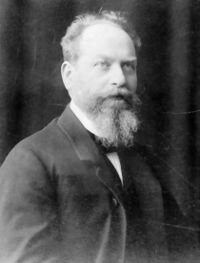
Edmund Husserl

Edmund Gustav Albrecht Husserl (April 8, 1859 – April 26, 1938) was a philosopher, known as the father of phenomenology. His work was a break with the purely positivist orientation and understanding of the science and philosophy of his day, giving weight to subjective experience as the source of all of our knowledge of objective phenomena.

Husserl was a pupil of Franz Brentano and Carl Stumpf; his philosophical work influenced, among others, Eugen Fink, Max Scheler, Martin Heidegger, Jean-Paul Sartre, Emmanuel Lévinas, Rudolf Carnap, Hermann Weyl, Maurice Merleau-Ponty, Pierre Bourdieu, Paul Ricœur, Jacques Derrida, Jan Patočka, Roman Ingarden, Edith Stein (St. Teresa Benedicta of the Cross), Karol Wojtyla and Dallas Willard. In 1887 Husserl converted to Christianity and joined the Lutheran Church. He taught philosophy at Halle as a tutor (Privatdozent) from 1887, then at Göttingen as professor from 1901, and at Freiburg im Breisgau from 1916 until he retired in 1928. After this, he continued his research and writing by using the library at Freiburg.

More...

Wednesday, March 31, 2010

Lucis Trust

The Lucis Trust (originally known as Lucifer Publishing) is a non-profit organization incorporated in New York State, created in 1920 by Alice Bailey and her husband Foster, to manage the business of publishing Mrs. Bailey's twenty-five esoteric books. Its headquarters are in New York City (at the 24th floor of 120 Wall Street), London (Lucis Press Ltd.) and Geneva (Lucis Trust Association).

In addition to continuing to publish her books worldwide, Lucis Trust's activities also include a correspondence school based on her teachings (known as the Arcane School), a lending library of esoteric books known as Lucis Trust Libraries, a publishing house called Lucis Publishing Companies, Lucis Productions, World Goodwill and Triangles.

More...

Tuesday, March 30, 2010

Plagues of Egypt

The Plagues of Egypt (Hebrew: מכות מצרים, Makot Mitzrayim), the Biblical Plagues or the Ten Plagues (עשר המכות, Eser Ha-Makot) are the ten calamities inflicted upon Egypt by God in the Biblical story recounted the book of Exodus, chapters 7 - 12, in order to convince Pharaoh (possibly Ramesses II, making the Pharaoh of the Oppression Djeserkheperure Horemheb) to let the Israelite slaves leave (see also Pharaoh of the Exodus).

The plagues as they appear in the Torah are:
  1. (Exodus 7:14-25) rivers and other water sources turned to blood ('Dam')
  2. (Exodus 7:26-8:11) amphibians (commonly believed to be frogs) ('Tsfardeia')
  3. (Exodus 8:12-15) lice ('Kinim')
  4. (Exodus 8:16-28) Either flies, wild animals or beetles ('Arov')
  5. (Exodus 9:1-7) disease on livestock ('Dever')
  6. (Exodus 9:8-12) unhealable boils ('Shkhin')
  7. (Exodus 9:13-35) hail mixed with fire ('Barad')
  8. (Exodus 10:1-20) locusts ('Arbeh')
  9. (Exodus 10:21-29) darkness ('Choshech')
  10. (Exodus 11:1-12:36) death of the firstborn ('Makat Bechorot')

More...

Monday, March 29, 2010

Passover Seder

The Passover Seder (Hebrew: סֵדֶר, seðɛɾ, "order", "arrangement") is a special Jewish ritual which takes place on the first evening of the Jewish feast of Passover (the 15th day of Nisan on the Hebrew calendar) in Israel, and on the first and second evenings of Passover (the 15th and 16th days of Nisan) in the Jewish Diaspora.
This year's Passover begins on Tuesday, March 30 2010 and goes through Monday April 5, 2010
Incorporating the holiday meal, the Seder relives the enslavement and subsequent Exodus of the Children of Israel from Ancient Egypt through the words of the Haggadah, the drinking of Four Cups of Wine, the eating of matzot, and the eating of and reference to symbolic foods placed on the Passover Seder Plate.

The Seder is considered an integral aspect of Jewish faith and identity. As the Haggadah—which contains the complete Seder service—explains, without the Exodus, the Jews would still be slaves to the Egyptian Pharaoh and would never have realized their role as a nation. Therefore this is an occasion for much praise and thanksgiving to God. It is considered a mitzvah (commandment) to embellish one's retelling of the Exodus on this night. Often the Seder lasts into the early hours of the morning of the next day, as participants continue to learn Torah and talk about the events of the night and sing special Passover songs included in the Haggadah.

More...

Sunday, March 28, 2010

Hosanna

Hosanna is a liturgical word in Judaism and Christianity. In Judaism, it is always used in its original Hebrew form, Hoshana.

The appearance of Christ was described by the prophet Zechariah, Zec 9:9. When Christ would arrive in his glory, it is in His meekness (like a wild horse that has been tamed), not as ruler of the universe, in mercy to give salvation. As meekness and outward deficiency were fully seen in Zion's King, and marked His triumphal entrance to Jerusalem, how wrong covetousness, ambition, and the pride of life must be in Zion's citizens! They brought the mule, but Jesus did not use it without the owner's consent. The signs were such as came to hand. We must not think the clothes on our backs too dear to part with for the service of Christ. The chief priests and the elders afterwards joined with the masses that abused him upon the cross; but none of them joined the multitude that praised Him. Those that take Christ for their King, must lay everything under his feet. Hosanna signifies, "Save now, we beseech thee! Blessed is he that cometh in the name of the Lord!" But of how little significance is the approval of the people! The changing multitude join the cry of the day, whether it be Hosanna, or Crucify him. Throngs often emerge to approve the gospel, but few become unfailing disciples. When Jesus came into Jerusalem all the city was inspired; some perhaps were moved with joy, who waited for the hope of Israel; others, of the Pharisees, were incited with malice. So varied are the motivations in the minds of men upon the nearing of Christ's kingdom.

More...

Saturday, March 27, 2010

Dietrich Bonhoeffer

Dietrich Bonhoeffer (February 4, 1906 – April 9, 1945) was a German Lutheran pastor and theologian. He was also a participant in the German Resistance movement against Nazism, a founding member of the Confessing Church. His involvement in plans by members of the Abwehr (the German Military Intelligence Office) to assassinate Adolf Hitler resulted in his arrest in April 1943 and his subsequent execution by hanging in April 1945, shortly before the war's end. His view of Christianity's role in the secular world has become very influential.

Academic Training

Bonhoeffer attended Tübingen University for a year and visited Rome, where he became conscious of the universality of the church, before he matriculated at the University of Berlin in 1924, then a centre of liberal theology under theologians such as Adolf von Harnack. Around this time, he discovered the writings of Karl Barth, an eminent Swiss theologian whose pioneering work in neo-orthodoxy was a reaction against liberal theology. Barth believed that "liberal theology" (understood as emphasizing personal experience and societal development) minimized scripture, reducing it to a mere textbook of metaphysics while sanctioning the deification of human culture. Harnack cautioned Bonhoeffer against dangers posed by Barth's "contempt for scientific theology", but young Bonhoeffer, becoming increasingly critical of liberal theology as too constraining and responsible for the lack of relevance in the church, was won over to Barth's dialectical theology. Bonhoeffer was nevertheless not beyond criticizing Barth, and the confluence of Barth's Christocentrism and Harnack's concern to show the relevance of Christianity to the modern world had indelible effect on Bonhoeffer's approach to theology.

More...

Friday, March 26, 2010

Ark of the Covenant

The Ark of the Covenant (ארון ברית in Hebrew: 'arown bĕriyth) called more fully, The "Ark of The Testimony," wherein rested the stone tablets containing the Ten Commandments. The Ark was built at the command of God, in accord with Moses's prophetic vision on Mount Sinai:
10 "They shall make an ark of acacia wood. Two cubits and a half shall be its length, a cubit and a half its breadth, and a cubit and a half its height. 11 You shall overlay it with pure gold, inside and outside shall you overlay it, and you shall make on it a molding of gold around it. 12 You shall cast four rings of gold for it and put them on its four feet, two rings on the one side of it, and two rings on the other side of it. 13 You shall make poles of acacia wood and overlay them with gold. 14 And you shall put the poles into the rings on the sides of the ark to carry the ark by them. 15 The poles shall remain in the rings of the ark; they shall not be taken from it. 16 And you shall put into the ark the testimony that I shall give you —Exodus 25:9-10

More...

Thursday, March 25, 2010

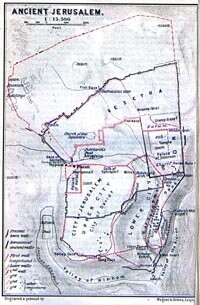
Jerusalem

Jerusalem is the holiest city of Judaism (since the 10th century BCE) and some denominations of Christianity (since the 5th century CE) and, after Mecca and Medina, the third holiest city of Islam

A heterogeneous city, Jerusalem represents a wide range of national, religious, and socioeconomic groups. The section called the "Old City" is surrounded by walls and consists of four quarters: Armenian, Christian, Jewish, and Muslim.

37 "O Jerusalem, Jerusalem, you who kill the prophets and stone those sent to you, how often I have longed to gather your children together, as a hen gathers her chicks under her wings, but you were not willing. 38 Look, your house is left to you desolate. 39 For I tell you, you will not see me again until you say, Blessed is he who comes in the name of the Lord.—Jesus, Matthew 23:37-39


More...


Wednesday, March 24, 2010

Joel

Joel (Hebrew: יואל‎) was a prophet of ancient Israel, the second of the twelve minor prophets and the author of the Book of Joel.

He is mentioned by name only once in the Hebrew Bible, in the introduction to his own brief book, as the son of Pethuel (Joel 1:1⁠). The name Joel combines the covenant name of God, YHWH (sometimes written Jehovah), and el (god), and has been translated as "one to whom Jehovah is God," that is, a worshipper of YHWH.

The dates of his life are unknown; he may have lived anywhere from the 9th century BCE to the 5th century BCE, depending on the dating of his book. He was from Judah/Judea, and, judging from its prominence in his prophecy, was quite possibly a prophet associated with the ritual of the temple of Jerusalem.

More...

Tuesday, March 23, 2010

Abraham

Abraham (אַבְרָהָם "Father/Leader of many", (circa 1900 BCE) Standard Hebrew Avraham, Arabic ابراهيم) is regarded as the founding patriarch of the Israelites whom God chose to bless out of all the families of the earth. He is a critical figure in both Judaism and Christianity, and is a very important prophet in Islam. Accounts of his life are given in the Book of Genesis and also in the Qur'an.

Judaism, Christianity, and Islam are sometimes referred to as the "Abrahamic religions", because of the role Abraham plays in their holy books and beliefs. In the Hebrew Bible and the Qur'an, Abraham is described as a patriarch blessed by God (the Jewish people called him "Father Abraham"), and promised great things. Jews and Christians consider him father of the people of Israel through his son Isaac; Muslims regard him as the father of the Arabs through his son Ishmael. In Christian belief, Abraham is a model of faith, and his intention to obey God by offering up Isaac is seen as a foreshadowing of God's offering of his son, Jesus. In Islam, Abraham obeyed God by offering up Ishmael and is considered to be one of the most important prophets sent by God.

More...

Monday, March 22, 2010

Pool of Siloam

Pool of Siloam (Hebrew sent or sending) is a landmark located at the lower part of the southern slope of Ophel, the original site of Jerusalem, but now just to the south east (and outside) the walls of Old City Jerusalem. The pool is a receptacle for the waters of the Gihon Spring, which were carried there by two aquaducts - the Middle Bronze Age Channel (a 20ft deep direct cutting that was covered with rock slabs, and dates from the Middle Bronze Age ~1800BC), and Hezekiah's Tunnel (a curving tunnel within the bedrock, dating from the reign of King Hezekiah ~700BC).

The pool is mentioned or alluded to several times in the Bible. Isaiah 8:6 mentions the pool's waters, while Isaiah 22:9 references the construction of Hezekiah's tunnel. For Christians, the most notable mention of the pool is as the location in which the Gospel of John places the act of Jesus healing a man who had been blind from birth (John 9). According to Ronny Reich of the University of Haifa, Jesus' presence at the pool could simply have been a result of the requirement to wash before attending the Temple; religious law of the period required Jews to make the pilgrimage to Jerusalem at least once a year.

More...

Sunday, March 21, 2010

Four Horsemen of the Apocalypse

The Four Horsemen of the Apocalypse is a term used to describe four horsemen that appear in the Christian Bible in chapter six of the Book of Revelation. The four horsemen are traditionally named after what the verses describe them bringing: Strife, War, Famine and Death; only Death, however, is directly named in the Bible.
1 Now I watched when the Lamb opened one of the seven seals, and I heard one of the four living creatures say with a voice like thunder, "Come!" 2 And I looked, and behold, a white horse! And its rider had a bow, and a crown was given to him, and he came out conquering, and to conquer.

3 When he opened the second seal, I heard the second living creature say, "Come!" 4 And out came another horse, bright red. Its rider was permitted to take peace from the earth, so that people should slay one another, and he was given a great sword.

5 When he opened the third seal, I heard the third living creature say, "Come!" And I looked, and behold, a black horse! And its rider had a pair of scales in his hand. 6 And I heard what seemed to be a voice in the midst of the four living creatures, saying, "A quart of wheat for a denarius, and three quarts of barley for a denarius, and do not harm the oil and wine!"


More...

Saturday, March 20, 2010

West Bank

The West Bank (Hebrew: הגדה המערבית‎, Hagadah Hamaaravit, Arabic: الضفة الغربية‎, aḍ-Ḍiffä l-Ġarbīyä), also referred to in Israel and by Jews as "Judea and Samaria", is a landlocked territory on the west bank of the Jordan River in the Middle East. To the west, north, and south the West Bank shares borders with the mainland Israel. To the east, across the Jordan River, lies the country of Jordan. The West Bank also contains a significant coast line along the western bank of the Dead Sea. Since 1967 most of the West Bank has been under Israeli military occupation.

Prior to the First World War, the area now known as the West Bank was under Ottoman rule as part of the province of Syria. In the 1920 San Remo conference, the victorious Allied powers allocated the area to the British Mandate of Palestine. The 1948 Arab-Israeli War saw the establishment of Israel in parts of the former Mandate, while the West Bank was captured and annexed by Jordan, who destroyed any existing Jewish villages. The 1949 Armistice Agreements defined its interim boundary. From 1948 until 1967, the area was under Jordanian rule, and Jordan did not officially relinquish its claim to the area until 1988. Jordan's claim was never recognized by the international community.

More...

Friday, March 19, 2010

Phenomenology

Phenomenology has at least three main meanings in philosophical history: one in the writings of Georg Wilhelm Friedrich Hegel, another in the writings of Edmund Husserl in 1920, and a third, deriving from Husserl's work, in the writings of his former research assistant Martin Heidegger in 1927.

For G.W.F. Hegel, phenomenology is an approach to philosophy that begins with an exploration of phenomena (what presents itself to us in conscious experience) as a means to finally grasp the absolute, logical, ontological and metaphysical Spirit that is behind phenomena. This has been called a "dialectical phenomenology."

For Edmund Husserl, phenomenology is "the reflective study of the essence of consciousness as experienced from the first-person point of view."

More...

Thursday, March 18, 2010

John the Apostle

John the Apostle (Hebrew: "⁠יוחנן⁠" John, Johanan, Greek: Iōannēs "The LORD is merciful"), was one of The Twelve Apostles of Jesus. Christian tradition proclaims he is the same person who wrote:
  • the Gospel of John and first epistle of John (the author of these is also referred to as John the Evangelist, John the Theologian or John the Divine)
  • the second and third Epistle of John (the author of these is sometimes distinguished under the name of John the Presbyter).
  • the Book of Revelation (the author is sometimes referred to as John of Patmos or John the Revelator).

    In the Bible

John the Apostle was the son of Zebedee, and the brother of James. One tradition gives his mother's name as Salome.

John and James were originally fishermen and fished with their father in the Lake of Genesareth (the Sea of Galilee).

More...

Wednesday, March 17, 2010

Crown of Thorns

In Christianity, the Crown of Thorns (Greek: στεφανον εξ ακανθων, stephanos ek akantha "crown"+"of"+"a thorn"), one of the instruments of the Passion, was the woven chaplet of thorn branches worn by ⁠Jesus⁠ before his crucifixion. It is mentioned in the Gospels of Matthew (27:29), Mark (15:17), and John (19:2, 5) and is often alluded to by the Early Church Fathers, such as Clement of Alexandria, Origen, and others.

John the Evangelist describes it like this:
1Then Pilate took Jesus and flogged him. 2And the soldiers twisted together a crown of thorns and put it on his head and arrayed him in a purple robe. 3They came up to him, saying, "Hail, King of the Jews!" and struck him with their hands. —John 19:1-3 ESV


More...

Tuesday, March 16, 2010

Liberation Theology

Liberation theology is a school of theology within Christianity, particularly in the Roman Catholic Church. It emphasizes the Christian mission to bring justice to the poor and oppressed, particularly through political activism. Its theologians consider sin the root source of poverty, the sin in question being exploitative capitalism and class war by the rich against the poor. It has a range of meanings: broadly, especially in the media, it may refer to any politically-activist Christian thought, but the technical sense is narrower.

Liberation Theologians use political theory, primarily Marxism, to help understand how to combat poverty. Some elements of certain liberation theologies have been rejected by leaders of the hierarchy of the Catholic Church over the last 30 years. At its inception, liberation theology was predominantly found in the Catholic Church after the Second Vatican Council. It is sometimes regarded as a form of Christian socialism, and it has enjoyed widespread influence in Latin America and among the Jesuits, although its influence diminished within Catholicism after liberation theologians using Marxist concepts were harshly admonished by Pope John Paul II (leading to the curtailing of its growth).

More...

Monday, March 15, 2010

David

David (Standard Hebrew דָּוִד, Davíd, "Beloved", Arabic داوود, Dā'ūd, "Beloved") was the second king of the united kingdom of Israel (c. 1005 BC – 965 BC) and successor to King Saul. His life and rule are recorded in the Hebrew Bible's books of First Samuel (from chapter 16 onwards), Second Samuel, First Kings and Second Kings (to verse 4). First Chronicles gives further stories of David, mingled with lists and genealogies.

He is depicted as the most righteous of all the ancient kings of Israel - although not without fault - as well as an acclaimed warrior, musician and poet (he is traditionally credited with the authorship of many of the Psalms). 2 Samuel 7:12-16 states that God was so pleased with David that He promised that the Davidic line would endure forever; Jews therefore believe that the Jewish Messiah will be a direct descendant of King David, and Christians trace the lineage of Jesus back to him through both Mary and Joseph.

The nature of his reign and even his existence have been questioned and debated, rejected and defended by modern biblical scholars, but the account given in the Hebrew Bible remains widely accepted by the majority of ordinary Jews and Christians and his story has been of central importance to Western culture.

More...

Sunday, March 14, 2010

The Defeat of Satan

The deceiver was given an advantage when Jesus was led into the desert to be tempted. Jesus was by Himself, none to pray for Him or to give Him any advice during this difficult time of temptation.
  • 40 days.
  • No food.
Jesus knew His own strength, and could give Satan this advantage. We, on the other hand, dare not.

The Temptation of Jesus
1 Jesus, full of the Holy Spirit, returned from the Jordan and was led by the Spirit in the desert, 2 where for forty days he was tempted by the devil. He ate nothing during those days, and at the end of them he was hungry.

3 The devil said to him, "If you are the Son of God, tell this stone to become bread."

4 Jesus answered, "It is written: 'Man does not live on bread alone.'"

The devil led him up to a high place and showed him in an instant all the kingdoms of the world. 6 And he said to him, "I will give you all their authority and splendor, for it has been given to me, and I can give it to anyone I want to. 7 So if you worship me, it will all be yours."

8 Jesus answered, "It is written: 'Worship the Lord your God and serve him only.'"

9 The devil led him to Jerusalem and had him stand on the highest point of the temple. "If you are the Son of God," he said, "throw yourself down from here. 10 For it is written:

" 'He will command his angels concerning you to guard you carefully;

11 they will lift you up in their hands, so that you will not strike your foot against a stone.'"

12 Jesus answered, "It says: 'Do not put the Lord your God to the test.'"

13 When the devil had finished all this tempting, he left him until an opportune time. —Luke 4:1-13
Jesus was human, like us, depended upon the Father's Providence and promise. The Word of God is our sword, and faith in it, our shield. We must always know that God is faithful and, we can depend upon Him to keep His promises. He has many ways of providing for His children. Satan, on the other hand, tells nothing but lies and if given an inch he will take a mile. He will use any opportunity he has to trap, deceive, and insnare you to your destruction. We need to reject, without omission, any and all of Satan's deceptions, all opportunities offering sinful advancement or personal gain that are offered as a price for our very souls. Rather, we ought to seek all things in worship and service only of God.

More...

Saturday, March 13, 2010

Eternity

The word eternity often means existing for an infinite, i.e., limitless, amount of time, many have used it to refer to a timeless existence altogether "outside" of time. There are a number of arguments for eternity, by which proponents of the concept, principally Aristotle, purported to prove that matter, motion, and time must have existed eternally.

Eternity as a timeless existence
Saint Augustine of Hippo wrote that time exists only within the created universe (see creation), so that God exists outside of time; for God there is no past or future, but only an eternal present. One need not believe in God in order to hold this concept of eternity: for example, an atheist mathematician can maintain the philosophical tenet that numbers and the relationships among them exist outside of time, and so are in that sense eternal.

The biblical word eternal is used in place of the Hebrew word qedem קדם Strong's H6924 (east, antiquity, front, that which is before, aforetime), with an early reference in the biblical book of Job:

More...

Friday, March 12, 2010

Epistle to the Hebrews

The Epistle to the Hebrews (abbr. Heb for citations) is a very consciously "literary" document in the New Testament. The purity of its Greek was noted by Clement of Alexandria, according to Eusebius of Caesarea (Historia Eccl., VI, xiv), and Origen asserted that every competent judge must recognize a great difference between this epistle and Paul's (Eusebius, VI, xxv).

The letter has carried its traditional title since Tertullian described it as Barnabae titulus ad Hebraeos in De Pudicitia chapter 20 ("Barnabas's Letter to the Hebrews").

More...

Thursday, March 11, 2010

The Four Loves

The Four Loves is a book by C. S. Lewis which explores the nature of love from a Christian perspective through thought-experiments and examples from literature. The content of the examination is prefaced by Lewis' admission that he initially mistook John the Apostle's words "God is Love" (1 John 4:7-9, 1 John 4:15-17) for a simple inroads to his topic. By distinguishing need-love (such as the love of a child for its mother) from gift-love (epitomized by God's love for humanity), Lewis happens upon the contemplative that the natures of even these basic categorizations of love are more complicated than they, at first, seem. As a result, he formulates the foundation of his topic ("the highest does not stand without the lowest") by exploring the nature of pleasure, and then divides love into four categories, based in part on the four Greek words for love: affection, friendship, eros, and charity. It must be noted, states Lewis, that just as Lucifer—a former archangel—perverted himself by pride and fell into depravity, so too can love— commonly held to be the arch-emotion—become corrupt by presuming itself to be what it is not ("love begins to be a demon the moment he begins to be a god").

As with other languages, it has been historically difficult to separate the meanings of these words for love. Nonetheless, the senses in which these words were generally used are given below.

More...

Wednesday, March 10, 2010

Gamaliel

Gamaliel the Elder (gəmā'lēəl), or Rabbi Gamaliel I, was a leading authority in the Sanhedrin in the mid first century. He was the grandson of the great Jewish teacher Hillel the Elder, and died twenty years before the destruction of the second temple in Jerusalem. He fathered a son, whom he called Simeon, after his father.

Gamaliel the Elder (gəmā'lēəl), or Rabbi Gamaliel I, was a leading authority in the Sanhedrin in the mid first century. He was the grandson of the great Jewish teacher Hillel the Elder, and died twenty years before the destruction of the second temple in Jerusalem. He fathered a son, whom he called Simeon, after his father's name, and a daughter, whose daughter (i.e., Gamaliel's granddaughter) married a priest named Simon ben Nathanael. The name Gamaliel is the Greek form of the Hebrew name meaning reward of God.

In the Christian tradition, Gamaliel is celebrated as a Pharisee doctor of Jewish Law, who was the teacher of Paul the Apostle; portrays Gamaliel as a man of great respect.

More...

Tuesday, March 09, 2010

Sharia

Sharia (Arabic: شريعة) is the body of Islamic religious law. The term means "way" or "path to the water source"; it is the legal framework within which the public and private aspects of life are regulated for those living in a legal system based on Islamic principles of jurisprudence and for Muslims living outside the domain. Sharia deals with many aspects of day-to-day life, including politics, economics, banking, business, contracts, family, sexuality, hygiene, and social issues — essentially, a way of life.

According to Religion News Blog published by Apologetics Index:
The Sharia (Islamic law) specifies the obligatory acts (fardh), the omission of which constitutes sin, and forbidden acts (haram), the practice of which constitutes sins. Everything else, not derived from these principles, are said to be permissable (mubah).

Throughout the world, Sharia has led — and still leads – to human rights violations — including cruel and unusual punishments (e.g. death penalty by stoning, hanging, or beheading. Amputations of hands and/or feet. Public executions, and etcetera).

Islamism is an ideology in Islam that wants to use the Sharia to its full extent, meaning that secular forms of governments and institutions are considered foreign to a true Muslim society.

By its very nature, Islam makes it extremely difficult for Muslims to integrate. Islam means submission, and the Quran makes it clear that Muslims expect non-Muslims to submit to Islam.

Therefore, Sharia has no place in a modern, free and civilized society.


More...

Monday, March 08, 2010

William Blake

William Blake (28 November 1757–12 August 1827) was an English poet, painter, and printmaker. Largely unrecognised during his lifetime, Blake is now considered a primary figure in the history of both the poetry and visual arts of the Romantic Age. His prophetic poetry has been said to form "what is in proportion to its merits the least read body of poetry in the English language". His visual artistry has led one British art journalist to proclaim him "far and away the greatest artist Britain has ever produced". Although he only once journeyed farther than a day's walk outside London during his lifetime, he produced a diverse and symbolically rich corpus, which embraced the imagination as "the body of God", or "Human existence itself".

Considered mad by contemporaries for his idiosyncratic views, Blake is held in high regard by later critics for his expressiveness and creativity, and for the philosophical and mystical undercurrents within his work. His paintings and poetry have been characterized as part of both the Romantic movement and "Pre-Romantic", for its large appearance in the 18th century. Reverent of the Bible but hostile to the Church of England, Blake was influenced by the ideals and ambitions of the French and American revolutions, as well as by such thinkers as Jakob Böhme and Emanuel Swedenborg.

Despite these known influences, the singularity of Blake's work makes him difficult to classify. The 19th century scholar William Rossetti characterised Blake as a "glorious luminary," and as "a man not forestalled by predecessors, nor to be classed with contemporaries, nor to be replaced by known or readily surmisable successors."

More...

Saturday, March 06, 2010

Hermit

A hermit (from the Greek ἔρημος ēremos, signifying "desert", "uninhabited", hence "desert-dweller"; adjective: "eremitic") is a person who lives to some greater or lesser degree in seclusion from society.

In Christianity, the term was originally applied to a Christian who lives the eremitic life out of a religious conviction, namely the Desert Theology of the Old Testament (i.e., the forty years wandering in the desert that was meant to bring about a change of heart).
In the Christian tradition the eremitic life is an early form of monastic living that preceded the monastic life in the cenobium. The Rule of St Benedict (ch. 1) lists hermits among four kinds of monks. In addition to hermits that are members of religious orders, modern Roman Catholic Church law (canon 603) recognizes also consecrated hermits under the direction of their diocesan bishop as members of the Consecrated Life.

Often, both in religious and secular literature, the term "hermit" is used loosely for anyone living a solitary life-style, including the misanthrope, and in religious contexts is sometimes assumed to be interchangeable with anchorite / anchoress (from the Greek ἀναχωρέω anachōreō, signifying "to withdraw", "to depart into the country outside the circumvallate city"), recluse and solitary. However, it is important to retain a clear distinction between the vocation of hermits and that of anchorites.

More...

Friday, March 05, 2010

For the Love of Money

Both the Hebrew bible (containing common portions of the Jewish and Christian canons) and Christian New Testament have a substantial amount to say about money and finances; evidence that these principles are something God considers important for us to be aware of.
10 For the love of money is a root of all kinds of evil. Some people, eager for money, have wandered from the faith and pierced themselves with many griefs... —1 Timothy 6:10 NIV

  • φιλαργυρία philargyria: for the love of money (avarice)
  • ῥίζα rhiza: is a root (that which like a root springs from a root, a sprout, shoot)
  • πᾶς pas: of all (each, every, any, all, the whole, everyone, all things, everything)
  • κακός kakos sorts of evil

  1. of a bad nature
    • not such as it ought to be
  2. of a mode of thinking, feeling, acting
    • base, wrong, wicked
  3. troublesome, injurious, pernicious, destructive, baneful


More...

Thursday, March 04, 2010

The Report to the Church

8And Jesus came and said to them, "All authority in heaven and on earth has been given to me. 19Go therefore and make disciples of all nations, baptizing them in the name of the Father and of the Son and of the Holy Spirit, 20teaching them to observe all that I have commanded you. And behold, I am with you always, to the end of the age."

Referring to the above verses of Matthew 28, the following narrative of the entire chapter provides the context with and to which it refers

The Report of the Church

16Now the eleven disciples went to Galilee, to the mountain to which Jesus had directed them.

This mountain is reminiscent of the other sites of revelation in the Gospel (Sermon on the Mount 5:1; The Transfiguration 17:1). All our primary corroboration indicates the Christian missionary momentum, suggesting that it arose from Jesus, as heterogeneous Gospel accounts affirm. Mary Magdalene offered a legitimate explanation (The Resurrection 28:1-10) and the guards one fabricated for money (11-15). The final paragraph commands that we, like Mary, must give an honest report and resist the temptation of money and safety that the guards fell prey to.

The story teaches us about belief and skepticism. Verse 9 suggests that those who clasped his feet and worshipped him recognize him for who he is--"God with them" (1:23; Isaiah 7:14). But others are skeptical (v. 17) or even too amazed to believe (as in Lk 24:40). As is true with Mark (Mk 16:8) that disciples often are foolishly unbelieving:
30If that is how God clothes the grass of the field, which is here today and tomorrow is thrown into the fire, will he not much more clothe you, O you of little faith? —Matt 6:30
even after Jesus is raised from the dead. Since even after the disciples have seen the resurrected Christ with their own eyes caused them to question what they had seen, surely we should not wait before we believe, since God provided ample evidence already.

More...

Wednesday, March 03, 2010

Cessationism

In Christian theology, cessationism is the view that the charismatic gifts of the Holy Spirit, such as tongues, prophecy and healing, ceased being practiced early on in Church history.

Cessationists usually believe the miraculous gifts were given only for the foundation of the Church, during the time between the coming of the Holy Spirit on Pentecost, c. AD 33 (see Acts 2) and the fulfillment of God's purposes in history, usually identified as either the completion of the last book of the New Testament or the death of the last Apostle. Its counterpart is continuationism.

Types of cessationist

Cessationists are divided into four main groups:
  1. Concentric Cessationists believe that the miraculous gifts have indeed ceased in the mainstream church and evangelized areas, but appear in unreached areas as an aid to spreading the Gospel (Martin Luther and John Calvin, though they were somewhat inconsistent in this position. Daniel B. Wallace is now the most prominent scholar to hold this view).
  2. Classical (or "Weak") cessationists assert that the miraculous gifts such as prophecy, healing and speaking in tongues ceased with the apostles and only served as launching pads for the spreading of the Gospel. However, these cessationists do believe that God still occasionally does miracle-like activities today, such as healings or divine guidance, so long as these "miracles" do not accredit new doctrine or add to the New Testament canon (Warfield, Gaffin). John MacArthur is perhaps the best-known classical cessationist.
  3. Full Cessationists argue that along with no miraculous gifts, there are also no miracles performed by God today. This argument, of course, turns on one's understanding of the term, "miracle."
  4. Consistent Cessationists believe that not only were the miraculous gifts only for the establishment of the first-century church, but the so-called five-fold ministry found in Eph. 4 was also a transitional institution (i.e., There are no more apostles, prophets, but also no more pastors, teachers, or evangelists).


More...

Tuesday, March 02, 2010

Socialism

Socialism refers to a broad set of economic theories of social organization advocating state or collective ownership and administration of the means of production and distribution of goods, and a society characterized by equal opportunities for all individuals with a fair or egalitarian method of compensation. Modern socialism originated in the late nineteenth-century working class political movement and the intellectual movement of that period which criticized the effects of industrialization and private ownership on society. Karl Marx posited that socialism would be achieved via class struggle and a proletarian revolution and would represent the transitional stage between capitalism and communism.

The first socialists predicted a world improved by harnessing technology and combining it with better social organization, and many modern socialists share this belief , although modern socialists have a bigger emphasis on egalitarianism whereas traditional socialists favored meritocracy. Socialists mainly share the belief that capitalism unfairly concentrates power and wealth among a small segment of society that controls capital, creates an unequal society and does not provide equal opportunities for everyone in society to attain such status. Therefore socialists advocate the creation of a society in which wealth and power are distributed more evenly based on the amount of work expended,although there is considerable disagreement among socialists over how, and to what extent this could be achieved.

More...

Monday, March 01, 2010

Ezekiel

The book of Ezekiel is a book of the Jewish Hebrew bible as well as the Christian Old Testament, attributed to the prophet Ezekiel (Hebrew: יחזקאל, Yehezkel).

Biography of Ezekiel

According to the Book of Ezekiel

The Book of Ezekiel gives little detail about Ezekiel's life. In it, he is mentioned only twice by name: 1:3 and 24:24. Ezekiel is a priest, the son of Buzi (my contempt), and his name means "God will strengthen". He was one of the Israelite exiles, who settled at a place called Tel-abib, on the banks of the Chebar, "in the land of the Chaldean dynasty." The place is thus not identical to the modern city Tel Aviv-Yafo, which is, however, named after it. He was probably carried away captive with Jehoiachin (2 Kings 24:14-16) about 597 BC.

More...


Subscribe


LifeNews.com

Desiring God Blog

Youth for Christ International