Showing posts with label G.W.F. Hegel. Show all posts

Friday, March 19, 2010

Phenomenology

Phenomenology has at least three main meanings in philosophical history: one in the writings of Georg Wilhelm Friedrich Hegel, another in the writings of Edmund Husserl in 1920, and a third, deriving from Husserl's work, in the writings of his former research assistant Martin Heidegger in 1927.

For G.W.F. Hegel, phenomenology is an approach to philosophy that begins with an exploration of phenomena (what presents itself to us in conscious experience) as a means to finally grasp the absolute, logical, ontological and metaphysical Spirit that is behind phenomena. This has been called a "dialectical phenomenology."

For Edmund Husserl, phenomenology is "the reflective study of the essence of consciousness as experienced from the first-person point of view."

More...

Sunday, October 25, 2009

Right Hegelians

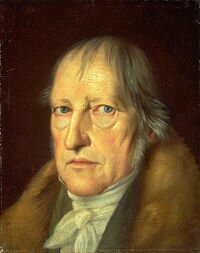
Georg Wilhelm Friedrich HegelThe Right Hegelians, Old Hegelians, or the Hegelian Right, were the followers of German philosopher Georg Wilhelm Friedrich Hegel who took his philosophy in a politically and religiously conservative direction. They are typically contrasted with the Young Hegelians, who interpreted Hegel's political philosophy to support innovations in politics or religion.Hegel's political philosophy could be read in liberal or conservative directions.

Hegel's historicism held that both ideas and nations could only be understood by understanding their history. Throughout his life, Hegel was an orthodox member of Prussia's Lutheran Church. He devoted considerable attention to the Absolute, his term for the totality of reality that was used in his philosophy to justify belief in God. In his Philosophy of Right, Hegel wrote that:

The State is absolutely rational inasmuch as it is the actuality of the substantial will which it possesses in the particular self-consciousness once that consciousness has been raised to consciousness of its universality. This substantial unity is an absolute unmoved end in itself, in which freedom comes into its supreme right. On the other hand this final end has supreme right against the individual, whose supreme duty is to be a member of the State.

— Philosophy of Right, "The State", s. 258


More...

Monday, October 27, 2008

Right Hegelians

The Right Hegelians, Old Hegelians, or the Hegelian Right, were the followers of German philosopher Georg Wilhelm Friedrich Hegel who took his philosophy in a politically and religiously conservative direction. They are typically contrasted with the Young Hegelians, who interpreted Hegel's political philosophy to support innovations in politics or religion. Hegel's political philosophy could be read in liberal or conservative directions.

Hegel's historicism held that both ideas and nations could only be understood by understanding their history. Throughout his life, Hegel was an orthodox member of Prussia's Lutheran Church. He devoted considerable attention to the Absolute, his term for the totality of reality that was used in his philosophy to justify belief in God. In his Philosophy of Right, Hegel wrote that:
The State is absolutely rational inasmuch as it is the actuality of the substantial will which it possesses in the particular self-consciousness once that consciousness has been raised to consciousness of its universality. This substantial unity is an absolute unmoved end in itself, in which freedom comes into its supreme right. On the other hand this final end has supreme right against the individual, whose supreme duty is to be a member of the State.
— Philosophy of Right, "The State", s. 258

More...
 

Subscribe


LifeNews.com

Desiring God Blog

Youth for Christ International