Showing posts with label Pharaoh. Show all posts

Wednesday, October 12, 2011

The Plagues of Egypt

The Plagues of Egypt (Hebrew: מִצְרַיִם מכות, makkah Mitsrayim) or the Ten Plagues (עשר המכות, Eser Ha-Makot) are the ten calamities inflicted upon Egypt by God in the Biblical story recounted the book of Exodus, chapters 7-12, in order to convince Pharaoh to let the Israelite slaves leave.


The plagues as they appear in the Torah are:

1. (Ex 7:14-25) rivers and other water sources turned to blood (דָם 'Dam')
2. (Ex 7:26-8:11) amphibians (commonly believed to be frogs) (צְּפַרְדֵּעַ 'Tsfardeia')
3. (Ex 8:12-15) lice (כִנִּים 'Kinim')
4. (Ex 8:16-28) Either flies, wild animals or beetles (עָרוֹב 'Arov')
5. (Ex 9:1-7) disease on livestock (דֶּבֶר 'Dever')
6. (Ex 9:8-12) unhealable boils (שְׁחִין 'Shkhin')
7. (Ex 9:13-35) hail mixed with fire (בָּרָד 'Barad')
8. (Ex 10:1-20) locusts (אַרְבֶּה 'Arbeh')
9. (Ex 10:21-29) darkness (חוֹשֶך 'Choshech')
10. (Ex 11:1-12:36) death of the firstborn (מַכַּת בְּכוֹרוֹת 'Makat Bechorot')


Whereas all the other plagues did not affect the Israelites, the Torah indicates that they were only spared from the final plague by sacrificing the Paschal lamb, marking their doorpost with the lamb's blood, and eating the roasted sacrifice together with Matzot ("Poor Man's Bread" לחם עוני) in a celebratory feast. The Torah describes God as actually passing through Egypt to kill all firstborn, but passing over (hence "Passover") houses which have the sign of lambs' blood on the doorpost. It was this plague which resulted in Pharaoh finally relenting, and sending the Israelites away at whatever terms they wished.

The Torah also relates God's instructions to Moses that the Exodus of the Israelites from Egypt must be celebrated yearly on the holiday of Passover ("Pesah" פסח); the rituals observed on Passover recall the events surrounding the Exodus from Egypt. The Torah additionally cites God's sparing of the Israelite firstborn as a rationale for the commandment of the redemption of the firstborn (Exodus 13:11-16).

This event is also commemorated by the fast of the firstborn on the day preceding Passover but which is traditionally not observed because a siyum celebration is held which obviates the need for a fast.

The plagues of Egypt are recognized by Christians, Muslims, and Jews.

The first three plagues seemed to affect "all the land of Egypt," while the 4th, 5th, 6th, 7th, and 9th did not affect the children of Israel. Conditions of the 8th plague are unclear. For the last plague the Torah indicates that they were only spared from the final plague by sacrificing the Paschal lamb, marking their doorpost with the lamb's blood, and eating the roasted sacrifice together with Matzot (לחם עוני) in a celebratory feast. The Torah describes the angel of death as actually passing through Egypt to kill all firstborn children, but passing over (hence "Passover") houses which have the sign of lambs' blood on the doorpost. The night of this plague, Pharaoh finally relents and sends the Israelites away under their terms.

More...
Thursday, October 07, 2010

Aaron

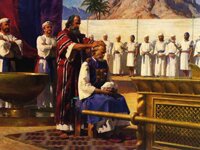
Aaron (אַהֲרֹן, a word meaning "bearer of martyrs" in Hebrew (perhaps also, or instead, related to the Egyptian "Aha Rw," "Warrior Lion"), was one of two brothers who play a unique part in the history of the Hebrew people. He was the elder son (and second child) of Amram and Jochebed of the tribe of Levi; Moses, the other son, being three years younger, and Miriam, their sister, several years older. Aaron was the great-grandson of Levi and represented the priestly functions of his tribe, becoming the first High Priest. While Moses was receiving his education at the Egyptian court and during his exile among the Midianites, Aaron and his sister remained with their kinsmen in the eastern border-land of Egypt.

Here he gained a name for eloquent and persuasive speech; so that when the time came for the demand upon Pharaoh to release Israel from captivity, Aaron became his brother’s Nabi, (in this case "spokesman" sometimes also referred to as a prophet), to his own people and, after their unwillingness to hear, to Pharaoh himself.

Moses' brother and born into the Tribe of Levi, first mentioned in the bible in Exodus 4:14. Spoke on behalf of Moses in front of Pharaoh when trying to persuade him to let the Israelites go free from Egypt. Became the first of the Levite priests and the first high priest of Israel. He died while Israel was still on the exodus (deuteronomy 10:4).

More...

includes Arnold Schoenberg: "Moses Und Aron" Music from Act Two. Scene Three: The Golden Calf and the Altar

Sunday, September 12, 2010

Moses

According to the Hebrew Bible, Moses (Hebrew: משה Mosheh "to draw out, pull out") led the Israelites out of Egypt, and received the Torah of Judaism from God on Mount Sinai. The Torah contains the life story of Moses and his people until his death at the age of 120 years, according to some calculations in the year 2488, or 1272 BC. Consequently, "may you live to 120" has become a common blessing among Jews.

Moses's greatest legacy was probably expounding the doctrine of monotheism, which was not widely accepted at the time, codifying it in Jewish religion with the 1st Commandment, and punishing polytheists. He is revered as a prophet in Judaism, Christianity, and Islam.

The birth of Moses occurred at a time when the current Egyptian monarch had commanded that all male children born to Hebrew captives should be killed by drowning in the Nile River.
22 And Pharaoh charged all his people, saying, Every son that is born ye shall cast into the river, and every daughter ye shall save alive. –Exodus 1:22

1. Exodus 1:22 Samaritan, Septuagint, Targum; Hebrew lacks to the Hebrews

The Torah leaves the identity of this Pharaoh unstated, but he is widely believed to be Ramses II; other, earlier pharaohs have also been suggested including a Hyksos pharaoh or one shortly after the Hyksos had been expelled.

More...

Sunday, August 08, 2010

Nile

The Great Bend of
the Nilein Sudan, looking
north across the Sahara
Desert towards Northern
Sudan and Southern Egypt.
Courtesy NASA.
The Nile (Hebrew: יאור y@`or, Arabic: النيل an-nīl) of Egyptian origin, meaning river, stream, canal, Nile, Nile-canal. The Nile is one of the two longest rivers on Earth.
After two whole years, Pharaoh dreamed that he was standing by the Nile –Gen. 41:1
In Greek, the word "Nile" ('nIl) comes from the word Neilos (Νειλος), a Greek name for the Nile River. Another Greek name for the Nile was Aigyptos (Αιγυπτος), which itself is the source of the name "Egypt."
1 Then the LORD said to Moses, "Go in to Pharaoh and say to him, 'Thus says the LORD, "Let my people go, that they may serve me. 2 But if you refuse to let them go, behold, I will plague all your country with frogs. 3 The Nile shall swarm with frogs that shall come up into your house and into your bedroom and on your bed and into the houses of your servants and your people, and into your ovens and your kneading bowls. Exodus 8:1-3

Among the Hebrews יאור (A River) signified:

a ditch, canal, channel. Is. 33:21, where it is the fosse of a fortified city ; Sept. SmqvI. So of the canals of the Nile.
  • 22 Then Pharaoh gave this order to all his people: "Every boy that is born you must throw into the Nile, but let every girl live." –Exodus 1:22

  • 3 But when she could hide him no longer, she got a papyrus basket for him and coated it with tar and pitch. Then she placed the child in it and put it among the reeds along the bank of the Nile. Exodus 2:3

  • 15 Go to Pharaoh in the morning as he goes out to the water. Wait on the bank of the Nile to meet him, and take in your hand the staff that was changed into a snake.–Exodus 7:15

  • 5 Then I, Daniel, looked, and behold, two others stood, one on this bank of the stream and one on that bank of the stream. 6 And someone said to the man clothed in linen, who was above the waters of the stream, "How long shall it be till the end of these wonders?" 7 And I heard the man clothed in linen, who was above the waters of the stream; he raised his right hand and his left hand toward heaven and swore by him who lives forever that it would be for a time, times, and half a time, and that when the shattering of the power of the holy people comes to an end all these things would be finished.–Dan 12:5-7

More...

Tuesday, March 30, 2010

Plagues of Egypt

The Plagues of Egypt (Hebrew: מכות מצרים, Makot Mitzrayim), the Biblical Plagues or the Ten Plagues (עשר המכות, Eser Ha-Makot) are the ten calamities inflicted upon Egypt by God in the Biblical story recounted the book of Exodus, chapters 7 - 12, in order to convince Pharaoh (possibly Ramesses II, making the Pharaoh of the Oppression Djeserkheperure Horemheb) to let the Israelite slaves leave (see also Pharaoh of the Exodus).

The plagues as they appear in the Torah are:
  1. (Exodus 7:14-25) rivers and other water sources turned to blood ('Dam')
  2. (Exodus 7:26-8:11) amphibians (commonly believed to be frogs) ('Tsfardeia')
  3. (Exodus 8:12-15) lice ('Kinim')
  4. (Exodus 8:16-28) Either flies, wild animals or beetles ('Arov')
  5. (Exodus 9:1-7) disease on livestock ('Dever')
  6. (Exodus 9:8-12) unhealable boils ('Shkhin')
  7. (Exodus 9:13-35) hail mixed with fire ('Barad')
  8. (Exodus 10:1-20) locusts ('Arbeh')
  9. (Exodus 10:21-29) darkness ('Choshech')
  10. (Exodus 11:1-12:36) death of the firstborn ('Makat Bechorot')

More...

Monday, February 08, 2010

Pharaoh

Pharaoh is a title used to refer to any ruler, usually male, of the Egyptian kingdom in the pre-Christian, pre-Islamic period. An absolute, all powerful, all providing ruler. Such rulers were believed to be the reincarnation of Horus.

From the Twelfth Dynasty onwards the word appears in a wish formula 'Great House, may it live, prosper and be in health', but only with reference to the buildings of the court rather than the king himself.

10So Moses and Aaron went to Pharaoh and did just as the LORD commanded. Aaron threw his staff down in front of Pharaoh and his officials, and it became a snake. — Exodus 7:10


However, the earliest certain instance where pr-`3 is used specifically to address the king is in a letter to Amenhotep IV (Akhenaten) in the mid-Eighteenth Dynasty (1539-1292 BC) which is addressed to 'Pharaoh, given life, prosperity and health, the Master'.

More...

Friday, February 23, 2007

Pharaoh

Moses and Aaron before Pharoah by Gustov DoréPharaoh is a title used to refer to any ruler, usually male, of the Egyptian kingdom in the pre-Christian, pre-Islamic period. An absolute, all powerful, all providing ruler. Such rulers were believed to be the reincarnation of Horus.

From the Twelfth Dynasty onwards the word appears in a wish formula 'Great House, may it live, prosper and be in health', but only with reference to the buildings of the court rather than the king himself.

10So Moses and Aaron went to Pharaoh and did just as the LORD commanded. Aaron threw his staff down in front of Pharaoh and his officials, and it
became a snake. - Exodus 7:10

However, the earliest certain instance where pr-`3 is used specifically to address the king is in a letter to Amenhotep IV (Akhenaten) in the mid-Eighteenth Dynasty (1539-1292 BC) which is addressed to 'Pharaoh, given life, prosperity and health, the Master'.

More...

Wednesday, December 27, 2006

Pharaoh

Moses and Aaron before Pharoah by Gustov DoréPharaoh is a title used to refer to any ruler, usually male, of the Egyptian kingdom in the pre-Christian, pre-Islamic period. An absolute, all powerful, all providing ruler. Such rulers were believed to be the reincarnation of Horus.
From the Twelfth Dynasty onwards the word appears in a wish formula 'Great House, may it live, prosper and be in health', but only with reference to the buildings of the court rather than the king himself.

10So Moses and Aaron went to Pharaoh and did just as the LORD commanded. Aaron threw his staff down in front of Pharaoh and his officials, and it became a snake. - Exodus 7:10


More...


Subscribe


LifeNews.com

Desiring God Blog

Youth for Christ International