Friday, July 24, 2009

Pauline Christianity

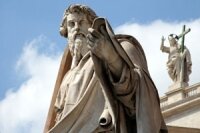
St. Paul statue in front of St. Peters Basilica, VaticanPauline Christianity is a term used to refer a branch of Early Christianity associated with the beliefs and doctrines espoused by Paul the Apostle through his writings. Most of mainstream Christianity relies heavily on these teachings and considers them to be amplifications and explanations of the teachings of Jesus. Others perceive in Paul's writings teachings that are radically different from the original teachings of Jesus documented in the canonical gospels, early Acts and the rest of the New Testament, such as the Epistle of James.

Proponents of the perceived Pauline distinctive include Marcion of Sinope, the 2nd century theologian who asserted that Paul was the only apostle who had rightly understood the new message of salvation as delivered by Christ.

Opponents of the same era include the Ebionites and Nazarenes, who rejected Paul for straying from "normative" Judaism.

Thursday, July 23, 2009

Philo of Alexandria

Philo of AlexandriaPhilo (20 BCE - 40 CE), known also as Philo of Alexandria and as Philo Judeaus, was a Hellenized Jewish philosopher born in Alexandria, Egypt. The few biographical details concerning him are found in his own works, especially in Legatio ad Caium, ("embassy to Caius") and in Flavius Josephus (Antiquities" xviii. 8, § 1; comp. ib. xix. 5, § 1; xx. 5, § 2).

The only event that can be determined chronologically is his participation in the embassy which the Alexandrian Jews sent to the emperor Caligula at Rome for the purpose of asking protection against the attacks of the Alexandrian Greeks. This occurred in the year 40 CE.

Philo included in his philosophy both Greek wisdom and Judaism, which he sought to fuse and harmonize by means of the art of allegory that he had learned as much from Jewish exegesis as from the Stoics. His work was not widely accepted. "The sophists of literalness," as he calls them (De Somniis, i. 16-17), "opened their eyes superciliously" when he explained to them the marvels of his exegesis. Philo's works were enthusiastically received by the early Christians, some of whom saw in him a Christian. Eusebius speculated that the Therapeutae, the Jewish group of ascetic hermits in the Egyptian desert that Philo describes in De vita contemplativa ("Contemplative Life") was in fact a Christian group.

More...

Monday, July 20, 2009

Jonathan (son of Saul)

Saul Throws Spear at David by George TinworthDavid and Jonathan were heroic figures of the Kingdom of Israel, whose intimate relationship was recorded favorably in the Old Testament books of Samuel.

According to the Bible, true friendship involves loyalty, sacrifice, compromise, and yes, emotional attachment.

12 If an enemy were insulting me, I could endure it; if a foe were raising himself against me, I could hide from him. 13 But it is you, a man like myself, my companion, my close friend, 14 with whom I once enjoyed sweet fellowship as we walked with the throng at the house of God.
(Psalm 55:12-14)

24 A man of many companions may come to ruin, but there is a friend who sticks closer than a brother.
(Proverbs 18:24)

13 "Greater love has no one than this, that he lay down his life for his friends. 14 You are my friends if you do what I command. 15 I no longer call you servants, because a servant does not know his master's business. Instead, I have called you friends, for everything that I learned from my Father I have made known to you."
(John 15:13-15)

7 Very rarely will anyone die for a righteous man, though for a good man someone might possibly dare to die. 8 But God demonstrates his own love for us in this: While we were still sinners, Christ died for us.
(Romans 5:7-8)
More...

Sunday, July 19, 2009

Christian mysticism

Philo of AlexandriaChristian mysticism is traditionally practised through the disciplines of:
  • prayer (including oratio, meditation and contemplation);
  • self-denial, including fasting, broadly called asceticism; and
  • service to others, again broadly called almsgiving.
Christian mystics interpret sacred texts and the life, sermons and parables of Jesus metaphorically: e.g. Jesus' Sermon on the Mount (Matthew 5–7) in its totality contains the way for direct union.

Whereas Christian doctrine generally maintains that God dwells in all Christians and that they can experience God directly through belief in Jesus, Christian mysticism aspires to apprehend spiritual truths inaccessible through intellectual means, typically by emulation of Christ. William Ralph Inge divides this scala perfectionis into three stages:
  1. the "purgative" or ascetic stage,
  2. the "illuminative" or contemplative stage, and
  3. the "unitive" stage, in which God may be beheld "face to face."
More...

Saturday, July 18, 2009

Oral Tradition

The Rylands Library Papyrus P52 is the earliest manuscript fragment found from John's Gospel; dated to about 125The Oral Torah, Oral Law, or Oral Tradition (Hebrew: תורה שבעל פה, Torah she-be-`al peh), according to Rabbinic Judaism, is an oral tradition received in conjunction with the written Torah (and the rest of the Hebrew Bible), which is known in this context as the "Written Torah" (Hebrew: תורה שבכתב, Torah she-bi-khtav). The traditions of the Oral Torah are believed to be the same as those recorded in the Mishnah and Talmud during the 2nd-5th centuries CE.

According to classical Judaism and the tenets of Orthodox Judaism, Moses and the Jews at Mount Sinai received an Oral as well as a written Torah ("teaching") from God. The books of the Tanakh (Hebrew Bible) were relayed with an oral tradition passed on by the scholarly and other religious leaders of each generation, and according to classical Rabbinic interpretation, the teachings of the Oral Law are a guide to that interpretation of the Written Law which is considered the authoritative reading. Jewish law and tradition thus is not based on a strictly literal reading of the Tanakh, but on combined oral and written traditions. Further, the basis of halakha (Jewish law) includes the premise that the Written Law is inherently bound together with an Oral Law.

More...

Friday, July 17, 2009

Exodus

View from Mount SinaiThe (Greek: "departure") book of Exodus is the second book of the Torah (the Pentateuch).

The Hebrew names of the five books of the Torah are taken from initial words of the first verse of each book. For example, the Hebrew name of the first book, ראשית re'shiyth, is the first word of Genesis 1:1:
  1. Re'shiyth (בראשית, adj. main, chief, principal, head, major, prime, top, leading, grand, master, prima, arch, capital, cardinal)
  2. Shemot (שמות, or שם shem v. to put, place, lay, set; make, cause; appoint; nm. name, reputation, fame, moniker, denomination, distinction)
  3. Vayikra (ויקרא, or קרא qara' v. to call, call out, recite, read, cry out, proclaim)
  4. Bamidbar (במדבר, מדבר midbar nm. desert, wilderness, waste, wildness, large tracts of wilderness)
  5. Devarim (דברים דבר dabar nm. word, speech, saying, utterance, say, speech; oratory; commandment)
More...

Thursday, July 16, 2009

New Testament view on the life of Jesus

Flight into Egypt, Rembrandt Harmensz. van RijnThe four canonical gospels of the New Testament are the main sources of information for the traditional Christian narrative of Jesus' life.

Genealogy and family

The Gospels give two accounts of Jesus' genealogy: one in the male line through his legal father Joseph of Nazareth (Matthew 1:2–16) and one through his mother, Mary, while referencing his supposed father; (Luke 3:23–38). Both accounts trace his line back to King David and from there to Abraham. These lists are identical between Abraham and David, but they differ between David and Joseph. Matthew starts with Solomon and proceeds through the kings of Judah to the last king, Jeconiah. After Jeconiah the line of kings terminated when Babylon conquered Judah. Thus, Matthew shows that Jesus is the legal heir to the throne of Israel. Luke's genealogy is longer than Matthew's; it goes back to Adam and provides more names between David and Jesus, thus giving us direct descendants from Adam to Jesus through Mary.

More...

Wednesday, July 15, 2009

Reformation

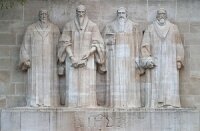
The Reformation Wall in Geneva. From left: William Farel, John Calvin, Theodore Beza, and John KnoxThe Protestant Reformation was a movement that emerged in the 16th century as a series of attempts to reform the Roman Catholic Church in Western Europe. The main front of the reformation was started by Martin Luther and his 95 Theses. The reformation ended in division and the establishment of new institutions, most importantly Lutheranism, the Reformed churches, and Anabaptists, a radical branch whose name means "those who baptize again".

Martin Luther's spiritual predecessors included men such as John Wycliffe and Jan Hus, who had attempted to reform the church along similar lines, though their efforts had been largely unsuccessful. The Reformation can be said to have begun in earnest on October 31, 1517, in Wittenberg, Saxony (in present-day Germany). There, Luther nailed his Ninety-Five Theses to the door of the All Saints' Church, which served as a notice board for university-related announcements. These were points for debate that criticized the Church and the Pope. The most controversial points centered on the practice of selling indulgences and the Church's policy on purgatory. Other reformers, such as Huldrych Zwingli, soon followed Luther's lead. Church beliefs and practices under attack by Protestant reformers included purgatory, particular judgment, devotion to Mary (Mariology), the intercession of and devotion to the saints, most of the sacraments, the mandatory celibacy requirement of its clergy (including monasticism), and the authority of the Pope.

More...

Monday, July 13, 2009

Love

loveLove (Greek: agape) is a primary characteristic of God's nature (1 John 4:8, 16) and the highest expression of Christian faith and action (1 Cor. 13:13; Gal. 5:14; Eph. 5:2; 1 John 4:7-21). In the New Testament, agape is charitable, selfless, altruistic, and unconditional.
And we have known and believed the Love that God hath to us. GOD IS LOVE; and he that dwelleth in Love dwelleth in God, and God in him. (1 John 4:16)
It is parental love seen as creating goodness in the world, it is the way God is seen to love humanity, and it is seen as the kind of love that Christians aspire to have for others. (Greek: Philia) - also used in the New Testament, Philia is a human response to something that is found to be delightful. Also known as "brotherly love".

Two other words for love in the Greek language -- (Greek: eros) (sexual love) and storge (needy child-to parent love) were never used in the New Testament.

Whether religious love can be expressed in similar terms to interpersonal love is a matter for philosophical debate. Religious 'love' might be considered a euphemistic term, more closely describing feelings of deference or acquiescence. Love can be expressed by prayer, service, good deeds, and personal sacrifice.

More...

Saturday, July 11, 2009

historicity of Jesus

Jesus, aged 12, teaching the doctors of the FaithThe historicity of Jesus (i.e., his existence as an actual historical figure), is accepted as a theological axiom by three world religions, Christianity, Islam and the Bahá’í Faith, based on their respective scriptures.

The earliest known sources are Christian writings - the New Testament - which, according to modern historians, were written only 20-30 years after Jesus died.

However, while Christianity considers Jesus to be the Christ (Messiah) and Son of God, and Islam views him only as a prophet, secular historians and followers of most other world religions (including Judaism) tend to regard him as an ordinary human. Messianic Judaism, however, also considers Jesus (Yeshua HaMashiach) to be the Jewish Messiah.

More...

Thursday, July 09, 2009

Fertile Crescent

City-states of the Fertile Crescent in the 2nd millennium BCE The Fertile Crescent is a historical region in the Middle East incorporating Ancient Egypt, the Levant, and Mesopotamia. The term "Fertile Crescent" was coined by University of Chicago archaeologist James Henry Breasted.

Watered by the Nile, Jordan, Euphrates and Tigris rivers and covering some 400-500,000 square kilometers, the region extends from the eastern shore of the Mediterranean Sea around the north of the Syrian Desert and through the Jazirah and Mesopotamia to the Persian Gulf. These areas correspond to the present-day Egypt, Israel, West Bank, Gaza strip, and Lebanon and parts of Jordan, Syria, Iraq (see also: Iraq Maps), south-eastern Turkey and south-western Iran.

The population of the Nile River Basin is about 70 million, the Jordan River Basin about 20 million, and the Tigris and Euphrates Basins about 30 million, giving the present-day Fertile Crescent a total population of approximately 120 million, or at least a third of the population of the Middle East.

More...

Wednesday, July 08, 2009

Joseph Lister

Joseph Lister, 1st Baron Lister, OM , FRS (5 April 1827 – 10 February 1912) was an English surgeon who promoted the idea of sterile surgery while working at the Glasgow Royal Infirmary.Joseph Lister, 1st Baron Lister, OM , FRS (5 April 1827 – 10 February 1912) was an English surgeon who promoted the idea of sterile surgery while working at the Glasgow Royal Infirmary. He successfully introduced carbolic acid (phenol) to sterilize surgical instruments and to clean wounds.

Joseph Lister came from a prosperous Quaker home in Upton, Essex, a son of Joseph Jackson Lister, the pioneer of the compound microscope, and Isabella Harris.

He attended the University of London, one of only a few institutions which was open to Quakers at that time. He initially studied the Arts but at the age of 25 became a Bachelor of Medicine and entered the Royal College of Surgeons.

In 1854, Lister became first assistant surgeon to James Syme, at the University of Edinburgh in Scotland. The two became close friends and Lister ended up marrying Syme's daughter Agnes, a member of the Scottish Episcopal Church, leaving the Quakers, perhaps because his religion did not permit marriages with non-members. He once stated,

“I am a believer in the fundamental doctrines of Christianity.”

More...

Tuesday, July 07, 2009

Korban

The lamb is one of the animals that was used as a sacrificial animal prior to 70 CEKorban (קרבן (nm. victim, prey, butt; sacrifice, offering, oblation, immolation) (plural: Korbanot קרבנות) is a Jewish practice of sacrificing an animal or of making an offering at the Temple. It is known as a Korban in Hebrew because its Hebrew root K [a] R [o] V (קרב) means to "[come] Close (or Draw Near) [to God]", which the English words "sacrifice" or "offering" do not fully convey. There were many different types of korbanot. Once performed as part of the religious ritual in the Temple in Jerusalem in Ancient Israel, the practice was stopped in 70 CE, after the destruction of the Second Temple.

A Korban was usually an animal sacrifice, such as a lamb or a bull that was ritually slaughtered, and (usually) cooked and eaten by the offerer, with parts given to the Kohanim (priests) and parts burned on an altar. Korbanot could also consist of turtle-doves or pigeons, grain, incense, fruit, and a variety of other offerings.

More...

Monday, July 06, 2009

Flavius Josephus

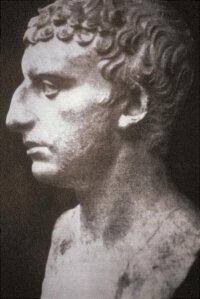
Bust of Flavius JosephusJosephus (c. 37 AD/CE – c. 100), who became known, in his capacity as a Roman citizen, as Flavius Josephus, was a 1st century Jewish historian and apologist of priestly and royal ancestry who survived and recorded the Destruction of Jerusalem in 70. His works give an important insight into first-century Judaism.
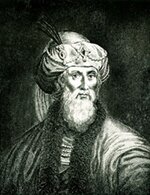
Josephus, who introduced himself in Greek as "Joseph, son of Matthias, a Hebrew by race, a priest from Jerusalem", fought the Romans in the First Jewish-Roman War of 66-73 as a Jewish military leader in Galilee. However, in circumstances that are somewhat unclear (see also Josephus problem), Josephus surrendered to the Roman forces invading Galilee in July 67.

He became a prisoner and provided the Romans with intelligence on the ongoing revolt.

The Roman forces were led by Flavius Vespasian and his son Titus (Titus Flavius Vespasianus), both subsequently Roman emperors). In 69 Josephus was released (cf. War IV. 622-629) and according to Josephus' own account, he appears to have played some role as a negotiator with the defenders in the Siege of Jerusalem in 70.

More...

Sunday, July 05, 2009

Codex Bezae

A portion of the Greek text of the Codex BezaeThe Codex Bezae Cantabrigensis (Gregory-Aland no. D or 05) is an important codex of the New Testament dating from the fifth- or sixth-century. It is written in an uncial hand on vellum and contains, in both Greek and Latin, most of the four Gospels and Acts, with a small fragment of 3 John.

Codex contents
The manuscript presents the gospels in the unusual order Matthew, John, Luke and Mark, of which only Luke is complete; after some missing pages the MS picks up with the Third Epistle of John and contains part of the Acts of the Apostles. Written with one column per page it has 406 leaves, out of perhaps an original 534, and the Greek pages on the left face Latin ones on the right. The first three lines of each book are in red letters, and black and red ink alternate lines towards the end of books. As many as nine correctors have worked on the manuscript between the sixth and twelfth century.

More...

Saturday, July 04, 2009

British Mandate of Palestine

Map showing Allenbys final attack at Megiddo, September 1918.The Palestine Mandate, was a set of protocols or articles that formed a multilateral legal and administrative agreement. They were part of the Laws of Nations, and thus were not a mere geographical territory or area. The territorial jurisdiction of the mandate was subject to change by treaty, capitulation, grant, usage, sufferance or other lawful means.

The mandate is sometimes referred to as the The Mandate for Palestine, the British Mandate for Palestine, or the British Mandate of Palestine, etc. It was a League of Nations Mandate that had been created by the Principle Allied and Associated Powers after the First World War. The Ottoman Empire was split up by the Treaty of Sèvres. That treaty never officially entered into force. The terms of the original settlements were significantly remodeled by the subsequent Treaty of Lausanne, after the Chanak Crisis. The provisions regarding Palestine remained unchanged, but many of the other provisions regarding Wilsonian Armenia and the proposed autonomous region of Kurdistan were eliminated.

The purported objective of the League of Nations Mandate system was to administer parts of the recently defunct Ottoman Empire, which had been in control of the Middle East since the 16th century, "until such time as they are able to stand alone." The terms of the Sykes-Picot Agreement involved such things as ports, tariffs, and trade. In the case of Syria and Palestine, the mandatory power actually used armed force to overthrow the indigenous government.

More...

Friday, July 03, 2009

Christian apologetics

Title page for the 1582 Douai-Rheims New TestamentChristian apologetics is the field of study concerned with the systematic defense of Christianity. The term "apologetic" comes from the Greek word apologia, which means in defense of; therefore a person involved in Christian or Bible Apologetics is a defender of Christianity. Someone who engages in Christian apologetics is called a "Christian apologist". Christian apologetics have taken many forms over the centuries, starting with Paul of Tarsus, including renowned writers such as Augustine of Hippo and Thomas Aquinas, and continuing today with the modern Christian community through authors such as Karl Keating and Jimmy Akin. Apologists have based their defense of Christianity on favoring interpretations of historical evidence, philosophical arguments, scientific investigation, and other avenues.

This Classical Greek term appears in the Koine Greek (i.e. common Greek) of the New Testament. The apostle Paul employed the term "apologia" (a speaking in defense) in his trial speech to Porcius Festus and Agrippa when he said, "I make my defense" (Acts 26:2). In the English language, the word apology, derived from the Greek word "apologia", usually refers to asking for forgiveness for an action that is open to blame. Christian apologetics are meant, however, to argue that Christianity is reasonable and in accordance with the evidence that can be examined, analogous to the use of the term in the Apology of Socrates, written by Plato.

More...

Thursday, July 02, 2009

Sanctification

depiction of Jesus in the Temple, Luke 4:14-21.Sanctification or in its verb form, sanctify (Hebrew קדש Strongs H6942: qadash), "to consecrate, sanctify, prepare, dedicate, be hallowed, be holy, be sanctified, Betroth, be dedicated, be separate, to make holy or sacred" (from the Latin verb sanctificare, which in turn derives from sanctus, "holy" and facere, "to make"). The Greek word is agiasmos (Greek: άγιασμος), meaning "consecration, holiness, or sanctification." It comes from the root agios (άγιος), which means "holy devoted to the gods." Sanctification then, refers to the state or process of being set apart or made holy. What is often missed, or overlooked, is the relational aspect that is associated with the word sanctification.

Only God is truly holy. Everything else, whether things or people, is holy only because of its relationship to God. What Jesus meant when He said,
"...Holy Father, protect them by the power of your name—the name you gave me—so that they may be one as we are one "
(John 17:11)
was that He is Holy because Jesus was, is, and will be one with the Father—without beginning, without end (see also: John 1:1 and John 1:1-30 in context).

More...

Wednesday, July 01, 2009

Olivet discourse

Four Horsemen of the Apocalypse, by Albrecht Dürer.The Olivet discourse or Little Apocalypse is a passage found in the Synoptic Gospels of Matthew 24, Mark 13 and Luke 21, occurring just before the narrative of Jesus's passion beginning with the Anointing of Jesus. In the narrative is a discourse or sermon given by Jesus on the Mount of Olives, hence the name. According to most textual scholars, the versions of the discourse in Matthew and Luke are based on the version in Mark.

The discourse contains a number of statements which at face value appear to refer to future events, and most modern Christians interpret as having been intended as prophecy.

The topics involved are:
  1. The future destruction of the Temple in Jerusalem
  2. Tribulation in Israel and the nations of the world
  3. Various signs of the coming of the Son of Man


More...

Monday, June 29, 2009

Tribe of Judah

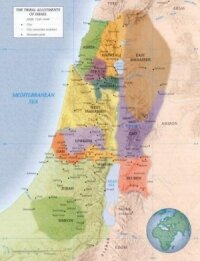
Map of the twelve tribes of IsraelThe Tribe of Judah (hebrew: יְהוּדָה, "praise" n. Judea; Judah, Yehuda (name), Jude; nm. Judaization) is one of the Hebrew tribes of Israel, founded by Judah, son of Jacob.

Together with the Tribe of Benjamin, descendants of Judah eventually formed the southern kingdom of Judah in the ancient land of Israel, when the kingdom of Israel was divided. These two tribes were thus not carried into captivity with the ten tribes of the northern kingdom of Israel when it fell. This started the tradition (some say myth) of the ten lost tribes of Israel.

As the Tribe of Benjamin was always very much the minor partner, in time the tribe of Judah became identified with the entire Israelite nation, and even the entire Hebrew nation, and gave their name to the Jews.

Judah and his three surviving sons went down with Jacob into Ancient Egypt (Gen. 46:12; Ex. 1:2). At the time of the Exodus, when we meet with the family of Judah again, they have increased to the number of 74,600 males (Num. 1:26-27).

More...

Saturday, June 27, 2009

Reductionism

Pablo Picasso. The Lovers. 1923.Reductionism in philosophy describes a number of related, contentious theories that hold, very roughly, that the nature of complex things can always be reduced to (explained by) simpler or more fundamental things. This is said of objects, phenomena, explanations, theories, and meanings.

Roughly, this means that chemistry is based on physics, biology is based on chemistry, psychology and sociology are based on biology. The first two of these reductions are commonly accepted but the last step is controversial and therefore the frontier of reductionism: evolutionary psychology and sociobiology versus those who claim that such special sciences are inherently irreducible. Reductionists believe that the behavioral sciences should become a "genuine" scientific discipline by being based exclusively on genetic biology.

In the painting (right) by the Spanish artist Pablo Picasso (1881-1973), titled "The Lovers," painted in 1923, we see that the two figures are rendered realistically and that they have the appearance of being a loving couple. But the hands and the faces have been innately simplified and are presented as simple lines rather than circumspectly imitated models.

More...

Friday, June 26, 2009

Original sin

Ceiling fresco of Creation in the Sistine Chapel, Main scene: original sin and expulsion from Paradise. Michelangelo BuonarrotiAccording to Christian tradition, Original sin is the general and non-personal condition of sinfulness (lack of holiness) into which human beings are born. It is also called hereditary sin or birth sin. Used with the definite article ("the original sin"), it refers to the first sin committed by humans, seen as the seed of future evil effects for the whole human race. Christians usually refer to this first sin as "the Fall".

By analogy the term is used in fields other than religion to indicate a pervading inherent flaw.

Adam and Eve's sin, as recounted in the Book of Genesis is sometimes called in Hebrew החטא הקדמון (the original sin), on the basis of the traditional Christian term. But the term used in classical Jewish literature is חטא אדם הראשׁון, (the first sin of man, or of Adam).

More...

Thursday, June 25, 2009

Mount of Olives

Christ on the Mount of Olives, Caravaggio, c. 1605The Mount of Olives (also Mount Olivet, Hebrew: Har HaZeitim הר הזיתים, sometimes Jebel et-Tur, "Mount of the Summit," or Jebel ez-Zeitun, "Mount of Olives") is a mountain ridge to the east of Jerusalem. It is named from the olive trees with which its sides are clothed. Jesus entered Jerusalem, gave his final teaching, and ascended to heaven from the Mount. It is the site of many important Biblical events.

In the Book of Zechariah the Mount of Olives is identified as the place from which God will begin to redeem the dead at the end of days.

For this reason, Jews have always sought to be buried on the mountain, and from Biblical times to the present day the mountain has been used as a cemetery for the Jews of Jerusalem.

Major damage was suffered when the Mount was occupied by Jordan during the 1948 Arab-Israeli War, with Jordanians using the gravestones from the cemetery for construction of roads and toilets, including gravestones from millennia-old graves.

More...

Wednesday, June 24, 2009

The Didache

Didache “The Teaching of the Lord to the Gentiles by the Twelve Apostles” (Διδαχὴ κυρίου διὰ τῶν δώδεκα ἀποστόλων τοῖς ἔθνεσιν, Didachē kyriou dia tōn dōdeka apostolōn tois ethnesin)The Didache (Διδαχὴ, Koine Greek for "Teaching") is the common name of a brief early Christian treatise (c. 70–160 CE), containing instructions for Christian communities. The text is possibly the first written catechism, with three main sections dealing with Christian lessons, rituals such as baptism and eucharist, and Church organization. It was considered by some of the Church Fathers as part of the New Testament but rejected as spurious (not from the claimed source) by others, eventually not accepted into the New Testament canon with the exception of the Ethiopian Orthodox Church "broader canon". The Roman Catholic Church has accepted it as part of the collection of Apostolic Fathers. It is the only rediscovered Christian text during the last 150 years of discoveries in libraries or in papyri to receive wide acceptance by the Catholic and Orthodox Churches.

Discovery
Considered lost, the Didache was rediscovered in 1883 by Philotheos Bryennios, a Greek Orthodox metropolitan bishop of Nicomedia, in the Greek Codex Hierosolymitanus written in 1053, from which he had already published the full text of the Epistles of Clement in 1875.

Shortly after Bryennios' initial publication, the scholar Otto von Gebhardt identified a Latin manuscript in the Abbey of Melk in Austria as containing a translation of the first part of the Didache.; later scholars now believe that to be an independent witness to the tradition of the Two Ways section.

More...

Tuesday, June 23, 2009

Gospel of Luke

St Luke the Evangelist. Artist: Domenico Ghirlandaio. Date: 1486-90The Gospel of Luke is a synoptic Gospel, and the third and longest of the four canonical Gospels of the New Testament, which purport to tell the story of Jesus' life, death, and resurrection. The author was also the author of Acts of the Apostles. Like all gospels, the gospel originally circulated anonymously. Since at least the 2nd century, authorship has been ascribed to Luke, named in Colossians 4:14, a doctor and follower of Paul.

The introductory dedication to Theophilus, 1:1-4 states that since many others have compiled an "orderly narrative of the events" from the original eyewitnesses, that the author has decided to do likewise, after thorough research of everything from the beginning, so that Theophilus may realize the reliability of the teachings in which he has been instructed. The main characteristic of this Gospel, as Farrar (Cambridge Bible, Luke, Introduction) remarks, is expressed in the motto, "Who went about doing good, and healing all that were oppressed of the devil" (Acts 10:38; cf. with Luke 4:18). Luke wrote for the "Hellenistic world".

More...

Monday, June 22, 2009

Saul

Saul and David (Rembrandt, approx. 1630)King Saul (Hebrew: שאול המלך) ("King Saul" or Sha'ul) (שָׁאוּל "Borrowed") was the first king of the ancient Kingdom of Israel [] described in the Hebrew Bible. His story is found in the first of the Books of Samuel.

Saul was the son of Kish, of the tribe of Benjamin.

According to the Book of Samuel, Saul was sent with a servant to look for his father's she-asses, who had strayed. Leaving his home at Gibeah, Saul and his servant wandered eventually to the district of Zuph, near Samuel's home at Ramah (1 Samuel 9:4-6). At this point, Saul proposed to them to return from the three days' fruitless search, but his servant suggested that they should first consult the "seer." The two met with Samuel, who secretly anointed Saul as king over Israel.

After Saul returned home, Samuel summoned the people to an assembly at Mizpah.

More...

Sunday, June 21, 2009

Ezra

Ezra in Prayer’, by Gustave Doré.The historical Ezra (Hebrew עזרא `Ezra', "help") was a priestly sofer (scribe) who is thought to have led about 5,000 Israelite exiles living in Babylon to their home city of Jerusalem [virtual map of Jerusalem] in 459 BCE. Many scholars credit him as the author of the Book of Ezra and the Book of 1 Chronicles in the Bible. Ezra is also believe to have led the reforms of the returned exiles in Jerusalem, and was a co-worker with Nehemiah.

Unless otherwise specified, all historical information about Ezra in this article is derived from the last four chapters of the Book of Ezra, and Chapter 8 of the Book of Nehemiah. More general historical information about the people and places Ezra would have interacted with is available at Israelites.

Ezra was either the son or grandson of the Biblical character Seraiah (2 Kings 25:18-21), and a lineal descendant of Phinehas, the son of Aaron (Ezra 7:1-5). In the seventh year of the reign of Artaxerxes Longimanus (see also Darius I of Persia), Ezra obtained leave to go to Jerusalem and to take with him a company of Israelites (Ezra 8). Artaxerxes showed great interest in Ezra's undertaking, granting him "all his requests," and giving him gifts for the house of God. Ezra assembled a band of approximately 5,000 exiles to go to Jerusalem. They rested on the banks of the Ahava for three days and organized their four-month march across the desert.

More...

Saturday, June 20, 2009

The Second Temple

A Greek language inscription from Herod's Temple, late 1st century BCE. It warns gentiles to refrain from entering the Temple enclosure, on pain of death.The Second Temple was the reconstructed Temple in Jerusalem which stood between 515 BCE and 70 CE. During this time, it was the center of Jewish worship, which focused on the sacrifices known as the korbanot (see korban). Solomon's Temple, also known as the First Temple, was destroyed in 586 BCE when the Jews were exiled into the Babylonian Captivity. The Romans destroyed Jerusalem and its Second Temple circa 70 CE, ending the Great Jewish Revolt that began in 66 CE.

After the return from captivity, under Zerubbabel and the high priest Jeshua, arrangements were almost immediately made to reorganize the desolated Kingdom of Judah after its demise seventy years earlier.

The body of pilgrims, forming a band of 42,360 including children, having completed the long and dreary journey of some four months, from the banks of the Euphrates to Jerusalem, were animated in all their proceedings by a strong religious impulse, and therefore one of their first concerns was to restore their ancient house of worship by rebuilding their destroyed temple and reinstituting the sacrificial rituals known as the korbanot ("sacrifices" in Hebrew).

More...

Friday, June 19, 2009

Shechem

Shechem Baal Berith temple © http://perimeno.ca/Shechem, Sichem, or Shkhem (Hebrew: שְׁכֶם‎ /שְׁכָם n. "Shoulder", v. to get up early, be awakened) was an Israelite city in the tribe of Ephraim, situated at Tell Balatah 32°12′11″N, 35°18′40″E, 2 km east of present-day Nablus) was the first capital of the Kingdom of Israel [].

Archaeological evidence (see biblical archaeology) indicates that the city was razed and reconstructed up to 22 times before its final demise in 200 CE.

Within the remains of the city can still be found a number of walls and gates built for defense, a government house, a residential quarter and the ruins of a temple raised to Zeus by the Roman Emperor Hadrian, the latter dating to the second century CE.

More...

Wednesday, June 17, 2009

Josephus on Jesus

A woodcut of Flavius Josephus by John C. Winston.In 93, the Jewish historian Flavius Josephus published his work Antiquities of the Jews. The extant copies of this work, which all derive from Christian sources, even the recently recovered Arabic version, contain two passages about Jesus. The one directly concerning Jesus has come to be known as the Testimonium Flavianum, and its authenticity has been disputed since the 17th century. The other passage concerns James the brother of Jesus.

The passage appears in Antiquities of the Jews xviii 3.3, which, in the translation of William Whiston, reads:
3. Now there was about this time Jesus, a wise man, if it be lawful to call him a man; for he was a doer of wonderful works, a teacher of such men as receive the truth with pleasure. He drew over to him both many of the Jews and many of the Gentiles. He was [the] Christ. And when Pilate, at the suggestion of the principal men amongst us, had condemned him to the cross, those that loved him at the first did not forsake him; for he appeared to them alive again the third day; as the divine prophets had foretold these and ten thousand other wonderful things concerning him.

And the tribe of Christians, so named from him, are not extinct at this day.
More...

Tuesday, June 16, 2009

Agapē

The divine, unconditional, self-sacrificing, active, volitional, and thoughtful love of Christ.Agapē (Αγάπη - affection, good will, love, benevolence, brotherly love) is one of several Greek words translated into English as "love." The word has been used in different ways by a variety of contemporary and ancient sources, including Biblical authors such as Matthew, John and Paul. Many have thought that this word represents divine, unconditional, self-sacrificing, active, volitional, and thoughtful love. Greek philosophers at the time of Plato and other ancient authors have used forms of the word to denote love of a spouse or family, or affection for a particular activity, in contrast to philia-an affection that could denote either brotherhood or generally non-sexual affection, and eros, an affection of a sexual nature. The term 'agape' is rarely used in ancient manuscripts, but was used by the early Christians to refer to the self-sacrificing love of God for humanity (cf. John 3:16), which they were committed to reciprocating and practicing towards God and among one another.

Strong's Lexicon, G25 defines agapaō as such:
  1. of persons
    • to welcome, to entertain, to be fond of, to love dearly
  2. of things
    • to be well pleased, to be contented at or with a thing
More...

Monday, June 15, 2009

Christianity

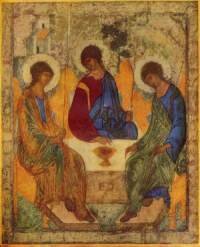
The “ Hospitality of Abraham ” by Andrei Rublev: The three angels represent the three persons of GodChristianity is a monotheistic religion centered on the life, teachings, and actions of Jesus, the Christ, as recounted in the New Testament.

With an estimated 2.1 billion adherents, Christianity is the world's largest religion. Its origins are intertwined with Judaism, with which it shares much sacred text and early history; specifically, it shares the Hebrew Bible, known in the Christian context as the Old Testament. Christianity is considered an Abrahamic religion, along with Judaism.

In the Christian scriptures, the name "Christian" (thus "Christianity") is first attested in Acts 11:25-27:
"25 So Barnabas went to Tarsus to look for Saul, 26 and when he had found him, he brought him to Antioch. For a whole year they met with the church and taught a great many people. And in Antioch the disciples were first called Christians."


More...

Sunday, June 14, 2009

Seven Churches of Asia

The Seven Churchs of AsiaThe seven churches of Asia (properly Asia Minor) are seven major churches of the early Christianity, as mentioned in the New Testament Book of Revelation. All sites are in modern-day Turkey. In Revelation, Jesus Christ instructs John the Apostle to:
"Write in a book what you see and send it to the seven churches, to Ephesus, to Smyrna, to Pergamum, to Thyatira, to Sardis, to Philadelphia, and to Laodicea."
(Revelation 1:11)

19"Write, therefore, what you have seen, what is now and what will take place later.

20The mystery of the seven stars that you saw in my right hand and of the seven golden lampstands is this: The seven stars are the angels of the seven churches, and the seven lampstands are the seven churches. (Revelation 1:19-20)
It should be understood that "churches," in this context, refers to the community of Christians living in each city, and not merely to the building or buildings in which they gathered for worship. This letter should also apply to the community of Christians today (the Christian Church, the Body of Christ).

More...

Friday, June 12, 2009

Hayah-'aher-Hayah

Michelangelo‘s depiction of God in the painting Creation of the Sun and Moon in the Sistine Chapel.The name Hayah (Hebrew: היה) denotes God's potency in the immediate future, to be, exist, be present; happen, occur, take place: become, turn into, and is part of YHVH. The phrase "Hayah-'aher-Hayah" (Hebrew: אהיה אשר אהיה) comes from the word Hayah and is used a total of 43 places in the Old Testament, where it is usually translated as "I will be" -- as is the case for its first occurrence, in Exodus 3:12 -- or "I shall be," as is the case for its final occurrence in Zechariah 8:8. It stems from the Hebrew conception of monotheism—that God exists within each and everyone and by himself, the uncreated Creator who does not depend on anything or anyone; therefore "I am who I am." Some scholars state the Tetragrammaton itself derives from the same verbal root, but others counter that it may simply sound similar as intended by God, such as Proverbs 8:34 and the Hebrew words "shaqad" (Hebrew: שקד, watching) and "shaqed" (Hebrew שקד, almond branch) found in Jeremiah 1:11-12.

I am that I am1 (Hebrew: אהיה אשר אהיה, pronounced ''Hayah 'aher Hayah') is the sole response used in (Exodus 3:14) when Moses asked for God's name. It is one of the most famous verses in the Hebrew Bible. Hayah means "existed" or "was" in Hebrew; Hayah is the first-person singular imperfect form. Hayah 'aher Hayah is generally interpreted to mean "I will be what I will be", I shall be what I shall be or I am that I am (King James Bible and others).

More...

Thursday, June 11, 2009

Rebekah

Rebecca at the Well. Artist: Nicola Grassi. c. 1720.Rebekah (also Rebecca, also Ribqah Hebrew: רבקה or רִבְקָה, Modern Rivqa Tiberian Riḇqāh, "to tie; to bind; captivating") was the wife of Isaac and the second matriarch of the four matriarchs of the Jewish people. She was the mother of Jacob and Esau. Rebekah and Isaac were one of the three "pairs" buried in the Cave of Machpelah in Hebron [virtual map of Hebron], together with Abraham and Sarah and Jacob and Leah.

According to the account in the Book of Genesis, Rebekah was the daughter of Bethuel and the granddaughter of Nahor, Abraham's brother. She was the sister of Laban, who would later become the father of Rachel and Leah, two of the wives of Rebekah's son Jacob.

The news of her birth was told to her great-uncle Abraham after the latter returned from Akeidat Yitzchak (the Binding of Isaac), the episode in which Abraham was told by God to bring Isaac as a sacrifice on a mountain.

More...

Wednesday, June 10, 2009

Auschwitz

The first gassings of prisoners occur in Auschwitz I. The SS tests Zyklon B gas by killing 600 Soviet prisoners of war and 250 other ill or weak prisoners.Auschwitz (Konzentrationslager Auschwitz) was the largest of the German Nazi concentration and extermination camps. Located in southern Poland, it took its name from the nearby town of Oświęcim (Auschwitz in German), situated about 50 kilometers west of Kraków and 286 kilometers from Warsaw. Following the German occupation of Poland in September 1939, Oświęcim was incorporated into Germany and renamed Auschwitz.

The complex consisted of three main camps:

1. Auschwitz I, the administrative center;
2. Auschwitz II (Birkenau), an extermination camp or Vernichtungslager; and
3. Auschwitz III (Monowitz), a work camp.
The first two of them have been on the World Heritage List since 1979. There were also around 40 satellite camps, some of them tens of kilometers from the main camps, with prisoner populations ranging from several dozen to several thousand.

More...

Tuesday, June 09, 2009

Theism

Theism is the belief in one or more deities. More specifically it may also mean the belief that God/god(s) is immanent in the world, yet transcends it.

Theism comes from the Greek word (theos, θεός) meaning God, especially (with G3588) the supreme Divinity, the Godhead, the trinity.

Scientific evidence in support of Theism (full article)
...

The term is attested in English from 1678, and was probably coined to contrast with atheism, a term that is attested from ca. 1587.

Views about the existence of deities are commonly divided into these categories

More...

Monday, June 08, 2009

Belshazzar

Rembrandt's depiction of the biblical account of Belshazzar seeing 'the writing on the wall'Belshazzar (or Baltasar; Akkadian Bel-sarra-usur) was a prince of Babylon, the son of Nabonidus, the last king of Babylon, not to be confused with Daniel's Babylonian name "Belteshazzar." In the Book of Daniel (chapters 5 and 8) of the Jewish Tanakh or Christian Old Testament, Belshazzar is the King of Babylon before the advent of the Medes and Persians.

Babylonian sources
Belshazzar was the son of Nabonidus, who after ruling only three years, went to the oasis of Tayma and devoted himself to the worship of the moon god, Sin. He made Belshazzar co-regent in 553 B.C, leaving him in charge of Babylon's defense.

In the year 540 B.C. Nabonidus returned from Tayma, hoping to defend his kingdom from the Persians who were planning to advance on Babylon. In 539 B.C. Belshazzar was positioned in the city of Babylon to hold the capital, while Nabonidus, marched his troops north to meet Cyrus. On October 10, 539 B.C. Nabonidus surrendered and fled from Cyrus. Two days later, October 12, 539 B.C., the Persian armies overthrew the city of Babylon.

More...

Sunday, June 07, 2009

Thessalonica

Thesaloniki. Panorama of the seashore viewed from the old town walls. Author: Daniel TellmanThessalonica or Thessaloniki [virtual map of Thessalonia] (Greek: Θεσσαλονίκη), is Greece's second-largest city and the capital of the Greek region of Macedonia.

Thessalonica had a Jewish colony, established during the first century, and was an early centre of Christianity. On his second missionary journey, Paul of Tarsus preached in the city's synagogue, the chief synagogue of the Jews in that part of Thessaloniki, and laid the foundations of a church. Opposition against him from the Jews drove him from the city, and he fled to Veroia. Paul wrote two of his epistles to the Christian community at Thessalonica, the First Epistle to the Thessalonians and the Second Epistle to the Thessalonians.

Paul's teaching about the end of the world is expressed most clearly in his letters to the Christians at Thessalonica. Heavily persecuted, it appears that they had written asking him first about those who had died already, and, secondly, when they should expect the end. Paul regarded the age as passing and, in such difficult times, he therefore encouraged marriage as a means of happiness. He assures them that the dead will rise first and be followed by those left alive (1 Thessalonians 4:16). This suggests an imminence of the end but he is unspecific about times and seasons, and encourages his hearers to expect a delay. The form of the end will be a battle between Jesus and the Man of Lawlessness (3ff) whose conclusion is the triumph of Christ.

More...

Saturday, June 06, 2009

Sanhedrin

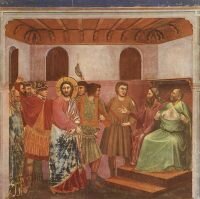
Christ Before Caiaphas: The Sanhedrin Trial of Jesus is an event reported by all four Gospels, in Mark 14:53-65, Matthew 26:57-68, Luke 22:63-71 and John 18:12-24.A Sanhedrin (Hebrew: סנהדרין Greek: συνέδριον synedrion, "sitting together," hence "assembly" or "council" from a presumed derivative of a compound of "syn" Union and "hedraios" from a derivative of hezomai "to sit"). It is an assembly of 23 judges biblically required in every city. The Great Sanhedrin is an assembly of 71 of the greatest Jewish judges who constituted the supreme court and legislative body of ancient Israel. The make-up of the Great Sanhedrin included a chief justice (Nasi), a vice chief justice (Av Beit Din), and sixty-nine general members who all sat in the form of a semi-circle when in session. "The Sanhedrin" without qualifer normally refers to the Great Sanhedrin. When the Temple in Jerusalem was standing, (prior to its destruction in 70 CE), the Great Sanhedrin would meet in the Hall of Hewn Stones in the Temple during the day, except before festivals and Shabbat (Hebrew for the Sabbath).

More...

Friday, June 05, 2009

Elohim

The Power and Majesty of Elohim as seen in nature.Elohim (אלהים) is a Hebrew word which expresses concepts of divinity. It consists of the Hebrew word Eloah (אלוה) with a plural suffix. Elohim is the third word in the Hebrew text of Genesis and occurs frequently throughout the Hebrew Bible. The most commonly accepted root of this source among Jewish scholars is that the word literally translates to "powers" meaning God is the One in control of these powers.
Bereshit bara Elohim et hashamayim ve'et ha'arets
(Genesis 1:1, Jewish Transliterated text)

In the beginning God created the heavens and the earth
(Genesis 1:1, English Text)
This word choice may be contrasted with the Tetragrammaton, which appears throughout the second telling of creation, in Genesis 2. The documentary hypothesis usually attributes Genesis 1:1 to the priestly source.
Tetragrammaton (from the Greek τετραγράμματον, meaning 'four-letter [word]'), and are usually transliterated JHWH in German, and YHWH or YHVH or JHWH or JHVH in English.


More...

Thursday, June 04, 2009

Wernher von Braun

Wernher von Braun, with the F-1 engines of the Saturn V first stage at the US Space and Rocket Center.Dr. Wernher Magnus Maximilian Freiherr von Braun (March 23, 1912 – June 16, 1977) was one of the leading figures in the development of rocket technology in Germany and the United States. The German scientist, who led Germany's rocket development program (V-2) before and during World War II, entered the United States at the end of the war through the then-secret Operation Paperclip. He became a naturalized U.S. citizen and worked on the American ICBM program before joining NASA, where he served as director of NASA's Marshall Space Flight Center and the chief architect of the Saturn V launch vehicle, the superbooster that propelled the United States to the Moon. He is generally regarded as the father of the United States space program. Wernher von Braun received the National Medal of Science in 1975. He was tall, articulate and spoke English with a distinctive German accent.

After von Braun's death, Major General John Medaris commented,

"His imagination strolled easily among the stars, yet the farther out into the unknown and unknowable vastness of Creation his thoughts went, the more he was certain that the universe, and this small garden spot within it, came from no cosmic accident, but from the thought and purpose of an all-knowing God."
More...

Tuesday, June 02, 2009

West Bank

Local Government in the West Bank The West Bank (Hebrew: הגדה המערבית‎, Hagadah
Hamaaravit, Arabic: الضفة الغربية‎, aḍ-Ḍiffä l-Ġarbīyä), also referred to in Israel and by Jews as "Judea and Samaria", is a landlocked territory on the west bank of the Jordan River in the Middle East. To the west, north, and south the West Bank shares borders with the mainland Israel. To the east, across the Jordan River, lies the country of Jordan. The West Bank also contains a significant coast line along the western bank of the Dead Sea. Since 1967 most of the West Bank has been under Israeli military occupation.

Prior to the First World War, the area now known as the West Bank was under Ottoman rule as part of the province of Syria. In the 1920 San Remo conference, the victorious Allied powers allocated the area to the British Mandate of Palestine. The 1948 Arab-Israeli War saw the establishment of Israel in parts of the former Mandate, while the West Bank was captured and annexed by Jordan, who destroyed any existing Jewish villages. The 1949 Armistice Agreements defined its interim boundary. From 1948 until 1967, the area was under Jordanian rule, and Jordan did not officially relinquish its claim to the area until 1988. Jordan's claim was never recognized by the international community.

The West Bank was captured by Israel during the Six-Day War. With the exception of East Jerusalem, the West Bank was not annexed by Israel. Most of the residents are Arabs, although a large number of Israeli settlements have been built in the region since 1967.

More...

Monday, June 01, 2009

Masoretic Text

Nash Papyrus (2nd century BCE) contains a portion of the pre-Masoretic Text, specifically the Ten Commandments and the Shema Yisrael prayerThe Masoretic Text (MT) is the Hebrew text of the Jewish Bible (Tanakh). It defines not just the books of the Jewish canon, but also the precise letter-text of the biblical books in Judaism, as well as their vocalization and accentuation for both public reading and private study. The MT is also widely used as the basis for translations of the Old Testament in Protestant Bibles, and in recent decades also for Catholic Bibles.

The MT was primarily copied, edited and distributed by a group of Jews known as the Masoretes between the seventh and tenth centuries CE. Though the consonants differ little from the text generally accepted in the early second century, it has numerous differences of both little and great significance when compared to (extant 4th century) versions of the Septuagint, originally a Greek translation (around 300 BCE) of the Hebrew Scriptures in popular use in Palestine during the common era and often quoted in the second part of the Christian Bible (known as the New Testament).

More...

Sunday, May 31, 2009

history of Ancient Israel

1759 map of the tribal allotments of IsraelThe history of Ancient Israel and Judah is known to us from classical sources including Judaism's Tanakh or Hebrew Bible (known to Christianity as the Old Testament), the Talmud, the Ethiopian Kebra Nagast, the writings of Nicolaus of Damascus, Artapanas, Philo of Alexandria and Flavius Josephus supplemented by ancient sources uncovered by biblical archaeology including Egyptian, Moabite, Assyrian, Babylonian as well as Israelite and Judean inscriptions.

It was also subject to domination by adjacent empires, beginning with Egypt in the late 3rd millennium BCE.

Traditions regarding the early history found in later works such as the Kebra Nagast and commentaries of Rashi, Philo of Alexandria, and numerous others, (besides of course, the Tanakh) refer to the early inhabitants as the sons of Shem and also speak of an invasion by the people known as Canaanites (see Canaan) descended from Ham.

More...
 

Subscribe


LifeNews.com

Desiring God Blog

Youth for Christ International