Showing posts with label The Messiah. Show all posts

Wednesday, March 30, 2011

The Anointed One

The Anointed One refers to The Messiah, Christ the Lord, The Chosen One of God.

To anoint is to smear, spread a liquid, a process employed ritually by many religions and races. It also refers to vesels consecrated to God. People and things are anointed to symbolize the introduction of a sacramental or divine influence, a holy emanation, spirit or power.

Unction is another term for anointing. The oil may be called chrism.

The word is known in English since c. 1303, deriving from Old French enoint "smeared on," pp. of enoindre "smear on," itself from Latin inunguere, from in- "on" + unguere "to smear." Originally it only referred to grease or oil smeared on for medicinal purposes; its use in the Coverdale Bible in reference to Christ (cf. The Lord's Anointed) has spiritualized the sense of it.

Anointing in Ancient Egypt, image from the 1901-1906 Jewish Encyclopedia.The indigenous Australians believed that the virtues of one killed could be transferred to survivors if the latter rubbed themselves with his caul-fat. So the Arabs of East Africa anoint themselves with lion's fat in order to gain courage and inspire the animals with awe of themselves. Such rites are often associated with the actual eating of the victim whose virtues are coveted.

More...

Hillsong United Nothing But The Blood
Saturday, December 05, 2009

The Anointed One

The Anointing of Jesus, by William Hole, 1906The Anointed One refers to The Messiah, Christ the Lord, The Chosen One of God.

To anoint is to smear, spread a liquid, a process employed ritually by many religions and races. It also refers to vesels consecrated to God. People and things are anointed to symbolize the introduction of a sacramental or divine influence, a holy emanation, spirit or power. Unction is another term for anointing. The oil may be called chrism.

The word is known in English since c. 1303, deriving from Old French enoint "smeared on," pp. of enoindre "smear on," itself from Latin inunguere, from in- "on" + unguere "to smear." Originally it only referred to grease or oil smeared on for medicinal purposes; its use in the Coverdale Bible in reference to Christ (cf. The Lord's Anointed, see also Chrism) has spiritualized the sense of it.

Anointing in Ancient Egypt, image from the 1901-1906 Jewish Encyclopedia.The indigenous Australians believed that the virtues of one killed could be transferred to survivors if the latter rubbed themselves with his caul-fat. So the Arabs of East Africa anoint themselves with lion's fat in order to gain courage and inspire the animals with awe of themselves. Such rites are often associated with the actual eating of the victim whose virtues are coveted.

Hebrew Bible
Among the Hebrews, the act of anointing was significant in consecration to a holy or sacred use: hence the anointing of the high priest (Exodus 29:29; Leviticus 4:3) and of the sacred vessels (Exodus 30:26).

More...

Monday, June 15, 2009

Christianity

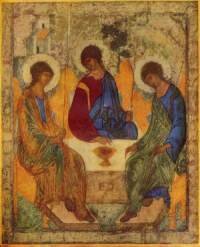
The “ Hospitality of Abraham ” by Andrei Rublev: The three angels represent the three persons of GodChristianity is a monotheistic religion centered on the life, teachings, and actions of Jesus, the Christ, as recounted in the New Testament.

With an estimated 2.1 billion adherents, Christianity is the world's largest religion. Its origins are intertwined with Judaism, with which it shares much sacred text and early history; specifically, it shares the Hebrew Bible, known in the Christian context as the Old Testament. Christianity is considered an Abrahamic religion, along with Judaism.

In the Christian scriptures, the name "Christian" (thus "Christianity") is first attested in Acts 11:25-27:
"25 So Barnabas went to Tarsus to look for Saul, 26 and when he had found him, he brought him to Antioch. For a whole year they met with the church and taught a great many people. And in Antioch the disciples were first called Christians."


More...

Friday, December 05, 2008

The Anointed One

The Anointing of Jesus, by William Hole, 1906The Anointed One refers to The Messiah, Christ the Lord, The Chosen One of God.

To anoint is to grease with perfumed oil, milk, water, melted butter or other substances, a process employed ritually by many religions and races. It also means to be in the presence of God. People and things are anointed to symbolize the introduction of a sacramental or divine influence, a holy emanation, spirit or power. It can also be seen as a spiritual mode of ridding persons and things of dangerous influences and diseases, especially of the demons (Persian drug, Greek κηρες, Armenian dev) which are believed to be or cause those diseases.

Unction is another term for anointing. The oil may be called chrism.

The word is known in English since c. 1303, deriving from Old French enoint "smeared on," pp. of enoindre "smear on," itself from Latin inunguere, from in- "on" + unguere "to smear." Originally it only referred to grease or oil smeared on for medicinal purposes; its use in the Coverdale Bible in reference to Christ (cf. The Lord's Anointed, see Chrism) has spiritualized the sense of it.

More...
 

Subscribe


LifeNews.com

Desiring God Blog

Youth for Christ International