rss rss Follow Jesus
Subscribe

Share/Save/Bookmark

Restore The Republic - The Home of the Freedom Movement!

Tuesday, November 20, 2007

Andrew

St. Andrew by Camillo Rusconi. Nave of the Basilica of St. John Lateran (Rome).Saint Andrew (Greek: Ανδρέας Andreas, "manly"), called in the Orthodox tradition Protocletos, or the First-called, is a Christian Apostle, brother of Simon Peter.

Biography

According to Christian tradition, Andrew was born at Bethsaida on the Sea of Galilee (John 1:44). Since he was a Jew, Andreas was almost certainly not his given name, but no Hebrew or Aramaic name is recorded for him (see also: Aramaic of Jesus). He had been a disciple of John the Baptist (John 1:37-40) and was one of the first to follow Jesus. He lived at Capernaum (Mark 1:29). In the gospels he is referred to as being present on some important occasions as one of the disciples more closely attached to Jesus (Mark 13:3; John 6:8, 12:22); in Acts there is only a bare mention of him (Acts 1:13).

The Kievan hill where St Andrew is said to have erected the cross is commemorated by the cathedral dedicated in his name. Eusebius quotes Origen as saying Andrew preached in Asia Minor and in Scythia, along the Black Sea as far as the Volga. Hence he became a patron saint of Romania and Russia. Traditionally, he became the first bishop of Byzantium in 38, a position which would later become Patriarch of Constantinople.

He is said to have suffered crucifixion at Patras (Patrae) in Achaea, on a cross of the form called Crux decussata (X-shaped cross) and commonly known as "St. Andrew's cross." or saltire. St Andrew is the patron of Patras. According to tradition his relics were removed from Patras to Constantinople, and thence to St Andrews (see below). Local legends say that the relics were sold to the Romans by the local priests in exchange of the Romans constructing a water reservoir for the city. In recent years, the relics were kept in the Vatican City, but were sent back to Patras by decision of the Pope Paul VI in 1964. The relics, which consist of the small finger and part of the top of the cranium of St Andrew, are since kept in the Church of St Andrew at Patras in a special tomb, and are reverenced in a special ceremony every November 30.

More...

Monday, November 19, 2007

Council of Trent

Paolo Farinatis: meeting of the council of Trient, 1563The Council of Trent is reckoned by the Roman Catholic Church to be the Nineteenth Ecumenical Council of the universal church. It was held from December 13, 1545, to December 4, 1563 in the Italian city of Trent. Although called an Ecumenical Council, only Roman Catholics attended. Indeed it was called as a riposte to the growth of Protestantism.

It is considered one of the most important councils in the history of the Roman Catholic Church, establishing church doctrine in response to the Reformation and condemning Protestantism. It clearly specified Catholic doctrines on salvation, the sacraments and the Biblical canon, and standardized the Mass throughout the church, largely abolishing local variations. This became called the "Tridentine Mass", from the city's Latin name Tridentum.

Occasion, sessions, and attendance

In reply to the Papal bull Exsurge Domine of Pope Leo X (1520), Martin Luther had burned the document and appealed to a general council. In 1522, German diets joined in the appeal, and Charles V seconded and pressed it as a means of reunifying the Church and settling the controversy started by the Reformation. Pope Clement VII (1523-1534) was vehemently against the idea of a council, agreeing with Francis I of France. After the deliverances of Pope Pius II in his bull Execrabilis (1460) and his reply to the University of Cologne (1463), setting aside the theory of the supremacy of general councils laid down by the Council of Constance, it was the papal policy to avoid councils.

More...

Saturday, November 17, 2007

Ravi Zacharias

Ravi ZachariasRavi Zacharias (full name Frederick Antony Ravi Kumar Zacharias, born 1946) is an Indian-born, Canadian-American evangelical Christian philosopher, apologist and evangelist. Zacharias is a descendant of two rich religious traditions, first Hindu priests (of the Nambudiri Brahmin caste), and later as Christian ministers. In one of his lectures, Zacharias asserts that a Swiss-German priest spoke to one of his ancestors about Christianity, and thereafter that branch of the family was converted and the family name was changed from Nambudiri to Zacharias. The biography Zacharias offers about himself is that he grew up in a nominally Anglican household, and was an atheist until the age of 17, when he unsuccessfully tried to commit suicide by swallowing poison. According to one of his books (Cries of the Heart), someone instructed his mother to read out the Gospel of John to him as he lay on a hospital bed in Delhi. Following that, he made the decision to become a Christian. He began preaching while still in his teens, and in 1974, shortly before the Khmer Rouge took over Cambodia, he was sent there to minister to the people in the country. He was also sent to Vietnam during the Vietnam War to minister to U.S. soldiers.

Biography

Zacharias was born near Madras, India and grew up in Delhi. In 1966, he and his family emigrated to Toronto; he is currently based outside Atlanta, Georgia. He holds dual U.S. and Canadian citizenship.

He briefly attended the University of Delhi as a pre-med student before transferring to the Institute of Hotel Management in Delhi. After moving to Canada, he worked in the hotel management business before enrolling in the Ontario Bible College in Toronto. Following that, he completed his Master of Divinity degree at the Trinity Evangelical Divinity School near Chicago. He was a visiting scholar at Cambridge University when he wrote his first book, A Shattered Visage: the Real Face of Atheism. Zacharias received honorary Doctor of Divinity degrees from Houghton College, NY, and from Tyndale University College and Seminary (the renamed Ontario Bible College). He also received an honorary Doctor of Laws degree from Asbury College in Kentucky. He is presently a Visiting Professor at Wycliffe Hall, Oxford University in Oxford, England (see also: The Oxford Centre for Christian Apologetics.


More...

Friday, November 16, 2007

Leviathan

“Destruction of Leviathan” 1865 engraving by Gustave Doré.Leviathan (Hebrew: לִוְיָתָן, "Twisted; coiled") was a Biblical sea monster referred to in the Old Testament (Psalm 74:13-14; Job 41; Isaiah 27:1). The word leviathan has become synonymous with any large sea monster or creature. In the novel Moby-Dick it refers to great whales, and in Modern Hebrew, it means simply "whale".

Judaism

The word "Leviathan" appears five places in the Bible, and the Book of Job 41 is dedicated in describing Leviathan in detail.:

  • Book of Job 3:8 "May those who curse days curse that day, those who are ready to rouse Leviathan "; NIV
  • Book of Job 41:1-34: "Canst thou draw out leviathan with an hook? or his tongue with a cord which thou lettest down?...He beholdeth all high things: he is a king over all the children of pride." KJV (quoted 1 and 34 only)
  • Psalms 74:14: "Thou brakest the heads of leviathan in pieces, and gavest him to be meat to the people inhabiting the wilderness." KJV
  • Psalms 104:24,25: "O LORD, how manifold are thy works! in wisdom hast thou made them all: the earth is full of thy riches. So is this great and wide sea, wherein are things creeping innumerable, both small and great beasts." KJV;
  • Isaiah 27:1: "In that day the Lord with his sore and great and strong sword shall punish leviathan the piercing serpent, even leviathan that crooked serpent; and he shall slay the dragon that is in the sea." KJV


More...

Thursday, November 15, 2007

ontological argument

Canterbury Cathedral is the Cathedral of the Anglican Archbishop of Canterbury, the Primate of All England and religious leader of the Church of England. Anselm of Canterbury first proposed the ontological argument in his Proslogion.An ontological argument for the existence of God is one that attempts the method of a priori proof, which utilizes intuition and reason alone. In the context of the Abrahamic religions, it was first proposed by the medieval philosopher Anselm of Canterbury in his Proslogion, and important variations have been developed by philosophers such as:
  • René Descartes,
  • Gottfried Leibniz,
  • Norman Malcolm,
  • Charles Hartshorne,
  • Alvin Plantinga, and
  • Kurt Gödel.
A modal logic version of the argument was devised by mathematician Kurt Gödel. The ontological argument has been a controversial topic in philosophy. Many philosophers, including David Hume, Immanuel Kant, Gottlob Frege, and Gaunilo of Marmoutiers, have openly criticized the argument.

The argument works by examining the concept of God, and arguing that it implies the actual existence of God; that is, if we can conceive of God, then God exists — it is thus self-contradictory to state that God does not exist.

More...

Wednesday, November 14, 2007

Anselmian satisfaction theory

Anselmian satisfaction theory or the satisfaction view of the atonement is a doctrine in Christian theology related to the meaning and effect of the death of Jesus Christ and has been traditionally taught in Catholic, Lutheran, and Reformed circles. Theologically and historically, the word "satisfaction" does not mean gratification as in common usage, but rather "to make restitution": mending what has been broken, paying back what was taken. It is thus connected with the legal concept of balancing out an injustice. Drawing primarily from the works of Anselm of Canterbury, the satisfaction theory teaches that Christ suffered as a substitute on behalf of humankind satisfying the demands of God's honor by his infinite merit. Anselm regarded his satisfaction view of the atonement as a distinct improvement over the older ransom theory of the atonement, which he saw as inadequate. Anselm's theory was a precursor to the refinements of Thomas Aquinas and John Calvin which introduced the idea of punishment to meet the demands of divine justice.

Development of the doctrine

The classic Anselmian formulation of the satisfaction view should be distinguished from penal substitution. Both are forms of satisfaction doctrine in that they speak of how Christ's death was satisfactory, but penal substitution and Anselmian satisfaction both offer different understandings of how Christ's death was satisfactory. Anselm speaks of human sin as defrauding God of the honour he is due. Christ's death, the ultimate act of obedience, brings God great honour. As it was beyond the call of duty for Christ, it is more honour than he was obliged to give. Christ's surplus can therefore repay our deficit. Hence Christ's death is substitutionary; he pays the honour instead of us. Penal substitution differs in that it sees Christ's death not as repaying God for lost honour but rather paying the penalty of death that had always been the moral consequence for sin (e.g., Genesis 2:17; Romans 6:23). The key difference here is that for Anselm, satisfaction is an alternative to punishment, "The honor taken away must be repaid, or punishment must follow." By Christ satisfying our debt of honor to God, we avoid punishment. In Calvinist Penal Substitution, it is the punishment which satisfies the demands of justice.

More...

Tuesday, November 13, 2007

John Duns Scotus

John Duns ScotusJohn Duns Scotus (c. 1266 – November 8, 1308) was a theologian, philosopher, and logician. Some argue that during his tenure at Oxford, the systematic examination of what differentiates Christian theology from philosophy and science began in earnest. He was one of the most influential theologians and philosophers of the High Middle Ages, nicknamed "Doctor Subtilis" for his penetrating manner of thought.

Life

The place of his birth is uncertain. Some scholars claim that he was born in Duns, Borders, Scotland, whilst others claim Ireland. Ordained a priest, in 1291, in Northampton, England, he studied and taught at Paris (1293-1297) and Oxford, and probably at Cambridge as well. He was, however, expelled from the University of Paris for siding with Pope Boniface VIII against Philip the Fair of France. Finally, he came to Cologne, Germany, in 1307.

Duns Scotus is considered one of the most important Franciscan theologians and was the founder of Scotism, a special form of Scholasticism. He came out of the Old Franciscan School, to which Haymo of Faversham (d. 1244), Alexander of Hales (d. 1245), John of Rupella (d. 1245), William of Melitora (d. 1260), St. Bonaventure (d. 1274), Cardinal Matthew of Aquasparta (d. 1289), John Peckham, Archbishop of Canterbury (d. 1292), Richard of Middletown (d. about 1300), etc., belonged. He was known as "Doctor Subtilis" because of his subtle merging of differing views. Later philosophers were not so complimentary about his work, as shown, for instance, by the modern word "dunce", which developed from the name "Dunse" given to his followers in the 1500s.


More...

Monday, November 12, 2007

Epistle to the Hebrews

The Epistle to the Hebrews (abbr. Heb for citations) is a very consciously "literary" document in the New Testament. The purity of its Greek was noted by Clement of Alexandria, according to Eusebius of Caesarea (Historia Eccl., VI, xiv), and Origen asserted that every competent judge must recognize a great difference between this epistle and Paul's (Eusebius, VI, xxv).
The letter has carried its traditional title since Tertullian described it as Barnabae titulus ad Hebraeos in De Pudicitia chapter 20 ("Barnabas's Letter to the Hebrews".)

This letter consists of two strands:


  1. an expositional or doctrinal strand:

    (Hebrews 1:1–14; 2:5–18; 5:1–14; 6:13–9:28; 13:18–25),

  2. an hortatory or ethical strand which punctuates the exposition parenthetically at key points as warnings to the readers:

    (Hebrews 2:1–4; 3:1–4:16; 6:1–12; 10:1–13:17)

Hebrews does not fit the form of a traditional Hellenistic epistle, lacking a proper closing and prescript. Modern scholars generally believe this book was originally a sermon or homily, although possibly modified after it was delivered to include the travel plans, greetings and closing (13:20-25).


More...

Saturday, November 10, 2007

Aleppo Codex

A page from the Aleppo Codex, Deuteronomy.The Aleppo Codex (Hebrew: כֶּתֶר אֲרָם צוֹבָא) was the oldest complete manuscript of the Hebrew Bible according to the Tiberian masorah, produced and edited by the influential masorete Aaron ben Asher. However, approximately one-third of it, including nearly all of the Torah, has been missing since 1947. It is also considered the most authoritative document in the masorah ("transmission"), the tradition by which the Hebrew Scriptures have been preserved from generation to generation. Thus the Aleppo Codex is seen as the most authoritative source document for both the biblical text and its vocalization, cantillation as it has been proven to have been the most faithful to the Masoretic principles.

The Aleppo Codex has a long history of consultation by rabbinic authorities (it is cited in numerous responsa). Modern studies have shown it to be the most accurate representation of Masoretic principles to be found in any extant manuscript, containing very few errors among the millions of orthographic details that make up the Masoretic text.

Authority

The consonants in the Codex were copied by the scribe Shlomo ben Buya'a in Israel circa 920. The text was then verified, vocalized, and provided with Masoretic notes by Aaron ben Asher. Ben-Asher was the last and most prominent member of the Ben-Asher dynasty of grammarians from Tiberias, which shaped the most accurate version of the Masorah and, therefore, the Hebrew Bible.

More...

Friday, November 09, 2007

Ephraim

Ephraim by Francesco Hayez 1842-1844Ephraim (Hebrew: אֶפְרַיִם/אֶפְרָיִם) – "double fruitfulness" ("for God had made him fruitful in the land of his affliction").

Biography

The second son of Joseph, born in Egypt (Gen. 41:52; 46:20). The first incident recorded regarding him is his being placed, along with his brother Manasseh, before their grandfather, Jacob, so that Jacob might bless them (Gen. 48:10; compare Gen 27:1). The intention of Joseph was that the right hand of the aged patriarch should be placed on the head of the elder of the two; but Jacob set Ephraim the younger before his brother, "guiding his hands wittingly." Before Joseph's death, Ephraim's family had reached the third generation (Gen. 50:23).

In the Biblical account, Joseph's other son is Manasseh, and Joseph himself is one of the two children of Rachel and Jacob, the other being Benjamin. Biblical scholars regard it as obvious, from their geographic overlap and their treatment in older passages, that originally Ephraim and Manasseh were considered one tribe - that of Joseph ; according to several biblical scholars, Benjamin was also originally part of this single tribe, but the biblical account of Joseph as his father became lost.

More...

Thursday, November 08, 2007

Christians United for Israel

For Zion’s sake I will not keep silent, for Jerusalem’s sake I will not remain quiet, till her righteousness shines out like the dawn, her salvation like a blazing torch. -Isaiah 62:1Christians United for Israel is an American organization which provides a national association through which every pro-Israel church, parachurch organization, ministry, or individual in America can speak and act with one voice in support of Israel.

In February 2006 Pastor John Hagee decided the time had come to create a national grassroots movement focused on the support of Israel. He called upon Christian leaders from across America to join him in launching this new initiative. Over 400 leaders, each representing a denomination, mega-church, media ministry, publishing company, or Christian university answered the call and Christians United for Israel was born.

Legally incorporated on February 7, 2006, CUFI is focused on communicating the need to defend Israel, in light of their interpretation of the Bible.

CUFI and its July 2006 Summit was instrumental in the founding of Israel Allies Caucus in the United States Congress.

The first college chapter of Christians United for Israel has been established at California State University, Bakersfield. More "CUFI on Campus" chapters on college campuses are hoped to develop.

More...

Wednesday, November 07, 2007

Jehovah

Ex 6.4 displaying Jehovah in 1671 KJVJehovah is an English transcription of יְהֹוָה, which is a specific vocalized spelling of יהוה (i.e. the Tetragrammaton, ) that is found in the Masoretic Text.

יְהֹוָה has the consonants of the Tetragrammaton, and יְהֹוָה 's vowel points are similar to, but not precisely the same as the vowel points found in Adonai. Since the beginning of the 17th century, [or possibly even earlier], scholars have questioned whether the vowel points found in יְהֹוָה are the actual vowel points of God's name. Some scholarly sources teach that יְהֹוָה has the vowel points of אֲדֹנָי [i.e. Adonai], but to be redundant, the vowel points of these two words are not precisely the same, and scholars are not in total agreement as to why יְהֹוָה does not have the precise same vowel points as Adonai has.


The first English translators of יְהֹוָה, believed they had the correct vowel points, and translated it as it was written:

  • "Iehouah" in 1530 A.D. English.
  • "Iehovah" in 1611 A.D. English.
  • "Jehovah" in 1671 A.D. English.
  • "Yehowah" used by some using another transcription of the consonants of the Tetragrammaton


More...

Tuesday, November 06, 2007

Pauline Epistles

Portrait of St. Paul by RembrandtThe Pauline Epistles are as follows:
  • Romans
  • 1 Corinthians
  • 2 Corinthians
  • Galatians
  • Ephesians
  • Philippians
  • Colossians
  • 1 Thessalonians
  • 2 Thessalonians
  • 1 Timothy
  • 2 Timothy
  • Titus
  • Philemon

The Epistle to the Romans

The Epistle to the Romans is one of the letters of the New Testament canon of the Christian Bible. When it is clear that the Bible is being discussed, it is often referred to as simply "Romans". Romans is one of the seven currently (as of 2004) undisputed letters of Paul and even among the four letters accepted as authentically his (in German scholarship, the Hauptbriefe) by F. C. Baur and the Tübingen School of historical criticism of texts in the 19th century.

History

It was probably written at Corinth or possibly in nearby Cenchrea, transcribed by Tertius. Phoebe (Romans 16:1) of Cenchrea, the Aegean port of Corinth, conveyed it to Rome, and Gaius of Corinth entertained the apostle Paul at the time of his writing it (Romans 16:23; 1 Cor 1:14), and Erastus was chamberlain of the city, that is, of Corinth (2 Tim 4:20).

The precise time at which it was written is not mentioned in the epistle, but it was obviously written when the collection for Jerusalem had been assembled and Paul was about to "go unto Jerusalem to minister unto the saints", that is, at the close of his second visit to Greece, during the winter preceding his last visit to that city (Rom. 15:25; cf. Acts 19:21; 20:2, 3, 16; 1 Cor 16:1–4) early in 58.


More...

Monday, November 05, 2007

Heaven

Heaven is an afterlife concept found in many religions or spiritual philosophies.

Those who believe in heaven, especially those of the Judeo-Christian faith, generally hold that it (or Hell) is one of the two possible afterlife destinations of many or all humans. In unusual instances, humans have had, according to many testimonies and traditions, personal knowledge of Heaven. They presume this is for the purpose of teaching the rest of humanity about life, Heaven, and God.


Conceptions


While there are abundant and varied sources for conceptions of Heaven, the typical believer's view appears to depend largely on his particular religious tradition. Various religions have described Heaven as being populated by angels, demons, gods and goddesses, and/or heroes (especially in Greek mythology). Heaven is generally thought of as a place of eternal happiness.


In Western religions, the belief in heaven appears to have supplanted the earlier concept of Sheol (mentioned in Isaiah 38:18, Psalms 6:5 and Job 7:7-10). Jewish converts to this concept of heaven and hell included the group known as the Pharisees. The larger, dogmatically conservative Sadducees maintained their belief in Sheol. While it was the Sadducees that represented the Jewish religious majority it was the Pharisees who best weathered Roman occupation, and their belief in Zoroaster's heaven and hell was passed on to both Christianity and Islam (in which heaven is referred to as Jannah).


More...

Saturday, November 03, 2007

Pelagius

PelagiusPelagius (ca. 354 - ca. 420/440) was an ascetic monk and reformer who denied the doctrine of Original Sin from Adam and was declared a heretic by the Roman Catholic Church. His interpretation of a doctrine of free will became known as Pelagianism. He was well educated, fluent in both Greek and Latin, and learned in theology. He spent time as an ascetic, focusing on practical asceticism, which his teachings clearly reflect. He was not, however, a cleric. He was certainly well known in Rome, both for the harsh asceticism of his public life as well as the power and persuasiveness of his speech. His reputation in Rome earned him praise early in his career even from such pillars of the Church as Augustine of Hippo, who referred to him as a "saintly man." However, he was later accused of lying about his own teachings in order to avoid public condemnation. Most of his later life was spent defending himself against other theologians and the Catholic Church.

Beginnings

Pelagius was born about 354. It is commonly agreed that he was born in the British Isles, but beyond that, his birthplace is not known. He was referred to as a "monk" by his contemporaries, though there is no evidence that he was associated with any monastic order (the idea of monastic communities was still quite new during his lifetime; solitary asceticism was more typical) or that he was ordained to the priesthood. He became better known c. 380 when he moved to Rome to write and teach about his ascetic practices. There, he wrote a number of his major works — "De fide Trinitatis libri III," "Eclogarum ex divinis Scripturis liber primus," and "Commentarii in epistolas S. Pauli," a commentary of Paul's epistles. Unfortunately, most of his work only survives in the quotations of his opponents.


More...

Friday, November 02, 2007

Gehenna

Fallen angels in Hell, John Martin c. 1841Gehenna (or Gehenom or Gehinom), in Jewish eschatology, is a fiery place where the wicked are punished after they die or on Judgment Day. Gehenna also appears in the New Testament and early Christian writing, and appears in Islam as Jahannam.

The word traces to Greek, ultimately from Hebrew: גי(א)-הינום‎ Gêhinnôm (also Guy ben-Hinnom (Hebrew: גיא בן הינום‎) meaning the Valley of Hinnom's son. The valley forms the southern border of ancient Jerusalem and stretches from the foot of Mt. Zion, eastward, to the Kidron Valley. It is first mentioned in Joshua 15:8. Originally it referred to a garbage dump in a deep narrow valley right outside the walls of Jerusalem (in modern-day Israel) where fires were kept burning to consume the refuse and keep down the stench. It is also the location where bodies of executed criminals, or individuals denied a proper burial, would be dumped. In addition, this valley was frequently not controlled by the Jewish authority within the city walls; it is traditionally held that this valley was used as a place of religious child-sacrifice to Moloch by the Canaanites outside the city.


Like Sheol, Gehenna is sometimes translated as Hell.


More...

Thursday, November 01, 2007

Hyksos

Territory of the Hyksos, 1750(?)-1575 A.C.The Hyksos (Egyptian heka khasewet meaning "foreign rulers") were an ethnically mixed group of Southwest Asiatic or Semitic people who appeared in the eastern Nile Delta during the Second Intermediate Period. They rose to power during the Second Intermediate Period, and ruled Lower and Middle Egypt for over one hundred years, forming the Fifteenth and Sixteenth Dynasties of Egypt, (ca. 1674-1548 B.C.E.).

Traditionally, only the six Fifteenth Dynasty rulers are called "Hyksos".

The Hyksos had names that bear strong similarities to Canaanite names, especially those which contain the names of Canaanite deities such as Anath or Ba'al. Archaeologists (see biblical archaeology) think of the Canaanites as being indistinguishable from the Phoenicians. The Hyksos introduced new tools of warfare into Egypt, most notably the composite bow and the horse-drawn chariot.

The numerous Sixteenth Dynasty princes are believed to be a mixed collection of "Hyksos", Asiatic Semites, and local native Egyptian princes. The names of the Fifteenth Dynasty Hyksos are known from Egyptian monuments, scarabs and other small objects, and Manetho's history of Egypt, written during the time of Ptolemy II.

More...

Wednesday, October 31, 2007

Levi

Tribe of Levi, the breastplate worn by the High PriestLevi/Levy (Hebrew: לֵוִי, "joining") was, according to the Book of Genesis, the third son of Jacob and Leah, and the founder of the Israelite Tribe of Levi (the Levites); however Biblical scholars view this as postdiction, an eponymous metaphor providing an Etiology of the connectedness of the tribe to others in the Israelite confederation. Certain religious and political functions were reserved for the Levites, and, according to textual scholars, the early sources of the Torah - the Jahwist and Elohist - appear to treat the term Levi as just being a word meaning priest; scholars suspect that "levi" was originally a general term for a priest, and had no connection to ancestry, and that it was only later, for example in the priestly source and Blessing of Moses, that the existence of a tribe named Levi became assumed, in order to explain the origin of the priestly caste.
The text of the Torah argues that the name of Levi refers to Leah's hope for Jacob to join with her, implying a derivation from yillaweh, meaning he will join, but Biblical scholars have proposed quite different origins of the name.

Many scholars suspect that it simply means priest, either by being a loan word originating from the Minaean word lawi'u, meaning priest, or by referring to those people who were joined to the Ark of the Covenant. Some scholars believe that the Levites were not originally Israelite, instead originating as migrants, and consequently consider the name to refer to the Levites joining with either the Israelites in general, or the earlier Israelite priesthood in particular. It has also been suggested that the term Levi may just be a corruption of the name Leah (or vice versa), or cognate with the word leviathan, whose exact translation remains highly debated.

More...

Tuesday, October 30, 2007

Egyptian hieroglyphs

A section of the Papyrus of Ani showing cursive hieroglyphs.Egyptian hieroglyphs (sometimes called hieroglyphics) were a writing system used by the Ancient Egyptians that contained a combination of logographic and alphabetic elements. Cartouches were also used by the Egyptians. The variety of brush-painted hieroglyphs used on papyrus and (sometimes) on wood for religious literature is known as cursive hieroglyphs; this should not be confused with hieratic.

Etymology

The word hieroglyph comes from the Greek ἱερογλυφικά (hieroglyphiká); the adjective hieroglyphic, as well as related words such as ἱερoγλυφος (hieroglyphos 'one who writes hieroglyphs', from ἱερός (hierós 'sacred') and γλύφειν (glýphein 'to carve' or 'to write', see glyph). Hieroglyphs themselves, were called τὰ ἱερογλυφικά (γράμματα) (tà hieroglyphiká (grámmata), 'engraved characters') on monuments (such as stelae, temples and tombs). The word hieroglyph has come to be used for the individual hieroglyphic characters themselves. While "hieroglyphics" is commonly used, it is discouraged by Egyptologists.

More...

Monday, October 29, 2007

John 3:16

Statue of Nicodemus by Giovanni Angelo Del Maino John 3:16 (chapter 3, verse 16 of the Gospel of John) is one of the most widely quoted verses from the Christian Bible. It has been called the "Bible in a nutshell" because it is considered a summary of some of the most central doctrines of traditional Christianity:
For God so loved the world, that He gave His only begotten Son, that whosoever believeth in Him shall not perish, but have everlasting life. — John 3:16 (KJV)
God "...didn't give Him into the hands of a trustworthy caregiver. He didn't give Him up for adoption by loving parents. He didn't even give Him up for a season only to have Him returned to Him unharmed. When God gave His only begotten Son, He gave Him up to be killed. That's how much God loved the world." -Jeff Miller , Th.M.

Context

The verse occurs in a narrative in the third chapter of John taking place in Jerusalem. Nicodemus, a member of the ruling council, comes to talk with Jesus, whom he calls Rabbi. Jesus' "miraculous signs" have convinced Nicodemus that Jesus is "from God." In reply, Jesus declares, "I tell you the truth, no one can see the kingdom of God unless he is born again" (verses 5–6). John 3:16 summarizes Jesus' lesson to Nicodemus: that belief in Jesus is the path to eternal life. In this passage, Jesus proclaims himself the Messiah and lays out important aspects of Christian theology. This shows a contrast with the Gospel of Mark, for instance, in which Jesus often tries to keep his divinity secret until his final trip to Jerusalem.


More...

Saturday, October 27, 2007

imputation

Diego Velasquez, Christ on the Cross Museo del Prado, Madrid, c. 1632Imputation is a concept in Christian theology which proposes that righteousness of Jesus Christ satisfies all criteria necessary to share in God's grace. Those who trust in the promise that the death of Jesus Christ on the cross atones for their sins believe in this type of righteousness as opposed to imparted righteousness and sanctification. The teaching of imputed righteousness is a signature doctrine of the Lutheran and Reformed traditions of Christianity.

The case for imputed righteousness

Imputed righteousness is the Protestant solution to a "divine predicament." On the one hand, God is infinitely merciful, "not wishing for any to perish, but for all to come to repentance." (2 Peter 3:9). On the other, God is infinitely holy and just, which means that he cannot approve of or even look upon evil (Habakkuk 1:13), neither can he justify a wicked person (Prov. 17:15). Because the Bible describes all men as sinners and says that there are none who are righteous (Rom. 3:23, 10), these two "competing" traits in God's nature appear to put him in a dilemma.

More...

Friday, October 26, 2007

sanctification

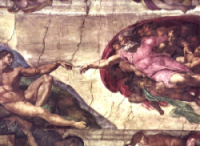
God creates Adam; Sistine Chapel, Michelangelo Buonarroti.Sanctification or in its verb form, sanctify, literally means to set apart for special use or purpose, that is to make holy or sacred (from the Latin verb sanctificare, which in turn derives from sanctus, "holy" and facere, "to make".). The Greek word is hagiasmos (άγιασμος), meaning "holiness, consecration, or sanctification." It comes from the root hagios (άγιος), which means holy or sacred. Sanctification then refers to the state or process of being set apart or made holy. What is often missed, or overlooked, is the relational aspect that is associated with the word sanctification. Only God is truly holy. Everything else, whether it is things or people, is holy only because of its relationship to God.

Definition and descriptions

The concept of sanctification is widespread among religions, but is perhaps more common among the various branches of the Christian religion, especially those of the Protestant-Reformed and Wesleyan-Arminian traditions. The term can be used to refer to objects which are set apart for special purposes (i.e., the Temple vessels), but the most common use within Christian theology is in reference to the change brought about by God in a believer, begun at the point of salvation or justification and continuing throughout the life of the believer. Many forms of Christianity believe that this process will only be completed in Heaven, but some believe that complete holiness is possible in this life on earth--particularly in the final days before the ultimate return of Jesus. Some Protestants denominations call the completion of sanctification "glorification".

More...

Thursday, October 25, 2007

Isaac Watts

Statue of Isaac Watts in Southampton. Isaac Watts (July 17, 1674 – November 25, 1748) is recognised as the "Father of English Hymnody", as he was the first prolific and popular English hymnwriter, credited with some 750 hymns. Many of his hymns remain in active use today and have been translated into many languages.

Life

Born in Southampton, Watts was brought up in the home of a committed Nonconformist — his father had been incarcerated twice for his controversial views. At King Edward VI School (where one of the houses is now named "Watts" in his honour), he learned Latin, Greek and Hebrew and displayed a propensity for rhyme at home, driving his parents to the point of distraction on many occasions with his verse. Once, he had to explain how he came to have his eyes open during prayers.
"A little mouse for want of stairs ran up a rope to say its prayers."

Receiving corporal punishment for this, he cried
"O father, do some pity take And I will no more verses make."

Watts, unable to go to either Oxford or Cambridge due to his Nonconformity, went to the Dissenting Academy at Stoke Newington in 1690.

More...

Wednesday, October 24, 2007

Abrahamic religion

Abrahamic Religions representing about one half of the religions of the worldIn the study of comparative religion, an Abrahamic religion is any of those religions deriving from a common ancient Semitic tradition and traced by their adherents to Abraham ("Father/Leader of many" Hebrew אַבְרָהָם Arabic ابراهيم), a patriarch whose life is narrated in the Hebrew Bible/Old Testament, and as a prophet in the Qur'an. This forms a large group of related, largely monotheistic religions, generally held to include Judaism, Christianity, Islam, and the Bahá'í Faith (based upon Islam), and comprises about half of the world's religious adherents.

According to the Jewish tradition, Abraham was the first person to reject idolatry, hence he symbolically appears as the founder of monotheistic religions. In that sense, Abrahamic religion could be simply equated with monotheistic religion, but not all monotheistic religions are Abrahamic. In Islam he is considered as the first monotheist and is often refered to as Ibrahim al-Hanif or Abraham the Monotheist. The term, desert monotheism, is sometimes used for a similar purpose of comparison in historical contexts, but not for modern faiths.

All the Abrahamic religions are derived to some extent from Judaism as practiced in ancient kingdoms of Israel and Judah prior to the Babylonian Exile, at the beginning of the 1st millennium BCE. Many believe that Judaism in Biblical Israel was renovated and reformed to some extent in the 6th century BCE by Ezra and other priests returning to Israel from the exile. Samaritanism (see: Samaritans) separated from Judaism in the next few centuries.

More...

Tuesday, October 23, 2007

Census of Quirinius

The Virgin and St. Joseph register for the census before Governor Quirinius. Byzantine mosaic c. 1315.The Census of Quirinius refers to the enrollment of the Roman Provinces of Syria and Iudaea for the purpose of taxation taken during the reign of the Roman Emperor Augustus when Publius Sulpicius Quirinius was appointed governor of Syria. An account of the census was given by the historian Josephus, who associated it with the beginning of the Zealot movement. The Gospel of Luke associates the birth of Jesus with this census, but appears to date it a decade earlier. Most scholars regard this as an error, but some have suggested ways of reconciling the two.

This was the first census that took place while Quirinius was governor of Syria. -Luke 2:2

Before becoming too "theologically preoccupied" with the doubts on Luke's accuracy regarding the Census of Quirinius, there are several things to consider...

More...

Recent Comments

Powered by Disqus

Blog Archive

Techledo Consulting

Techledo Consulting, LLC

Prevail Magazine

My Photo
Timothy Ministries
View my complete profile