Thursday, November 08, 2007

Christians United for Israel

For Zion’s sake I will not keep silent, for Jerusalem’s sake I will not remain quiet, till her righteousness shines out like the dawn, her salvation like a blazing torch. -Isaiah 62:1Christians United for Israel is an American organization which provides a national association through which every pro-Israel church, parachurch organization, ministry, or individual in America can speak and act with one voice in support of Israel.

In February 2006 Pastor John Hagee decided the time had come to create a national grassroots movement focused on the support of Israel. He called upon Christian leaders from across America to join him in launching this new initiative. Over 400 leaders, each representing a denomination, mega-church, media ministry, publishing company, or Christian university answered the call and Christians United for Israel was born.

Legally incorporated on February 7, 2006, CUFI is focused on communicating the need to defend Israel, in light of their interpretation of the Bible.

CUFI and its July 2006 Summit was instrumental in the founding of Israel Allies Caucus in the United States Congress.

The first college chapter of Christians United for Israel has been established at California State University, Bakersfield. More "CUFI on Campus" chapters on college campuses are hoped to develop.

More...

Wednesday, November 07, 2007

Jehovah

Ex 6.4 displaying Jehovah in 1671 KJVJehovah is an English transcription of יְהֹוָה, which is a specific vocalized spelling of יהוה (i.e. the Tetragrammaton, ) that is found in the Masoretic Text.

יְהֹוָה has the consonants of the Tetragrammaton, and יְהֹוָה 's vowel points are similar to, but not precisely the same as the vowel points found in Adonai. Since the beginning of the 17th century, [or possibly even earlier], scholars have questioned whether the vowel points found in יְהֹוָה are the actual vowel points of God's name. Some scholarly sources teach that יְהֹוָה has the vowel points of אֲדֹנָי [i.e. Adonai], but to be redundant, the vowel points of these two words are not precisely the same, and scholars are not in total agreement as to why יְהֹוָה does not have the precise same vowel points as Adonai has.


The first English translators of יְהֹוָה, believed they had the correct vowel points, and translated it as it was written:

  • "Iehouah" in 1530 A.D. English.
  • "Iehovah" in 1611 A.D. English.
  • "Jehovah" in 1671 A.D. English.
  • "Yehowah" used by some using another transcription of the consonants of the Tetragrammaton


More...

Tuesday, November 06, 2007

Pauline Epistles

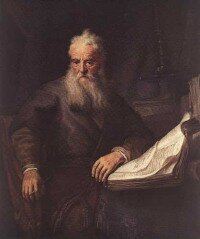
Portrait of St. Paul by RembrandtThe Pauline Epistles are as follows:
  • Romans
  • 1 Corinthians
  • 2 Corinthians
  • Galatians
  • Ephesians
  • Philippians
  • Colossians
  • 1 Thessalonians
  • 2 Thessalonians
  • 1 Timothy
  • 2 Timothy
  • Titus
  • Philemon

The Epistle to the Romans

The Epistle to the Romans is one of the letters of the New Testament canon of the Christian Bible. When it is clear that the Bible is being discussed, it is often referred to as simply "Romans". Romans is one of the seven currently (as of 2004) undisputed letters of Paul and even among the four letters accepted as authentically his (in German scholarship, the Hauptbriefe) by F. C. Baur and the Tübingen School of historical criticism of texts in the 19th century.

History

It was probably written at Corinth or possibly in nearby Cenchrea, transcribed by Tertius. Phoebe (Romans 16:1) of Cenchrea, the Aegean port of Corinth, conveyed it to Rome, and Gaius of Corinth entertained the apostle Paul at the time of his writing it (Romans 16:23; 1 Cor 1:14), and Erastus was chamberlain of the city, that is, of Corinth (2 Tim 4:20).

The precise time at which it was written is not mentioned in the epistle, but it was obviously written when the collection for Jerusalem had been assembled and Paul was about to "go unto Jerusalem to minister unto the saints", that is, at the close of his second visit to Greece, during the winter preceding his last visit to that city (Rom. 15:25; cf. Acts 19:21; 20:2, 3, 16; 1 Cor 16:1–4) early in 58.


More...

Monday, November 05, 2007

Heaven

Heaven is an afterlife concept found in many religions or spiritual philosophies.

Those who believe in heaven, especially those of the Judeo-Christian faith, generally hold that it (or Hell) is one of the two possible afterlife destinations of many or all humans. In unusual instances, humans have had, according to many testimonies and traditions, personal knowledge of Heaven. They presume this is for the purpose of teaching the rest of humanity about life, Heaven, and God.


Conceptions


While there are abundant and varied sources for conceptions of Heaven, the typical believer's view appears to depend largely on his particular religious tradition. Various religions have described Heaven as being populated by angels, demons, gods and goddesses, and/or heroes (especially in Greek mythology). Heaven is generally thought of as a place of eternal happiness.


In Western religions, the belief in heaven appears to have supplanted the earlier concept of Sheol (mentioned in Isaiah 38:18, Psalms 6:5 and Job 7:7-10). Jewish converts to this concept of heaven and hell included the group known as the Pharisees. The larger, dogmatically conservative Sadducees maintained their belief in Sheol. While it was the Sadducees that represented the Jewish religious majority it was the Pharisees who best weathered Roman occupation, and their belief in Zoroaster's heaven and hell was passed on to both Christianity and Islam (in which heaven is referred to as Jannah).


More...

Saturday, November 03, 2007

Pelagius

PelagiusPelagius (ca. 354 - ca. 420/440) was an ascetic monk and reformer who denied the doctrine of Original Sin from Adam and was declared a heretic by the Roman Catholic Church. His interpretation of a doctrine of free will became known as Pelagianism. He was well educated, fluent in both Greek and Latin, and learned in theology. He spent time as an ascetic, focusing on practical asceticism, which his teachings clearly reflect. He was not, however, a cleric. He was certainly well known in Rome, both for the harsh asceticism of his public life as well as the power and persuasiveness of his speech. His reputation in Rome earned him praise early in his career even from such pillars of the Church as Augustine of Hippo, who referred to him as a "saintly man." However, he was later accused of lying about his own teachings in order to avoid public condemnation. Most of his later life was spent defending himself against other theologians and the Catholic Church.

Beginnings

Pelagius was born about 354. It is commonly agreed that he was born in the British Isles, but beyond that, his birthplace is not known. He was referred to as a "monk" by his contemporaries, though there is no evidence that he was associated with any monastic order (the idea of monastic communities was still quite new during his lifetime; solitary asceticism was more typical) or that he was ordained to the priesthood. He became better known c. 380 when he moved to Rome to write and teach about his ascetic practices. There, he wrote a number of his major works — "De fide Trinitatis libri III," "Eclogarum ex divinis Scripturis liber primus," and "Commentarii in epistolas S. Pauli," a commentary of Paul's epistles. Unfortunately, most of his work only survives in the quotations of his opponents.


More...

Friday, November 02, 2007

Gehenna

Fallen angels in Hell, John Martin c. 1841Gehenna (or Gehenom or Gehinom), in Jewish eschatology, is a fiery place where the wicked are punished after they die or on Judgment Day. Gehenna also appears in the New Testament and early Christian writing, and appears in Islam as Jahannam.

The word traces to Greek, ultimately from Hebrew: גי(א)-הינום‎ Gêhinnôm (also Guy ben-Hinnom (Hebrew: גיא בן הינום‎) meaning the Valley of Hinnom's son. The valley forms the southern border of ancient Jerusalem and stretches from the foot of Mt. Zion, eastward, to the Kidron Valley. It is first mentioned in Joshua 15:8. Originally it referred to a garbage dump in a deep narrow valley right outside the walls of Jerusalem (in modern-day Israel) where fires were kept burning to consume the refuse and keep down the stench. It is also the location where bodies of executed criminals, or individuals denied a proper burial, would be dumped. In addition, this valley was frequently not controlled by the Jewish authority within the city walls; it is traditionally held that this valley was used as a place of religious child-sacrifice to Moloch by the Canaanites outside the city.


Like Sheol, Gehenna is sometimes translated as Hell.


More...

Thursday, November 01, 2007

Hyksos

Territory of the Hyksos, 1750(?)-1575 A.C.The Hyksos (Egyptian heka khasewet meaning "foreign rulers") were an ethnically mixed group of Southwest Asiatic or Semitic people who appeared in the eastern Nile Delta during the Second Intermediate Period. They rose to power during the Second Intermediate Period, and ruled Lower and Middle Egypt for over one hundred years, forming the Fifteenth and Sixteenth Dynasties of Egypt, (ca. 1674-1548 B.C.E.).

Traditionally, only the six Fifteenth Dynasty rulers are called "Hyksos".

The Hyksos had names that bear strong similarities to Canaanite names, especially those which contain the names of Canaanite deities such as Anath or Ba'al. Archaeologists (see biblical archaeology) think of the Canaanites as being indistinguishable from the Phoenicians. The Hyksos introduced new tools of warfare into Egypt, most notably the composite bow and the horse-drawn chariot.

The numerous Sixteenth Dynasty princes are believed to be a mixed collection of "Hyksos", Asiatic Semites, and local native Egyptian princes. The names of the Fifteenth Dynasty Hyksos are known from Egyptian monuments, scarabs and other small objects, and Manetho's history of Egypt, written during the time of Ptolemy II.

More...

Wednesday, October 31, 2007

Levi

Tribe of Levi, the breastplate worn by the High PriestLevi/Levy (Hebrew: לֵוִי, "joining") was, according to the Book of Genesis, the third son of Jacob and Leah, and the founder of the Israelite Tribe of Levi (the Levites); however Biblical scholars view this as postdiction, an eponymous metaphor providing an Etiology of the connectedness of the tribe to others in the Israelite confederation. Certain religious and political functions were reserved for the Levites, and, according to textual scholars, the early sources of the Torah - the Jahwist and Elohist - appear to treat the term Levi as just being a word meaning priest; scholars suspect that "levi" was originally a general term for a priest, and had no connection to ancestry, and that it was only later, for example in the priestly source and Blessing of Moses, that the existence of a tribe named Levi became assumed, in order to explain the origin of the priestly caste.
The text of the Torah argues that the name of Levi refers to Leah's hope for Jacob to join with her, implying a derivation from yillaweh, meaning he will join, but Biblical scholars have proposed quite different origins of the name.

Many scholars suspect that it simply means priest, either by being a loan word originating from the Minaean word lawi'u, meaning priest, or by referring to those people who were joined to the Ark of the Covenant. Some scholars believe that the Levites were not originally Israelite, instead originating as migrants, and consequently consider the name to refer to the Levites joining with either the Israelites in general, or the earlier Israelite priesthood in particular. It has also been suggested that the term Levi may just be a corruption of the name Leah (or vice versa), or cognate with the word leviathan, whose exact translation remains highly debated.

More...

Tuesday, October 30, 2007

Egyptian hieroglyphs

A section of the Papyrus of Ani showing cursive hieroglyphs.Egyptian hieroglyphs (sometimes called hieroglyphics) were a writing system used by the Ancient Egyptians that contained a combination of logographic and alphabetic elements. Cartouches were also used by the Egyptians. The variety of brush-painted hieroglyphs used on papyrus and (sometimes) on wood for religious literature is known as cursive hieroglyphs; this should not be confused with hieratic.

Etymology

The word hieroglyph comes from the Greek ἱερογλυφικά (hieroglyphiká); the adjective hieroglyphic, as well as related words such as ἱερoγλυφος (hieroglyphos 'one who writes hieroglyphs', from ἱερός (hierós 'sacred') and γλύφειν (glýphein 'to carve' or 'to write', see glyph). Hieroglyphs themselves, were called τὰ ἱερογλυφικά (γράμματα) (tà hieroglyphiká (grámmata), 'engraved characters') on monuments (such as stelae, temples and tombs). The word hieroglyph has come to be used for the individual hieroglyphic characters themselves. While "hieroglyphics" is commonly used, it is discouraged by Egyptologists.

More...

Monday, October 29, 2007

John 3:16

Statue of Nicodemus by Giovanni Angelo Del Maino John 3:16 (chapter 3, verse 16 of the Gospel of John) is one of the most widely quoted verses from the Christian Bible. It has been called the "Bible in a nutshell" because it is considered a summary of some of the most central doctrines of traditional Christianity:
For God so loved the world, that He gave His only begotten Son, that whosoever believeth in Him shall not perish, but have everlasting life. — John 3:16 (KJV)
God "...didn't give Him into the hands of a trustworthy caregiver. He didn't give Him up for adoption by loving parents. He didn't even give Him up for a season only to have Him returned to Him unharmed. When God gave His only begotten Son, He gave Him up to be killed. That's how much God loved the world." -Jeff Miller , Th.M.

Context

The verse occurs in a narrative in the third chapter of John taking place in Jerusalem. Nicodemus, a member of the ruling council, comes to talk with Jesus, whom he calls Rabbi. Jesus' "miraculous signs" have convinced Nicodemus that Jesus is "from God." In reply, Jesus declares, "I tell you the truth, no one can see the kingdom of God unless he is born again" (verses 5–6). John 3:16 summarizes Jesus' lesson to Nicodemus: that belief in Jesus is the path to eternal life. In this passage, Jesus proclaims himself the Messiah and lays out important aspects of Christian theology. This shows a contrast with the Gospel of Mark, for instance, in which Jesus often tries to keep his divinity secret until his final trip to Jerusalem.


More...

Saturday, October 27, 2007

imputation

Diego Velasquez, Christ on the Cross Museo del Prado, Madrid, c. 1632Imputation is a concept in Christian theology which proposes that righteousness of Jesus Christ satisfies all criteria necessary to share in God's grace. Those who trust in the promise that the death of Jesus Christ on the cross atones for their sins believe in this type of righteousness as opposed to imparted righteousness and sanctification. The teaching of imputed righteousness is a signature doctrine of the Lutheran and Reformed traditions of Christianity.

The case for imputed righteousness

Imputed righteousness is the Protestant solution to a "divine predicament." On the one hand, God is infinitely merciful, "not wishing for any to perish, but for all to come to repentance." (2 Peter 3:9). On the other, God is infinitely holy and just, which means that he cannot approve of or even look upon evil (Habakkuk 1:13), neither can he justify a wicked person (Prov. 17:15). Because the Bible describes all men as sinners and says that there are none who are righteous (Rom. 3:23, 10), these two "competing" traits in God's nature appear to put him in a dilemma.

More...

Friday, October 26, 2007

sanctification

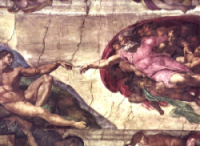
God creates Adam; Sistine Chapel, Michelangelo Buonarroti.Sanctification or in its verb form, sanctify, literally means to set apart for special use or purpose, that is to make holy or sacred (from the Latin verb sanctificare, which in turn derives from sanctus, "holy" and facere, "to make".). The Greek word is hagiasmos (άγιασμος), meaning "holiness, consecration, or sanctification." It comes from the root hagios (άγιος), which means holy or sacred. Sanctification then refers to the state or process of being set apart or made holy. What is often missed, or overlooked, is the relational aspect that is associated with the word sanctification. Only God is truly holy. Everything else, whether it is things or people, is holy only because of its relationship to God.

Definition and descriptions

The concept of sanctification is widespread among religions, but is perhaps more common among the various branches of the Christian religion, especially those of the Protestant-Reformed and Wesleyan-Arminian traditions. The term can be used to refer to objects which are set apart for special purposes (i.e., the Temple vessels), but the most common use within Christian theology is in reference to the change brought about by God in a believer, begun at the point of salvation or justification and continuing throughout the life of the believer. Many forms of Christianity believe that this process will only be completed in Heaven, but some believe that complete holiness is possible in this life on earth--particularly in the final days before the ultimate return of Jesus. Some Protestants denominations call the completion of sanctification "glorification".

More...

Thursday, October 25, 2007

Isaac Watts

Statue of Isaac Watts in Southampton. Isaac Watts (July 17, 1674 – November 25, 1748) is recognised as the "Father of English Hymnody", as he was the first prolific and popular English hymnwriter, credited with some 750 hymns. Many of his hymns remain in active use today and have been translated into many languages.

Life

Born in Southampton, Watts was brought up in the home of a committed Nonconformist — his father had been incarcerated twice for his controversial views. At King Edward VI School (where one of the houses is now named "Watts" in his honour), he learned Latin, Greek and Hebrew and displayed a propensity for rhyme at home, driving his parents to the point of distraction on many occasions with his verse. Once, he had to explain how he came to have his eyes open during prayers.
"A little mouse for want of stairs ran up a rope to say its prayers."

Receiving corporal punishment for this, he cried
"O father, do some pity take And I will no more verses make."

Watts, unable to go to either Oxford or Cambridge due to his Nonconformity, went to the Dissenting Academy at Stoke Newington in 1690.

More...

Wednesday, October 24, 2007

Abrahamic religion

Abrahamic Religions representing about one half of the religions of the worldIn the study of comparative religion, an Abrahamic religion is any of those religions deriving from a common ancient Semitic tradition and traced by their adherents to Abraham ("Father/Leader of many" Hebrew אַבְרָהָם Arabic ابراهيم), a patriarch whose life is narrated in the Hebrew Bible/Old Testament, and as a prophet in the Qur'an. This forms a large group of related, largely monotheistic religions, generally held to include Judaism, Christianity, Islam, and the Bahá'í Faith (based upon Islam), and comprises about half of the world's religious adherents.

According to the Jewish tradition, Abraham was the first person to reject idolatry, hence he symbolically appears as the founder of monotheistic religions. In that sense, Abrahamic religion could be simply equated with monotheistic religion, but not all monotheistic religions are Abrahamic. In Islam he is considered as the first monotheist and is often refered to as Ibrahim al-Hanif or Abraham the Monotheist. The term, desert monotheism, is sometimes used for a similar purpose of comparison in historical contexts, but not for modern faiths.

All the Abrahamic religions are derived to some extent from Judaism as practiced in ancient kingdoms of Israel and Judah prior to the Babylonian Exile, at the beginning of the 1st millennium BCE. Many believe that Judaism in Biblical Israel was renovated and reformed to some extent in the 6th century BCE by Ezra and other priests returning to Israel from the exile. Samaritanism (see: Samaritans) separated from Judaism in the next few centuries.

More...

Tuesday, October 23, 2007

Census of Quirinius

The Virgin and St. Joseph register for the census before Governor Quirinius. Byzantine mosaic c. 1315.The Census of Quirinius refers to the enrollment of the Roman Provinces of Syria and Iudaea for the purpose of taxation taken during the reign of the Roman Emperor Augustus when Publius Sulpicius Quirinius was appointed governor of Syria. An account of the census was given by the historian Josephus, who associated it with the beginning of the Zealot movement. The Gospel of Luke associates the birth of Jesus with this census, but appears to date it a decade earlier. Most scholars regard this as an error, but some have suggested ways of reconciling the two.

This was the first census that took place while Quirinius was governor of Syria. -Luke 2:2

Before becoming too "theologically preoccupied" with the doubts on Luke's accuracy regarding the Census of Quirinius, there are several things to consider...

More...

Saturday, October 20, 2007

justification

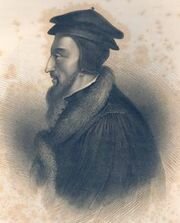
Engraved from the original oil painting in the University Library of Geneva, this is considered the best likeness of John Calvin.In Christian theology, justification is God's act making a sinner righteous before Him by His grace, received through the faith given to the person by God, for Christ's sake, because of his life, death, and resurrection. Because the meaning of the term is subject to dispute among Christians, simple definitions should be taken with a grain of salt.

"Night and day I pondered until I saw the connection between the justice of God and the statement that 'the just shall live by his faith.' Then I grasped that the justice of God is that righteousness by which through grace and sheer mercy God justifies us through faith. Thereupon I felt myself to be reborn and to have gone through open doors into paradise. " -Martin Luther
Considerable sectarian controversy exists as to its nature and definition. These controversies include:


  • Whether justification is an ongoing process in addition to an immediate change in the person or if it is a change in a person's state before God followed by Sanctification;

  • The relationship between justification and religious law; whether justification is merely "forensic", a legal declaration that a sinner is now righteous before God for Christ's sake, or more;

  • The relationship of justification to sanctification, the process whereby sinners become more righteous and are enabled by the Holy Spirit to live lives more pleasing to God; and

  • The relationship of justification to atonement, the expiation of sins.

More...

Friday, October 19, 2007

Tribes of Israel

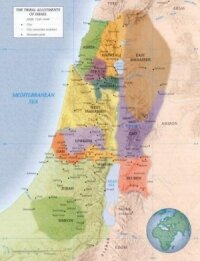
Map of the twelve tribes of IsraelIsrael had 12 sons, as follows: Reuben, Simeon, Levi, Judah, Dan, Naphtali, Gad, Asher, Issachar, Zebulun, Joseph, and Benjamin (Jacob was renamed Israel Gen. 32:27-29)The Tribe of Levi was set apart from the others in the sense that, the members of the Tribe of Levi were to be in charge of the tabernacle of the Testimony. (see: Num. 1).

The Tribe of Joseph is not usually listed with the Hebrew tribes although Joseph is one of Jacobs twelve sons, the eldest of Rachel. It is sometimes referred to as the House of Joseph. Rather, the two tribes founded by his sons Ephraim and Manasseh are listed separately.

Tribal Divisions

Politically, the Israelites were composed of thirteen tribes: Reuben, Simeon, Levi, Judah, Dan, Naphtali, Gad, Asher, Issachar, Zebulun, Manasseh, Ephraim, and Benjamin. In parts of the Bible, Ephraim and Manasseh are treated as together constituting the House of Joseph, while the Levi have a special religious role and had only scattered cities as territory; whence traditionally either Ephraim and Manasseh were counted as one tribe, or Levi wasn't counted, so that together the tribes were the Twelve Tribes of Israel.

The division into Tribes was geographical, as well as genealogical; each tribe held a distinct territory, though there are a few peculiarities. Levi's territory was very discontinuous, consisting entirely of towns and cities scattered as enclaves within the territory of the other tribes, Simeon's territory was entirely inside the territory of Judah, and Manasseh was split between the half tribe west of the Jordan, and the other half tribe on the eastern side. The Kingdom of Judah consisted of Judah, Simeon, Benjamin, and the parts of Levi within those lands, while the Kingdom of Israel contained Reuben, Dan, Naphtali, Gad, Asher, Issachar, Zebulun, Manasseh, Ephraim, and the remainder of Levi.

More...

Thursday, October 18, 2007

Founders of modern science

Earthrise over the Moon, Apollo 8, NASA. This image helped create awareness of the finiteness of Earth, and the limits of its natural resources.Science (from the Latin scientia, 'knowledge') is a system of acquiring knowledge based on the scientific method, as well as the organized body of knowledge gained through such research. Science as defined here is sometimes termed pure science to differentiate it from applied science, which is the application of scientific research to specific human needs.

The renewal of learning in Europe, that began with 12th century Scholasticism, came to an end about the time of the Black Death, and the initial period of the subsequent Italian Renaissance is sometimes seen as a lull in scientific activity. The Northern Renaissance, on the other hand, showed a decisive shift in focus from Aristoteleian natural philosophy to chemistry and the biological sciences (botany, anatomy, and medicine).

Thus modern science in Europe was resumed in a period of great upheaval: the Protestant Reformation and Catholic Counter-Reformation; the discovery of the Americas by Christopher Columbus; the Fall of Constantinople; but also the re-discovery of Aristotle during the Scholastic period presaged large social and political changes. Thus, a suitable environment was created in which it became possible to question scientific doctrine, in much the same way that Martin Luther and John Calvin questioned religious doctrine. The works of Ptolemy (astronomy), Galen (medicine), and Aristotle (physics) were found not always to match everyday observations. For example, an arrow flying through the air after leaving a bow contradicts Aristotle's laws of motion, which say that a moving object must be constantly under influence of an external force, as the natural state of earthly objects is to be at rest. Work by Vesalius on human cadavers also found problems with the Galenic view of anatomy.

More...

Wednesday, October 17, 2007

YHVH

YHVH, the name of God  or Tetragrammaton, in Phoenician (1100 BC to AD 300), Aramaic (10th Century BC to 0)and modern Hebrew scripts.The convenant name of God. It means "I AM WHO I AM."

Also Yahweh: a name for the God of the Old Testament as transliterated from the Hebrew consonants YHVH (Yod)(Heh)(Vav)(Heh), it is the distinctive personal name of the God of Abraham, Isaac and Jacob.

This is the same name ("I AM") that Jesus used when the high priest asked if He was the Christ (Mark 14:61-62).

Of all the names of God, the one which occurs most frequently is the Tetragrammaton, appearing 6,823 times, according to the Jewish Encyclopedia. The Biblia Hebraica and Biblia Hebraica Stuttgartensia texts of the Hebrew Scriptures each contain the Tetragrammaton 6,828 times.

In Judaism, the Tetragrammaton is the ineffable name of God, and is therefore not to be read aloud. In the reading aloud of the scripture or in prayer, it is replaced with Adonai (Lord). Other written forms such as:

י (yod) ו (vav) (YW or Yaw); or י (yod) ה (heh) (YH or Yah)
are read in the same way.

More...

Tuesday, October 16, 2007

Psalms

Psalm 1 in a form of the Sternhold and Hopkins version widespread in Anglican usage before the English Civil War (1628 printing). It was from this version that the armies sang before going into battle <br />Psalms (from the Greek: Psalmoi) (originally meaning "songs sung to a harp", from psallein "play on a stringed instrument", Ψαλμοί; Hebrew: Tehilim, תהילים) is a book of the Hebrew Bible, Tanakh or Old Testament.

In the Hebrew Bible, the Psalms are counted among the "Writings" or Ketuvim (one of the three main sections into which the books are grouped).


The Book of Psalms, especially if printed separately and set for singing or chanting, is also called the Psalter.

Composition of the Book of Psalms


The Book of Psalms is divided into 150 Psalms, each of which constitutes a religious song or chant, though one or two are atypically long and may constitute a set of related chants. When the Bible was divided into chapters, each Psalm was assigned its own chapter. Psalms are sometimes referenced as chapters, despite that chapter assignments postdate the initial composition of the "canonical" Psalms by at least 1,500 years.

The organization and numbering of the Psalms differs slightly between the (Masoretic) Hebrew and the (Septuagint) Greek manuscripts


More...


Subscribe


LifeNews.com

Desiring God Blog

Youth for Christ International