Wednesday, November 29, 2006

history of South Africa

Satellite image of Cape peninsula, Courtesy of NASAThe written history of South Africa begins with the arrival of the first European explorers to the region. The Portuguese, the first Europeans to see South Africa, chose not to colonise it, and instead the Dutch set up a supply depot on the Cape of Good Hope. This depot rapidly developed into the Cape Colony. The British seized the Cape Colony from the Dutch in the end of the 18th century, and the Cape Colony became a British colony. The ever-expanding number of European settlers prompted fights with the natives over the rights to land and farming, which caused numerous fatalities on both sides. Hostilities also emerged between the Dutch and the British, and many Dutch people trekked into the central Highveld in order to establish their own colonies. The Dutch (by then known as Boers) and the British went to war twice in the Anglo-Boer Wars, which ended in the defeat of the Boers and of their independent republics.

The Cape Colony, Natal and the two Boer republics unified in 1910 as the Union of South Africa.


More...

Caesarea Philippi

The Banias WaterfallCaesarea Philippi "Caesarea of Philip" was founded by Philip the Tetrarch, son of Herod the Great. The city is also known as the modern dwindling city of Banias, Paneas (Greek), Panias( Arabic) is located in the upper Jordan Valley along the southwestern slopes of Mt. Hermon in the disputed Golan Heights (claimed by Israel and Syria, currently under control of Israel). The site is 95 miles north of Jerusalem and 35 miles southwest from Damascus about 1,150 feet above sea level. The location is strategic, guarding the plains in the area. It was called Paneas by the Greeks because of its cavern, which had a peculiar similarity to the places dedicated to the worship of the god Pan.

The city was called Caesarea Philippi by the Romans.
The city was built near the Banyas spring (Banias Waterfall above), one of the sources of the Jordan River.

More...

Tuesday, November 28, 2006

Narnia

The Land of Narnia, artwork from the 2005 movieNarnia is a fantasy world created by C. S. Lewis as a location for his Chronicles of Narnia, a series of seven fantasy novels for children.

In Narnia, some animals can talk, mythical beasts abound, and magic is common. The series tracks the story of Narnia from its creation to its end, and especially the stories of those humans, usually children, who enter the land from 'our world'.

Geography
The name "Narnia" refers to not only the Narnian world, but especially to the country of Narnia within it, which its creator, Aslan the great lion, filled with talking animals and mythical creatures. C.S.Lewis may have got the name from the Italian town of Narni, whose latin name was in fact Narnia. Narnia is a land of rolling hills rising into low mountains to the south, and is predominantly forested except for marshlands in the north. The country is bordered on the east by the Eastern Ocean, on the west by a great mountain range, on the north by the River Shribble, and on the south by a continental divide.

More...

Monday, November 27, 2006

Dispensationalism

The Horsemen of the Apocalypse, the entities that bring false peace, War, famine, pestilence, and death.Dispensationalism is a branch of Christian theology that
  1. teaches Biblical history as best understood in light of a number of successive economies or administrations under God, which it calls "dispensations," and
  2. emphasizes prophecy of the end-times and the pre-tribulation rapture view of Christ's second coming.

Dispensation is an English term excogitated from the Latin dispensatio, frequently used to translate the Greek oikonomia. The Greek word denotes the law or management of a household (to manage, administer, regulate, or plan).


Some consider Dispensationalism to be a nineteenth century distortion of Biblical history. Dispensationalists teach that there are seven distinct "dispensations" within biblical history. The seventh being the 1000 year reign of Christ or the millennium. According to some, the primary error is the "two covenant" teaching. Dispensationalists believe that God's covenant with Israel continues even through the present "church age." Many Protestants believe that the new covenant in Christ replaces the old covenant with Israel.

As a branch of Christian theology, Dispensationalism teaches biblical history as a number of successive economies or administrations, called dispensations, each of which emphasizes the continuity of the Old Testament covenants God made with His chosen people through Abraham, Moses and King David.

More...

Saturday, November 25, 2006

Isaac

The angel hinders the offering up of Isaac, by RembrandtIsaac (Yitschak or Yitzhak) (יִצְחָק "He will laugh") is the son and heir of Abraham and the father of Jacob and Esau as described in the Hebrew Bible. His story is told in the Book of Genesis (Genesis 25:29-34).

Isaac was named because when his mother, Sarah, overheard that she would bear a child in her old age, she laughed (Genesis 18:10-15, 21:6-7). Some commentators believe that in the Book of Amos there is some suggestion that Israel may actually be another name for Isaac (Amos 7:9, 16) despite the Bible stating that Israel is the later name given to Isaac's son Jacob (Genesis 32:22-28, especially 28).


Isaac was born to Abraham by his wife Sarah, and the only child they had together. He was the longest lived of the three patriarchs (Genesis 21:1-3). Isaac was circumcised by his father when eight days old (Genesis 4-7); and a great feast was held in connection with his being weaned.

The next memorable event in his life is that connected with the story of God testing Abraham by asking him to offer Isaac as a sacrifice on a mountain (Mount Moriah) in the land of Moriah (Genesis 22, current location of The Temple Mount).

More...

Friday, November 24, 2006

Covenant

Rainbow by bluemist57, Adelaide, AustraliaCovenant, meaning a solemn contract, is the customary word used to translate the Hebrew word berith (ברית) as it is used in the Hebrew Bible.

God's promise to Israel in both the Old Testament and the New Testament that He would redeem the nation of Israel, give Israel the land of Zion, and "appear in his glory" and "come out of Zion" when "all Israel shall be saved" (cf. Psalm
102:15-18, Romans 11:25-27).


While the word is used to identify treaties or similar contracts between rulers or individuals, the primary covenants mentioned in the Bible are the one between God and the Israelites (Old Testament) and the one between God and the Christian Church (New Testament).

This covenant was the basis for the Torah, and the claimed status of the Israelites as God's "chosen people." According to the terms of the covenant, Israelites understand that God had promised to undertake certain things on behalf of the people of Israel, and that the Israelites owed God obedience and worship in return.

More...

Thursday, November 23, 2006

Shekhinah

Moses and Shekhinah Glory (the burning bush)Shekhinah (שכינה - alternative transliterations Shekinah, Shechinah, Shekina, Shechina, Schechinah) is the English spelling of a feminine Hebrew language word that means the dwelling or settling, and is used to denote the dwelling or settling presence of God, especially in the Temple in Jerusalem.

Etymology
Shechinah is derived from the Hebrew verb 'sakan' or 'shachan'.

In Biblical Hebrew the word means literally to settle, inhabit, or dwell, and is used frequently in the Hebrew Bible. (See Genesis 9:27, 14:13, Psalms 37:3, Jeremiah 33:16), as well as the weekly Shabbat blessing recited in the Temple in Jerusalem ("May He who causes His name to dwell [shochan] in this House, cause to dwell among you love and brotherliness, peace and friendship"). In Mishnaic Hebrew the word is often used to refer to bird's nesting and nests. ("Every bird nests [shechinot] with its kind, and man with its like, Talmud Baba Kammah 92b.) and can also mean "neighbor" ("If a neighbor and a scholar, the scholar is preferred" Talmud Ketubot 85b). The word "Shechinah" also means "royalty" or "royal residence" ( The Greek word 'skene' - dwelling - is thought to be derived from 'shekinah' and 'sakan'. The word for Tabernacle, mishcan, is a derivative of the same root and is also used in the sense of dwelling-place in the Bible, e.g. Psalm 132:5 ("Before I find a place for God, mishcanot (dwelling-places) for the Strong One of Israel.") Accordingly, in classic Jewish thought, the Shekhina refers to a dwelling or settling in a special sense, a dwelling or settling of divine presence, to the effect that, while in proximity to the Shekhinah, the connection to God is more readily perceivable.

More...

Wednesday, November 22, 2006

Judas Iscariot

Judas returns the silver coins to the priestsJudas Iscariot (died April AD 29–33) was, according to the New Testament, one of the twelve original apostles of Jesus, and the one who is said to have betrayed him.

Traditional Christian views

Biblical narrative
Mark also states that the chief priests were looking for a "sly" way to arrest Jesus. They determine not to do so during the feast because they were afraid that the people would riot. It is after the feast that they do end up arresting him.

According to the account given in the gospels, he carried the disciples' money box and betrayed Jesus for a bribe of "thirty pieces of silver" by identifying him with a kiss—the "kiss of Judas"— to arresting soldiers of the High Priest Caiphas, who then turned Jesus over to Pontius Pilate's soldiers. These "pieces of silver" were most likely intended to be understood as silver Tyrian shekels.


More...

Tuesday, November 21, 2006

Christian worldview

Christian WorldviewChristian worldview refers to a collection of distinctively Christian philosophical and religious beliefs. The term is typically used in one of three ways:
  1. A set of worldviews voiced by those identifying themselves as Christian;
  2. Common elements of worldviews predominant among those identifying themselves as Christian;
  3. The concept of a single "Christian worldview" on a range of issues.

There are some rather startling statistics, based upon the following definition of "worldview," including a firm belief in six specific religious views.

  1. Jesus Christ lived a sinless life;
  2. God is the all-powerful and all-knowing Creator of the universe and He stills rules it today;
  3. salvation is a gift from God and cannot be earned;
  4. Satan is real;
  5. a Christian has a responsibility to share their faith in Christ with other people;
  6. and the Bible is accurate in all of its teachings.

Based upon the above definition, Barna and other polling organizations have observered a decline in Christian beliefs. A recent study indicates that only 4% of American adults have a biblical worldview as the basis of their decision-making -- while at the same time "spirituality" has been on the rise. This most recent study revealed the following percentages of church goers who adhere to a biblical worldview:

  • Protestants -- 7%
  • Those in mainline denominations -- 2%
  • Catholics -- less than 1/2 of 1%
  • Baptists - 8%
  • Pentecostals -- 10%
  • Non-denominational - 13%

More...

Monday, November 20, 2006

Samaria

Israel in New Testament times, 1st Century A.D., Samaria left centerSamaria, or Shomron (Hebrew: שֹׁמְרוֹן) is a term used for the mountainous northern part of the area on the west bank of the Jordan River. The word is perhaps from shâmar, 'to watch,' hence meaning something like 'outlook'; but, according to 1 Kings 16:24, derived from the individual [or clan] Shemer, from whom Omri purchased the site.

Samaria is one of the several standard statistical "areas" utilized by the Central Bureau of Statistics of the State of Israel. "The CBS also collects statistics on Judea-Samaria and the Gaza District. It has produced various basic statistical series on the territories, dealing with population, employment, wages, external trade, national accounts, and various other topics." Samaria is used by people who want to emphasize Israel's and the Jewish people's relationship with their land. For example, Samaria, along with Judea, is now more widely known, outside of Israel, by the neologism "West Bank."

According to Paul, the last words of Jesus before His ascension included Samaria:

6So when they met together, they asked him, "Lord, are you at this time going to restore the kingdom to Israel?" 7He said to them: "It is not for you to know the times or dates the Father has set by his own authority. 8But you will receive power when the Holy Spirit comes on you; and you will be my witnesses in Jerusalem, and in all Judea and Samaria, and to the ends of the earth." 9After he said this, he was taken up before their very eyes, and a cloud hid him from their sight. -Acts 1:6-9
More...

Friday, November 17, 2006

Capernaum

Ruins of the synagogue at CapernaumCapernaum (pronounced k-pûrn-m; Hebrew כפר נחום Kefar Nachum, "Nahum's hamlet") was a settlement on the shore of the Sea of Galilee. The site is a ruin today, but was inhabited from 150 BC to about AD 750.

The town is mentioned in the New Testament: in the Gospel of Luke it was reported to have been the home of the apostles Peter, Andrew, James and John, as well as the tax collector Matthew.

In Matthew 4:13 the town was reported to have been the home of Jesus himself. According to Luke, Jesus taught in the synagogue in Capernaum, and a building which may have been a synagogue of that period has been found beneath the remains of a later synagogue.

More...

Rylands Library Papyrus P52

John Rylands Library Papyrus P52, rectoThe Rylands Library Papyrus P52, also known as the St John's fragment, is a papyrus conserved at the John Rylands Library, Manchester, UK. The front (recto) contains lines from the Gospel of John 18:31-33, in Greek, and the back (verso) contains lines from verses 37-38.

Although Rylands P52 is generally accepted as the earliest extant New Testament canonical record, the dating of the papyrus is by no means the subject of consensus among critical scholars. The style of the script is strongly Hadrian, which would suggest a date somewhere between 125 and 160 CE. But the difficulty of fixing the date of a fragment based solely on paleographic evidence allows for a range of dates that extends from before 100 CE to well into the second half of the 2nd century.

The original translation of the work was not done until 1934 by C.H. Roberts, who published the essay “An Unpublished Fragment of the Fourth Gospel in the John Rylands Library” in the Bulletin of the John Rylands Library XX, 1936, pp 45-55. Roberts found comparator hands in papyri then dated between 50 CE and 150 CE, with the closest match of Hadrianic date.

More...

Thursday, November 16, 2006

salvation

Two Trinities, Bartolomé Estéban Murillo (1618 - 1682)Salvation refers to deliverance from an undesirable state or condition. In theology, the study of salvation is called soteriology and is a vitally important concept in several religions. Christianity regards salvation as deliverance from the bondage of sin and from condemnation, resulting in eternal life with God.

Christian views of salvation
Salvation is arguably one of the most important Christian spiritual concepts, perhaps second only to the deity of Jesus Christ, the son of God.

Among many Christians, the primary goal of religion is to attain salvation. Others maintain that the primary goal of Christians is to do the will of God, or that the two are equivalent. In many traditions, attaining salvation is synonymous with going to heaven after death, while most also emphasize that salvation represents a changed life while on Earth as well. Many elements of Christian theology explain why salvation is needed and how to attain it.

More...

Wednesday, November 15, 2006

eschatology

Four Horsemen of the Apocalypse, by Albrecht Dürer.Eschatology (eschatos: "final" or "last" + (logos): "word") is a part of theology and philosophy concerned with the final events in the history of the world, (death and judgment, heaven and hell, the end of the world) or the ultimate destiny of human kind, commonly phrased as the end of the world. In many religions, the end of the world is a future event prophesied in sacred texts or folklore. More broadly, eschatology may encompass related concepts such as the Messiah or Messianic Age, the afterlife, and the soul.

As the time of Jesus' own death neared, this is what He said to His disciples to offer them comfort:

1"Do not let your hearts be troubled. Trust in God; trust also in me. 2In my Father's house are many rooms; if it were not so, I would have told you. I am going there to prepare a place for you. 3And if I go and prepare a place for you, I will come back and take you to be with me that you also may be where I am. 4You know the way to the place where I am going."


5Thomas said to him, "Lord, we don't know where you are going, so how can we know the way?" 6Jesus answered, "I am the way and the truth and the life. No one comes to the Father except through me. -John 14:1-6 (NIV)


In verse 6, Jesus is telling not only His disciples but He is telling the world that, He is the way to heaven; that there is no other way to share eternity with God.

Most Western monotheistic religions have doctrines claiming that "chosen" or "worthy" members of the one true faith will be "spared" or "delivered" from the coming judgment and wrath of God. They will be ushered into paradise either before, during, or after it depending upon the end-time scenario to which they hold.

More...

Tuesday, November 14, 2006

Christian Music

A Dove.  Click to read more...Christian music is music created by or adapted for the Christian church. It also includes Contemporary Christian music, in which the music explores Christian themes but is designed to be played in places other than churches. Music during service for many churches is a big part of the worship. Hymns are sung, psalms are vocalized and spiritual songs are uplifted to praise God. Sometimes, musical instruments are played while singing is implemented in the service. On the other hand, some times churches use just a cappella to worship God. At times, just musical instruments are only used to express praise towards God. All of these ways are used by one church or another in this period of time.

Being Jewish, Jesus and his disciples would most likely have sung the psalms from memory. However, without a centralised music industry, the repertoire of ordinary people was much greater than it is today, so they probably knew other songs too. Early Christians continued to sing the psalms much as they were sung in the synagogues in the first century.

More...

Monday, November 13, 2006

Jesus

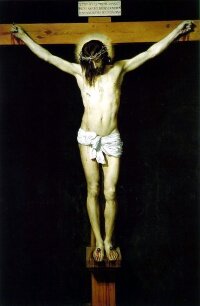
the crucifixion of Jesus as portrayed by Diego VelázquezThe name of Jesus, meaning "Savior" in Christian usage, derived from the Aramaic and Hebrew Yeshua and Joshua, meaning Yahweh is salvation. Jesus is the incarnate Son of God, the second person of the Trinity, and the prophesied Hebrew Messiah (Anointed One, deliverer of Israel). Also known as "Jesus Christ", "Jesus of Nazareth", and "Jesus the Nazarene".

Christian views of Jesus (known as Christology) are both diverse and complex. Most Christians are Trinitarian and affirm the Nicene Creed, believing that Jesus is both the Son of God and God made incarnate, sent to provide salvation and reconciliation with God by atoning for the sins of humanity.

Other Christians, however, do not believe that the Nicene Creed correctly interprets Scripture.


More...

Saturday, November 11, 2006

The Temple Mount

Dome of the Rock, The Temple MountThe Temple Mount (Hebrew: הַר הַבַּיִת (without niqqud: הר הבית) or Noble Sanctuary (Arabic: الحرم الشريف) is a hotly contested religious site in the Old City of Jerusalem. It was the site of the first and second Jewish Temple in Jerusalem and according to Judaism is to be the site of the third and final Temple in the time of the Messiah. It is also the site of two major Muslim religious shrines, the Dome of the Rock and Al-Aqsa Mosque, built in the 7th century.

It is the holiest site in Judaism, the third holiest site in Islam, and has special significance to Christianity. It is thus one of the most contested religious sites in the world.

More...

Thursday, November 09, 2006

Reductionism

Pablo Picasso. The Lovers. 1923. Oil on canvas. The National Gallery of Art, Washington, DC, USAReductionism in philosophy describes a number of related, contentious theories that hold, very roughly, that the nature of complex things can always be reduced to (explained by) simpler or more fundamental things. This is said of objects, phenomena, explanations, theories, and meanings.

Roughly, this means that chemistry is based on physics, biology is based on chemistry, psychology and sociology are based on biology. The first two of these reductions are commonly accepted but the last step is controversial and therefore the frontier of reductionism: evolutionary psychology and sociobiology versus those who claim that such special sciences are inherently irreducible. Reductionists believe that the behavioral sciences should become a "genuine" scientific discipline by being based exclusively on genetic biology.

In this painting by the Spanish artist Pablo Picasso (1881-1973), titled "The Lovers," painted in 1923, we see that the two figures are rendered realistically and that they have the appearance of being a loving couple. But the hands and the faces have been innately simplified and are presented as simple lines rather than circumspectly imitated models.


More...

Wednesday, November 08, 2006

Sumer

Sumer, Akkad and Elam Sumer (or Shumer, Egyptian Sangar, biblical Shinar, native ki-en-gir, (from Ki = Earth, En = (title) usually translated as Lord, Gir = (cultured) usually translated as Civilised, thus "the land of the civilised lords") was an ancient civilization located in the southern part of Mesopotamia (modern day southeastern Iraq) from the time of the earliest records in the mid 4th millennium BC until the rise of Babylonia in the late 3rd millennium BC. The term "Sumerian" applies to all speakers of the Sumerian language. Sumer is considered the first settled society in the world to have manifested all the features needed to qualify fully as a "civilization".

Background
The term "Sumerian" is an exonym first applied by the Akkadians. The Sumerians called themselves "the black-headed people" (sag-gi-ga) and their land "land of the civilized lords" (ki-en-gir). The Akkadian word Shumer possibly represents this name in dialect. The Sumerians were a non-Semitic people and were at one time believed to have been invaders, as a number of linguists believed they could detect a substrate language beneath Sumerian. However, the archaeological record shows clear uninterrupted cultural continuity from the time of the Early Ubaid period (5200-4500 BC C-14, 6090-5429 calBC) settlements in southern Mesopotamia. The Sumerian people who settled here farmed the lands in this region that were made fertile by silt deposited by the Tigris and the Euphrates rivers.

More...

Ur

Ur seen across the Royal tombs, with the Great Ziggurat in the background, January 17, 2004Ur was an ancient city in southern Mesopotamia, located near the original mouth of the Euphrates and Tigris rivers on the Persian Gulf and close to Eridu. Because of marine regression, the remains are now well inland in present-day Iraq, south of the Euphrates on its right bank , and named Tell el-Mukayyar, near the city of Nasiriyah south of Baghdad.

6Abram believed the LORD, and he credited it to him as righteousness. 7He also said to him, "I am the LORD, who brought you out of Ur of the Chaldeans to give you this land to take possession of it." 8But Abram said, "O Sovereign LORD, how can I know that I will gain possession of it?"
-Genesis 15:6-8

The site is marked by the ruins of a ziggurat (right), still largely intact, and by a settlement mound. The ziggurat is a temple of Nanna, the moon deity in Sumerian mythology. It has has two stages constructed from brick: in the lower stage the bricks are joined together with bitumen, in the upper stage they are joined with mortar. Ur at its height had around 30,000 residents.

More...


Subscribe


LifeNews.com

Desiring God Blog

Youth for Christ International