Friday, June 18, 2010

Religious Pluralism

Religious pluralism (rel. comparative religion) is a loosely defined term concerning peaceful relations between different religions, and is also used in a number of related ways:
  • As a synonym for religious relativism; that one's religion is not the sole and exclusive source of truth, and that some level of truth and value exists in at least some other religions. As a synonym for ecumenism. At a minimum, ecumenism is the promotion of unity, co-operation, or improved understanding between different denominations within the same religion, or sometimes between different religions. The latter is sometimes called Macro-ecumenism.
  • As a synonym for religious tolerance, which is a condition of harmonious co-existence between adherents of different religions or religious denominations.
  • Pluralism as the belief that more than one religion can teach truths
  • In its strongest sense, religious pluralism holds that no single religion can claim absolute authority to teach absolute truth. The word of God is not literal religion. On the contrary, religion attempts to describe God's utterances. Given the finite and fallible nature of human beings, no religious text written by Man can absolutely describe God, God's will, or God's counsel, since it is God apart from Man who reveals the divine thoughts, intentions and volition perfectly.
"Just as microsurgery proves more effective than the amputation of a limb, there are better ways to deal with religious pluralism than removing religion from public life. In short, there are good reasons to question whether secularism is the enlightened path to living together." Hunter Baker's The End of Secularism (pg 23).
Religious pluralists point out that nearly all religious texts are a combination of an assortment of human observations documented, for example, as historical narratives, poetry, lections, and morality plays. Accordingly, a distinction exists between what may be claimed as literal in a religious text and what may be metaphorical. The text, therefore, is open to interpretation. In this light, no religion is able to comprehensively capture and communicate all truth. Although all religions attempt to capture reality, their attempts occur within particular cultural and historical contexts that affect the writer's viewpoint.

Believers in religious pluralism, in this sense, hold that their own, self-made syncretistic belief system is "true". In other words, their religion is the most complete and accurate interpretation of the divine, though they also accept that other religions teach many truths about the nature of God and man, and that it is possible to establish a significant amount of common ground across all belief systems.

Dr N. T. Wright Bishop of Durham, in his lecture titled, Paul in Different Perspectives has this to say regarding religious pluralism:


More...

Thursday, June 17, 2010

Cave of Machpelah

The Cave of Machpelah (a.k.a. Cave of the Patriarchs) is considered to be the spiritual center of the ancient city of Hebron . It lies in the southwest part of the West Bank, in the heart of ancient Judea.

In Hebrew it is called Me'arat HaMakhpela (Hebrew: מערת המכפלה, Me'arat HaMachpela, Trans. "Cave of the Double Tombs"; Arabic: المغارة‎ Al Magharah, "the Cave") because according to Jewish tradition its hidden twin caves are the burial place of four Biblical couples:

    According to Midrashic sources, it also contains the head of Esau.
  • Adam and Eve
  • Abraham and Sarah;
  • Isaac and Rebekah;
  • Jacob and Leah.


More...
Wednesday, June 16, 2010

Horatio Gates Spafford

Horatio Gates Spafford (October 20, 1828, Troy, New York - October 16, 1888, Jerusalem) was a prominent American lawyer, best known for penning the Christian hymn It Is Well With My Soul, following a family tragedy in which four of his daughters died.

Life

On September 5, 1861, in Chicago, he married Anna Larsen, of Stavanger, Norway.

On October 8, 1871, the Great Chicago Fire swept through the city. Horatio was a prominent lawyer in Chicago, and had invested heavily in the city's real estate, and the fire destroyed almost everything he owned.

The wreck of the Ville Du Havre

Two years later, in 1873, Spafford decided his family should take a holiday somewhere in Europe, and chose England knowing that his friend D. L. Moody would be preaching there in the fall. Delayed because of business, he sent ahead of him his family: his wife and their four children, daughters Anna “Annie” (born June 11, 1862), Margaret Lee “Maggie” (born May 31, 1864), Elizabeth “Bessie” (born June 19, 1868), and Tanetta (born July 24, 1871).

More...

Monday, June 14, 2010

Antiochus IV Epiphanes

Antiochus IV Epiphanes (Greek: Αντίοχος Επιφανής, "The Shining One") (ca. 215–164 BC) ruled the Hellenistic Seleucid Empire from 175 BC until his death.

He was a son of Antiochus III the Great and brother of Seleucus IV Philopator. He was originally named Mithradates, but renamed Antiochus, either upon his ascension, or after the death of his elder brother Antiochus. Notable events during his reign include the near-conquest of Egypt, which was halted by the threat of Roman intervention, and the beginning of the Jewish revolt of the Maccabees.

Antiochus took power after the death of Seleucus Philopator. He had been hostage in Rome following the Treaty of Apamea in 188 BC, but had recently been exchanged for the son and rightful heir of Seleucus IV, the later Demetrius I Soter. Antiochus took advantage of this situation, and proclaimed himself co-regent with another of Seleucus' sons, the infant Antiochus, whose murder he orchestrated a few years later.

More...

Sunday, June 13, 2010

Chuck Colson

Charles (Chuck) Wendell Colson (born October 16, 1931, in Boston, Massachusetts) was the chief counsel for President Richard Nixon from 1969 to 1973 and while he was commonly named as one of the Watergate Seven, he was never charged with, or prosecuted, for any crime related to the Watergate break-in or its cover-up. After extensively investigating Colson's activities relating to Watergate, Special Prosecutor Leon Jaworski attempted to make a deal with Colson in which Colson would agree to plead guilty to a misdemeanor charge relating to Watergate, in exchange for which Jaworski agreed to recommend that he not be sentenced to prison. Colson felt doing so would be pleading guilty to a crime he did not commit. Instead, Colson counter-offered. Colson told Jaworski that he would agree to plead guilty to the crime of obstruction of justice, not in relation to Watergate, but in relation to the planning of the break-in at the office of Daniel Elsberg's psychiatrist. This was a crime of which Jaworski had no knowledge. Colson insisted also that Jaworski would not be constrained to recommend no prison time. At the sentencing, Judge Sirica sentenced Colson to the maximum prison term permitted under federal law.

Colson's later life has been spent working with his non-profit organization devoted to prison ministry called Prison Fellowship. Colson is also a public speaker and author. He is founder and chairman of the Wilberforce Forum, which is the "Christian worldview thinking, teaching, and advocacy arm of" Prison Fellowship, and includes Colson's daily radio broadcast, BreakPoint, now heard on a thousand outlets. The ministry conducts justice reform efforts through Justice Fellowship.

More...

Thursday, June 10, 2010

Shi‘ite Islam

Shī‘a Islam, also Shi‘ite Islam or Shi‘ism (Arabic شيعة šīʿa), is the second largest denomination of the Islamic faith after Sunni Islam. Shias adhere to the teachings of Muhammad and the religious guidance of his family (who are referred to as the Ahl al-Bayt) or his descendents known as Shi'a Imams. Muhammad's bloodline continues only through his beloved daughter Fatima Zahra and cousin Ali which alongside the prophet's grandsons are the Ahl al-Bayt. Thus, Shi'as consider Muhammad's descendents as the true source of guidance while considering the first three ruling Sunni Caliph (the head of state in a Caliphate) a historic occurrence and not something attached to faith. The singular/adjective form is šīʿī (شيعي.) and refers to a follower of the faction of Imam Ali according to the Shia ideology.

Shia Islam, like Sunni Islam, has at times been divided into many branches; however, only three of these currently have a significant number of followers. The best known and the one with most adherents is the Twelvers (اثنا عشرية iṯnāʿašariyya) which have a large percentage in Iran 90% and Iraq (see also: Iraq Maps); the others are Ismaili, Sevener, and Zaidiyyah. Alawites and Druzes consider themselves Shias, although this is sometimes disputed by mainstream Shias. The Sufi orders among the Shias are the Alevi, Bektashi, Kubrawiya, Noorbakhshi, Oveyssi, Qizilbashi, Hamadani and Fatimid orders and denominations. Twenty percent of Turkey's population is Alevi while Lebanon and Syria have a large presence of Druze and Alawites.

More...

Tuesday, June 08, 2010

El Shaddai

El Shaddai (Hebrew: אל שדי) is one of the Judaic names of God.

The name Shaddai (Hebrew: שַׁדַּי), which occurs both independently and in combination with El, is used as a name of God chiefly in the Book of Job. According to Exodus 6:2, 3, this is the name by which God was known to Abraham, Isaac, and Jacob. In the Septuagint and other early translation it was translated with words meaning 'Almighty'.

The root word "shadad" (שדד) means "to overpower" or "to destroy". This would give Shaddai the meaning of "destroyer" as one of the aspects of God. Compare to "Shiva," the destroyer in the Hindu trinity, "creator, preserver, destroyer".

Another theory is that 'Shaddai' is a derivation of a Semitic stem that appears in the Akkadian shadû, 'mountain', and shaddā`û or shaddû`a, 'mountain-dweller'. This theory was popularized by W. F. Albright but was somewhat weakened when it was noticed that the doubling of the medial d is first documented only in the Neo-Assyrian period. However, the doubling in Hebrew might possibly be secondary. In this theory God is seen as inhabiting a mythical holy mountain: a concept not unknown in ancient near eastern mythology, and also evident in the Syriac Christian writings of Ephrem the Syrian, who places Eden on an inaccessible mountaintop.

More...

Monday, June 07, 2010

caliphate

The term caliphate (from the Arabic خلافة or khilāfa, khilafah) refers to the first system of governance established in Islam, and represented the political authority and unity of the Muslim Ummah. It was initially led by Muhammad's disciples as a continuation of the political authority the prophet established, known as the 'Rashidun Caliphate'. It represented the political unity of the Muslim Ummah, not the theological unity as this was a personal matter, and was the world's first major welfare state. A "caliphate" is also a state which implements such a government.

Sunni Islam dictates that the head of state, the caliph, should be selected by Shura - elected by Muslims or their representatives. Followers of Shia Islam believe the caliph should be an imam descended in a line from the Ahl al-Bayt. After the Rashidun period until 1924, caliphates, sometimes two at a single time, real and illusory, were ruled by dynasties. The first dynasty was the Umayyad. This was followed by the Abbasid, the Fatimid, and finally the Ottoman Dynasty.

The caliphate was "the core political concept of Sunni Islam, by the consensus of the Muslim majority in the early centuries."

More...

Sunday, June 06, 2010

Mount Ararat

Mount Ararat is the tallest peak in modern Turkey. This snow-capped, dormant volcanic cone is located in the Ağrı Province, near the northeast corner of Turkey, 16 km west of the Iranian and 32 km south of the Armenian borders.

During the time of Noah, this mountain was completely covered with water:
17 The flood continued forty days on the earth. The waters increased and bore up the ark, and it rose high above the earth. 18 The waters prevailed and increased greatly on the earth, and the ark floated on the face of the waters. 19 And the waters prevailed so mightily on the earth that all the high mountains under the whole heaven were covered. 20 The waters prevailed above the mountains, covering them fifteen cubits deep. (Genesis 7:17-20 ESV)
During the time of Sennacherib, was the son of Sargon II, whom he succeeded on the throne of Assyria (705 BC–681 BC), Adrammelech and Sharezer, his sons, struck him down with the sword and escaped into the land of Ararat. (cf. 2 Kings 19:36-37. The same story is mentioned in Isaiah 37:38).

More...

Saturday, June 05, 2010

Islam and anti-semitism

Islam and anti-semitism relates to Islamic theological teaching against Jews and Judaism and the treatment of Jews in Muslim countries.

With the origin of Islam in the 7th century AD and its rapid spread in the Arabian peninsula and beyond, Jews (and many other peoples) came to be subject to the rule of Muslim rulers. The quality of the rule varied considerably in different periods, as did the attitudes of the rulers, government officials, clergy and general population to various subject peoples from time to time, which was reflected in their treatment of these subjects. Reuven Firestone notes that, negative assessments and even condemnation of prior religions and their adherents occur in all three scriptures of Judaism, Christianity, and Islam. This article looks at the Muslim attitude to, and treatment of, Jews in Islamic thought and societies throughout history, and explores the ramifications of these attitudes in the contemporary world.

The nature and extent of anti-semitism in Islam and the Muslim world are hotly-debated issues among students of the Middle East and Islam. However the use of the word anti-semitism in the context of Islam is somewhat inaccurate in etymological terms, since Islam and Arabic, its language, is essentially semitic itself. The more appropriate term to describe this phenomena would be "anti-judaism".

More...

Thursday, June 03, 2010

Ezekiel

The book of Ezekiel is a book of the Jewish Hebrew bible as well as the Christian Old Testament, attributed to the prophet Ezekiel (Hebrew:יחזקאל, Yeheskel or Yehezkel).

Biography of Ezekiel

The Book of Ezekiel gives little detail about Ezekiel's life. In it, he is mentioned only twice by name: 1:3 and 24:24. Ezekiel is a priest, the son of Buzi (my contempt), and his name means "God will strengthen". He was one of the Israelite exiles, who settled at a place called Tel-abib, on the banks of the Chebar, "in the land of the Chaldean dynasty." The place is thus not identical to the modern city Tel Aviv-Yafo, which is, however, named after it. He was probably carried away captive with Jeconiah (a.k.a Jehoiachin) (2 Kings 24:14-16) about 597 BC.

13 Thus says the Lord GOD: "This is the boundary by which you shall divide the land for inheritance among the twelve tribes of Israel. Joseph shall have two portions. 14 And you shall divide equally what I swore to give to your fathers. This land shall fall to you as your inheritance.

15 "This shall be the boundary of the land: On the north side, from the Great Sea by way of Hethlon to Lebo-hamath, and on to Zedad, 16 Berothah, Sibraim (which lies on the border between Damascus and Hamath), as far as Hazer-hatticon, which is on the border of Hauran. 17 So the boundary shall run from the sea to Hazar-enan, which is on the northern border of Damascus, with the border of Hamath to the north. This shall be the north side.

18 "On the east side, the boundary shall run between Hauran and Damascus; along the Jordan between Gilead and the land of Israel; to the eastern sea and as far as Tamar. This shall be the east side.

19 "On the south side, it shall run from Tamar as far as the waters of Meribah-kadesh, from there along the Brook of Egypt to the Great Sea. This shall be the south side.

20 "On the west side, the Great Sea shall be the boundary to a point opposite Lebo-hamath. This shall be the west side. –Ezekiel 47:13-20 (ESV)

More...

Wednesday, June 02, 2010

Shahid

Shahid (Arabic: شَهيد ‎ šahīd, plural: شُهَداء šuhadā', also romanized as shaheed) is an Arabic word meaning "witness". It is a religious term in Islam, literally meaning "witness", but practically means a "martyr." It is used as a honorific for Muslims who have laid down their life fulfilling a religious commandment, or waging war (jihad) for Islam.

The Arabic word 'shahid', meaning one who is present as a witness, is translated into English as martyr. Through its usage in the Qur'an and through the manner in which it has been employed in early Islamic history, shahid has come to mean one who bears witness to the truth. This definition sets the ground rules for deciding who qualifies as a martyr and who does not. To attain the status of a martyr it is necessary to die or be slain in the course of defending and upholding the principles of the Qur'an, so martyrdom became valid only under certain specific circumstances.

The term suicide attack is misleading. In the eyes of the attacker and his community this phenomenon has nothing to do with committing suicide … Committing suicide is forbidden in Islam but instead, he is seen as a shahid—a martyr who fell in the process of fulfilling the religious commandment of jihad."

More...

Tuesday, June 01, 2010

West Bank

The West Bank (Hebrew: הגדה המערבית‎), also referred to in Israel and by Jews as "Judea and Samaria", is a landlocked territory on the west bank of the Jordan River in the Middle East. To the west, north, and south the West Bank shares borders with the mainland Israel. To the east, across the Jordan River, lies the country of Jordan. The West Bank also contains a significant coast line along the western bank of the Dead Sea. Since 1967 most of the West Bank has been under Israeli military occupation.

Prior to the First World War, the area now known as the West Bank was under Ottoman rule as part of the province of Syria. In the 1920 San Remo conference, the victorious Allied powers allocated the area to the British Mandate of Palestine. The 1948 Arab-Israeli War saw the establishment of Israel in parts of the former Mandate, while the West Bank was captured and annexed by Jordan, who destroyed any existing Jewish villages. The 1949 Armistice Agreements defined its interim boundary. From 1948 until 1967, the area was under Jordanian rule, and Jordan did not officially relinquish its claim to the area until 1988. Jordan's claim was never recognized by the international community.

The West Bank was captured by Israel during the Six-Day War. With the exception of East Jerusalem, the West Bank was not annexed by Israel. Most of the residents are Arabs, although a large number of Israeli settlements have been built in the region since 1967.

More...

Monday, May 31, 2010

Hamas

Hamas (حماس Ḥamās, an acronym of حركة المقاومة الاسلامية Ḥarakat al-Muqāwamat al-Islāmiyyah, meaning "Islamic Resistance Movement") is a Palestinian Sunni Islamist militant organization and political party which holds a majority of seats in the elected legislative council of the Palestinian National Authority.

The Islamic Resistance Movement is one of the wings of Muslim Brotherhood in Palestine. Muslim Brotherhood Movement is a universal organization which constitutes the largest Islamic movement in modern times. It is characterized by its deep understanding, accurate comprehension and its complete embrace of all Islamic concepts of all aspects of life, culture, creed, politics, economics, education, society, justice and judgment, the spreading of Islam, education, art, information, science of the occult and conversion to Islam.

Hamas was created in 1987 by Sheikh Ahmed Yassin, Abdel Aziz al-Rantissi and Mohammad Taha of the Palestinian wing of the Muslim Brotherhood at the beginning of the First Intifada.

More...

Thursday, May 27, 2010

The Gaza Strip

The Gaza Strip is a narrow coastal strip of land along the Mediterranean, in the Middle East. It takes its name from Gaza, its main city, and has about 1.4 million residents, all Palestinians, in an area of 360 km².

The Gaza Strip is not currently recognized internationally as a de jure part of any sovereign country. According to the international community the Gaza Strip is occupied by Israel. The Israeli government disputes this, especially after the withdrawal of Israel and the liquidation of its settlements in the strip in 2005.

The main city, Gaza, is mentioned at least 22 times in the bible.

More...

Wednesday, May 26, 2010

Council on American-Islamic Relations (CAIR)

The Council on American-Islamic Relations (CAIR) a "non-profit, grassroots membership organization" that deals with civil advocacy and promotes human rights. It is headquartered on Capitol Hill in Washington, D.C., with regional offices nationwide and in Canada.

Through media relations, lobbying, and education, CAIR presents what it views as an Islamic perspective on issues of importance to the American public, and seeks to empower the American Muslim community and encourage its social and political activism. Annual banquets, through which CAIR raises the majority of its funds, are attended by American politicians, statesmen, interfaith leaders, activists and media personalities.

Mission and offices


CAIR's mission statement is "to enhance understanding of Islam, encourage dialogue, protect civil liberties, empower American Muslims, and build coalitions that promote justice and mutual understanding"

CAIR’s literature describes the group as promoting understanding of Islam and protecting Muslim civil liberties. It has intervened on behalf of many American Muslims who claim discrimination, profiling, or harassment. Its stated core principles include supporting freedom of religion, protecting all Americans' civil rights, and encouraging inter-faith dialogue. CAIR believes that "the active practice of Islam strengthens the social and religious fabric of our nation."

However, a closer look at the practice CAIR claims to promote reveals a different reality. Daniel Pipes and Sharon Chadha give us a view of that different reality in a Middle East Quarterly article titled, "CAIR: Islamists Fooling the Establishment"

More...

Tuesday, May 25, 2010

Ministry of Jesus

According to the Gospels, the Ministry of Jesus began when Jesus was around 30 years old, and lasted a period of 1-3 years. In the Biblical narrative, Jesus' method of teaching involved parables, metaphor, allegory, sayings, proverbs, and a small number of direct sermons. This was the first coming of Jesus, most Christian denominations believe in a Second Coming when Jesus will return to the earth to fulfill aspects of Messianic prophecy, such as the general resurrection of the dead, last judgment of the dead and the living and the full establishment of the Kingdom of God on earth (also called the "Reign of God"), including the Messianic Age.

The start of Jesus' ministry

From Nazareth to Capernaum
Some time after having rejected Satan's temptation, Jesus is described as leaving Nazareth. While Matthew doesn't explain why Jesus did this, both he and Mark mention that John the Baptist was arrested by Herod Antipas at this time. Luke gives a different circumstance, stating that Jesus left when the people of Nazareth rejected him. The texts don't recount what occurred between Jesus being tempted and John being arrested, but Jones believes that some months likely elapsed, with Jesus frequently being seen as a disciple of John the Baptist, until this was no longer possible (due to John being arrested). France argues that it was the flight from Nazareth which resulted in Jesus carrying out a ministry based on itinerant preaching, which France sees as being quite different to the ministry which John the Baptist had carried out.

More...

Monday, May 24, 2010

Gog and Magog

The tradition of Gog and Magog begins with cryptic Biblical references regarding apocalyptic prophecy in the Book of Ezekiel. The ambiguity of this tradition cannot be overstated. The very nature of these entities differs greatly in the discourse according to the places and times of the sources. They are variously presented as human beings, supernatural beings (giants or demons), nations, or as lands. Part of the confusion is the difference between the Tanakh and Septuagint (BHS p.967) and internal contradictions in the text.

References to Gog and Magog appear in the Book of Revelation, in the Qur'an as Yajooj-Majooj (Arabic يأجوج و مأجوج, Yecüc-Mecüc in the Turkish spelling) and occur widely in mythology and folklore.

The Biblical Gog and Magog

Magog in Genesis

The first occurrence of "Magog" in the Bible is in the "Table of Nations" in Genesis 10, where Magog is the eponymous ancestor of a people or nation (without any accompanying apocalyptic symbolism, or mention of Gog):

2. The sons of Japheth were Gomer, Magog, Madai, Javan, Tubal, Meshech, and Tiras
3. The sons of Gomer were Ashkenaz, Riphath, and Togarmah. (Genesis 10:2-3)

In this occurrence Magog is clearly the name of a person, although in the anthropology proposed by Genesis, ethnic groups and nations are founded by, and usually named after, their founding ancestors. The names of Gomer, Tubal, Meshech, and Togarmah also occur in Ezekiel.

More...

Sunday, May 23, 2010

The Council for Secular Humanism

The Council for Secular Humanism (originally the Council for Democratic and Secular Humanism, or CODESH) is a secular humanist organization headquartered in Amherst, New York. In 1980 CODESH issued A Secular Humanist Declaration, an argument for and statement of belief in Democratic Secular Humanism. The Council for Secular Humanism does not call itself religious and has never claimed tax-exemption as a religious organization; instead it has an educational exemption.

The council acts as an umbrella organization for a number of other groups, such as the Committee for the Scientific Examination of Religion, Secular Organizations for Sobriety, African Americans for Humanism, and provides support for Center for Inquiry - On Campus. It also publishes several magazines and newsletters, including Free Inquiry. The council was founded by Dr. Paul Kurtz, who also founded CSICOP (now known as the Committee for Skeptical Inquiry) and the Center for Inquiry.

The council is a member organisation of the International Humanist and Ethical Union, and endorses both the IHEU minimum statement of Humanism (ref bylaw 5.1) and the Amsterdam Declaration 2002).

The Council for Secular Humanism with the Committee for the Scientific Investigation of Claims of the Paranormal (CSICOP) and The Commission for Scientific Medicine and Mental Health are all headquartered at the Center for Inquiry, adjacent to the State University of New York.

More...

Saturday, May 22, 2010

The Jeremiah Wright controversy

The Jeremiah Wright controversy is an American political issue that gained national attention in March 2008 when ABC News, after reviewing dozens of U.S. 2008 Presidential Election candidate Barack Obama's pastor Jeremiah Wright's sermons, excerpted parts which were subject to intense media scrutiny. Wright is a retired senior pastor of Trinity United Church of Christ in Chicago and former pastor of President of the United States Barack Obama. Obama denounced the statements in question, but after critics continued to press the issue of his relationship with Wright he gave a speech titled "A More Perfect Union," in which he sought to place Dr. Wright's comments in a historical and sociological context. In the speech, Obama again denounced Wright's remarks, but did not disown him as a person. The controversy began to fade, but was renewed in late April when Wright made a series of media appearances, including an interview on Bill Moyers Journal, a speech at the NAACP and a speech at the National Press Club. After the last of these, Obama spoke more forcefully against his former pastor, saying that he was "outraged" and "saddened" by his behavior, and in May he resigned his membership in the church.

More...

Thursday, May 20, 2010

Egyptian hieroglyphs

Egyptian hieroglyphs (sometimes called hieroglyphics) were a writing system used by the Ancient Egyptians that contained a combination of logographic and alphabetic elements. Cartouches were also used by the Egyptians. The variety of brush-painted hieroglyphs used on papyrus and (sometimes) on wood for religious literature is known as cursive hieroglyphs; this should not be confused with hieratic.

Etymology

The word hieroglyph comes from the Greek ἱερογλυφικά (hieroglyphiká); the adjective hieroglyphic, as well as related words such as ἱερoγλυφος (hieroglyphos 'one who writes hieroglyphs', from ἱερός (hierós 'sacred') and γλύφειν (glýphein 'to carve' or 'to write'). Hieroglyphs themselves, were called τὰ ἱερογλυφικά (γράμματα) (tà hieroglyphiká (grámmata), 'engraved characters') on monuments (such as stelae, temples and tombs). The word hieroglyph has come to be used for the individual hieroglyphic characters themselves. While "hieroglyphics" is commonly used, it is discouraged by Egyptologists.

More...

Wednesday, May 19, 2010

Unconditional love

Unconditional love is a term that means to love someone regardless of his actions or beliefs. It is a concept comparable to true love, a term which is more frequently used to describe love between lovers. By contrast, unconditional love is frequently used to describe love between family members, comrades in arms and between others in highly committed relationships. It has also been used in a religious context to describe God's love for humankind through the forgiveness of Christ. However, this can be seen as contradictory in some cases where God's "unconditional" love is predicated upon the believer's fulfillment of one or more criteria. But this love is not solely based on those met expectations.

More...

Tuesday, May 18, 2010

Radical Islam

Radical Islam or "Islamism" is a term with definitions that sometimes vary. Leading Islamist thinkers emphasized the desire to apply many aspects of sharia (Islamic law) to modern society; of pan-Islamic political unity; and of the elimination of non-Muslim, particularly western, military, economic, political, social, or cultural influences in the Muslim world, which they believe to be incompatible with Islam.

Some observers suggest Islamism's tenets are less strict and can be defined as a form of identity politics or "support for [Muslim] identity, authenticity, broader regionalism, revivalism, [and] revitalization of the community". Still others define it as "an Islamic militant, anti-democratic movement, bearing a holistic vision of Islam whose final aim is the restoration of the caliphate".

Attributes of sharia law supported by many Islamists include "enforcement of Islamic punishments, including prohibitions on charging interest on loans, playing music, showing television", and enforcing traditional dress and prayer attendance.


More...

Monday, May 17, 2010

The Protestant Ethic and the Spirit of Capitalism

The Protestant Ethic and the Spirit of Capitalism is a book written by Max Weber, a German sociologist, economist, and politician, in 1904 and 1905 that began as a series of essays. The original edition was in German and has been released. Considered a founding text in economic sociology and sociology in general, the book was translated into English for the first time by Talcott Parsons and appeared in 1930.

In the book, Weber wrote that capitalism in northern Europe evolved when the Protestant (particularly Calvinist) ethic influenced large numbers of people to engage in work in the secular world, developing their own enterprises and engaging in trade and the accumulation of wealth for investment. In other words, the Protestant ethic was a force behind an unplanned and uncoordinated mass action that influenced the development of capitalism. This idea is also known as "the Weber thesis". Weber, however, rejected deterministic approaches, and presented the Protestant Ethic as merely one in a number of 'elective affinities' leading toward capitalist modernity. Weber's term Protestant work ethic has become very widely known. The work relates significantly to the cultural "rationalization" and so-called "disenchantment" which Weber associated with the modern West.

More...

Sunday, May 16, 2010

Enigma Variations

Variations on an Original Theme for orchestra, Op. 36 ("Enigma"), commonly referred to as the Enigma Variations, is a set of a theme and its fourteen variations written for orchestra by Edward Elgar in 1898–1899. It is Elgar's best-known large-scale composition, for both the music itself and the enigmas behind it. Elgar dedicated the piece to "my friends pictured within", each variation being an affectionate portrayal of one of his circle of close acquaintances.

History


His wife's contribution
One account of the piece's genesis is that after a tiring day of teaching in 1898, Elgar was daydreaming at the piano. A melody he played caught the attention of his wife Alice, who liked it and asked him to repeat it for her. So, to entertain Alice, he began to improvise variations on this melody, each one either a musical portrait of one of their friends, or in the musical style they might have used. Elgar eventually expanded and orchestrated these improvisations into the Enigma Variations.

More...

Saturday, May 15, 2010

Paradise Lost

Paradise Lost is an epic poem in blank verse by the 17th-century English poet John Milton. It was originally published in 1667 in ten books, with a total of over ten thousand individual lines of verse. A second edition followed in 1674, redivided into twelve books (in the manner of the division of Virgil's Aeneid) with minor revisions throughout and a note on the versification; the majority of the poem was written while Milton was blind, and was transcribed for him.

The poem concerns the Christian story of the Fall of Man: the temptation of Adam and Eve by the fallen angel Satan and their expulsion from the Garden of Eden. Milton's purpose, stated in Book I, is to "justify the ways of God to men" and elucidate the conflict between God's eternal foresight and free will.

Milton incorporates Paganism, classical Greek references, and Christianity within the poem. It deals with diverse topics from marriage, politics (Milton was politically active during the time of the English Civil War), and monarchy, and grapples with many difficult theological issues, including fate, predestination, the Trinity, and the introduction of sin and death into the world, as well as angels, fallen angels, Satan, and the war in heaven. Milton draws on his knowledge of languages, and diverse sources — primarily Genesis, much of the New Testament, the deuterocanonical Book of Enoch, and other parts of the Old Testament. Milton's epic is generally considered one of the greatest literary works in the English language.

More...

Friday, May 14, 2010

Kabbalah

Kabbalah
(Hebrew: קבלה standard vocalization: Qabbala; Tiberian vocalization: Qabbālāh; literally a "receiving" in the sense of a "received tradition") is an esoteric form of Jewish mysticism, which attempts to reveal hidden mystical insights in the Tanakh (Hebrew Bible). It offers mystical insight into divine nature.

The term "Kabbalah" was originally used in Talmudic texts (see Talmud), among the Geonim (early medieval rabbis) and by Rishonim (later medieval rabbis) as a reference to the full body of the oral tradition of Jewish teaching, which was publicly available.

Even the works of Prophets were referred to as Kabbalah, before they were cannonized (see biblical canon) as part of the written tradition. In this sense Kabbalah was used in referring to all of Judaism's oral law. Over time, the oral law was recorded, but the esoteric teachings remained an oral tradition. Thus, this term became connected with doctrines of esoteric knowledge concerning God, God's creation of the universe and the laws of nature, reasons for the commandments in the Torah and the ways by which God administers the existence of the universe. Now, even the esoteric teachings of the Torah are recorded, but it is still known as Kabbalah.

More...

Thursday, May 13, 2010

Francis collins

Francis S. Collins (born April 14, 1950), M.D., Ph.D., is an American physician-geneticist, noted for his landmark discoveries of disease genes, and his leadership of the Human Genome Project (HGP). He was director of the National Human Genome Research Institute (NHGRI), one of the 27 institutes and centers that make up the National Institutes of Health in Bethesda, Maryland until August 1, 2008. Collins was described by the Endocrine Society as "one of the most accomplished scientists of our time." On October 14, 2009, Pope Benedict XVI appointed Francis Collins to the Pontifical Academy of Sciences.

With Collins at the helm, the HGP has attained several milestones, while running ahead of schedule and under budget. A working draft of the human genome was announced in June 2000, and Collins was joined by US President Bill Clinton and rival biologist Craig Venter in making the announcement. Venter and Collins thus shared the "Biography of the Year" title from A&E Network. An initial analysis was published in February 2001.

More...

Wednesday, May 12, 2010

Ezra Pound

Ezra Weston Loomis Pound (October 30, 1885 – November 1, 1972) was an American expatriate poet and critic who was a major figure of the Modernist movement in the first half of the 20th century. He is generally considered the poet most responsible for defining and promoting a modernist aesthetic in poetry.

In the early teens of the twentieth century, he opened a fruitful exchange of work and ideas between British and American writers, and was famous for the generosity with which he advanced the work of such major contemporaries as Robert Frost, William Carlos Williams, Marianne Moore, H. D., Ernest Hemingway, James Joyce, Wyndham Lewis, and especially T. S. Eliot.

His own significant contributions to poetry begin with his promotion of Imagism, a movement in poetry which derived its technique from classical Chinese and Japanese poetry—stressing clarity, precision, and economy of language, and forgoing traditional rhyme and meter in order to, in Pound's words, "compose in the sequence of the musical phrase, not in the sequence of the metronome." His later work, spanning nearly fifty years, focused on his epic poem The Cantos.

More...

Tuesday, May 11, 2010

Kleptocracy

Kleptocracy, alternatively cleptocracy or kleptarchy, from Greek: κλέπτης (thieve) and κράτος (rule), is a term applied to a government that takes advantage of governmental corruption to extend the personal wealth and political power of government officials and the ruling class (collectively, kleptocrats), via the embezzlement of state funds at the expense of the wider population, sometimes without even the pretense of honest service. The term means "rule by thieves". Not an "official" form of government (such as democracy, republic, monarchy, theocracy) the term is a pejorative for governments perceived to have a particularly severe and systemic problem with the selfish misappropriation of public funds by those in power.

Kleptocracies are generally associated with corrupt forms of authoritarian governments, particularly dictatorships, oligarchies, military juntas, or some other form of autocratic and nepotist government in which no outside oversight is possible, due to the ability of the kleptocrat(s) to personally control both the supply of public funds and the means of determining their disbursal. A kleptocratic ruler typically treats their country's treasury as though it were their own personal bank account, spending the funds on luxury goods as they see fit. Many kleptocratic rulers also secretly transfer public funds into secret personal numbered bank accounts in foreign countries in order to provide them with continued luxury if/when they are eventually removed from power and forced to flee the country.

More...

Sunday, May 09, 2010

Jordan

Jordan (Arabic: الأردنّ‎, transliterated as Al-Urdunn), officially the Hashemite Kingdom of Jordan (المملكة الأردنية الهاشمية), is a country in the Arab World in western Asia, bordered by Syria to the north, Iraq to the north-east, Israel and the West Bank to the west, and Saudi Arabia to the east and south. It shares with Israel the coastlines of the Dead Sea, and the Gulf of Aqaba with Israel, Saudi Arabia, and Egypt.

With the break-up of the Ottoman Empire at the end of World War I, the League of Nations created the French Mandate of Syria and British Mandate of Palestine. Approximately 90% of the was east of the Jordan River and was known as "Transjordan". In 1921, the British gave semi-autonomous control of Transjordan to the future King Abdullah I of Jordan, of the Hashemite family. Abdullah I continued to rule until a Palestinian Arab assassinated him in 1951 on the steps of the Mosque of Omar. At first he ruled "Transjordan", under British supervision until after World War II. In 1946, the British requested that the United Nations approve an end to British Mandate rule in Transjordan. Following this approval, the Jordanian Parliament proclaimed King Abdullah as the first ruler of the Hashemite Kingdom of Jordan.

In 1950, Jordan annexed the West Bank, which had been under its control since the armistice that followed the 1948 Six-Day War. The annexation was recognized only by the United Kingdom (de facto in the case of East Jerusalem).

More...

Saturday, May 08, 2010

Modernism

Modernism is a trend of thought that affirms the power of human beings to create, improve, deconstruct and reshape their environment, with the aid of scientific knowledge, technology and practical experimentation, and is thus in its essence both progressive and optimistic. The term covers many political, cultural and artistic movements rooted in the changes in Western society at the end of the nineteenth and beginning of the twentieth century. Broadly, modernism describes a series of reforming cultural movements in art and architecture, music, literature and the applied arts which emerged in the decades before 1914. But Modernism encouraged the re-examination of every aspect of existence, from commerce to philosophy, with the goal of finding that which was "holding back" progress, and replacing it with new, progressive and therefore better, ways of reaching the same end. In essence, the modernist movement argued that the new realities of the industrial and mechanized age were permanent and imminent, and that people should adapt their world view to accept that the new equaled the good, the true and the beautiful. Modern (quantum and relativistic) physics, modern (analytical and continental) philosophy and modern number theory in mathematics are, however, also said to date from this period.

More...

Friday, May 07, 2010

Triarii

The Triarii (Latin singular triarius) was the third standard line of infantry of the Roman Republic's army. Its name is related to the Latin word tres ("three"), ultimately derived from Proto-Indo-European *trei-. When suffering defeat, the first and second lines, the Hastati and Principes, fell back on the Triarii to attempt to reform the line and allow for a counter attack or withdrawal of the other lines. Because falling back on the Triarii was an act of desperation, to mention "falling on the Triarii" ("ad triarios rediisse") became a common Roman phrase indicating one to be in a desperate situation. To be the officer of the triarii was an honor. It made the individual one of the best men in the legion. A triarii officer's pay would be superior to the other middle-class officers and he would be given a horse for the long marches, which was quite important.

Triarii were sometimes, not unlike the Principes, divided into ten maniples of 160 men. Each maniple consisted of two centuries consisting of 80 men each, commanded by a centurion. In other cases they were in fact divided into ten maniples of only 120 men, the size of a century of Hastati or Principes. Hence in many battles the Triarii numbered only half as many as the Hastati or the Principes. The Triarii were the veterans of the Roman army, making them perfectly suited for reinforcing the two front lines of the formation. They were armored much like the rest of the Roman Republican army, with whatever they could afford (typically more than the poorer Hastati and Principes).

More...

Thursday, May 06, 2010

Promised Land

According to the Bible, the Land of Israel (Hebrew: Eretz Yisrael) was promised to the descendants of Hebrew patriarchs Abraham, Isaac, and Jacob by God, making it the Promised land. The concept is frequently used symbolically by Christians, especially in hymnody as a reference to Heaven, or to a new land, such as North America colonized by the Pilgrims. In the Bible, particularly in Genesis, Deuteronomy and Joshua, the Land of Israel was promised as an everlasting possession.

Abraham
'On that day, God made a covenant with Abram, saying: "To your descendants I have given this land, from the river of Egypt as far as the great river the Euphrates. The land of the Kenites, Kenizites, Kadmonites; the Chitties, Perizites, Refaim; the Emorites, Canaanites, Gigashites and Yevusites." ' (Genesis 15:18-21)

More...

Wednesday, May 05, 2010

Koine Greek

Koine Greek refers to the forms of the Greek language used in post-classical antiquity (c.300 BC – AD 300). Other names are Alexandrian, Hellenistic, Common, or New Testament Greek. Koine Greek is important not only to the history of the Greeks for being their first common dialect and main ancestor of Demotic Greek, but it is also significant for its impact on Western Civilization as a lingua franca (a common language used by speakers of different languages; "Koine is a dialect of ancient Greek that was the lingua franca of the empire of Alexander the Great and was widely spoken throughout the eastern Mediterranean area in Roman times" for the Mediterranean.

Koine Greek: "In [The]Beginning was the Word, and the Word was with God, and God was the Word. This one was in [The]Beginning with God all things through Him came to be, and without Him came to be not one thing. That which came into being in Him was life, and the life was the light of men; and the light" [in the darkness shines and the darkness did not grasp it.]

English: 1 In the beginning was the Word, and the Word was with God, and the Word was God. 2 He was in the beginning with God. 3 All things were made through him, and without him was not any thing made that was made. 4 In him was life, and the life was the light of men. 5 The light shines in the darkness, and the darkness has not overcome it.

More...

Tuesday, May 04, 2010

Cyrus the great

Cyrus the Great (Hebrew: כורש Kowresh Old Persian: Kuruš, modern Persian: کوروش, Kourosh; ca. 576 or 590 BC — July 529 BC, Cyrus, Koresh, Persian prince, the king of Persia and conqueror of Babylon; first ruler of Persia to make a decree allowing the Israelite exiles to return to Jerusalem  ), also known as Cyrus II of Persia and Cyrus the Elder, was the founder of the Persian Empire under the Achaemenid dynasty and the creator of the Cyrus Cylinder, considered to be the first declaration of human rights. As the ruler of the Persian people in Anshan, he conquered the Medes and unified the two separate Iranian kingdoms.
Strong's H3566 - Kowresh Cyrus = "posses thou the furnace"

1) the king of Persia and conqueror of Babylon; first ruler of Persia to make a decree allowing the Israelite exiles to return to Jerusalem

More...

Monday, May 03, 2010

Gates of Jerusalem

During the era of the crusader Kingdom of Jerusalem, there were four gates to the Old City, one on each side. The current walls, built by Suleiman the Magnificent, have a total of eleven gates, but only seven are open. Until 1887, each gate was closed before sunset and opened at sunrise. These gates have been known by a variety of names used in different historic periods and by different community groups.
1 The word that Isaiah the son of Amoz saw concerning Judah and Jerusalem 2 It shall come to pass in the latter days that the mountain of the house of the LORD shall be established as the highest of the mountains, and shall be lifted up above the hills; and all the nations shall flow to it, 3 and many peoples shall come, and say: "Come, let us go up to the mountain of the LORD, to the house of the God of Jacob, that he may teach us his ways and that we may walk in his paths." For out of Zion shall go the law, and the word of the LORD from Jerusalem. 4 He shall judge between the nations, and shall decide disputes for many peoples; and they shall beat their swords into plowshares, and their spears into pruning hooks; nation shall not lift up sword against nation, neither shall they learn war anymore.

5 O house of Jacob, come, let us walk in the light of the LORD. Isaiah 2:1-5

More...

Sunday, May 02, 2010

Rebekah

Rebekah (also Rebecca, also Ribqah Hebrew: רבקה or רִבְקָה, Modern Rivqa Tiberian Riḇqāh, "to tie; to bind; captivating") was the wife of Isaac and the second matriarch of the four matriarchs of the Jewish people. She was the mother of Jacob and Esau. Rebekah and Isaac were one of the three "pairs" buried in the Cave of Machpelah in Hebron , together with Abraham and Sarah and Jacob and Leah.

Early life

According to the account in the Book of Genesis, Rebekah was the daughter of Bethuel and the granddaughter of Nahor, Abraham's brother. She was the sister of Laban, who would later become the father of Rachel and Leah, two of the wives of Rebekah's son Jacob.

The news of her birth was told to her great-uncle Abraham after the latter returned from Akeidat Yitzchak (the Binding of Isaac), the episode in which Abraham was told by God to bring Isaac as a sacrifice on a mountain.

More...

Saturday, May 01, 2010

A brief history of Christian music

The Christian church creates Christian music or adapts existing music for Christian use. Contemporary Christian music explores Christian themes, but not always in the confines of the church. Music makes up a large part of Christian worship and includes the singing of hymns, vocalized psalms, vocal and instrumental versions of spiritual songs for the purpose of uplifting and praising God. Musical instruments often accompany singing in the service, either through live performance or the use of soundtracks. Some churches employ only a cappella music to worship God. On other occasions instrumental music only expresses praise toward God. Churches today use these methods of musical expression in many different combinations to offer their praise to God.

Being Jewish, Jesus and his disciples would most likely have sung the psalms from memory.

More...

Friday, April 30, 2010

Anthropic Principle

In physics and cosmology, the anthropic principle is an umbrella term for various dissimilar attempts to explain the structure of the universe by way of coincidentally balanced features that are necessary and relevant to the existence on Earth of biochemistry, carbon-based life, and eventually human beings to observe such a universe. The common (and "weak") form of the anthropic principle is a truism or tautology that begins with the observation that the universe appears surprisingly hospitable to the emergence of life, particularly complex multicellular life, that can make such an observation and concludes with that premise that in only such a fine-tuned universe can such living observers be.

The idea evolved from the so-called "Dicke's coincidence", and has subsequently been reinforced by the discovery of many more anthropic coincidences since Intelligent Design for the existence of God.

The "Anthropic principle" has lead Patrick Glynn, former Special Assistant to the Director of the U.S. Arms Control and Disarmament Agency under the Reagan Administration, to abandon atheism. He says,
"Today the concrete data point strongly in the direction of the God hypothosis. It is the simplist and most obvious solution to the anthropic puzzle." -The Case for a Creator, Lee Strobel

More...

Thursday, April 29, 2010

Anselmian Satisfaction Theory

Anselmian satisfaction theory or the satisfaction view of the atonement is a doctrine in Christian theology related to the meaning and effect of the death of Jesus Christ and has been traditionally taught in Catholic, Lutheran, and Reformed circles. Theologically and historically, the word "satisfaction" does not mean gratification as in common usage, but rather "to make restitution": mending what has been broken, paying back what was taken. It is thus connected with the legal concept of balancing out an injustice. Drawing primarily from the works of Anselm of Canterbury, the satisfaction theory teaches that Christ suffered as a substitute on behalf of humankind satisfying the demands of God's honor by his infinite merit. Anselm regarded his satisfaction view of the atonement as a distinct improvement over the older ransom theory of the atonement, which he saw as inadequate. Anselm's theory was a precursor to the refinements of Thomas Aquinas and John Calvin which introduced the idea of punishment to meet the demands of divine justice.

More...

Wednesday, April 28, 2010

Radical Islam

Radical Islam or "Islamism" is a term with definitions that sometimes vary. Leading Islamist thinkers emphasized the desire to apply many aspects of sharia (Islamic law) to modern society; of pan-Islamic political unity; and of the elimination of non-Muslim, particularly western, military, economic, political, social, or cultural influences in the Muslim world, which they believe to be incompatible with Islam.

Some observers suggest Islamism's tenets are less strict and can be defined as a form of identity politics or "support for [Muslim] identity, authenticity, broader regionalism, revivalism, [and] revitalization of the community". Still others define it as "an Islamic militant, anti-democratic movement, bearing a holistic vision of Islam whose final aim is the restoration of the caliphate".

Attributes of sharia law supported by many Islamists include "enforcement of Islamic punishments, including prohibitions on charging interest on loans, playing music, showing television", and enforcing traditional dress and prayer attendance.

More...

Tuesday, April 27, 2010

Parable of the mustard seed

In Christianity, Parable of the Mustard Seed is a a short narrative that, according to the Gospels of Matthew (Matthew 13:31-32), Mark (Mark 4:30-32), Luke (Luke 13:18-19), and the non-canonical Thomas (Thomas 20) was told by Jesus. Possible Hebrew Bible parallels are Daniel 4:10-12, Daniel 4:20-22 and Ezekiel 17:22-23, 31:1-9.
18 Then Jesus asked, "What is the kingdom of God like? What shall I compare it to? 19 It is like a mustard seed, which a man took and planted in his garden. It grew and became a tree, and the birds of the air perched in its branches." – Luke 13:18-19

More...

Monday, April 26, 2010

Presuppositional apologetics

Presuppositional apologetics is a school of Christian apologetics, a field of Christian theology that attempts to present a rational basis for the Christian faith, defend the faith against objections, and attack the alleged flaws of other worldviews. Presuppositional apologetics argues that the existence or non-existence of God is the basic presupposition of all human thought, and that all men arrive at a worldview which is ultimately determined by the theology they presuppose. Evidence and arguments are only marshalled after the fact in an attempt to justify the theological assumptions already made. According to this view, it is impossible to demonstrate the existence of God unless one presupposes that God exists; modern science is incapable of discovering the supernatural because it relies on methodological naturalism and thereby fashions a Procrustean bed which rejects any observation which would disprove the naturalistic assumption. For example, science's methodological naturalism cannot make use of this statement:
By faith we understand that the universe was created by the word of God, so that what is seen was not made out of things that are visible. —Hebrews 11:3 ESB

More...

Sunday, April 25, 2010

Rationalism

Rationalism, also known as the rationalist movement, is a philosophical doctrine that asserts that the truth can best be discovered by reason and factual analysis, rather than faith, dogma or religious teaching. Rationalism has some similarities in ideology and intent to humanism, secular humanism, and atheism, in that it aims to provide a framework for social and philosophical discourse outside of religious or supernatural beliefs; however, rationalism differs from both of these, in that:

As its name suggests, humanism is centered on the dignity and worth of people. While rationalism is a key component of humanism, there is also a strong ethical component in humanism that rationalism does not require. As a result, being a rationalist does not necessarily mean being a humanist.

Atheism, a disbelief or lack of belief in God, can be on any basis, or none at all, so it doesn't require rationalism. Furthermore, rationalism does not, in itself, affirm or deny atheism, although it does reject any belief based on faith alone. Historically, many rationalists were not atheists. Presumably, people who are rationalists today generally do not believe that theism can be rationally justified, because modern-day rationalism is strongly correlated with atheism.

More...

Legio X Fretensis (Latin: "Tenth legion of the sea strait") was a Roman legion levied by Augustus in 41/40 BC to fight during the period of civil war that started the dissolution of the Roman Republic. X Fretensis is recorded to exist at least until 410s.

X Fretensis symbols were the bull, the holy animal of the goddess Venus (mythical ancestor of the gens Julia), a ship (probably a reference to the battles of Naulochus and/or Actium), the god Neptune, and a boar. The symbol of Taurus may also mean that it was organized between 20 April and 20 May.

More...

Legio X Fretensis (Latin: "Tenth legion of the sea strait") was a Roman legion levied by Augustus in 41/40 BC to fight during the period of civil war that started the dissolution of the Roman Republic. X Fretensis is recorded to exist at least until 410s.

X Fretensis symbols were the bull, the holy animal of the goddess Venus (mythical ancestor of the gens Julia), a ship (probably a reference to the battles of Naulochus and/or Actium), the god Neptune, and a boar. The symbol of Taurus may also mean that it was organized between 20 April and 20 May.

More...

Saturday, April 24, 2010

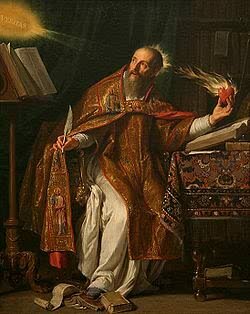
Augustine of Hippo

Aurelius Augustinus, Augustine of Hippo ("The knowledgeable one") (November 13, 354–August 28, 430) was one of the most important figures in the development of Western Christianity. In Roman Catholicism, he is a saint and pre-eminent Doctor of the Church. Many Protestants, especially Calvinists, consider him to be one of the theological fountainheads of Reformation teaching on salvation and grace. Born in Africa as the eldest son of Saint Monica, he was educated and baptised in Italy. His works—including The Confessions, which is often called the first Western autobiography—are still read by Christians around the world.

Life

Saint Augustine was born in 354 in Tagaste, a provincial Roman city in North Africa. He was raised and educated in Carthage

His mother Monica was a devout Catholic and his father Patricius a pagan, but Augustine followed the controversial Manichaean religion, much to the horror of his mother.
Now we come to the man who is more than anyone else the representative of the West; he is the foundation of everything the West had to say. Augustine lived from A.D. 354 to 430. His influence overshadows not only the next thousand years but all periods ever since. In the Middle Ages his influence was such that even those who struggled against him in theological terminology and method—the Dominicans, with the help of Aristotle—quoted him often. Thomas Aquinas, who was the great opponent of Augustinianism in the Middle Ages, quoted him affirmatively most frequently.

More...

Thursday, April 22, 2010

Ein Gedi

Ein Gedi (Hebrew:עין גדי `Eyn Gediy; KJV Bible Engedi, NIV Bible En Gedi) is an oasis located west of the Dead Sea, close to Masada and the caves of Qumran where the Dead Sea Scrolls were discovered. Location 31°27′N, 35°23′E.

It is known for its caves, springs, and its rich diversity of flora and fauna. Ein Gedi is mentioned several times in biblical writings, for example, in the Song of Songs:
"My beloved is unto me as a cluster of henna flowers in the vineyards of Ein Gedi" (1:14).
Accorded to Jewish tradition, David hid from Saul in the caves here;
"And David went up from thence, and dwelt in the strongholds of Ein Gedi" (1 Samuel 24:1).

More...

Wednesday, April 21, 2010

Abortion


An abortion is the removal or expulsion from the uterus of an embryo or fetus, resulting in or caused by its death. This can occur spontaneously as a miscarriage, or be artificially induced through chemical, surgical or other means.

Commonly, "abortion" refers to an induced abortion procedure at any point in the pregnancy; medically, it is defined as a miscarriage or induced termination before twenty weeks gestation, which is considered nonviable.

There have been various methods of inducing abortion throughout history. The moral and legal aspects of abortion are the subject of intense debate in many parts of the world.

The recently passed Healthcare Bill supports the public funding of abortion.

More...


Subscribe


LifeNews.com

Desiring God Blog

Youth for Christ International