Saturday, May 30, 2009

Sarah

Sarah (Hebrew: שָׂרָה, Arabic: سارة, Sāra ; "a woman of high rank") is the wife of Abraham as described in the Quran and the Hebrew Bible (Genesis).

The Hebrew word sarah indicates a woman of high rank and is sometimes translated as "princess" or goddess, or "high holy one".

Judaism
Sarah was originally called Sarai (שָׂרַי / שָׂרָי / שרי, Standard Hebrew Saray, Tiberian Hebrew Saray / Śāray / Śārāy, Gen. 17:15) and was married to and lived with her husband, then called Abram (אברם) in the city of Haran.

Etymology
Saray is a proper feminine noun from the masuline root word Sar (Strong's H8323) which is from the primitive root verb sarar (שרר):

More...

Friday, May 29, 2009

Copper Scroll

Copper Scroll found at Khirbet KumranThe Copper Scroll is one of the Dead Sea Scrolls found at Khirbet Qumran, but differs significantly from the others. While they are written on leather or papyrus, this scroll is written on metal: copper mixed with about 1% tin. Unlike the others, it is not a literary work, but contains a listing of locations at which various items of gold and silver are buried or hidden. It is currently on display at the Archaeological Museum in Amman, Jordan. The treasure it describes is worth at least one billion dollars.

History and origin

The scroll was found in 1952 in Cave 3 at Qumran, the last of 15, and is thus referred to as 3Q15. Two copper rolls were discovered off by themselves in the back of the cave. The metal being corroded, they could not be unrolled by conventional means. Professor H. Wright Baker, of the College of Technology at Manchester, England, cut the sheets into strips. It then became clear that the rolls were part of the same document. Low-quality photographs of the scrolls were taken and published. Scholars have found these to be difficult to work with, and have relied on a drawing of the text by scholar Józef Milik published in 1962. Another scholar, John Marco Allegro, published his translation in 1960. The scroll was rephotographed in 1988 with clearer precision, under an effort led by P. Kyle McCarter, Jr.

More...

Thursday, May 28, 2009

Aramaic

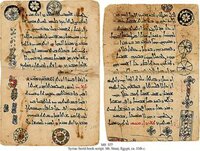
11th century book in Syriac Serto, Mount Sinai, Egypt.Aramaic is a Semitic language with a 3,000-year history. It has been the language of administration of empires and the language of divine worship. It is the original language of large sections of the biblical books of Daniel and Ezra, and is the main language of the Talmud. Aramaic is believed to have been the native language of Jesus (see also: Aramaic of Jesus). In the following passage, spoken by Jesus while being crucified, "Eloi, Eloi, lama sabachthani" is Aramaic. Matthew 27:46 has a direct parallel in Psalm 22 (written by David nearly 1,000 years before the birth of Jesus):
About the ninth hour Jesus cried out in a loud voice, "Eloi, Eloi, lama sabachthani?"—which means, "My God, my God, why have you forsaken me?" -Matthew 27:46
Even at the threshold of death, Jesus quotes scripture (See Psalm 22:1)
And this seems to be the state of this psalm, which is understood of the Messiah, by the Hebrew doctors themselves, and by Christ himself and by his apostles. And there are many passages in it, which were literally accomplished in him, and cannot be understood of any other. In this psalm David speaks of the humiliation of Christ, ver. 1 - 21. Of the exaltation of Christ, ver. 22 - 31. To the chief musician upon Aijeleth Shahar, A psalm of David.

Christian Classics Ethereal Library of Calvin College.
John Wesley's notes on Psalm 22


More...

Wednesday, May 27, 2009

rationalism

Statue of philosopher Immanuel Kant after Friedrich Hagemann (1773-1806), Berlin, Museum Friedrichswerdersche KircheRationalism, also known as the rationalist movement, is a philosophical doctrine that asserts that the truth can best be discovered by reason and factual analysis, rather than faith, dogma or religious teaching. Rationalism has some similarities in ideology and intent to humanism, secular humanism, and atheism, in that it aims to provide a framework for social and philosophical discourse outside of religious or supernatural beliefs; however, rationalism differs from both of these, in that:
  • As its name suggests, humanism is centered on the dignity and worth of people. While rationalism is a key component of humanism, there is also a strong ethical component in humanism that rationalism does not require. As a result, being a rationalist does not necessarily mean being a humanist.
  • Atheism, a disbelief or lack of belief in God, can be on any basis, or none at all, so it doesn't require rationalism. Furthermore, rationalism does not, in itself, affirm or deny atheism, although it does reject any belief based on faith alone. Historically, many rationalists were not atheists. Presumably, people who are rationalists today generally do not believe that theism can be rationally justified, because modern-day rationalism is strongly correlated with atheism.
As a result, most—if not all—prominent rationalists today, including self-proclaimed secular humanist, sceptic, "scientific" rationalist, supporter of the Brights movement, and critic of creationism and intelligent design, Richard Dawkins, is an atheist.


More...

Monday, May 25, 2009

Arab-Israeli War (1948)

Israeli Soldiers Raising the ink flag in Umm Rashrash (now Eilat) which marked the end of the war, 1949 The 1948 Arab-Israeli War, referred to as the "War of Independence" (Hebrew: מלחמת העצמאות) or as the "War of Liberation" by Israelis, is the first in a series of armed conflicts fought between Israel and its Arab neighbors in the ongoing Arab-Israeli conflict. For Palestinians, the war marked the beginning of the events they refer to as "The Catastrophe" ("al Nakba", Arabic: النكبة‎). After the United Nations proposed to partition the territory of the British Mandate of Palestine into two states, Jewish and Arab, the Arabs refused to accept it and the armies of Egypt, Syria, Transjordan, Lebanon and Iraq (see also: Iraq Maps), supported by others, attacked the newly established State of Israel which they refused to recognize. As a result, the region was divided between Israel, Egypt and Transjordan.

Following the defeat of the Ottoman Empire in World War I, the League of Nations granted the British and the French temporary colonial administration over former Ottoman provinces south of present day Turkey. These regions had been called vilayets under the Ottomans, but were referred to as mandates at the time, after the process that allocated them. The two powers drew arbitrary borders, dividing the area into four sections. Three of these — Iraq, Syria, and Lebanon — survive to this day as states.

The fourth section was created from what had been known as "southern Syria". The region was officially named the British Mandate of Palestine, and was called "Falastin" in Arabic and "Palestina (E.I.)" in Hebrew. The British revised its borders repeatedly, but under the direction of Winston Churchill the region was divided along the Jordan River, forming two administrative regions.

More...

Saturday, May 23, 2009

Simon Peter

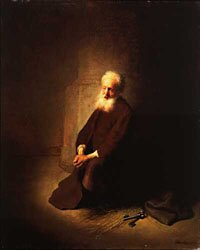
St. Peter in Prison by Rembrandt, 1631Saint Peter, also known as Simon ben Jonah/BarJonah, Simon Peter, Cephas and Kepha - original name Simon or Simeon (Acts 15:14) - was one of the Twelve Apostles whom Jesus chose as his original disciples. His life is prominently featured in the New Testament Gospels and the Acts of the Apostles. A Galilean fisherman, he (with his brother Andrew)
was literally "called" by Jesus to be a disciple. Above all the other disciples, Peter was assigned a leadership role by Jesus (Matt 16:18; John 21:15–16); and many within the early Church, such as St Clement of Rome and St Irenaeus (Adversus Haereses 3:3:20), mention his primacy.

The ancient Christian Churches, Roman Catholic, Eastern Orthodox and Oriental Orthodox, consider Simon Peter a saint and associate him with the foundation of the Church in Rome ,
even if they differ on the significance of this for the position of the see of Rome and of the Pope in present-day Christianity.

More...

Friday, May 22, 2009

Promised Land

The Kingdom of David and Solomon. Solomon ruled over all the kingdoms west of the Euphrates River from Tiphsah to Gaza; he was at peace with all his neighbors (I Kings, 4:24)According to the Bible, the Land of Israel (Hebrew: Eretz Yisrael) was promised to the descendants of Hebrew patriarchs Abraham, Isaac, and Jacob by God, making it the Promised land. The concept is frequently used symbolically by Christians, especially in hymnody as a reference to Heaven, or to a new land, such as North America colonized by the Pilgrims. In the Bible, particularly in Genesis, Deuteronomy and Joshua, the Land of Israel was promised as an everlasting possession.

Abraham
'On that day, God made a covenant with Abram, saying: "To your descendants I have given this land, from the river of Egypt as far as the great river the Euphrates. The land of the Kenites, Kenizites, Kadmonites; the Chitties, Perizites, Refaim; the Emorites, Canaanites, Gigashites and Yevusites." '
(Genesis 15:18-21)
More...

Thursday, May 21, 2009

Oxyrhynchus

Location of Oxyrhynchus in EgyptOxyrhynchus (Greek: Ὀξύρρυγχος; "sharp-snouted or sharp-nosed"; ancient Egyptian Pr-Medjed; Coptic Pemdje; modern Egyptian Arabic el-Bahnasa) is a city in Upper Egypt, located about 160 km south-southwest of Cairo, in the governorate of Al Minya. It is also an archaeological site, considered one of the most important ever discovered. For the past century, the area around Oxyrhynchus has been continually excavated, yielding an enormous collection of papyrus texts dating from the time of the Ptolemaic and Roman periods of Egyptian history. Among the texts discovered at Oxyrhynchus are plays of Menander and fragments of the Gospel of Thomas, an early Christian apocryphal document with doubtful authorship.

The town was named after a species of fish of the Nile River which was important in Egyptian mythology, though it is not known exactly which species of fish this is. One possibility is a species of mormyrid, medium-sized freshwater fish that figure in various Egyptian and other artworks.

More...

Wednesday, May 20, 2009

Legio X Fretensis

Herodium one of the fortresses of the Jewish revolt conquered by the X Fretensis.Legio X Fretensis (Latin: "Tenth legion of the sea strait") was a Roman legion levied by Augustus in 41/40 BC to fight during the period of civil war that started the dissolution of the Roman Republic. X Fretensis is recorded to exist at least until 410s.

X Fretensis symbols were the bull, the holy animal of the goddess Venus (mythical ancestor of the gens Julia), a ship (probably a reference to the battles of Naulochus and/or Actium), the god Neptune, and a boar. The symbol of Taurus may also mean that it was organized between 20 April and 20 May.

Octavian, later known as Caesar Augustus, levied a legion and gave it the number ten, as a reference to Julius Caesar's famous Tenth Legion.

In 36 BC, the Tenth Legion fought under Octavian against Sextus Pompeius in the Battle of Naulochus, where it earned its cognomen Fretensis. The name refers to the fact that the battle took place near the sea Strait of Messina (Fretum Siculum).

More...

Tree of Jesse

Jesse (detail), from  The Tree of Jesse (Hebrew: ישי Yishay) refers to a passage in the biblical Book of Isaiah which describes metaphorically the descent of the Messiah and is accepted by Christians as pertaining to Jesus, and is often represented in art, particularly in that of the Medieval period, the earliest dating from the 11th century.
“ 1 There shall come forth a shoot from the stump of Jesse, and a branch from his roots shall bear fruit.

2 And the Spirit of the LORD shall rest upon him, the Spirit of wisdom and understanding, the Spirit of counsel and might, the Spirit of knowledge and the fear of the LORD.

3 And his delight shall be in the fear of the LORD. He shall not judge by what his eyes see, or decide disputes by what his ears hear, ” (Isaiah 11:1-3 ESV)


More...

Monday, May 18, 2009

Samuel

The prophet Samuel. The Fresco Painting. Circa 1112 From the Mikhailovskr Monastery of Kiev Samuel or Shĕmuw'el (Hebrew: שְׁמוּאֵל is an important leader of ancient Israel in the Book(s) of Samuel in the Hebrew Bible.

His status, as viewed by rabbinical literature, is that he was the last of the Hebrew Judges and the first of the major prophets who began to prophesy inside the Land of Israel. He was thus at the cusp between two eras.

In the Biblical narrative, Hannah is one of two wives of Elkanah; the other, Peninnah, bore a child to Elkanah, but Hannah remained childless. Nevertheless, Elkanah preferred Hannah. Every year Elkanah would offer a sacrifice at the Shiloh sanctuary, and give Hannah twice as big a portion of it as he would to Penninah. One day Hannah went up to the temple, and prayed silently, while Eli the High Priest was sitting on a chair near the doorpost. In her prayer she begs for a child in return for giving the child up, putting him in the service of the Shiloh priests, and raising him as a nazir.
11 And she vowed a vow and said, "O LORD of hosts, if you will indeed look on the affliction of your servant and remember me and not forget your servant, but will give to your servant a son, then I will give him to the LORD all the days of his life, and no razor shall touch his head." (1 Samuel 1:10-11)


More...

Sunday, May 17, 2009

Being and Time

Being and Time (German: Sein und Zeit, 1927) is a book by German philosopher Martin Heidegger. Although written quickly, and despite the fact that Heidegger never completed the project outlined in the introduction, it remains his most important work and has profoundly influenced 20th-century philosophy, particularly existentialism, hermeneutics and deconstruction.

Being and Time was originally intended to consist of two major parts, each part consisting of three divisions. Heidegger was forced to prepare the book for publication when he had completed only the first two divisions of part one. The remaining divisions planned for Being and Time (particularly the divisions on time and being, Immanuel Kant, and Aristotle) were never published, although in many respects they are addressed in one form or another in Heidegger's other works. In terms of structure, Being and Time remains as it was when it first appeared in print; it consists of the lengthy and important two-part introduction, followed by Division One, the "Preparatory Fundamental Analysis of Dasein," and Division Two, "Dasein and Temporality."

More...

Saturday, May 16, 2009

Babylon

Babylon (in Arabic: بابل; in Syriac: ܒܒܙܠ in Hebrew:בבל) is the Greek variant of Akkadian Babilu (bāb-ilû, meaning "Gateway of the god", translating Sumerian Kadingirra), an ancient city in Mesopotamia (modern Al Hillah, Iraq, see also: Iraq Maps), the ruins of which can be found in present-day Babil Province, about 50 miles (80 km) south of Baghdad. It was the "holy city" of Babylonia from around 2300 BC, and the seat of the Neo-Babylonian empire from 612 BC. In the Bible, the name appears as בבל (Babel).

In the Old Testament, the name appears as בבל Babel or Babylon interpreted by Genesis 11:9 to mean "confusion (by mixing)", from the verb balal:
1) to mix, mingle, confuse, confound
a) (Qal)
1) to mingle, confuse
2) to mix
3) to give provender, feed (animals)
b) (Hithpoel) to mix oneself (among others)
c) (Hiphil) to fade away

The Hanging Gardens of Babylon were one of the Seven Wonders of the Ancient World.

More...

Friday, May 15, 2009

Apocatastasis

The Major prophets: Isaiah, Jeremiah, Ezekiel, and Daniel each originally depicted on the fresco at the Sistine Chapel ceiling.Apocatastasis (pronounced /ˌæpoʊkəˈtæstəsɨs/) is a Greek word (αποκαταστασις) meaning either reconstitution or restitution or restoration to the original or primordial condition.

In Christianity, apocatastasis is the doctrine of the ultimate reconciliation of good and evil forces. Apocatastasis maintains that all moral creatures -- angels, humans and devils - will eventually come to a harmony in God's kingdom, the evil ones through repentance and rejection of evil.

The belief was first articulated by Clement of Alexandria (d. 215) and Origen of Alexandria (d. 232) and defended by Diodore of Tarsus. They adapted Platonic terminology and ideas to Christianity while explaining and differentiating the new faith from all the others. . Proponents cited Biblical passage in 1 Corinthians 15:28 ("When he has done this, then the Son himself will be made subject to him who put everything under him, so that God may be all in all.") in support.

More...

Thursday, May 14, 2009

Ein Gedi

Shulamit Fall at Nahal DavidEin Gedi (עין גדי; KJV Bible Engedi, NIV Bible En Gedi) is an oasis located west of the Dead Sea, close to Masada and the caves of Qumran where the Dead Sea Scrolls were discovered. Location 31°27′N, 35°23′E.

It is known for its caves, springs, and its rich diversity of flora and fauna. Ein Gedi is mentioned several times in biblical writings, for example, in the Song of Songs;

"My beloved is unto me as a cluster of henna flowers in the vineyards of Ein Gedi" (1:14).

Accorded to Jewish tradition, David hid from Saul in the caves here;

"And David went up from thence, and dwelt in the strongholds of Ein Gedi" (1 Samuel 24:1).

More...

Tuesday, May 12, 2009

Merkabah

The Vision of Ezekiel. Artist: Sanzio Raffaello, Date: c. 1518.The Hebrew word Merkabah (מרכבה "chariot", derived from the consonantal root r-k-b with general meaning "to ride") is used in Ezekiel (1:4-26) to refer to the thron e-chariot of God, the four-wheeled vehicle driven by four "chayot" (Hebrew: "living creatures"), each of which has four wings and the four faces of a man, lion, ox, and eagle.

Several movements in Jewish mysticism, including the Ma’asei Merkavah of the late Hellenistic period following the destruction of the Second Temple in 70 CE, and later, students of the Kabbalah, have focused on these passages from Ezekiel, seeking underlying meaning and the secrets of Creation in what they argued was the metaphoric language of the verses. Due to the concern of some Torah scholars that misunderstanding these passages as literal descriptions of God's image might lead to blasphemy and/or idolatry, there was great opposition to studying this topic without the proper initiation. Jewish biblical commentaries emphasize that the imagery of the Merkaba is not meant to be taken literally; rather the chariot and its accompanying angels are analogies for the various ways that God reveals Himself in this world. Hasidic philosophy and Kabbalah discuss at length what each aspect of this vision represents in this world, and how the vision does not imply that God is made up of these forms. Jews customarily read the biblical passages concerning the Merkaba in their synagogues every year on the holiday of Shavuot, and the Merkabah is also referenced in several places in traditional Jewish liturgy.

More...

Monday, May 11, 2009

Jacob's Ladder

The angels climb Jacob‘s Ladder on the west front of Bath AbbeyJacob's Ladder refers to a ladder to heaven described in the Genesis 28:11-19 which the biblical patriarch Jacob envisioned during his flight from his brother Esau:

10 Jacob left Beersheba and set out for Haran. 11 When he reached a certain place, he stopped for the night because the sun had set. Taking one of the stones there, he put it under his head and lay down to sleep. 12 He had a dream in which he saw a stairway resting on the earth, with its top reaching to heaven, and the angels of God were ascending and descending on it. 13 There above it stood the LORD, and he said: "I am the LORD, the God of your father Abraham and the God of Isaac. I will give you and your descendants the land on which you are lying. 14 Your descendants will be like the dust of the earth, and you will spread out to the west and to the east, to the north and to the south. All peoples on earth will be blessed through you and your offspring. 15 I am with you and will watch over you wherever you go, and I will bring you back to this land. I will not leave you until I have done what I have promised you."

16 When Jacob awoke from his sleep, he thought, "Surely the LORD is in this place, and I was not aware of it." 17 He was afraid and said, "How awesome is this place! This is none other than the house of God; this is the gate of heaven."

18 Early the next morning Jacob took the stone he had placed under his head and set it up as a pillar and poured oil on top of it. 19 He called that place Bethel, though the city used to be called Luz.

20 Then Jacob made a vow, saying, "If God will be with me and will watch over me on this journey I am taking and will give me food to eat and clothes to wear 21 so that I return safely to my father's house, then the LORD will be my God 22 and this stone that I have set up as a pillar will be God's house, and of all that you give me I will give you a tenth." (Gen. 28: 10-22)

More...

Sunday, May 10, 2009

fine-tuned universe

The deepest visible-light image of the cosmos. Hubble Ultra Deep Field.The term fine-tuned universe refers to the idea that conditions that allow life in the universe can only occur with the tightly restricted values of the universal physical constants, and that small changes in these constants would correspond to a very different universe, not likely conducive to the establishment and development of matter, astronomical structures, or life as it is presently known.

The arguments relating to the fine-tuned universe concept are related to the anthropic principle, which states that any valid theory of the universe must be consistent with our existence as human beings at this particular time and place in the universe. In other words even though the actual probability of a universe to be one which supports intelligent life is very low, the conditional probability given our existence in it is 1 - and even if there are other universes devoid of life, there will be no one to observe them.

The premise of the fine-tuned universe assertion is that any small change in the approximately 26 dimensionless fundamental physical constants would make the universe radically different: if, for example, the strong nuclear force were 2% stronger than it is (i.e. if the constant representing its strength were 2% larger), diprotons would be stable and hydrogen would fuse into them instead of deuterium and helium. This would drastically alter the physics of stars, and presumably prevent the universe from developing life as it is currently observed on the earth.

More...

Thursday, May 07, 2009

Narrative theology

Wisembach, Commune des Vosges, Copyright © Christian AmetNarrative theology was a late 20th century theological development which supported the idea that the Church's use of the Bible should focus on a narrative presentation of the faith, rather than on the development of a systematic theology. The Christian faith is thus also to be interpreted by the Christian community, and not by outside scholars or explorers.

Partly a reaction to the modern, individualist and romantic trends of theological liberalism, important post liberal thinkers included George Lindbeck, Hans Wilhelm Frei, and Stanley Hauerwas.

Frequently referred to as postliberal theology, narrative theology was inspired by a group of theologians at Yale Divinity School, many influenced theologically by Karl Barth, Thomas Aquinas and to some extent, the nouvelle théologie of French Catholics such as Henri de Lubac. The clear philosophical influence, however, was Ludwig Wittgenstein's philosophy of language, the moral philosophy of Alasdair MacIntyre, and the sociological insights of Clifford Geertz and Peter Berger on the nature of communities.
More...

Tuesday, May 05, 2009

Doctrines of Grace

Anonymous 16th century portrait of John Calvin.Calvinist theology is sometimes identified with the five points of Calvinism, also called the Doctrines of Grace, which are a point-by-point response to the five points of the Arminian Remonstrance (see History of Calvinist-Arminian debate) and which serve as a summation of the judgments rendered by the Synod of Dort in 1619. Calvin himself never used such a model and never combated Arminianism directly.

The points therefore function as a summary of the differences between Calvinism and Arminianism, but not as a complete summation of Calvin's writings or of the theology of the Christian Reformed Church in general. In English, the points are sometimes referred to by the acronym TULIP, though this puts the points in a different order than the Canons of Dort.

The central assertion of these canons is that God is able to save every person upon whom he has mercy and that his efforts are not frustrated by the unrighteousness or the inability of humans.

More...

Monday, May 04, 2009

supernatural

Belshazzars Feast. Artist: Harmenszoon van Rijn Rembrandt. Date: 1635.The supernatural (Latin: super- "exceeding" + nature) refers to forces and phenomena which are are not observed in nature, and therefore beyond verifiable measurement. If a phenomenon can be demonstrated, it can no longer be considered supernatural. Because phenomena must be subjected to verifiable measurement and peer review to be considered as a scientific theory, science cannot approach the supernatural; see also Ex nihilo.
"Measure what is measurable, and make measurable what is not so." —Galileo Galilei
Concepts in the supernatural domain are closely related to concepts in religious spirituality and metaphysics. The term "supernatural" is often used interchangeably with paranormal or preternatural — the latter typically limited to an adjective for describing abilities which appear to exceed possible bounds.

Characteristic for phenomena claimed as supernatural are anomaly, uniqueness and uncontrollability, thus lacking reproducibility required for scientific examination. Supernatural themes are often associated with paranormal and occult ideas, suggesting for possibility of interaction with the supernatural by means of summoning or trance for instance.

More...

Sunday, May 03, 2009

Christian Church

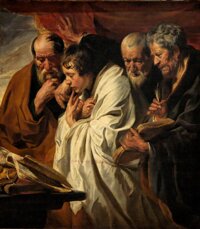
The Four Evangelists. Oil on canvas, ca. 1625–1630, Jakob Jordaens (Dutch, 1593–1678)The Christian Church is a religiously ambiguous and cultural-sociological term to refer to all religions based on the worship of Jesus of Nazareth as the son of God. It is not a single religious institution. Today there is no single political entity recognized by the secular world as the unique Christian Church.

The Roman Catholic Church and the Orthodox Churches all claim to be the unique church established by Jesus in the Great Commission. Protestants, on the other hand, hold that the concept is justified by the notion that the Church is ultimately headed by Jesus Christ himself, who acts as the unifying figure for all who follow Him. Anglicans feel that they are but a branch of the Church. The term means something quite different for each religious institution that sees itself as belonging to the Christian traditions.

The phrase The Church in its widest sense, as the Body of Christ has a similar breadth.

The word "church" is used in two senses:

  1. the visible
    • The visible church consists of all the people that claim to be Christians and go to church.
  2. and

  3. the invisible church.
    • The invisible church is the actual body of Christians; those who are truly saved. The true church of God is not an organization on earth consisting of people and buildings, but is really a supernatural entity comprised of those who are saved by Jesus.
More...

Saturday, May 02, 2009

Essenes

Dead Sea Scroll FragmentThe Essenes (es'-eenz) were followers of a religious way of living in Judaism that flourished from the 2nd century BC to the 1st century AD. Many scholars today argue that there were a number of separate but related groups that had in common mystic, eschatological, messianic, and ascetic beliefs that were referred to as the "Essenes". There are also contemporary movements which identify themselves as Essenes, including the "Orthodox" Christian Essenes.

The main source of information about the life and belief of Essenes is the detailed account contained in a work of the 1st century Jewish historiographer Josephus entitled The Jewish War written about 73-75 CE (War 2.119-161) and his shorter description in his Antiquities finished some 20 years later (Ant. 18.11 & 18-22). Claiming first hand knowledge (Life §§10-11), he refers to them by the name Essenoi and lists them as the followers of one of the three "choices" in "Jewish Philosophy'" (War 2.119) alongside the Pharisees and the Sadducees.

The only other known contemporary accounts about the Essenes are two similarly detailed ones by the Jewish philosopher Philo (fl. c. 20 BCE - c. 54 CE; Quod Omnis Probus Liber Sit XII.75-87, and the excerpt from his Hypothetica 11.1-18 preserved by Eusebius, Praep. Evang. Bk VIII), who, however, admits to not being quite certain of the Greek form of their name that he recalls as Essaioi (Quod Omn. Prob. XII.75), and the brief reference to them by the Roman equestrian Pliny the Elder (fl. 23 CE - 79 CE; Natural History, Bk 5.73).

More...

Friday, May 01, 2009

Missional Living

Village Children, Eastern Cape of South Africa.The Oxford English Dictionary defines "missional" as "Relating to or connected with a religious mission; missionary." In contemporary usage "missional" is an adjectival alternative to "missionary." Although both words are related to "missio" (Latin: sending), some scholars, including Darrell Guder et. al. in The Missional Church believe "missional" focuses on the the Church's indigenous, rather than cross-cultural context, with the church contextualizing its methods, morality, and message to fit this indigenous culture.

In this usage "missional" has rapidly entered the lexicon of the growing emerging church movement whose participants have popularized the term, enabling participants in this movement to recognize each other across denominational lines.

Different emergents may use the term with different nuances and connotations, but the term persists as essentially a postmodern alternative to the ecclesiology and missiology of Evangelical Christians. The practical outworking of emergent, missional living does not coincide with the emphases on propositional evangelism, teaching, and holiness found in historic Christianity. Missional believers are more inclusive than exclusive, refusing to identify boundaries that could be perceived as an "us vs. them" mentality. Within this atmosphere so-called missional believers seek to enhance the lives of all postmoderns regardless of their belief system or lifestyle.

More...

Thursday, April 30, 2009

abortion

an unborn fetus in the mothers womb, a newborn babyAn abortion is the removal or expulsion from the uterus of an embryo or fetus, resulting in or caused by its death. This can occur spontaneously as a miscarriage, or be artificially induced through chemical, surgical or other means.

Commonly, "abortion" refers to an induced abortion procedure at any point in the pregnancy; medically, it is defined as a miscarriage or induced termination before twenty weeks gestation, which is considered nonviable.

There have been various methods of inducing abortion throughout history. The moral and legal aspects of abortion are the subject of intense debate in many parts of the world.

Early Christian writers condemned abortion explicitly. There is no known Early Christian text that contains any exceptions under which abortion would be morally permissible.

The Didache, which most scholars consider to be written in the latter 1st century A.D., comments on the commandment, "you shall do nothing to any man that you would not wish to be done to yourself", by saying:
... Commit no murder, adultery, sodomy, fornication, or theft. Practise no magic, sorcery, abortion, or infanticide....


More...

Wednesday, April 29, 2009

Christian art

Entry into Jerusalem. Artist: French Miniaturist. Date: c. 1100. Medium: Illumination on parchment. Location: Bibliothèque Nationale, ParisChristian art is art that spans many segments of Christianity. Per each religious sect, art mediums, style, and representations change; however, the unifying theme is ultimately the representation of the life and times of Jesus Christ and in some cases the Old Testament.

History
Much of the art surviving from Europe after the fall of the Roman Empire is Christian art. While the Western Roman Empire's political structure essentially collapsed after the fall of Rome, its religious hierarchy, what is today the modern-day Catholic Church funded and supported production of sacred art. The Orthodox Church of Constantinople, which enjoyed greater stability within the surviving Eastern Empire was key in funding arts there, and glorifying Christianity.

As a stable Western European society emerged during the Middle Ages, the Catholic Church led the way in terms of art, using its resources to commission paintings and sculptures. Christian art is found in architecture principally in the form of churches, cathedrals, monasteries and tombs.

More...

Tuesday, April 28, 2009

Triple-alpha process

The Triple-alpha process is a set of nuclear fusion reactions by which three helium nuclei (alpha particles) are transformed into carbon.

Hoyle's Contribution to cosmology
An early paper of Sir Frederick "Fred" Hoyle made an interesting use of the "anthropic principle. In trying to work out the routes of stellar nucleosynthesis, he observed that one particular nuclear reaction, the Triple-alpha process, which generated carbon, would require the carbon nucleus to have a very specific energy for it to work. The large amount of carbon in the universe, which makes it possible for carbon-based lifeforms (e.g. humans) to exist, demonstrated that this nuclear reaction must work. Based on this notion, he made a prediction of the energy levels in the carbon nucleus that was later borne out by experiment.

However, those energy levels, while needed in order to produce carbon in large quantities, were statistically very unlikely. Hoyle later wrote:
Would you not say to yourself, "Some super-calculating intellect must have designed the properties of the carbon atom, otherwise the chance of my finding such an atom through the blind forces of nature would be utterly minuscule." Of course you would...A common sense interpretation of the facts suggests that a superintellect has monkeyed with physics, as well as with chemistry and biology, and that there are no blind forces worth speaking about in nature. The numbers one calculates from the facts seem to me so overwhelming as to put this conclusion almost beyond question.
More...

Monday, April 27, 2009

timeline of Christianity

A folio from P46, early 3rd c. New Testament manuscript useful in discerning the early Christian canon.The purpose of this chronology is to give a detailed account of Christianity from the beginning of the current era to the present. Question marks on dates indicate approximate dates.

For "Old Testament" chronology, see History of ancient Israel.

The year one is the first year in the Christian calendar (there is no year zero), which is the calendar presently used (in unison with the Gregorian calendar) almost everywhere in the world, because of the current dominance of the Western world. Traditionally, this was held to be the year Jesus was born, however most modern scholars argue for an earlier date and later dates, the most agreed upon being between 6 B.C. and 4 B.C.

6 Herod Archelaus deposed by Augustus Caesar; Samaria, Judea and Idumea annexed as Iudaea Province under direct Roman administration, capital at Caesarea, Publius Sulpicius Quirinius became Legate (Governor) of Syria, conducted Census of Quirinius, opposed by Zealots (JA18, Luke 2:1-3, Acts 5:37)


More...

Sunday, April 26, 2009

Antioch

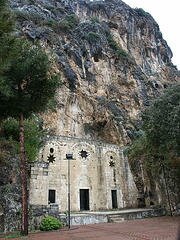
The church of Saint Peter, AntiochAntioch on the Orontes (Greek: Αντιόχεια η επί Δάφνη, Αντιόχεια ή επί Ορόντου or Αντιόχεια η Μεγάλη; Latin: Antiochia ad Orontem, also Antiochia dei Siri), the Great Antioch or Syrian Antioch was an ancient city located on the eastern side (left bank) of the Orontes River about 30 km from the sea and its port, Seleucia of Pieria (Suedia, now Samandağı). The city's ruins are located in Antakya, Turkey .

Founded near the end of the 4th century BC by Seleucus I Nicator, one of Alexander the Great's generals, Antioch was destined to rival Alexandria as the chief city of the nearer East and to be the cradle of gentile Christianity.

The geographical character of the district north and north-east of the elbow of Orontes makes it the natural centre of Syria, so long as that country is held by a western power; and only Asiatic, and especially Arab, dynasties have neglected it for the oasis of Damascus .

More...

Saturday, April 25, 2009

Ministry of Jesus

Jesus among the Doctors, c. 1558 or 1566-67, Artist: Paolo VERONESE, Oil on canvas, 236 x 430 cm, Museo del Prado, Madrid.According to the Gospels, the Ministry of Jesus began when Jesus was around 30 years old, and lasted a period of 1-3 years. In the Biblical narrative, Jesus' method of teaching involved parables, metaphor, allegory, sayings, proverbs, and a small number of direct sermons. This was the first coming of Jesus, most Christian denominations believe in a Second Coming when Jesus will return to the earth to fulfill aspects of Messianic prophecy, such as the general resurrection of the dead, last judgment of the dead and the living and the full establishment of the Kingdom of God on earth (also called the "Reign of God"), including the Messianic Age.

Some time after having rejected Satan's temptation, Jesus is described as leaving Nazareth. While Matthew doesn't explain why Jesus did this, both he and Mark mention that John the Baptist was arrested by Herod Antipas at this time. Luke gives a different circumstance, stating that Jesus left when the people of Nazareth rejected him. The texts don't recount what occurred between Jesus being tempted and John being arrested, but Jones believes that some months likely elapsed, with Jesus frequently being seen as a disciple of John the Baptist, until this was no longer possible (due to John being arrested). France argues that it was the flight from Nazareth which resulted in Jesus carrying out a ministry based on itinerant preaching, which France sees as being quite different to the ministry which John the Baptist had carried out.

More...

Friday, April 24, 2009

social action

The ONE campaign was launched at a rally in Philadelphia with the help of Bono.In sociology, social actions refer to any action that takes into account actions and reactions of other individuals and is modified based on those events.

"Doing a '180' is putting others before yourself and also a willingness to be counter cultural." -ginkworld.net

In England in the 1830s, many poor children had no time for school or play. They worked in coal mines under inhuman conditions.

But these children had a friend in high places: Anthony Ashley Cooper, seventh Earl of Shaftesbury and a member of parliament. He was also a devoted Christian who believed God had called him to help the downtrodden. Shaftesbury fought for years to end the abusive child labor practices, although at times he felt “every hand is against me.” But he stood firm, and Parliament abolished child slavery in the mines.
©bible.org

More...

Thursday, April 23, 2009

Abrahamic religion

Abrahamic Religions representing about one half of the world's religionsIn the study of comparative religion, an Abrahamic religion is any of those religions deriving from a common ancient Semitic tradition and traced by their adherents to Abraham ("Father/Leader of many" Hebrew אַבְרָהָם Arabic ابراهيم), a patriarch whose life is narrated in the Hebrew Bible/Old Testament, and as a prophet in the Qur'an.

This forms a large group of related, largely monotheistic religions, generally held to include Judaism, Christianity, Islam, and the Bahá'í Faith (based upon Islam), and comprises about half of the world's religious adherents.

According to the Jewish tradition, Abraham was the first person to reject idolatry, hence he symbolically appears as the founder of monotheistic religions. In that sense, Abrahamic religion could be simply equated with monotheistic religion, but not all monotheistic religions are Abrahamic. In Islam he is considered as the first monotheist and is often refered to as Ibrahim al-Hanif or Abraham the Monotheist. The term, desert monotheism, is sometimes used for a similar purpose of comparison in historical contexts, but not for modern faiths.

More...

Wednesday, April 22, 2009

faith

left: Abraham, Right: JesusThe word faith has various uses; its central meaning is similar to "belief", "trust" or "confidence", but unlike these terms, "faith" tends to imply transcending the personal rather than an interpersonal relationship – with God. The object of faith can be a person (or even an inanimate object or state of affairs) or a proposition (or body of propositions, such as a religious credo). In each case, however, faith is in an aspect of the object and cannot be logically proven or objectively known. Faith can also be defined as accepting as true something which one has been told by someone who is believed to be trustworthy. In its proper sense faith means trusting the word of another.

In religious contexts, "faith" has several different meanings. Sometimes, it means loyalty to one's religion. It is in this sense in which one can speak of, for example, "the Catholic faith" or "the Islamic faith." For denominational or doctrinal religions, faith also means that one accepts the religious tenets of the religion as true. For non-doctrinal or creed-oriented religions, often means that one is loyal to a particular religious community. In general, faith means being sure of what you hope for and certain of what you do not see with your physical (as opposed to spiritual) eyes.

More...

Tuesday, April 21, 2009

Presuppositional apologetics

Photo of Cornelius Van Til from The Works of Cornelius Van Til, 1895-1987, CD-ROM (New York: Labels Army Co., 1997), ISBN 0875524613Presuppositional apologetics is a school of Christian apologetics, a field of Christian theology that attempts to present a rational basis for the Christian faith, defend the faith against objections, and attack the alleged flaws of other worldviews. Presuppositional apologetics, argues that the existence or non-existence of God is the basic presupposition of all human thought, and that all men arrive at a worldview which is ultimately determined by the theology they presuppose. Evidence and arguments are only marshalled after the fact in an attempt to justify the theological assumptions already made. According to this view, it is impossible to demonstrate the existence of God unless one presupposes that God exists; modern science is incapable of discovering the supernatural because it relies on methodological naturalism and thereby fashions a Procrustean bed which rejects any observation which would disprove the naturalistic assumption. For example, science's methodological naturalism cannot make use of this statement:
By faith we understand that the universe was created by the word of God, so that what is seen was not made out of things that are visible. -Hebrews 11:3 ESB

More...

Monday, April 20, 2009

Shiloh

Tel ShiloShiloh "place of rest" (Hebrew: שלה Šīlōh, שלו Šīlô, שילו Šîlô‎) is mentioned in the Hebrew Bible as a city in Ephraim and temporary home of the Ark of the Covenant and the Tabernacle, the place where Samuel grew up.

Shiloh is mentioned in the Hebrew Bible as an assembly place for the people of Israel where there was a sanctuary containing the Ark of the Covenant until it was taken by the Philistines. According to the Book of Joshua 18:1, it was at Shiloh that the "whole congregation of the children of Israel assembled...and set up the tabernacle of the congregation...", being the tent which housed the ark.

Later on, the portable tent seems to have been enclosed within a compound or replaced with a standing structure with "doors" (1 Samuel 3:15) a precursor to the Temple, that survived until the time of Samuel.

At Shiloh Samuel was raised by the priest Eli and later himself served as priest there. When the Israelites were defeated at the battle of Aphek, their Philistine foes (who had already captured the Ark of the Covenant) apparently destroyed the shrine (1 Samuel 4).

More...

Sunday, April 19, 2009

Anthropic principle

The deepest visible-light image of the cosmos. Hubble Ultra Deep FieldIn physics and cosmology, the anthropic principle is an umbrella term for various dissimilar attempts to explain the structure of the universe by way of coincidentally balanced features that are necessary and relevant to the existence on Earth of biochemistry, carbon-based life, and eventually human beings to observe such a universe. The common (and "weak") form of the anthropic principle is a truism or tautology that begins with the observation that the universe appears surprisingly hospitable to the emergence of life, particularly complex multicellular life, that can make such an observation and concludes with that premise that in only such a fine-tuned universe can such living observers be.

The idea evolved from the so-called "Dicke's coincidence", and has subsequently been reinforced by the discovery of many more anthropic coincidences since Robert Dicke first noted that the evolution of the universe is not random, but is coincidentally constrained by biological factors that require that the age of the universe had to be roughly this "golden-age". Much younger, and there would not have been time for sufficient interstellar levels of carbon to build up by nucleosynthesis, but much older, and the golden age of main sequence stars and stable planetary systems would have already come to an end.

More...

Saturday, April 18, 2009

Authenticity

Christ with the crown of thorns, 1623, Oil on canvas, 106 cm x 136 cm, Catharijneconvent, UtrechtIn the arts, history, archaeology, the study of antiques, and similar fields involving unique or scarce artifacts from the past, and, with regard to documents in law, authenticity (Greek: ἀρχηγός from 'archēgos'='author')
  1. the chief leader, prince
    • of Christ
  2. one that takes the lead in any thing and thus affords an example, a predecessor in a matter,pioneer
  3. the author
Strong's Number: 747 — Greek: archegos

Author:

translated "Prince" in Act 3:15 (marg., "Author") and Acts 5:31, but "Author" in Hebrews 2:10, RV, "Captain," RV marg., and AV, and "Author" in Hebrews 12:2, primarily signifies "one who takes a lead in, or provides the first occasion of, anything." In the Septuagint it is used of the chief of a tribe or family, Numbers 13:2 (RV, prince); of the "heads" of the children of Israel, Numbers 13:3; a captain of the whole people, Numbers 14:4; in Micah 1:13, of Lachish as the leader of the sin of the daughter of Sion: there, as in Hebrews 2:10, the word suggest a combination of the meaning of leader with that of the source from whence a thing proceeds. That Christ is the Prince of life signifies, as Chrysostom says, that "the life He had was not from another; the Prince or Author of life must be He who has life from Himself." But the word does not necessarily combine the idea of the source or originating cause with that of leader. In Hebrews 12:2 where Christ is called the "Author and Perfecter of faith," He is represented as the one who takes precedence in faith and is thus the perfect Exemplar of it. The pronoun "our" does not correspond to anything in the original, and may well be omitted. Christ in the days of His flesh trod never deviating the path of faith, and as the Perfecter has brought it to a perfect end in His own person. Thus He is the leader of all others who tread that path.

More...

Friday, April 17, 2009

Jonah

  1. Jonah Leaves the Whale's Belly. Artist: Tintoretto. Date: 1577-78Jonah (יוֹנָה "Dove") was a person in the Biblical Old Testament and Jewish Tanakh, the son of Amittai ("My Truth"), from the Galilean village of Gath-hepher, near Nazareth.
  2. In the Hebrew Bible, the Book of Jonah is the 5th book in a series of books called the Minor Prophets (itself a subsection of the Nevi’im or Prophets). Unlike other prophetic books however, this book is not a record of a prophet’s words toward Israel. Instead of the poetry and prophetic prose of Isaiah or Lamentations, this book tells the story of an apparently inept prophet who becomes one of the most effective prophets in the entire Bible.
God ordered Jonah to preach at the city of Nineveh. Jonah did not want to, and tried to avoid God's command by sailing to Tarshish. A huge storm arises. The sailors, realizing this is no ordinary storm, cast lots, and learn that Jonah is to blame. Jonah admits this, and states that if he is thrown overboard, the storm will cease. The sailors throw him overboard, and the seas calm. Jonah is miraculously saved by being swallowed by a large fish. In chapter two, while in the great fish, Jonah prayed to God and asked forgiveness and thanked God for being so faithful, and the result was, God commanded the fish to vomit Jonah out.

More...

Thursday, April 16, 2009

Mesopotamia

Archaeological sites of MesopotamiaMesopotamia refers to the region now occupied by modern Iraq, eastern Syria, and southern Turkey . The name comes from the Greek words μέσος "between" and ποταμός "river", referring to the area between the Euphrates and the Tigris (the Arabic term is بين نهرين Bayn Nahrain "between two rivers"). The fertile area watered by these two rivers is known as the "Cradle of Civilization," (see also cradle of humanity) and it was here that the first literate societies developed.
10 Then the servant took ten of his master’s camels and departed, taking all sorts of choice gifts from his master; and he arose and went to Mesopotamia to the city of Nahor. 11 And he made the camels kneel down outside the city by the well of water at the time of evening, the time when women go out to draw water. 12 And he said, "O LORD, God of my master Abraham, please grant me success today and show steadfast love to my master Abraham. 13 Behold, I am standing by the spring of water, and the daughters of the men of the city are coming out to draw water. 14 Let the young woman to whom I shall say, 'Please let down your jar that I may drink,' and who shall say, 'Drink, and I will water your camels'—let her be the one whom you have appointed for your servant Isaac. By this I shall know that you have shown steadfast love to my master." Genesis 24:10-14 ESV
There has never been a political entity called Mesopotamia, nor does Mesopotamia have any definite boundaries; the name is simply a convenient one invented by Greek historians to refer to a broad geographical area.

More...

Wednesday, April 15, 2009

Dispensationalism

The Horsemen of the Apocalypse, the entities that bring false peace, War, famine, pestilence, and death. The Horsemen of the Apocalypse, the entities that bring false peace, War, famine, pestilence, and death.Dispensationalism is a branch of Christian theology that:
  1. teaches Biblical history as best understood in light of a number of successive economies or administrations under God, which it calls "dispensations," and
  2. emphasizes prophecy of the end-times and the pre-tribulation rapture view of Christ's second coming.
Dispensation is an English term excogitated from the Latin dispensatio, frequently used to translate the Greek oikonomia. The Greek word denotes the law or management of a household (to manage, administer, regulate, or plan).

Some consider Dispensationalism to be a nineteenth century distortion of Biblical history. Dispensationalists teach that there are seven distinct "dispensations" within biblical history. The seventh being the 1000 year reign of Christ or the millennium. According to some, the primary error is the "two covenant" teaching. Dispensationalists believe that God's covenant with Israel continues even through the present "church age." Many Protestants believe that the new covenant in Christ replaces the old covenant with Israel.

More...

Monday, April 13, 2009

Early Christianity

Tertullian, Paul of Tarsus, Clement of Alexandria, and James the JustThe term Early Christianity here refers to Christianity of the period after the Death of Jesus in the early 30s and before the First Council of Nicaea in 325. The term is sometimes used in a narrower sense of just the very first followers (disciples) of Jesus of Nazareth and the faith as preached and practiced by the Twelve Apostles, their contemporaries, and their immediate successors, also called the Apostolic Age.

Early Christianity, which began within Judaism, became clearly distinct from Rabbinic Judaism. It continued to revere the Hebrew Bible, generally using the Septuagint translation that was in general use among Greek-speaking Jews and Gentile Godfearers, and added to it the writings that would become the New Testament, thus developing the first Christian biblical canons. It defended Christian beliefs against criticism by non-believing Jews and followers of other Roman religions, survived various persecutions, consisted of divisions that accused each other of heresy, and developed church hierarchy.

What started as a religious movement within Second Temple Judaism became, by the end of this period, the favored religion of the Roman Empire under Constantine the Great (leading later to the rise of Christendom), and a significant religion also outside of the empire. The First Council of Nicaea marks the end of this era and the beginning of the period of the first Seven Ecumenical Councils (325 - 787).

More...

Sunday, April 12, 2009

Easter

Luigi Pellegrino Scaramuccia, known as il Perugino (1621-1680)Easter is the most important religious holiday of the Christian liturgical year, observed in March, April, or May to celebrate the resurrection of Jesus, which Christians believe occurred after his death by crucifixion in AD 27-33. Easter can also refer to the season of the church year, lasting for fifty days, which follows this holiday and ends at Pentecost.

In most languages of Christian societies, other than English, German and some Slavic languages, the holiday's name is derived from pecach פסח, the Hebrew name of Passover, a Jewish holiday to which the Christian Easter is intimately linked.

Easter depends on Passover not only for much of its symbolic meaning but also for its position in the calendar; the Last Supper shared by Jesus and his disciples before his crucifixion is generally thought of as a Passover seder, based on the chronology in the Synoptic Gospels. The Gospel of John has a different chronology which has the death of Jesus at the time of the slaughter of the Passover lambs, which may have been for theological reasons but which is regarded by some scholars as more historically likely given the surrounding events.

More...

Saturday, April 11, 2009

eternity

While in the popular mind, eternity often simply means existing for an infinite, i.e., limitless, amount of time, many have used it to refer to a timeless existence altogether outside of time. There are a number of arguments for eternity, by which proponents of the concept, principally Aristotle, purported to prove that matter, motion, and time must have existed eternally.

Eternity as a timeless existence
Saint Augustine of Hippo wrote that time exists only within the created universe (see creation), so that God exists outside of time; for God there is no past or future, but only an eternal present. One need not believe in God in order to hold this concept of eternity: for example, an atheist mathematician can maintain the philosophical tenet that numbers and the relationships among them exist outside of time, and so are in that sense eternal.

The biblical word eternal is used in place of the Hebrew word qedem קדם Strong's H6924 (east, antiquity, front, that which is before, aforetime), with an early reference in the biblical book of Job:


More...

Friday, April 10, 2009

Good Friday

Burial of Jesus, Carl Heinrich BlochGood Friday, also called Holy Friday or Great Friday, is the Friday preceding Easter Sunday. It commemorates the crucifixion and death of Jesus at Calvary.

Original Events of Good Friday
Jesus Christ, having been arrested in the Garden of Gethsemane by the Temple Guards through the guidance of Judas Iscariot, is brought to the house of Annas, who is father-in-law of the current high priest, Caiaphas. There he is interrogated with little result, and sent bound to Caiaphas the high priest, where the Sanhedrin had assembled (John 18:1-24).

Conflicting testimony against Jesus is brought forth by many witnesses, to which Jesus answers nothing. Finally the high priest says to Jesus,
" 57 Then those who had seized Jesus led him to Caiaphas the high priest, where the scribes and the elders had gathered. 58And Peter was following him at a distance, as far as the courtyard of the high priest, and going inside he sat with the guards to see the end. 59Now the chief priests and the whole Council were seeking false testimony against Jesus that they might put him to death, 60but they found none, though many false witnesses came forward. At last two came forward 61and said, "This man said, 'I am able to destroy the temple of God, and to rebuild it in three days.'" 62And the high priest stood up and said, "Have you no answer to make? What is it that these men testify against you?" 63But Jesus remained silent. And the high priest said to him, "I adjure you by the living God, tell us if you are the Christ, the Son of God." 64Jesus said to him, "You have said so. But I tell you, from now on you will see the Son of Man seated at the right hand of Power and coming on the clouds of heaven." 65Then the high priest tore his robes and said, "He has uttered blasphemy. What further witnesses do we need? You have now heard his blasphemy. 66What is your judgment?" They answered, "He deserves death." (Matthew 26:57-66).
In the morning the whole assembly brings Jesus to the Roman governor Pontius Pilate, under charges of subverting the nation, opposing taxes to Caesar, and making himself a king (Luke 23:1-2). Pilate authorizes the Jewish leaders to judge Jesus according to their own Law and execute sentencing, however the Jewish leaders reply that they are not allowed by the Romans to carry out a sentence of death (John 18:31).

More...

Thursday, April 09, 2009

Plagues of Egypt

Moses and Aaron before Pharoah by Gustov DoréThe Plagues of Egypt (Hebrew: מכות מצרים, Makot Mitzrayim), the Biblical Plagues or the Ten Plagues (עשר המכות, Eser Ha-Makot) are the ten calamities inflicted upon Egypt by God in the Biblical story recounted the book of Exodus, chapters 7 - 12, in order to convince Pharaoh (possibly Ramesses II, making the pharaoh of the Oppression Djeserkheperure Horemheb) to let the Israelite slaves leave (see also Pharaoh of the Exodus).
  1. (Exodus 7:14-25) » rivers and other water sources turned to blood ('Dam')
  2. (Exodus 7:26-8:11) » amphibians (commonly believed to be frogs) ('Tsfardeia')
  3. (Exodus 8:12-15) » lice ('Kinim')
  4. (Exodus 8:16-28) » Either flies, wild animals or beetles ('Arov')
  5. (Exodus 9:1-7) » disease on livestock ('Dever')
  6. (Exodus 9:8-12) » unhealable boils ('Shkhin')
  7. (Exodus 9:13-35) » hail mixed with fire ('Barad')
  8. (Exodus 10:1-20) » locusts ('Arbeh')
  9. (Exodus 10:21-29) » darkness ('Choshech')
  10. (Exodus 11:1-12:36) » death of the firstborn ('Makat Bechorot')
Whereas all the other plagues did not affect the Israelites, the Torah indicates that they were only spared from the final plague by sacrificing the Paschal lamb, marking their doorpost with the lamb's blood, and eating the roasted sacrifice together with Matzot ("Poor Man's Bread" לחם עוני) in a celebratory feast. The Torah describes God as actually passing through Egypt to kill all firstborn, but passing over (hence "Passover") houses which have the sign of lambs' blood on the doorpost. It was this plague which resulted in Pharaoh finally relenting, and sending the Israelites away at whatever terms they wished.

More...

Wednesday, April 08, 2009

Syriac Peshitta

Peshitta text of Exodus 13:14-16 produced in Amida in the year 464.The Peshitta is the standard version of the bible in the Syriac language. The name 'Peshitta' is derived from the Syriac mappaqtâ pšîṭtâ (ܡܦܩܬܐ ܦܫܝܛܬܐ), literally meaning 'simple version'. However, it is also possible to translate pšîṭtâ as 'common' (that is, for all people), or 'straight', as well as the usual translation as 'simple'. Syriac is a dialect, or group of dialects, of Eastern Aramaic. It is written in the Syriac alphabet, and is transliterated into the Roman alphabet in a number of ways: Peshitta, Peshittâ, Pshitta, Pšittâ, Pshitto, Fshitto. All of these are acceptable, but 'Peshitta' is the most convenient spelling in English.

History of the Syriac versions
Peshitta text of Exodus 13:14-16 produced in Amida in the year 464. The name 'Peshitta' was first applied to the standard, common Syriac bible in the ninth century, when it is called such by Moshe bar Kepha. However, it is clear that the Peshitta had a long and complex history before receiving its name. In fact the Peshitta Old Testament and New Testament are two completely separate works of translation.

The Peshitta Old Testament is the earliest piece of Syriac literature of any length, probably originating in the second century. Whereas the majority of the Early Church relied on the Greek Septuagint, or translations from it, for their Old Testament, the Syriac-speaking church had its text translated directly from the Hebrew. The Hebrew text that served as a master copy for the translation must have been relatively similar to the Masoretic Text of mediaeval and modern Hebrew Bibles. Although previous studies had suggested that it was translated from Aramaic Targumim, this is now rejected. However, some isolated targumic influences can be seen in the text (especially in the Pentateuch and Books of Chronicles), with the addition of little interpretive asides. The style and quality of translation in the Peshitta Old Testament varies quite widely. Some parts may have been translated by Syriac-speaking Jews before being taken over by the church, while other parts may have been worked on by early Jewish converts to Christianity. As Syriac is the language of Edessa, it is likely that the translation took place in that region. However, Arbela and Adiabene, with its large and influential second-century Jewish population, has also been suggested as the place of origin. A few scholars have pointed to a few supposedly Western Aramaic features in the text, which may suggest that the original translation took place in Palestine or Syria. However, the interpretation of these features is extremely difficult.

More...
 

Subscribe


LifeNews.com

Desiring God Blog

Youth for Christ International