Showing posts with label Dead Sea Scrolls. Show all posts

Friday, December 16, 2011

The Damascus Document

The Damascus Document also
known as CDC, the
Covenant of Damascus
from Cairo,
© Cambridge University Library
The Damascus Document is the name given to one of the works found in multiple fragments and copies in the caves at Qumran, and as such is counted amongst the Dead Sea Scrolls. The current majority view is that the scrolls are related to an Essenes community based there around the first century BC.

The fragments from Qumran have been assigned the document references 4Q265-73, 5Q12, and 6Q15. Even before the Qumran discovery of the mid-20th century, this particular work had been known to scholars, through two manuscripts found during the late 19th century amongst the Cairo Genizah collection, in a room adjoining the Ben Ezra synagogue in Fustat. These fragments are housed at the Cambridge University Library with the classmarks T-S 10K6 and T-S 16.311 (other references are CDa and CDb, where "CD" stands for "Cairo Damascus"), and date from the tenth and twelfth centuries, respectively. In contrast to the fragments found at Qumran, the CD documents are largely complete, and therefore are vital for reconstructing the text.

The title of the document comes from numerous references within it to Damascus. The way this Damascus is treated in the document makes it possible that it was not a literal reference to Damascus in Syria, but to be understood either geographically for Babylon or Qumran itself. If symbolic, it is probably taking up the Biblical language found in Amos 5:27, "therefore I shall take you into exile beyond Damascus"; Damascus was part of Israel under King David, and the Damascus Document expresses an eschatalogical hope of the restoration of a Davidic monarchy.

More...



The DEAD SEA SCROLLS by Zola Levitt (1938-2006)

Walid Shoebat, Zola Levitt When Good is Called Evil

Friday, May 29, 2009

Copper Scroll

Copper Scroll found at Khirbet KumranThe Copper Scroll is one of the Dead Sea Scrolls found at Khirbet Qumran, but differs significantly from the others. While they are written on leather or papyrus, this scroll is written on metal: copper mixed with about 1% tin. Unlike the others, it is not a literary work, but contains a listing of locations at which various items of gold and silver are buried or hidden. It is currently on display at the Archaeological Museum in Amman, Jordan. The treasure it describes is worth at least one billion dollars.

History and origin

The scroll was found in 1952 in Cave 3 at Qumran, the last of 15, and is thus referred to as 3Q15. Two copper rolls were discovered off by themselves in the back of the cave. The metal being corroded, they could not be unrolled by conventional means. Professor H. Wright Baker, of the College of Technology at Manchester, England, cut the sheets into strips. It then became clear that the rolls were part of the same document. Low-quality photographs of the scrolls were taken and published. Scholars have found these to be difficult to work with, and have relied on a drawing of the text by scholar Józef Milik published in 1962. Another scholar, John Marco Allegro, published his translation in 1960. The scroll was rephotographed in 1988 with clearer precision, under an effort led by P. Kyle McCarter, Jr.

More...

Wednesday, June 18, 2008

Qumran

Qumran cavesQumran (Hebrew: חירבת קומראן‎, Khirbet Qumran) is located on a dry plateau about a mile inland from the northwestern shore of the Dead Sea in the West Bank, just next to the Israeli Kibbutz of Kalia. The site was most likely constructed sometime during or before the reign of John Hyrcanus, 134-104 BCE and saw various phases of occupation until, probably after the fall of Jerusalem in 70 CE, Titus and his Legio X Fretensis destroyed it. It is best known as the settlement nearest to the hiding place of the Dead Sea Scrolls in the caves of the sheer desert cliffs.

The Dead Sea scrolls comprise roughly 825-870 documents, including texts from the Hebrew Bible, discovered between 1947 and 1956 in eleven caves in and around the Wadi Qumran (near the ruins of the ancient settlement of Khirbet Qumran, on the northwest shore of the Dead Sea).

Since the discovery in the middle of the last century of almost 900 scrolls in various states of completeness, mostly written on parchment, extensive excavations of the settlement have been undertaken. Jewish ritual baths and cemeteries have been found, a large cistern, a large dining or assembly room, an alleged scriptorium, and a guard tower.

Most scholars consider it to have been home to a Jewish sect, often said to be Essenes; others have proposed that it was a villa for a single wealthy family, or even that it was a Roman fort. The large cemetery nearby may contain some answers, if women are buried there in great numbers. It would tell what the occupants of the settlement were like and who lived there; but under Jewish law (Halakha) excavating cemeteries is forbidden.

The scrolls were found in a series of caves just to the west of the settlement. Some of the caves seem to have been permanent libraries with built in shelves. The texts found in them represent the beliefs and practices of different Jewish religious orientations. A number of them appear to have been selected for the library there, when Qumran is thought to have become the asylum for supporters of the traditional priestly family of the Zadokites against the Hasmonean priest/kings. A letter found in the 1990s expresses the reasons for creating a community, some of which mirror Sadducean arguments in the Talmud. But most of the scrolls seem to have been dumped in the caves only during the turmoil of the First Jewish Revolt, at a time when Jericho and Jerusalem were facing the sack, or had already been sacked, but Qumran was still standing and secretly accessible from Jerusalem via the Kidron Valley.

More...

Saturday, February 10, 2007

Dead Sea Scrolls

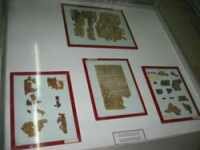
Fragments of the scrolls on display at the Archeological Museum, AmmanThe Dead Sea Scrolls comprise roughly 600 documents, including texts from the Hebrew Bible, discovered between 1947 and 1956 in eleven caves in and around the Wadi Qumran (near the ruins of the ancient settlement of Khirbet Qumran, on the northwest shore of the Dead Sea). The texts are of great religious and historical significance, as they are practically the only remaining Biblical documents dating from before AD 100.

According to carbon dating and textual analysis, the documents were written at various times between the middle of the 2nd century BC and the 1st century AD. At least one document has a carbon date range of 21 BC–AD 61. The Nash Papyrus from Egypt, containing a copy of the Ten Commandments, is the only other Hebrew document of comparable antiquity. Similar written materials have been recovered from nearby sites, including the fortress of Masada.


More...
 

Subscribe


LifeNews.com

Desiring God Blog

Youth for Christ International