Showing posts with label Christian church. Show all posts

Friday, November 19, 2010

Early Church Fathers

The Early Church Fathers, (Church Fathers, or Fathers of the Church) are the early and influential theologians and writers in the Christian Church, particularly those of the first five centuries of Christian history. The term is used of writers and teachers of the Church, not necessarily saints. It is generally not meant to include the New Testament authors, though in the early Church some writing of Church Fathers were considered canonical (those books considered to be inspired by God or to express the authoritative history of the relationship between God and his people).

Apostolic Fathers
The very earliest Church Fathers, of the first two generations after The Twelve Apostles of Christ, are usually called the Apostolic Fathers.

Famous Apostolic Fathers include
  • Ignatius of Antioch
  • Polycarp of Smyrna
  • Clement of Rome

In addition, the Didache (a brief early Christian treatise (c. 70–160 CE), containing instructions for Christian communities) and The Shepherd of Hermas (a Christian work of the second century, considered a valuable book by many Christians, and occasionally considered canonical scripture by some of the early Church fathers) are usually placed among the writings of the Apostolic Fathers although their authors are unknown.

More...
Sunday, May 03, 2009

Christian Church

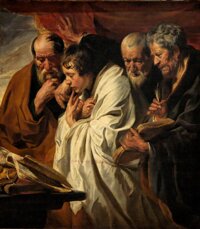
The Four Evangelists. Oil on canvas, ca. 1625–1630, Jakob Jordaens (Dutch, 1593–1678)The Christian Church is a religiously ambiguous and cultural-sociological term to refer to all religions based on the worship of Jesus of Nazareth as the son of God. It is not a single religious institution. Today there is no single political entity recognized by the secular world as the unique Christian Church.

The Roman Catholic Church and the Orthodox Churches all claim to be the unique church established by Jesus in the Great Commission. Protestants, on the other hand, hold that the concept is justified by the notion that the Church is ultimately headed by Jesus Christ himself, who acts as the unifying figure for all who follow Him. Anglicans feel that they are but a branch of the Church. The term means something quite different for each religious institution that sees itself as belonging to the Christian traditions.

The phrase The Church in its widest sense, as the Body of Christ has a similar breadth.

The word "church" is used in two senses:

  1. the visible
    • The visible church consists of all the people that claim to be Christians and go to church.
  2. and

  3. the invisible church.
    • The invisible church is the actual body of Christians; those who are truly saved. The true church of God is not an organization on earth consisting of people and buildings, but is really a supernatural entity comprised of those who are saved by Jesus.
More...

Friday, July 25, 2008

The AIDS Crisis

HIV prevalence from national population-based surveys in countries in West and Central Africa, 2003-2007 © Joint United Nations Programe on HIV/AIDS(UNAIDS) and World Health Organization (WHO) 2007Acquired Immune Deficiency Syndrome (AIDS or Aids) is a collection of symptoms and infections in humans resulting from the specific damage to the immune system caused by the human immunodeficiency virus (HIV). The late stage of the condition leaves individuals prone to opportunistic infections and tumors. Although treatments for AIDS and HIV exist to slow the virus's progression, there is no known cure.

HIV is transmitted through direct contact of a mucous membrane or the bloodstream with a bodily fluid containing HIV, such as blood, semen, vaginal fluid, preseminal fluid, and breast milk.

This transmission can come in the form of anal, vaginal or oral sex, blood transfusion, contaminated hypodermic needles, exchange between mother and baby during pregnancy, childbirth, or breastfeeding, or other exposure to one of the above bodily fluids.

Most researchers believe that HIV originated in sub-Saharan Africa during the twentieth century; it is now a pandemic, with an estimated 38.6 million people now living with the disease worldwide.

More...

Monday, May 12, 2008

Christian church

The Four Evangelists. Oil on canvas, ca. 1625–1630, Jakob Jordaens (Dutch, 1593–1678)The Christian Church is a religiously ambiguous and cultural-sociological term to refer to all religions based on the worship of Jesus of Nazareth as the son of God. It is not a single religious institution. Today there is no single political entity recognized by the secular world as the unique Christian Church.

The Roman Catholic Church and the Orthodox Churches all claim to be the unique church established by Jesus in the Great Commission. Protestants, on the other hand, hold that the concept is justified by the notion that the Church is ultimately headed by Jesus Christ himself, who acts as the unifying figure for all who follow Him. Anglicans feel that they are but a branch of the Church. The term means something quite different for each religious institution that sees itself as belonging to the Christian traditions.

The phrase The Church in its widest sense, as the Body of Christ has a similar breadth.


The word "church" is used in two senses:

  1. the visible and
    • The visible church consists of all the people that claim to be Christians and go to church.
  2. the invisible church.
    • The invisible church is the actual body of Christians; those who are truly saved. The true church of God is not an organization on earth consisting of people and buildings, but is really a supernatural entity comprised of those who are saved by Jesus.

Terminology

Throughout history there have been various terms that have been used to express the concept of a united Christian Church. This section discusses some of these.

The English word church derives from the Greek κυριακή (kyriake), "Lord's (house)". The term has expanded over time to the allow today's more general meanings.

More...


Subscribe


LifeNews.com

Desiring God Blog

Youth for Christ International