rss rss
Subscribe

Share/Save/Bookmark

Monday, October 08, 2007

Ephesus

The Roman Theater at EphesusEphesus ( Greek: Έφεσος see also List of traditional Greek place names, Turkish: Efes) was one of the great cities of the Ionian Greeks in Asia Minor, located in Lydia where the Cayster river flows into the Aegean Sea (in modern day Turkey). It was founded by colonists principally from Athens. The ruins of Ephesus are a major tourist attraction, especially for people travelling to Turkey by cruise ship via the port of Kuşadası.

Ancient Ephesus

Ephesus is believed by many to be the Apasa (or Abasa) mentioned in Hittite sources as the capital of the kingdom of Arzawa. Mycenaean pottery has been found in excavations at the site.

The many-breasted "Lady of Ephesus", identified by Greeks with Artemis, was venerated in the Temple of Artemis, the largest building of the ancient world, according to Pausanias (4.31.8) and one of the Seven Wonders of the World, of which scarcely a trace remains.


Roman Ephesus

Beginning in the Roman Republic, Ephesus was the capital of proconsular Asia, which covered the western part of Asia Minor.

More...

Saturday, October 06, 2007

Zealot

Simon the Zealot was a brother of James the Great and St Jude Thaddeus. He is portrayed with a large, serrated saw. It was with this that he was eventually martyred for his faith. St Simon was cut in half by heathens in a most gruesome way. (image courtesy of www.art.nl)A member of an ancient Jewish sect in Judea in the first century who fought to the death against the Romans and who killed or persecuted Jews who collaborated with the Romans. Zealotry (with an upper case "Z") was a movement in first century Judaism, described by Flavius Josephus as one of the "four sects" at this time. The term Zealot, Kanahi (Hebrew: קנאי, plural: kanahim, קנאים); is a term given for a "zealot". It literally means one who is "jealous" on behalf of God.The term is Greek in origin. The lower case form in modern English is used to refer to any form of zeal, especially in cases where activism and ambition in relation to ideology have become excessive, possibly to the point of being harmful to others, oneself, and one's own cause. A zealous person is called a zealot. In non-political or non-religious terms, zeal is an ordinary word and simply means extreme enthusiasm and passion for a particular activity.


History

Zealotism denotes zeal in excess, usually on behalf of Israel's God. The original Zealots were a Jewish political movement in the 1st century AD which sought to incite the people of Iudaea Province to rebel against the Roman Empire and expel it from the country by force of arms during the Great Jewish Revolt (AD 66-70). When the Romans introduced the imperial cult, the Jews had rebelled and been put down. The Zealots continued to oppose the Romans, on the grounds that Israel belonged only to a Jewish king descended from David.

More...

Friday, October 05, 2007

Gethsemane

The Garden of Gethsemane. The Church of All Nations is visible in the background. Gethsemane (also spelled Gethsemani) was the garden where, according to the New Testament and Christian traditions, Jesus watched and prayed the night before he was crucified and suffered for the sins of the world (see Atonement). According to Luke 22:43–44, Jesus' anguish in Gethsemane was so deep that "his sweat was as it were great drops of blood falling down to the ground." Gethsemane was also where Christ was betrayed by the disciple Judas Iscariot.

The garden identified as Gethsemane is located at the foot of the Mount of Olives, now within the city of Jerusalem. Located by the garden is the Church of All Nations, also known as the Church of the Agony.

The ancient church was destroyed by the Sassanids in 614. The church rebuilt on the site by the Crusaders was finally razed, probably in 1219.

The name Gethsemane is given in the Greek of the Gospels (Matthew 26:36 and Mark 14:32) as Γεθσημανι (Gethsêmani). This represents the Aramaic (see also: Aramaic of Jesus) 'Gath-Šmânê', meaning 'the oil press' or 'oil vat' (referring to olive oil). It would appear from this that there were a number of olive trees planted around the area at the time.

More...

Thursday, October 04, 2007

Tower of Babel

Figures de la Bible. Illustrated by Gerard Hoet, and others. Published by P. de Hondt in The Hague (La Haye). 1728. Image courtesy Bizzell Bible Collection, University of Oklahoma Libraries.The tower constructed by the builders at Babel (that is, Babylonia - modern day Iraq) became a symbol of their defiance against God, (Gen. 11:1-6). It was probably modeled after a ziggurat which is a mound of sun-dried bricks and was probably constructed before 4,000 bc.

According to the narrative in Genesis 11 of the Bible, the Tower of Babel was a tower built by a united humanity to reach the heavens. Because the hearts of men were said to be inherently evil and disobedient, they were striving to make a name for themselves instead of worshipping the God who created them. Because of this open defiance, God stopped their efforts by confusing languages so that no one could understand each other. As a result, they could no longer communicate and the work was halted. The builders were then scattered to different parts of Earth. This story is used to explain the existence of many different languages and races.

The story is found in Genesis 11:1-9 as follows:

1Now the whole world had one language and a common speech. 2As men moved eastward, they found a plain in Shinarand settled there. 3They said to each other, "Come, let's make bricks and bake them thoroughly." They used brick instead of stone, and tar for mortar. 4Then they said, "Come, let us build ourselves a city, with a tower that reaches to the heavens, so that we may make a name for ourselves and not be scattered over the face of the whole earth."

5But the LORD came down to see the city and the tower that the men were building. 6The LORD said, "If as one people speaking the same language they have begun to do this, then nothing they plan to do will be impossible for them. 7Come, let us go down and confuse their language so they will not understand each other."

8So the LORD scattered them from there over all the earth, and they stopped building the city. 9That is why it was called Babel —because there the LORD confused the language of the whole world. From there the LORD scattered them over the face of the whole earth.


More...

Wednesday, October 03, 2007

Persecution of Christians

martyrdom of St. Paul, 16th - 17th century, Hendrik Goltzius Many Christians have experienced persecution from both non-Christians and from other Christians during the history of Christianity. Persecution may refer to unwarranted arrest, imprisonment, beating, torture, or execution. It also may refer to the confiscation or destruction of property, or incitement to hate Christians.

The New Testament reports that the earliest Christians suffered persecution at the hands of the Jewish leadership of the day, commencing with Jesus Himself. It also reports the beginning of persecutions by the Romans (see Rome). However the definition of Jewish is frequently used in an undiscriminating way that has been the cause of later controversy.


The first Christians were born and raised under Judaism, as Christianity began as a sect of Judaism. The earliest examples of "Jewish persecution of Christians" could better be understood perhaps as examples of "Jewish persecution of other Jews," that is, sectarian conflict. The creeds of early Christianity (for example 1Cor 15:3-9) were a clear departure from Pharisaic Judaism of the time. However, several other Jewish sects of this time such as the Essenes were similarly heterodox.

More...

Tuesday, October 02, 2007

Syriac Peshitta

Peshitta text of Exodus 13:14-16 produced in Amida in the year 464The Peshitta is the standard version of the Bible in the Syriac language.

The name 'Peshitta'

The name 'Peshitta' is derived from the Syriac mappaqtâ pšîṭtâ (ܡܦܩܬܐ ܦܫܝܛܬܐ), literally meaning 'simple version'. However, it is also possible to translate pšîṭtâ as 'common' (that is, for all people), or 'straight', as well as the usual translation as 'simple'. Syriac is a dialect, or group of dialects, of Eastern Aramaic. It is written in the Syriac alphabet, and is transliterated into the Roman alphabet in a number of ways: Peshitta, Peshittâ, Pshitta, Pšittâ, Pshitto, Fshitto. All of these are acceptable, but 'Peshitta' is the most convenient spelling in English.

History of the Syriac versions

Peshitta text of Exodus 13:14-16 produced in Amida in the year 464. The name 'Peshitta' was first applied to the standard, common Syriac Bible in the ninth century, when it is called such by Moshe bar Kepha. However, it is clear that the Peshitta had a long and complex history before receiving its name. In fact the Peshitta Old Testament and New Testament are two completely separate works of translation.

The Peshitta Old Testament is the earliest piece of Syriac literature of any length, probably originating in the second century.

More...

Monday, October 01, 2007

Doctrine of the Trinity

depiction of The Holy TrinityGod is a single being existing simultaneously as three distinct persons: The Father, The Son, and the Holy Spirit. The doctrine of the trinity is a reference to the "tri-unity" of God. There is only one God, but this God is a unity of one (Deuteronomy 6:4; Isaiah 44:6-8; 45:5-6; 1 Tim 2:5; 1 Cor 8:4). This God is also a complexity within unity (Gen. 2:24; 11:6; 1 Cor 3:6-8).

Scripture and tradition

The word "Trinity" comes from "Trinitas", a Latin abstract noun that most literally means "three-ness" (or "the property of occurring three at once"). Or, simply put, "three are one". The first recorded use of this Latin word was by Tertullian in about 200, to refer to Father, Son and Holy Spirit, or, in general, to any set of three things.

The Greek term used for the Christian Trinity, "Τριάς" (a set of three or the number three), has given the English word triad. The Sanskrit word, "Trimurti," has a similar meaning, as has "Dreifaltigkeit" in German, and many other words in other languages.

The New Testament does not use the word "Τριάς" (Trinity), but only speaks of God (often called "the Father"), of Jesus Christ (often called "the Son"), and of the Holy Spirit, and of the relationships between them. The word "Trinity" began to be applied to them only in the course of later theological reflection.

The earliest Christians were noted for their insistence on the existence of one true God, in contrast to the polytheism of the prevailing culture. While maintaining strict monotheism, they believed also that the man Jesus Christ was at the same time something more than a man (a belief reflected, for instance, in the opening verses of the Letter to the Hebrews, which describe him as the reflection of God's glory and bearing the impress of God's own being, and, yet more explicitly, in the prologue of the Gospel according to John) and also with the implications of the presence and power of God that they believed was among them and that they referred to as the Holy Spirit. St Paul even goes so far as to state that "in [Jesus] lives all the fullness of Deity bodily" (Colossians 2:9).

More...

Saturday, September 29, 2007

Koine Greek

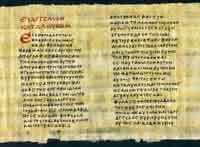
Luke 2:1-9, in the original Koine GreekKoine Greek refers to the forms of the Greek language used in post-classical antiquity (c.300 BC – AD 300). Other names are Alexandrian, Hellenistic, Common, or New Testament Greek. Koine Greek is important not only to the history of the Greeks for being their first common dialect and main ancestor of Demotic Greek, but it is also significant for its impact on Western Civilization as a lingua franca (a common language used by speakers of different languages; "Koine is a dialect of ancient Greek that was the lingua franca of the empire of Alexander the Great and was widely spoken throughout the eastern Mediterranean area in Roman times" for the Mediterranean.


John 1 beginning fragment in the original Koine Greek

Koine Greek: "In [The]Beginning was the Word, and the Word was with God, and God was the Word. This one was in [The]Beginning with God all things through Him came to be, and without Him came to be not one thing. That which came into being in Him was life, and the life was the light of men; and the light" [in the darkness shines and the darkness did not grasp it.]
English: In the beginning was the Word, and the Word was with God, and the Word was God. 2He was with God in the beginning. Through him all things were made; without him nothing was made that has been made. In him was life, and that life was the light of men. The light [shines in the darkness, but the darkness has not understood it.] -John 1:1-5


Koine also was the original language of the New Testament of the Christian Bible as well as the medium for the teaching and spreading of Christianity. Koine Greek was unofficially a first or second language in the Roman Empire.


More...
Friday, September 28, 2007

Son of Man

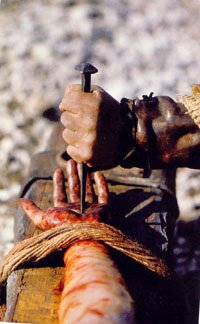
depiction of Christ being nailed to the crossIn the bible, Jesus (Greek: Ίησους (Iēsous), itself a Hellenization of the Hebrew יהושע (Yehoshua) or Aramaic ישוע (Yeshua) often refers to Himself as the Son of Man.
32They were on their way up to Jerusalem, with Jesus leading the way, and the disciples were astonished, while those who followed were afraid. Again he took the Twelve aside and told them what was going to happen to him. 33"We are going up to Jerusalem," he said, "and the Son of Man will be betrayed to the chief priests and teachers of the law. They will condemn him to death and will hand him over to the Gentiles, 34who will mock him and spit on him, flog him and kill him. Three days later he will rise." -Mark 10:32-34

Christian interpretation

The phrase son of man took on Messianic significance within the Christian movement primarily due to the Jewish eschatology during the time of its early conception. Originating in the book of Daniel, in a vision, one like a son of man is described coming upon the clouds of the sky to unite the world. As a result, some Christians believe that in the body of the New Testament, son of man is used forty-three times as a distinctive title of Jesus within this Messianic context. Other Christians interpret it as Jesus showing humility, avoiding using titles like Messiah and Son of God. Still other Christians believe the title is meant to signify Jesus upholding his identification with his humanity and fellowship with mankind, perhaps also conveying the idea that Jesus is the man par excellence. In this last context it serves as putting humans and Jesus on the same level.


More...

Thursday, September 27, 2007

Barnabas

Paul and Barnabas at Lystra. 1650 Oil on canvas. Musée d’Art, Saint-EtienneBarnabas was an early Christian mentioned in the New Testament. His Hellenic Jewish parents called him Joseph, (although the Byzantine text-type calls him Joses, the Aramaic version of Joseph, see also: Aramaic of Jesus) but when he sold all his goods and gave the money to the apostles in Jerusalem, they gave him a new name: Barnabas, which means huios parakleseos (Greek: υιος παρακλήσεως) "son of exhortation," or 'man of encouragement.' see Acts 11:23) and connotes a prophet in the primitive Christian sense of the word (see Acts 13:1; 15:32). His feast day is June 11. In many English translations of the Bible, including the New International Version (NIV), King James Version (KJV), and New American Standard Bible (NASB), Barnabas is called an apostle. In Acts 14:14 of these translations, he is listed ahead of Paul, "Barnabas and Paul," instead of "Paul and Barnabas;" both men being described as apostles. Whether Barnabas was an apostle became an important political issue, which was debated in the Middle Ages.
8-10There was a man in Lystra who couldn't walk. He sat there, crippled since the day of his birth. He heard Paul talking, and Paul, looking him in the eye, saw that he was ripe for God's work, ready to believe. So he said, loud enough for everyone to hear, "Up on your feet!" The man was up in a flash—jumped up and walked around as if he'd been walking all his life.

11-13When the crowd saw what Paul had done, they went wild, calling out in their Lyconian dialect, "The gods have come down! These men are gods!" They called Barnabas "Zeus" and Paul "Hermes" (since Paul did most of the speaking). The priest of the local Zeus shrine got up a parade—bulls and banners and people lined right up to the gates, ready for the ritual of sacrifice.

14-15When Barnabas and Paul finally realized what was going on, they stopped them. Waving their arms, they interrupted the parade, calling out, "What do you think you're doing! We're not gods! We are men just like you, and we're here to bring you the Message, to persuade you to abandon these silly god-superstitions and embrace God himself, the living God. We don't make God; he makes us, and all of this—sky, earth, sea, and everything in them. -Acts 14:10-15 (The Message)

More...

Wednesday, September 26, 2007

documentary hypothesis

A relational diagram describing the various versions postulated by the biblical documentary hypothesis. The documentary hypothesis (DH) proposes that the first five books of the Old Testament (Genesis, Exodus, Leviticus, Numbers and Deuteronomy, known collectively as the Torah or Pentateuch), represent a combination of documents from four originally independent texts dating from various periods between the early 8th and late 5th centuries BCE. The hypothetical texts are:

  • the J, or Yahwist, text

  • the E, or Elohist, text (edited with J to form a combined JE text)

  • the P, or Priestly, text

  • the D, or Deuteronomist, text (which had a further major edit, resulting in sub-texts known as Dtr1 and Dtr2).
The texts were combined into their current form in the post-Exilic period (late 5th century BC) by an editor known as R (for Redactor, see Torah redactor), who also made small additions to harmonise discrepencies between his sources.

More...

Tuesday, September 25, 2007

The Lord's Day

The Scotish Church - view from Mishkenot Sha’ananim, Jerusalem (photo © Deror avi) The "Lord's Day" is used by the Apostle John in Revelation 1:10, when John starts receiving his Revelations on the Jewish Sabbath. He is clearly quoting Jesus in Matt. 12:8 where he says: "I'm the LORD OF THE SABBATH."

The name Lord's Day

Origins

The first appearance of the term kyriake hemera is in the New Testament, in the Book of Revelation, which was written in the latter decades of the first century.

In Rev. 1:10, the author writes, "I was in the Spirit on the Lord's Day." Most Christian commentators interpret Rev. 1:10 as a reference to Sunday, however this interpretation lacks contextual force since nothing in the passage implies he's talking about the first day of the week, Sunday. Also, the argument that the Lord's Day in Revelation 1:10 refers to the eschatological day of the Lord lacks contextual force as well since nothing in the adjacent passage implies the Second Coming or the Day of Judgment. Based on Jesus assertion that he was the "Lord of the Sabbath" (cf. Matt. 12:8), the "Lord's Day" of Revelation can only refer to the Jewish Sabbath, observed by Jesus and his Apostles.


More...

Monday, September 24, 2007

Exegesis

Tree of Life, MedievalExegesis (from the Greek ἐξηγεῖσθαι 'to lead out') involves an extensive and critical interpretation of a text, especially of a holy scripture, such as of the Old and New Testaments of the Bible, the Talmud, the Midrash, the Qur'an, etc. An exegete is a practitioner of this science, and the adjectival form is exegetic.

The word exegesis means "to draw the meaning out of" a given text. Exegesis may be contrasted with eisegesis, which means to read one's own interpretation into a given text. In general, exegesis presumes an attempt to view the text objectively, while eisegesis implies more subjectivity.

One may encounter the terms exegesis and hermeneutics used interchangeably; however, there remains a distinction. Exegesis is the practical application of hermeneutics, which is the interpretation and understanding of a text on the basis of the text itself.


Traditional exegesis requires the following: analysis of significant words in the text in regard to translation; examination of the general historical and cultural context, confirmation of the limits of the passage, and lastly, examination of the context within the text.


Although the most widely-known exegeses concern themselves with Christian, Jewish and Islamic books, analyses also exist of books of other religions.

More...

Friday, September 21, 2007

The parables of Jesus

The Good Samaritan, Rembrandt Harmensz. van RijnThe parables of Jesus, found in the Synoptic Gospels, embody much of Jesus' teaching. Jesus' parables are quite simple, memorable stories, often with humble imagery, each with a single message. Jesus, for example, likened the Kingdom of God to leaven (an image usually meant as corruption) or a mustard seed. Like his aphorisms, Jesus' parables were often surprising and paradoxical. The parable of the good Samaritan, for example, turned expectations on their head with the despised Samaritan proving to be the wounded man's neighbor. The parables were simple and memorable enough to survive in an oral tradition before being written down years after Jesus' death.

His parables are sometimes interpreted as allegories in the gospels themselves and in Christian tradition. In such an allegory, each element corresponds metaphorically to a class of people (e.g., false Christians), a heavenly reward, or some other topic. The gospel of John includes allegories but no parables. Parables are attributed to Jesus in the three synoptic gospels of the New Testament and the noncanonical Gospel of Thomas. According to some interpretations, the Gospel of John also contains a parable.

More...

New Testament view on the life of Jesus

Jesus Christ being nailed to the cross The four canonical gospels of the New Testament are the main sources of information for the traditional Christian narrative of Jesus' life.

The Gospels give two accounts of Jesus' genealogy: one in the male line through his legal father Joseph of Nazareth (Matt 1:2–16 and one through his mother, Mary, while referencing his supposed father; Luke 3:23–38). Both accounts trace his line back to King David and from there to Abraham. These lists are identical between Abraham and David, but they differ between David and Joseph. Matthew starts with Solomon and proceeds through the kings of Judah to the last king, Jeconiah. After Jeconiah the line of kings terminated when Babylon conquered Judah. Thus, Matthew shows that Jesus is the legal heir to the throne of Israel. Luke's genealogy is longer than Matthew's; it goes back to Adam and provides more names between David and Jesus, thus giving us direct descendants from Adam to Jesus through Mary.

Joseph of Nazareth appears only in descriptions of Jesus' childhood. With Jesus commending Mary into the care of the beloved disciple during his crucifixion (John 19:25–27), it is likely that he had died by the time of Jesus' ministry. Both Matthew 13:55–56 and Mark 6:3 tell of Jesus' relatives. Mark 6:3 reports that those hearing Jesus asked, "Isn't this the carpenter? Isn't this Mary's son and the brother of James, Joseph, Judas and Simon? Aren't his sisters here with us?" The apostle Paul, in his letter to the Galatians, mentions at 1:19 that "I saw none of the other apostles—only James, the Lord's brother." The first-century Jewish historian Flavius Josephus also describes James the Just as "the brother of Jesus, who was called Christ" (translation of William Whiston), though this passage has been suggested as an interpolation (see Josephus on Jesus). Additionally, the Christian historian Eusebius (who wrote in the 4th century but quoted earlier sources that are now lost) refers to James the Just as Jesus' brother (see Desposyni). However, Epiphanius argued that they were "Joseph's children by his (unrecorded) first wife", while Jerome argued that they were "Jesus' cousins". The Greek word adelphos in these verses is often translated as brother in many Bible translations. However, the word can refer to any familial relation, and Roman Catholic and Eastern Orthodox traditions, along with certain other Christians, cite later revelations concerning the perpetual virginity of Mary, contend the correct translation of adelphos is kinsman or cousin.

More...

Thursday, September 20, 2007

miracles of Jesus

Resurrection of Lazarus by Juan de Flandes, around 1500.According to the canonical Gospels, Jesus performed many miracles in the course of His ministry. The majority of them are various cures, although there are a large number of exorcisms, three instances of raising the dead, and various other miracles that do not fit into these categories.

Power over deathThe Gospels report three cases where Jesus calls a dead person back to life. In one, the daughter of Jairus had just died, and Jesus says she was only sleeping and wakes her with a word. Another case involves a young man being brought out for burial. When Jesus sees his widowed mother, he has pity and raises him from the dead. The third case involves a close friend of Jesus, Lazarus (right), who has been four days in the tomb.

Expelling demonsBelief in supernatural creatures was very common in the first century Judea, as it was nearly everywhere in the world.

According to a literal reading of the Synoptic Gospels, Jesus was present at multiple examples of demonic possession, while these incidents are not mentioned by the Gospel of John.

More...

Wednesday, September 19, 2007

Josephus on Jesus

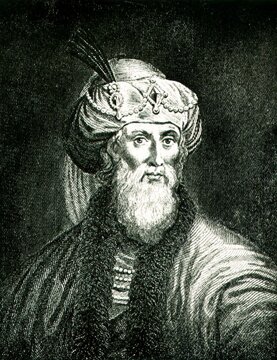
A woodcut of Flavius Josephus by John C. Winston.In 93, the Jewish historian Flavius Josephus published his work Antiquities of the Jews. The extant copies of this work, which all derive from Christian sources, even the recently recovered Arabic version, contain two passages about Jesus. The one directly concerning Jesus has come to be known as the Testimonium Flavianum, and its authenticity has been disputed since the 17th century. The other passage concerns James the brother of Jesus.

Testimonium Flavianum

Greek version

The passage appears in Antiquities of the Jews xviii 3.3, which, in the translation of William Whiston, reads:

3. Now there was about this time Jesus, a wise man, if it be lawful to call him a man; for he was a doer of wonderful works, a teacher of such men as
receive the truth with pleasure. He drew over to him both many of the Jews and
many of the Gentiles. He was [the] Christ. And when Pilate, at the suggestion of
the principal men amongst us, had condemned him to the cross, those that loved
him at the first did not forsake him; for he appeared to them alive again the
third day; as the divine prophets had foretold these and ten thousand other
wonderful things concerning him.

And the tribe of Christians, so named from him, are not extinct at this day.

As usual with ancient texts, the surviving sources for this passage are Greek manuscripts, all minuscules, the oldest of which dates from the 9th century. It is likely that these all derive from a single exemplar written in uncial, as is the case with most other ancient Greek texts transmitted to the present in medieval copies, and have come down through the hands of the church. The text of Antiquities appears to have been transmitted in two halves — books 1–10 and books 11–20. But other ad hoc copies of this passage also exist. However, other manuscripts existed which did not contain this passage, and one such was known to Isaac Vossius.

There are also citations in other writers of antiquity.

More...

Tuesday, September 18, 2007

lineage of Jesus

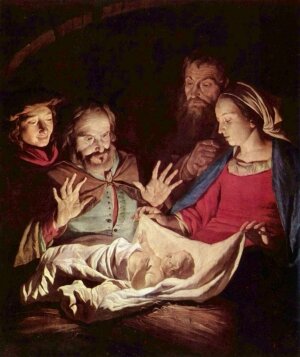
The infant Jesus in Adoration of the Shepherds, Gerard van HonthorstThe lineage of Jesus is recorded in two places in the bible:
1) Matthew 1:1-17, and

2) Luke 3:23-38 (in addition to several other new testament references: Mark 10:47, luke 1:32, Acts 2:29-30, Rev. 5:5, 22:16).

The Matthew 1:1-17 and Luke 3:23-38 accounts differ because, Luke follows Mary's lineage (Jesus' blood mother), through David's son Nathan (Luke's genealogy focused on Jesus' descent from God through the virgin birth. It placed no emphasis on Jesus being the descendant of king David) and the Matthew genealogy follows Joseph's line (Joseph being the legal father of Jesus, see below) through David's son Solomon.

God's promise to David was fulfilled because mary was the biological parent of Jesus.

The virgin birth also addressed the curse God had pronounced upon Jehoiakim. Kingship was an inherited right. By Joseph, Jesus inherited a legal claim to the throne of David. However, he was exempt from the curse of Jehoiakim (Jeremiah 36:1-32, i.e. Joseph's offspring could not claim David's throne because of the curse) because Joseph was not the genetic father of Jesus.

More...

Monday, September 17, 2007

historicity of Jesus

Jesus, aged 12, teaching the doctors of the faithThe historicity of Jesus (i.e., his existence as an actual historical figure), is accepted as a theological axiom by three world religions, Christianity, Islam and the Bahá’í Faith, based on their respective scriptures.

The earliest known sources are Christian writings - the New Testament - which, according to modern historians, were written several decades after he is said to have died.

However, while Christianity and the Bahá'í Faith also consider Jesus to be the Christ (Messiah) and Son of God, and Islam views him as a prophet, secular historians and followers of most other world religions (including Judaism) tend to regard him as an ordinary human.

Most scholars, however, agree that Jesus was an historical figure regardless of their perspectives on His teaching, His message of salvation, or statements about Himself.

More...

Saturday, September 15, 2007

Jerusalem

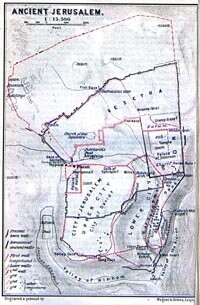
From Palestine and Syria. Handbook for Travellers by Karl Baedeker, 5th Edition, 1912Jerusalem is the holiest city of Judaism (since the 10th century BCE) and some denominations of Christianity (since the 5th century CE) and, after Mecca and Medina, the third holiest city of Islam (since the 7th century CE). A heterogeneous city, Jerusalem represents a wide range of national, religious, and socioeconomic groups. The section called the "Old City" is surrounded by walls and consists of four quarters: Armenian, Christian, Jewish, and Muslim.

37"O Jerusalem, Jerusalem, you who kill the prophets and stone those sent to you, how often I have longed to gather your children together, as a hen gathers her chicks under her wings, but you were not willing. 38Look, your house is left to you desolate. 39For I tell you, you will not see me again until you say, 'Blessed is he who comes in the name of the Lord." -יהושע Yehoshua, Matthew 23:37-39
The status of the united Jerusalem as Israel's capital is not widely recognized by the international community, and Israel's annexation of East Jerusalem is particularly controversial.

Jerusalem has long been embedded into the religious consciousness of the Jewish people. Jews have always studied and personalized the struggle by King David to capture Jerusalem and his desire to build the Jewish temple there, as described in the Book of Samuel and the Book of Psalms. Many of King David's yearnings about Jerusalem have been adapted into popular prayers and songs.

More...

Friday, September 14, 2007

Rome

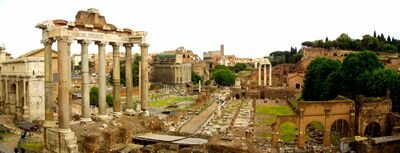
The Roman Forum was the central area around which ancient Rome developedAncient Rome was a civilization that grew out of the city-state of Rome, founded on the Italian peninsula around 800 BC. During its twelve-century existence, the Roman civilization shifted from a monarchy to an oligarchic republic to a vast empire. It came to dominate Western Europe and the entire area surrounding the Mediterranean Sea through conquest and assimilation.

The western half of the empire, including Hispania, Gaul, and Italia, eventually succumbed to a number of factors and broke into independent kingdoms in the 5th century (see The Roman Empire). The eastern empire, governed from Constantinople, is referred to as the Byzantine Empire after 476 AD.

The city of Rome grew from settlements around a ford on the river Tiber, a crossroads of traffic and trade.

According to archaeological evidence, the village of Rome was probably founded sometime in the 9th century BC by members of two central Italian tribes, the Latins and the Sabines, on the Palatine, Capitoline, and Quirinal Hills.

The Etruscans, who had previously settled to the north in Etruria, seem to have integrated into the region by the late 9th century BC and formed the aristocratic and monarchial elite. The Etruscans apparently lost power in the area by the late 6th century BC, and at this point, the original Latin and Sabine tribes reinvented their government by creating a republic, with much greater restraints on the ability of rulers to exercise power.

More...

Thursday, September 13, 2007

Tarsus

Location of Tarsus in TurkeyTarsus (Greek Ταρσός) is a city and a large district in Mersin Province, Turkey, 25 km from the city of Mersin and near (40 km) to the city of Adana.

With a history going back 5,000 years Tarsus has long been an important stop for traders to the Orient, a focal point of many civilisations including the Ancient Romans when Tarsus was capital of the province of Cilicia, scene of the romance between Mark Anthony and Cleopatra and birthplace of Saint Paul.


Because of its critical and strategic location, invulnerable from the Tarus Mountains, from the north, and the Mediterranean, on the south, the city was a treasure for many peoples. After the Roman Empire Tarsus wasted away to a small city in the aftermath of hostilities between differing Christian and Muslim empires.


In about 170 BC Tarsus became a free city, leaving it open to Greek culture and Education. By the time of Christ, Tarsus was on a cultural parallel with great cities such as Athens and Alexandria, being a pedagogical center of the world.


Paul Speaks to the Crowd

21

37As the soldiers were about to take Paul into the barracks, he asked the commander, "May I say something to you?"


"Do you speak Greek?" he replied. 38"Aren't you the Egyptian who started a revolt and led four thousand terrorists out into the desert some time ago?"


39Paul answered, "I am a Jew, from Tarsus in Cilicia, a citizen of no ordinary city. Please let me speak to the people."


40Having received the commander's permission, Paul stood on the steps and motioned to the crowd. When they were all silent, he said to them in Aramaic:


22

1"Brothers and fathers, listen now to my defense." 2When they heard him speak to them in Aramaic, they became very quiet. -Paul of Tarsus (Acts 21:37-22:11)


More...

Wednesday, September 12, 2007

Jericho

The Taking of Jericho, by Jean FouquetJericho (Arabic أريحا , Hebrew יְרִיחוֹ ) - Holy echo is a town in the West Bank, Palestine near the Jordan River. Jericho has a population of approximately 19,000. It is believed by some to be the oldest continuously occupied settlement in the world. The current mayor of Jericho is Hassan Saleh.

Archaeology

Three separate settlements have existed at or near the current location for more than 11,000 years. The position is on an east-west route north of the Dead Sea.

The first archaeological excavations of the site were made by Charles Warren in 1868. Ernst Sellin and Carl Watzinger excavated Tell es-Sultan and Tulul Abu el-'Alayiq between 1907-1909 and in 1911. John Garstang excavated between 1930 and 1936. Extensive investigations using more modern techniques were made by Kathleen Kenyon between 1952 and 1958. Lorenzo Nigro and Nicolo Marchetti conducted a limited excavation in 1997. Later that same year, Dr. Bryant Wood also made a visit to the site to verify the findings of the earlier 1997 team.


More...

Tuesday, September 11, 2007

Damascus

Wall of the New Testament period (called Bab Kisan) in Damascus where Paul escaped to begin his ministry.Damascus (Arabic: دمشق‎) is the capital and largest city of Syria, with close ties to Israel. Founded approximately 2500 BCE, it is thought to be the oldest continuously inhabited city in the world, before Al Fayyum, and Gaziantep. Its current population is estimated at about 4.5 million.

Name


In Arabic, the city is called دمشق الشام Dimashq ash-Shām.


Although this is often shortened to Dimashq by many, the citizens of Damascus, and of Syria and some other Arab neighbors, colloquially call the city ash-Shām. Ash-Shām is an Arabic term for North and for Syria. (Syria — particularly historical Greater Syria — is called Bilād ash-Shām — بلاد الشام, 'country of the north' — in Arabic.) The English name for Damascus is taken from the Greek Δαμασκός, via Latin. This comes from the old Aramaic (see also: Aramaic of Jesus) name for the city — דרמשק Darmeśeq, which means "a well-watered place". However, pre-Aramaic tablets unearthed at Ebla refer to a city to the south of Ebla named Damaski. It is possible that the name 'Damascus' pre-dates the Aramaic era of the city. Damascus is designated as having been part of the ancient province of Amurru in the Hyksos Kingdom, from 1720 to 1570 BC. (MacMillan, pp. 30-31).


More...

Monday, September 10, 2007

Hebron

cave of MachpelahHebron (Al-Khalil) (Arabic الخليل, Hebrew חֶבְרוֹן derived from the word "friend") is a town in the Southern Judea region of the West Bank of around 130,000 Palestinians and 500 Israeli settlers. It lies 3,050 feet (930 m) above sea level.

Geographic coordinates : 31°32' N, 35°6' E

Hebron is located 30km south of Jerusalem. Its elevation from sea level is about 1000m. Hebron is famous for its grapes, limestones, pottery workshops and glassblowing factories. It is also home of the nationally famous Al-Juneidi factory for dairy products.

The old city of Hebron is characterized by its narrow and winding streets, the flat-roofed stone houses, and the old bazaars. It is the home of Hebron University and Palestine Polytechnic University.


More...

Techledo Consulting

Techledo Consulting, LLC

Prevail Magazine

My Photo
Timothy Ministries
View my complete profile