Tuesday, February 08, 2011

The Twelve Apostles

The Twelve Apostles (in Koine Greek "απόστολος" apostolos: "messenger from God, LXX 3 Ki.14.6; esp. of the Apostles, Ev.Matt.10.2, al." (Henry George Liddell, Robert Scott), G652: "a delegate, messenger, one sent forth with orders a) specifically applied to the twelve apostles of Christ) in a broader sense applied to other eminent Christian teachers" (Strong's Concordance) were men that according to the Synoptic Gospels and Christian tradition (see also Oral Tradition), were chosen from among the disciples of Jesus for a mission (see also: Seventy Disciples). According to the Bauer lexicon, Walter Bauer's Greek-English Lexicon of the New Testament: "..Judaism had an office known as apostle שליח".

The Gospel of Mark states that Jesus initially sent out these twelve in pairs (Mark 6:7-13, cf. Matthew 10:5-42, Luke 9:1-6), to towns in Galilee .

Literal readings of the text state that their initial instructions were to heal the sick and drive out demons, but some scholars read this more metaphorically as instructions to heal the spiritually sick and thus to drive away wicked behaviour.

They are also instructed to only take their staffs, and that if any town rejects them they ought to shake the dust off their feet as they leave, a gesture which some scholars think was meant as a contemptuous threat (Miller 26). Their carrying of just a staff is sometimes given as the reason for the use by Christian Bishops of a staff of office, in those denominations that believe they maintain an Apostolic Succession.

More

Monday, February 07, 2011

Syria

Syria (Arabic: سوريا ‎or سورية ), officially the Syrian Arab Republic (Arabic: الجمهورية العربية السورية ), is a country in the Middle East, bordering Lebanon to the west, Palestine to the southwest, Jordan to the south, Iraq to the east (see also: Iraq Maps), and Turkey to the north. The modern state of Syria attained independence from the French mandate of Syria in 1946, but can trace its historical roots to the fourth millennium BC; its capital city, Damascus, was the seat of the Umayyad Empire and a provincial capital of the Mamluk Empire.

Syria has a population of 19 million, of whom the majority are Arabic-speaking Sunni Muslims, as well as 16% other Muslim groups, including the Alawi, Shiite, and Druze, and 10% Christian.

Since 1963 the country has been governed by the Baath Party; the head of state since 1970 has been a member of the Assad family.

Syria's current President is Bashar al-Assad, son of Hafez al-Assad, who held office from 1970 until his death in 2000.

Historically, Syria has often been taken to include the territories of Lebanon, Israel and the Palestinian Territories, and parts of Jordan, but excluding the Jazira region in the north-east of the modern Syrian state. In this historic sense, the region is also known as Greater Syria or by the Arabic name Bilad al-Sham (بلاد الشام ). Since the Six-Day War in 1967, Israel administers the disputed Golan Heights to the southwest of the country; a dispute with Turkey over the Hatay Province has subsided.

The name Syria comes from the ancient Greek name for the former colonial territories of Assyria such as Canaan and Aram.

At the eastern end of the Mediterranean Sea between Egypt and Arabia to the south and Cilicia to the north, stretching inland to include Mesopotamia, and having an uncertain border to the northeast that Pliny the Elder describes as including from west to east Commagene, Sophene, and Adiabene, "formerly known as Assyria" (N.H. 5.66).

More

Friday, February 04, 2011

The Council for Secular Humanism

The Council for Secular Humanism (originally the Council for Democratic and Secular Humanism, or CODESH) is a secular humanist organization headquartered in Amherst, New York. In 1980 CODESH issued A Secular Humanist Declaration, an argument for and statement of belief in Democratic Secular Humanism. The Council for Secular Humanism does not call itself religious and has never claimed tax-exemption as a religious organization; instead it has an educational exemption.

The council made news in 2006 when Borders Group refused to carry the April-May issue of Free Inquiry in their Borders and Waldenbooks stores because of the magazine's publication of 4 cartoons that originally appeared in the Danish newspaper Jyllands-Posten and sparked violent worldwide Muslim protests, (The reason given by Borders for their decision was not sensitivity to religion but fear of illegal violence.) The Free Inquiry affair was reminiscent of a 1989 withdrawal of Salman Rushdie's novel The Satanic Verses by Waldenbooks and B. Dalton in the aftermath of a death sentence issued by Ayatollah Khomeini against the British author as well as the recent Everybody Draw Mohammad Day on May 20, 2010 which resulted in Indian Muslims asking the government to ban facebook.

The notion of secular humanism was the topic in a recent Washinton Post article by columnist Kathleen Parker:

All Roads Lead to Heaven? — Kathleen Parker Does Theology
What catches the attention of a columnist for The Washington Post? A recent column by Kathleen Parker indicates that theology has become a focus of national attention. Kathleen Parker used her column in The Washington Post to take on Franklin Graham and his belief that belief in Jesus Christ is the only way of salvation.

Also:
Edward Tabash-William Lane Craig Debate: "Secular Humanism vs. Christianity: Which One is True?"
February 8, 1999, Pepperdine University, Malibu, California, USA. Edward Tabash, a Beverly Hills attorney who is affiliated with the Council for Secular Humanism, takes on William Lane Craig, a Christian philosopher and Campus Crusade's full-time anti-atheist debater, arguing that Secular Humanism is preferable and more supported by the evidence than Christian Theism. Tabsh does his usual and emotional "God is a big meanie" routine while Craig took him down with ease. Even atheist Richard Carrier said "the rhetorical victory was Craig's.

More

Flagellation of Christ

The Flagellation of Christ, sometimes known as Christ at the Column, is a scene from the Passion of Christ very frequently shown in Christian art, in cycles of the Passion or the larger subject of the Life of Christ. It is one of the modern alternate Stations of the Cross, but is not in the traditional sequence. The column to which Christ is normally tied, and the rope, scourge, whip or birch are elements in the Arma Christi — various places, including the Basilica di Santa Prassede in Rome, claimed to possess the original column.

The event is mentioned in three of the four canonical Gospels, and was the usual prelude to crucifixion under Roman law. In the Passion of Christ it precedes the Mocking of Christ and the Crowning with thorns.

It first appears in art in the West in the 9th century. It is almost never found in Byzantine art, and remains very rare in Eastern Orthodox art at any date. Initially found in illuminated manuscripts and small ivories, there are surviving monumental wall-paintings from around 1000 in Italy. From the start there are most often three figures, Christ and two servants of Pontius Pilate who whip him. In early depictions Christ may be naked, or wearing a long robe, facing out or seen from behind; from the 12th century it is standard that Christ wears a loincloth and faces out towards the viewer.

More

Wednesday, February 02, 2011

Christlike

To be like Christ; showing the spirit of Christ.

Very early in the morning, while it was still dark, Jesus got up, left the house and went off to a solitary place, where he prayed. Simon Peter and his companions went to look for him, and when they found him, they exclaimed: “Everyone is looking for you!”
—Mark 1:35-37, NIV

We know about...
  • Jesus healing the sick;
  • Jesus raising the dead;
  • Jesus throwing the money-changers out of the temple;
  • Jesus having mercy on the woman caught in the act of adultery;
  • Jesus feeding the multitude from a few pieces of bread and a few fish;
  • Jesus performing many miracles.
However, in the above passage we see Jesus in the fullness of His character.

We see Him as one who not only carried out the will of God, but one who sought God's Will during times of solitude in prayer. Jesus sacrificed Himself to carry out the will of God. He could have stopped it at any time, but He allowed it to happen because it was God's Will and because He loves us that much.
Going a little farther, he fell with his face to the ground and prayed, "My Father, if it is possible, may this cup be taken from me. Yet not as I will, but as you will."
-Matthew 26:39
From the Shadows to the Substance
6-7My counsel for you is simple and straightforward: Just go ahead with what you've been given. You received Christ Jesus, the Master; now live him. You're deeply rooted in him. You're well constructed upon him. You know your way around the faith. Now do what you've been taught. School's out; quit studying the subject and start living it! And let your living spill over into thanksgiving. —Colossians 2:6-7, The Message

More

Tuesday, February 01, 2011

The Gospels

Books in the new testament referred to as the Gospels:

In Christianity, a gospel (from Old English, "good news") is generally one of four canonical books of the New Testament that describe the miraculous birth, life, ministry, crucifixion, and resurrection of Jesus. These books are the Gospels according to Matthew, Mark, Luke and John, written between 65 and 100 AD.

Many modern scholars argue that the sequence in which the Gospel accounts have traditionally been printed in the Bible is not the order of their composition, and that the first canonical gospel to have been written is Mark (c 65-70), which in turn was used as a source for the gospels of Matthew and Luke. Matthew and Luke may have also used the hypothetical Q Document. These first three gospels are called the synoptic gospels because they share a similar view. The last gospel, the gospel of John, presents a very different picture of Jesus and his ministry from the synoptics.

The vast majority of biblical scholars believe the canonical gospels were originally written in Greek, although some believe the gospel of Matthew was originally written in Aramaic or Hebrew and later translated to Greek. However, Eusebius wrote that Matthew composed the Gospel According to the Hebrews and his Church Catalog suggests that it was the only Jewish Gospel. Yet, some have accused Eusebius of falsification.

Originally, the "gospel" meant the proclamation of God's saving activity in Jesus of Nazareth, or the agape (love) message proclaimed by Jesus of Nazareth. This is the original New Testament usage (for example Mark 1:14-15 or 1 Corinthians 15:1-9; see also Strong's G2098). The word is still used in this sense. Ancient, non-canonical works that purport to quote Jesus (e.g., Gospel of Thomas) are also called gospels, and the term refers, in general, to works of a genre of Early Christian literature (cf. Peter Stuhlmacher, ed., Das Evangelium und die Evangelien, Tübingen 1983, also in English: The Gospel and the Gospels).

More

Monday, January 31, 2011

Come, everyone who thirsts, come to the waters...

The Compassion of the LORD
1 "Come, everyone who thirsts,
come to the waters;
and he who has no money,
come, buy and eat!
Come, buy wine and milk
without money and without price. -Isaiah 55:1

Read Rev. 6:1-8....

Christ, the Lamb, opens the first seal: observe what appeared. A rider on a white horse. By the going forth of this white horse, a time of peace, or the early progress of the Christian religion, seems to be intended; its going forth in purity, at the time when its heavenly Founder sent his apostles to teach all nations, adding, Lo! I am with you alway, even to the end of the world. The Divine religion goes out crowned, having the Divine favour resting upon it, armed spiritually against its foes, and destined to be victorious in the end. On opening the second seal, a red horse appeared; this signifies desolating judgments. The sword of war and persecution is a dreadful judgment; it takes away peace from the earth, one of the greatest blessings; and men who should love one another, and help one another, are set upon killing one another. Such scenes also followed the pure age of early Christianity, when, neglectful of charity and the bond of peace, the Christian leaders, divided among themselves, appealed to the sword, and entangled themselves in guilt. On opening the third seal, a black horse appeared; a colour denoting mourning and woe, darkness and ignorance. He that sat on it had a yoke in his hand. Attempts were made to put a yoke of superstitious observances on the disciples. As the stream of Christianity flowed further from its pure fountain, it became more and more corrupt. During the progress of this black horse, the necessaries of life should be at excessive prices, and the more costly things should not be hurt. According to prophetic language, these articles signified that food of religious knowledge, by which the souls of men are sustained unto everlasting life; such we are invited to buy, Isaiah 55:1. But when the dark clouds of ignorance and superstition, denoted by the black horse, spread over the Christian world, the knowledge and practice of true religion became scarce. When a people loathe their spiritual food, God may justly deprive them of their daily bread. The famine of bread is a terrible judgment; but the famine of the word is more so. Upon opening the fourth seal, another horse appeared, of a pale colour. The rider was Death, the king of terrors. The attendants, or followers of this king of terrors, hell, a state of eternal misery to all who die in their sins; and in times of general destruction, multitudes go down unprepared into the pit. The period of the fourth seal is one of great slaughter and devastation, destroying whatever may tend to make life happy, making ravages on the spiritual lives of men. Thus the mystery of iniquity was completed, and its power extended both over the lives and consciences of men. The exact times of these four seals cannot be ascertained, for the changes were gradual. God gave them power, that is, those instruments of his anger, or those judgments: all public calamities are at his command; they only go forth when God sends them, and no further than he permits.
-Matthew Henry Commentary

More

Come, everyone who thirsts, come to the waters...

The Compassion of the LORD
1 "Come, everyone who thirsts,
come to the waters;
and he who has no money,
come, buy and eat!
Come, buy wine and milk
without money and without price. -Isaiah 55:1

Read Rev. 6:1-8....

Christ, the Lamb, opens the first seal: observe what appeared. A rider on a white horse. By the going forth of this white horse, a time of peace, or the early progress of the Christian religion, seems to be intended; its going forth in purity, at the time when its heavenly Founder sent his apostles to teach all nations, adding, Lo! I am with you alway, even to the end of the world. The Divine religion goes out crowned, having the Divine favour resting upon it, armed spiritually against its foes, and destined to be victorious in the end. On opening the second seal, a red horse appeared; this signifies desolating judgments. The sword of war and persecution is a dreadful judgment; it takes away peace from the earth, one of the greatest blessings; and men who should love one another, and help one another, are set upon killing one another. Such scenes also followed the pure age of early Christianity, when, neglectful of charity and the bond of peace, the Christian leaders, divided among themselves, appealed to the sword, and entangled themselves in guilt. On opening the third seal, a black horse appeared; a colour denoting mourning and woe, darkness and ignorance. He that sat on it had a yoke in his hand. Attempts were made to put a yoke of superstitious observances on the disciples. As the stream of Christianity flowed further from its pure fountain, it became more and more corrupt. During the progress of this black horse, the necessaries of life should be at excessive prices, and the more costly things should not be hurt. According to prophetic language, these articles signified that food of religious knowledge, by which the souls of men are sustained unto everlasting life; such we are invited to buy, Isaiah 55:1. But when the dark clouds of ignorance and superstition, denoted by the black horse, spread over the Christian world, the knowledge and practice of true religion became scarce. When a people loathe their spiritual food, God may justly deprive them of their daily bread. The famine of bread is a terrible judgment; but the famine of the word is more so. Upon opening the fourth seal, another horse appeared, of a pale colour. The rider was Death, the king of terrors. The attendants, or followers of this king of terrors, hell, a state of eternal misery to all who die in their sins; and in times of general destruction, multitudes go down unprepared into the pit. The period of the fourth seal is one of great slaughter and devastation, destroying whatever may tend to make life happy, making ravages on the spiritual lives of men. Thus the mystery of iniquity was completed, and its power extended both over the lives and consciences of men. The exact times of these four seals cannot be ascertained, for the changes were gradual. God gave them power, that is, those instruments of his anger, or those judgments: all public calamities are at his command; they only go forth when God sends them, and no further than he permits.
-Matthew Henry Commentary

More

Saturday, January 29, 2011

Josephus on Jesus

In 93, the Jewish historian Flavius Josephus published his work Antiquities of the Jews. The extant copies of this work, which all derive from Christian sources, even the recently recovered Arabic version, contain two passages about Jesus. The one directly concerning Jesus has come to be known as the Testimonium Flavianum, and its authenticity has been disputed since the 17th century. The other passage concerns James the Just (also known as James the brother of Jesus).

The passage appears in Antiquities of the Jews xviii 3.3, which, in the translation of William Whiston, reads:
3. Now there was about this time Jesus, a wise man, if it be lawful to call him a man; for he was a doer of wonderful works, a teacher of such men as receive the truth with pleasure. He drew over to him both many of the Jews and many of the Gentiles. He was [the] Christ. And when Pilate, at the suggestion of the principal men amongst us, had condemned him to the cross,(9) those that loved him at the first did not forsake him; for he appeared to them alive again the third day;(10) as the divine prophets had foretold these and ten thousand other wonderful things concerning him. And the tribe of Christians, so named from him, are not extinct at this day. and also in Book XX, 9.1

1. And now Caesar, upon hearing the death of Festus, sent Albinus into Judea, as procurator. But the king deprived Joseph of the high priesthood, and bestowed the succession to that dignity on the son of Ananus, who was also himself called Ananus. Now the report goes that this eldest Ananus proved a most fortunate man; for he had five sons who had all performed the office of a high priest to God, and who had himself enjoyed that dignity a long time formerly, which had never happened to any other of our high priests. But this younger Ananus, who, as we have told you already, took the high priesthood, was a bold man in his temper, and very insolent; he was also of the sect of the Sadducees, who are very rigid in judging offenders, above all the rest of the Jews, as we have already observed; when, therefore, Ananus was of this disposition, he thought he had now a proper opportunity [to exercise his authority]. Festus was now dead, and Albinus was but upon the road; so he assembled the sanhedrim of judges, and brought before them the brother of Jesus, who was called Christ, whose name was James, and some others, [or, some of his companions]; and when he had formed an accusation against them as breakers of the law, he delivered them to be stoned: but as for those who seemed the most equitable of the citizens, and such as were the most uneasy at the breach of the laws, they disliked what was done; they also sent to the king [Agrippa], desiring him to send to Ananus that he should act so no more, for that what he had already done was not to be justified; nay, some of them went also to meet Albinus, as he was upon his journey from Alexandria, and informed him that it was not lawful for Ananus to assemble a sanhedrim without his consent.

As usual with ancient texts, the surviving sources for this passage are Greek manuscripts, all minuscules, the oldest of which dates from the 9th century. It is likely that these all derive from a single exemplar written in uncial, as is the case with most other ancient Greek texts transmitted to the present in medieval copies, and have come down through the hands of the church. The text of Antiquities appears to have been transmitted in two halves — books 1–10 and books 11–20. But other ad hoc copies of this passage also exist. However, other manuscripts existed which did not contain this passage, and one such was known to Isaac Vossius.

There are also citations in other writers of antiquity.

The first to cite this passage of Antiquities was Eusebius of Caesarea, writing in about 324, who quotes the passage in essentially the same form. This is evidence that this passage existed in at least some manuscripts of the Antiquities of the Jews at that time, though many scholars believe that Eusebius himself might be the author of the passage. Alice Whealey has demonstrated, however, that a Greek text differing in at least one respect existed in the late 4th century.

More

Friday, January 28, 2011

The Beast

The Beast is a figure in the Book of Revelation, the last book of the New Testament. There are two beasts described in Revelation 13; the First Beast arises out of the sea, having seven heads and 10 horns. The Second (Lamb-like) Beast arises out of the earth, having the appearance of a lamb while speaking like a dragon. This Beast exercises authority on behalf of the first beast, causing the Earth-dwellers to make an image of the First Beast and worship him.

It is able to give life to this image so that it could speak and kill anyone who does not worship the First Beast. This Beast is later called “The False Prophet” (Rev. 16:13; Rev. 19:20; Rev. 20:10). In Christian eschatology the Beast together with the Dragon (Satan) and the First Beast (the Antichrist) forms The Unholy Trinity.

More

Wednesday, January 26, 2011

Atheism

The Greek word "atheoi"αθεοι ("without God, knowing and worshipping no God") as it appears in the Epistle to the Ephesians 2:12, on the early 3rd-century Papyrus 46.

Atheism, in its broadest sense, is an absence of belief in the existence of gods. This definition includes as atheists both those who assert that there are no gods, and those who make no claim about whether gods exist or not. Narrower definitions, however, often only qualify those who assert there are no gods as atheists, labeling the others as agnostics or simply non-theists.

Although atheists often share common concerns regarding empirical evidence and the scientific method of investigation and a large number are skeptics, there is no single ideology that all atheists share. Additionally, there are certain individuals whose religious or spiritual beliefs some might describe as atheistic, though those holding such beliefs do not normally describe themselves as atheists.

Atheism includes, but is not equivalent to, the position of antitheism, the active opposition to theism.

In early Ancient Greek, the adjective atheos (from privative a- + theos "god") meant "without gods" or "lack of belief in gods". The word acquired an additional meaning in the 5th century BCE, expressing a total lack of relations with the gods; that is, "denying the gods, godless, ungodly", with more active connotations than asebēs, "impious". Modern translations of classical texts sometimes translate atheos as "atheistic". As an abstract noun, there was also atheotēs: "atheism". Cicero transliterated atheos into Latin. The discussion of atheoi was pronounced in the debate between early Christians and pagans, who each attributed atheism to the other.

More

Tuesday, January 25, 2011

Merkabah

The Hebrew word Merkabah (מרכבה "chariot", derived from the consonantal root r-k-b with general meaning "to ride") is used in Ezekiel (1:4-26) to refer to the throne-chariot of God, the four-wheeled vehicle driven by four "chayot" (Hebrew: "living creatures"), each of which has four wings and the four faces of a man, lion, ox, and eagle.

Several movements in Jewish mysticism, including the Ma’asei Merkavah of the late Hellenistic period following the destruction of the Second Temple in 70 CE, and later, students of the Kabbalah, have focused on these passages from Ezekiel, seeking underlying meaning and the secrets of Creation in what they argued was the metaphoric language of the verses. Due to the concern of some Torah scholars that misunderstanding these passages as literal descriptions of God's image might lead to blasphemy and/or idolatry, there was great opposition to studying this topic without the proper initiation. Jewish biblical commentaries emphasize that the imagery of the Merkaba is not meant to be taken literally; rather the chariot and its accompanying angels are analogies for the various ways that God reveals Himself in this world. Hasidic philosophy and Kabbalah discuss at length what each aspect of this vision represents in this world, and how the vision does not imply that God is made up of these forms. Jews customarily read the biblical passages concerning the Merkaba in their synagogues every year on the holiday of Shavuot, and the Merkabah is also referenced in several places in traditional Jewish liturgy.

More...

http://timothyministries.org/theologicaldictionary/references.aspx?theword=merkabah

Saturday, January 22, 2011

Hyksos

The Hyksos (Egyptian heka khasewet meaning "foreign rulers") were an ethnically mixed group of Southwest Asiatic or Semitic people who appeared in the eastern Nile Delta during the Second Intermediate Period. They rose to power during the Second Intermediate Period, and ruled Lower and Middle Egypt for over one hundred years, forming the Fifteenth and Sixteenth Dynasties of Egypt, (ca. 1674-1548 B.C.E.).

Traditionally, only the six Fifteenth Dynasty rulers are called "Hyksos."

The Hyksos had names that bear strong similarities to Canaanite names, especially those which contain the names of Canaanite deities such as Anath or Ba'al. Archaeologists think of the Canaanites as being indistinguishable from the Phoenicians. The Hyksos introduced new tools of warfare into Egypt, most notably the composite bow and the horse-drawn chariot.

The numerous Sixteenth Dynasty princes are believed to be a mixed collection of "Hyksos", Asiatic Semites, and local native Egyptian princes. The names of the Fifteenth Dynasty Hyksos are known from Egyptian monuments, scarabs and other small objects, and Manetho's history of Egypt, written during the time of Ptolemy II.

Some scholars controversially associate the Hyksos to the ancient Hebrews, seeing their departure from Egypt as the story retold in the Exodus.

It is significant that the Hyksos departure as such is not currently known from any Levantine literature contemporary with the event, while the Exodus is told in the Bible as the formative event of Jewish culture.

The Hyksos kingdom was centered in the eastern Nile Delta and Middle Egypt and was limited in size, never extending south into Upper Egypt, which was under control by Theban-based rulers. Hyksos relations with the south seem to have been mainly of a commercial nature, although Theban princes appear to have recognized the Hyksos rulers and may possibly have provided them with tribute for a period. The Hyksos Fifteenth Dynasty rulers established their capital and seat of government at Memphis and their summer residence at Avaris.

More

Tuesday, January 18, 2011

Cush

Cush (Hebrew: ⁠כּוּשׁ⁠ "black," or "dark" Probably of foreign origin) was the eldest son of Ham, brother of Canaan and the father of Nimrod, mentioned in the "Table of Nations" in Genesis 10:6 and in I Chronicles 1:8. It is usually considered to be the eponym of the people of Kush.
  1. a Benjamite mentioned only in the title of Ps 7
  2. the son of Ham and grandson of Noah and the progenitor of the southernmost peoples located in Africa
  3. the peoples descended from Cush
  4. the land occupied by the descendants of Cush located around the southern parts of the Nile (Ethiopia), Ps. 68:32; Acts 8:27; Gen. 10:7,8; whose country was surrounded by the river Gihon Gen. 2:13
Ethiopia was called the land of Cush, mentioned in (Genesis 10:6; 1 Chronicles 1:9; Isaiah 11:11)

Cush was the father of the Seba, Havilah, Sabtah, Raamah, and Sabteca (Genesis 10:7; 1 Chronicles 1:9). He is also the father of Nimrod.

Another person named Cush in the Bible is a Benjamite who is mentioned only in Psalm 7 and is believed to be a follower of Saul.

Cush is first mentioned in Genesis 2:12-14:
12 (The gold of that land is good; aromatic resin and onyx are also there.) 13 The name of the second river is the Gihon; it winds through the entire land of Cush. 14 The name of the third river is the Tigris; it runs along the east side of Asshur. And the fourth river is the Euphrates.
Jewish historian Flavius Josephus gives an account of the nation of Cush, who is the son of Ham and the grandson of Noah:
"For of the four sons of Ham, time has not at all hurt the name of Chus; for the Ethiopians, over whom he reigned, are even at this day, both by themselves and by all men in Asia, called Chusites." (Antiquities of the Jews 1.6)
The wife of Moses was a Kushite, according to the biblical Book of Numbers.

More

Monday, January 17, 2011

The abomination of desolation

The abomination of desolation (or desolating sacrilege) is a term found in the Hebrew Bible, in the book of Daniel. It also occurs in the book of 1 Maccabees and in the New Testament gospels, for example:
And he said unto them, Ye are they which justify yourselves before men; but God knoweth your hearts: for that which is highly esteemed among men is abomination in the sight of God. –Luke 16:15

The woman was arrayed in purple and scarlet, and adorned with gold and precious stones and pearls, having in her hand a golden cup full of abominations and the filthiness of her fornication. –Rev 17:4

But there shall by no means enter it anything that defiles, or causes an abomination or a lie, but only those who are written in the Lamb's Book of Life. Rev 21:27
from the Greek ⁠βδέλυγμα⁠ bdelygma a foul thing, a detestable thing, of idols and things pertaining to idolatry

In the case of idolatry, the Old Testament often describes such things as an abomination by the Israelites:

And Solomon did evil in the sight of the LORD, and went not fully after the LORD, as [did] David his father. –1 Kings 11:6
Hebrew:⁠רַע ⁠ ra` "ad, wrong, ill, lousy, foul, moldy, mouldy, noxious, unkind, verminous, atrocious; evil, wicked, vicious, meany, nefarious, baleful; dangerous, malignant"
But he walked in the way of the kings of Israel, yea, and made his son to pass through the fire, according to the abominations of the heathen, whom the LORD cast out from before the children of Israel. –2 Kings 16:3

And he did [that which was] evil in the sight of the LORD, after the abominations of the heathen, whom the LORD cast out before the children of Israel. 2 Kings 21:2
Hebrew:⁠תועבה⁠ tow`ebah "nf. abomination, shameful deed, profanity, scabrousness, villainousness, anathema; idols, idolatry"

However, the reference we are most familiar with, that has been attributed to Jesus in Matthew and Mark, referring to Daniel is:
And arms shall stand on his part, and they shall pollute the sanctuary of strength, and shall take away the daily [sacrifice], and they shall place the abomination that maketh desolate. Dan 11:31
shiqquwts "detestable thing or idol, "abominable thing, abomination, idol, detested thin

And I will cast abominable filth upon thee, and make thee vile, and will set thee as a gazingstock. Nahum 3:6

And I will take away his blood out of his mouth, and his abominations from between his teeth: but he that remaineth, even he, [shall be] for our God, and he shall be as a governor in Judah, and Ekron as a Jebusite. Zech 9:7
Especially:
For Solomon went after Ashtoreth the goddess of the Zidonians, and after Milcom the abomination of the Ammonites. 1 Kings 11:5

And the high places that [were] before Jerusalem, which [were] on the right hand of the mount of corruption, which Solomon the king of Israel had builded for Ashtoreth the abomination of the Zidonians, and for Chemosh the abomination of the Moabites, and for Milcom the abomination of the children of Ammon, did the king defile. 2 Kings 23:13
Compare:
And he shall confirm the covenant with many for one week: and in the midst of the week he shall cause the sacrifice and the oblation to cease, and for the overspreading of abominations he shall make [it] desolate, even until the consummation, and that determined shall be poured upon the desolate. Dan 9:27
with:
And arms shall stand on his part, and they shall pollute the sanctuary of strength, and shall take away the daily [sacrifice], and they shall place the abomination that maketh desolate. Dan 11:31

And from the time [that] the daily [sacrifice] shall be taken away, and the abomination that maketh desolate set up, [there shall be] a thousand two hundred and ninety days. Dan 12:11
As a good part of biblical references to the concept of abomination relates to things generally considered as idolatrous, evil, vile, nefarious, wicked, etc., there was recently something that came to my attention that stuck out in my thinking as unexplainably odd. Of course, after putting two and two together this, too, made perfect sense. Just more pure evil...hidden in deception.

More

Sunday, January 16, 2011

Huldrych Zwingli

Huldrych (or Ulrich) Zwingli (1 January 1484 – 11 October 1531) was a leader of the Reformation in Switzerland. He attended the University of Vienna and the University of Basel. He continued his studies while he served as a pastor in Glarus and later in Einsiedeln where he was influenced by the writings of Erasmus, a humanist scholar and theologian.

In 1519, Zwingli became the pastor of the Grossmünster in Zürich where he began to preach ideas on reforming the church. In his first public controversy in 1522, he attacked the custom of fasting during Lent. In his publications, he noted problems in the corruption of the ecclesiastical hierarchy, promoted clerical marriage, and attacked the use of images. In 1525, Zwingli introduced a new communion liturgy to replace the mass. Zwingli also clashed with the radical wing of the Reformation, the Anabaptists, which resulted in their persecution.

The Reformation spread to other parts of the Swiss Confederation, but several cantons resisted preferring to remain Catholic. Zwingli formed an alliance of Reformed cantons which divided the Confederation along religious lines. In 1529, a war between the two sides was averted at the last moment. Meanwhile, Zwingli ’s ideas came to the attention of Martin Luther and other reformers.

More

Isaiah 7:14 (referring to the name Immanuel)

Isaiah 7:14 is a verse of the Hebrew Bible and the Christian Old Testament that is often a point of contention between Christians and Jews. It is one of the few Biblical references to the name Immanuel.

According to Howard Clarke, in this verse, Isaiah seems to be explicitly referring to a son of the Judean King Ahaz (ca. 735-15) rather than to his mother as Matthew understands it.

Judaism and the Hebrew Bible
Judaism reads the verse in Isaiah 7:14 as:
"Therefore the Lord Himself shall give you a sign: behold, the young woman [ha-almah] shall conceive, and bear a son, and shall call his name Immanu-el".
Judaism affirms that [ha-almah] ("young woman") does not refer to a virgin and that had the Tanakh intended to refer to such, the specific Hebrew word for virgin [bethulah] would have been used. This view is often disputed by Christians (see below), and has been a point of contention between Jews and Christians since the formation of the modern Church. Jerome, in 383 CE, wrote in "Adversus Helvidium" that Helvidius misunderstood just this same point of confusion between the Greek and the Hebrew.

More...

Thursday, January 13, 2011

Bartholomew

"Bartholomew" (Greek: ⁠Βαρθολομαῖος⁠ "son of Tolmai" or "from Ptolemais" (of Aramaic origin: ⁠בַּר⁠ bar (Aramaic) son + ⁠תַּלְמַי⁠ Talmai = "furrowed") from תֶּלֶם telem = "furrow," from an unused root word meaining "to accumulate," often identified with the Nathanael of John 1:45-1:51.

The name Nathanael is derived from the Hebrew: "Nathanael" a male given name that means "gift of God" (from Hebrew Natan "he gives" + el "God"). Based on this meaning, many have assumed it was not a given name, but a family name.

Bartholomew (Nathanael) was born in Cana of Galilee. (John 21:2).
45 Philip found Nathanael and said to him, "We have found him of whom Moses in the Law and also the prophets wrote, Jesus of Nazareth, the son of Joseph." 46 Nathanael said to him, "Can anything good come out of Nazareth?" Philip said to him, "Come and see." John 1:45-46
He was listed as one of Christ's twelve disciples (Matthew 10:2-4; Acts 1:13).

He was honest
7 Jesus saw Nathanael coming toward him and said of him, "Behold, an Israelite indeed, in whom there is no deceit!" (John 1:47)
and he was faithful (John 1:49).
Jesus told him "Truly, truly, I say to you, you will see heaven opened, and the angels of God ascending and descending on the Son of Man." (John 1:50:51)
He was a witness of the miracle catch of fish and ate with Jesus after his resurrection
2 Simon Peter, Thomas (called the Twin), Nathanael of Cana of Galilee, the sons of Zebedee, and two others of his disciples were together. 3 Simon Peter said to them, "I am going fishing." They said to him, "We will go with you." They went out and got into the boat, but that night they caught nothing. 4 Just as day was breaking, Jesus stood on the shore; yet the disciples did not know that it was Jesus. 5 Jesus said to them, "Children, do you have any fish?" They answered him, "No." 6 He said to them, "Cast the net on the right side of the boat, and you will find some." So they cast it, and now they were not able to haul it in, because of the quantity of fish. 7 That disciple whom Jesus loved therefore said to Peter, "It is the Lord!" When Simon Peter heard that it was the Lord, he put on his outer garment, for he was stripped for work, and threw himself into the sea. John 21:2-7 ESV

More...

Tuesday, January 11, 2011

Joshua

Joshua or Yehoshúa (יְהוֹשֻׁעַ "The LORD of/is help/court") is a biblical character, much of whose life is described in the biblical Book of Joshua. The lack of a vav after the shin would normally indicate a pronunciation of Yehoshēa`, and in three places he is actually called Hoshēa. In Greek he is called ⁠Ιησούς⁠ (Iēsoûs) του Ναυή, the same as the name of Jesus of Nazareth and others bearing the Hebrew name Yēshua`. He is a historical figure, and would have lived sometime between the 18th century BC and the late 13th century BC.

Joshua was the son of Nun, of the tribe of Ephraim and the successor to Moses as the leader of Israel. See also History of ancient Israel and Judah. He is called Jehoshua in Num. 13:16 (A.V.), and Jesus in Acts 7:45 and Heb. 4:8 (R.V., Joshua).

He was born in Egypt, and was probably of the age of Caleb, with whom he is generally associated. He shared in all the events of the Exodus, and held the place of commander of the host of the Israelites at their great battle against the Amalekites in Rephidim (Ex. 17:8-16).

He became Moses' minister, and accompanied him part of the way when he ascended sount sinai to receive the (Exodus 32:17). He was also one of the twelve spies who were sent on by Moses to explore the land of Canaan (Num. 13:16, 17), and only he and Caleb gave an encouraging report.

Before Moses died, he appointed Joshua as his successor. The people were encamped at Shittim when he assumed the command before crossing the Jordan River. Upon Joshua devolved a twofold duty: to conquer the land, and to apportion it among the tribes (see tribes of Israel). According to the Book of Joshua, God encouraged him to be strong and to cling to the Law, which was never to "depart out of his mouth." After enlisting the cooperation of the kindred east Jordanic tribes, his first concern was to spy out Jericho. On receiving the report of his emissaries he gave the necessary instructions for the crossing by the Israelites of the Jordan River. With the Ark of the Covenant carried by the priests in the van, on the tenth day of the first month of the forty-first year after the Exodus the Israelites set out to conquer the land.

More

Monday, January 10, 2011

Hermit

A hermit (from the Greek ἔρημος ēremos, signifying "desert", "uninhabited", hence "desert-dweller"; adjective: "eremitic") is a person who lives to some greater or lesser degree in seclusion from society.

In Christianity, the term was originally applied to a Christian who lives the eremitic life out of a religious conviction, namely the Desert Theology of the Old Testament (i.e., the forty years wandering in the desert⁠ that was meant to bring about a change of heart).

In the Christian tradition the eremitic life⁠ is an early form of monastic living that preceded the monastic life in the cenobium. The Rule of St Benedict (ch. 1) lists hermits among four kinds of monks. In addition to hermits that are members of religious orders, modern Roman Catholic Church law (canon 603) recognizes also consecrated hermits under the direction of their diocesan bishop as members of the Consecrated Life.

Often, both in religious and secular literature, the term "hermit" is used loosely for anyone living a solitary life-style, including the misanthrope, and in religious contexts is sometimes assumed to be interchangeable with anchorite / anchoress (from the Greek ἀναχωρέω anachōreō, signifying "to withdraw", "to depart into the country outside the circumvallate city"), recluse and solitary. However, it is important to retain a clear distinction between the vocation of hermits and that of anchorites.

The Christian eremitic lifeBecause the life of the Christian hermit, both in ancient and in modern times, is rooted in the Desert Theology of the Old Testament, it is a life entirely given to the praise of God and the love and, through the hermit's penance and prayers, also the service of all humanity. The latter is crucial to the correct understanding of the eremitic vocation, since the Judeo-Christian tradition holds that God created man (i.e., the individual human being) relational,⁠ which means that solitude can never be the purpose of any Christian vocation but only a conducive environment for striving after a particular spiritual purpose that forms part of our common human vocation.

More

Sunday, January 09, 2011

Balaam

Balaam (Hebrew: בִּלְעָם, nm. absorption; swallowing) is a prophet in the Torah, his story occurring in Numbers 22-24)⁠. The etymology of his name is uncertain, and discussed below. Every ancient reference to Balaam considers him a non-Israelite, a prophet, and the son of Beor, though Beor is not so clearly identified. Though other sources describe the apparently positive blessings he delivers upon the Israelites, he is reviled as a "wicked man" in the major story concerning him.

Impure seducers and their abandoned followers, give themselves up to their own fleshly minds. Refusing to bring every thought to the obedience of Christ, they act against God's righteous precepts. They walk after the flesh, they go on in sinful courses, and increase to greater degrees of impurity and wickedness.

They also despise those whom God has set in authority over them, and requires them to honour. Outward temporal good things are the wages sinners expect and promise themselves. And none have more cause to tremble, than those who are bold to gratify their sinful lusts, by presuming on the Divine grace and mercy. Many such there have been, and are, who speak lightly of the restraints of God's law, and deem themselves freed from obligations to obey it. Let Christians stand at a distance from such. (2 Peter 2:17-22)⁠

More

Friday, January 07, 2011

Spiritual Formation

Spiritual formation is the growth and development of the whole person by an intentional focus on one's:

  • (1) spiritual and interior life,
  • (2) interactions with others in ordinary life, and
  • (3) the spiritual practices (prayer, the study of scripture, fasting, simplicity, solitude, confession, worship, etc.).

In Care of Mind, Care of Spirit, Gerald G. May has written,

“Spiritual formation is a rather general term referring to all attempts, means, instruction, and disciplines intended towards deepening of faith and furtherance of spiritual growth. It includes educational endeavors as well as the more intimate and in-depth process of spiritual direction.”

Introduction

Spiritual formation is a universal experience. Dallas Willard writes that “it is a process that happens to everyone. Errorists as well as saints are the outcome of spiritual formation. Their spirits or hearts have been formed.”

A study of various world religions, such as:

  • Judaism,
  • Islam,
  • Hinduism,
  • Buddhism,
  • Confucianism, and
  • Taoism

and others, would enable one to understand, specifically, how each religion views spiritual formation or spiritual growth within its unique belief system.

Christian Spiritual Formation

In Christian Spiritual Formation the focus is on Jesus. It is a life-long process as a believer desires to become a disciple of Jesus and become more like Him. This would be possible because of divine grace and the empowering presence of the Holy Spirit. Dallas Willard writes that:

“spiritual formation for the Christian basically refers to the Spirit-driven process of forming the inner world of the human self in such a way that it becomes like the inner being of Christ himself.”

More

Thursday, January 06, 2011

Book of Revelation

The Book of Revelation, also called Revelation of John, Apocalypse of John, or The Revelation of Jesus Christ (Rev. 1:1) is the canonical book of the New Testament commonly placed last in the Bible. It is the only biblical book that is wholly composed of apocalyptic literature.

Naming
The book is frequently called "Book of Revelation" or simply "Revelation"; however, the title found on some of the earliest manuscripts is "The Apocalypse/Revelation of John" (⁠ΑΠΟΚΑΛΥΨΙΣ ΙΩΑΝΝΟΥ⁠), and the most common title found on later manuscripts is "The Apocalypse/Revelation of thetheologian" (⁠ΑΠΟΚΑΛΥΨΙΣ
ΤΟΥ ΘΕΟΛΟΓΟΥ⁠). Many mistake The Book of Revelation for the plural revelations, which is false; there was only one known revelation recorded in the author's manuscript. The first sentence of the book, The Revelation of Jesus Christ ... unto his servant John, is also sometimes used as a title.

Introduction
After a short introduction (ch. 1:1–10), it contains an account of the author, who identifies himself as John, and of two visions that he received on the isle of Patmos. The first vision (chs. 1:11–3:22), related by "one like unto the Son of man, clothed with a garment down to the foot, and girt about the paps with a golden girdle", speaking with "a great voice, as of a trumpet", are statements addressed to the seven churches of Asia.

More...


Tuesday, January 04, 2011

Cain and Abel

According to the biblical book of Genesis, Cain (meaning "acquisition") and Abel (a biblical forename which may derive from the Hebrew Hebel, itself derived from hevel (breath or vapour), or from the Assyrian for son. In reference to the biblical story, the name Abel often occurs with that of his brother, as Cain and Abel. Cain and Abel were the first and second sons of Adam and Eve, born after the Fall of Man. Their story is told in Genesis 4:1-16. Cain, a farmer, commits the first murder by killing his brother Abel, a shepherd, after God rejects Cain's sacrifice but accepts Abel's.

The oldest known copy of the biblical narration is from the Dead Sea Scrolls (4QGenb = 4Q242, mid 1st century), inspected using infra-red photography and published by Jim R Davila as part of his doctoral dissertation in 1988. Cain and Abel appear in a number of other texts, and the story is the subject of various interpretations. Abel, the first murder victim, is sometimes seen as the first martyr; while Cain, the first murderer, is sometimes seen as a progenitor of evil. A few scholars suggest the pericope may have been based on a Sumerian story representing the conflict between nomadic shepherds and settled farmers.


More

Monday, January 03, 2011

10 Most Viewed of 2010

2010 was quite a year. Considering the beginning of the Timothy Ministries Dictionary of Theology2010 was quite a year. Considering the beginning of the Timothy Ministries Dictionary of Theology, in 2005 we had roughly 18,000 visitors. Our peak year was 2008, with 5.5 million visitors. Not too bad for our humble 2 Timothy 2:2 ministry. To know that this many arrived at our site, for whatever reason, is encouraging to us.
This is the message: salvation is available, and it is a free gift from the one and only God of the universe, and Jesus is on call 24/7/365. If you would like to know more about how YOU can have salvation, please contact us right away.

As Larry and Susan Correll and their teammates look ahead, they see a clear focus for mission ministry. It is based on 2 Timothy 2:2... proclaiming the Bible, in Holy Spirit power, with prayerful obedience to Christ, to strengthen the people of God and help "rescue and revive" churches and Christian leaders, until the coming of our Lord Jesus Christ.

They stand squarely on the Word of God, in 1 Corinthians 16:9, that indicates that it is the Lord who "opens doors for effective ministry". For the next three years the Corrells, and the workers of Timothy Ministries, will concentrate on open doors among the churches of North America and the U.K.

Timothy Ministries, as an experienced home mission in the English-speaking world, will more clearly focus on offereing the local church:

"Interim Pastorates" to help your congregation through transitional times

"Timothy Teams" of short-term missionaries who can come to encourage your church with their personal testimonies for Jesus Christ

"Revival Preaching" by Dr. Correll, upon invitation by local churches

"The Servant-Hearted Leader" workshops to help train church staffs, elders, deacons/deaconesses, and church workers in the biblical principles for effective leadership

"Mission-hearted Church" seminars to help your people see their parish or their community as a mission field "ripe for harvest"

Larry and Susan, and their teammates worldwide, want to be available to the Lord and His local churches across America to help strengthen and encourage congregations to do what Christ has asked them to do in His Name, until He comes again. Their motto is "Bible in hand, Christ in the heart, the Church in revival!"

More...

Saturday, January 01, 2011

Simon Peter

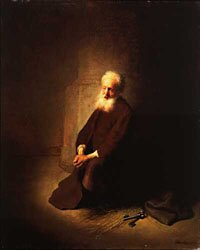
St. Peter in Prison by Rembrandt, 1631Saint Peter, also known as Simon ben Jonah/BarJonah, Simon Peter, Cephas and Kepha - original name Simon or Simeon (Acts 15:14) - was one of the Twelve Apostles whom Jesus chose as his original disciples. His life is prominently featured in the New Testament Gospels and the Acts of the Apostles. A Galilean fisherman, he (with his brother Andrew)
was literally "called" by Jesus to be a disciple. Above all the other disciples, Peter was assigned a leadership role by Jesus (Matt 16:18; John 21:15–16); and many within the early Church, such as St Clement of Rome and St Irenaeus (Adversus Haereses 3:3:20), mention his primacy.

The ancient Christian Churches, Roman Catholic, Eastern Orthodox and Oriental Orthodox, consider Simon Peter a saint and associate him with the foundation of the Church in Rome ,
even if they differ on the significance of this for the position of the see of Rome and of the Pope in present-day Christianity.


More...

Wednesday, December 29, 2010

Apostolic Fathers

The Apostolic Fathers are a small collection of Early Christian authors who lived and wrote in the second half of the 1st century and the first half of the 2nd century. These authors are acknowledged as leaders in the early church, but their writings were not included in the New Testament biblical canon.

The apostolic fathers include St. Clement of Rome, St. Ignatius of Antioch, and St. Polycarp of Smyrna.

The Roman Catholic label “Apostolic Fathers” has been used since the 17th century to emphasize that these authors were thought of as being of the generation that had personal contact with The Twelve Apostles. Thus they provide a link between the Apostles who knew Jesus of Nazareth and the later generation of Christian apologists, defenders of orthodoxy, and developers of doctrine known as the Church Fathers.

Apostolic fathers and their works

Famous Apostolic Fathers include St. Clement of Rome (c 30 - c 100), St. Ignatius of Antioch, and Polycarp of Smyrna. In addition, The Didache and The Shepherd of Hermas are usually placed among the writings of the Apostolic Fathers although their authors are unknown.


More...

Saturday, December 25, 2010

The Child Jesus is a religious symbol based on the activities of Jesus as an infant up to the age of twelve that recurs throughout history, starting from around the third or fourth century. It includes religious figurines and icons of the infant Jesus, usually with his mother, Mary, and his legal father Joseph.

Holy Family
This "original nuclear family" symbolized the Holy Trinity to many early Christian believers. They solidified the family unit with such deep spiritual significance that the Holy Family eventually became an integral part of Roman Catholic religious dogma.

The Scriptures and many apocryphal works were passed down either by word of mouth or through song, and later in works of art. The symbolism of the Child Jesus in art reached its apex during the Renaissance: the holy family was a central theme in the works of Leonardo Da Vinci and many other masters.

Simeon would not see death before he had seen the Lord's Christ
25 Now there was a man in Jerusalem, whose name was Simeon, and this man was righteous and devout, waiting for the consolation of Israel, and the Holy Spirit was upon him. 26 And it had been revealed to him by the Holy Spirit that he would not see death before he had seen the Lord’s Christ. 27 And he came in the Spirit into the temple, and when the parents brought in the child Jesus, to do for him according to the custom of the Law, 28 he took him up in his arms and blessed God and said 29 "Lord, now you are letting your servant depart in peace, according to your word;30 for my eyes have seen your salvation 31 that you have prepared in the presence of all peoples, 32 a light for revelation to the Gentiles, and for glory to your people Israel."⁠. –Luke 2:25-32

More...

Friday, December 24, 2010

Star of Bethlehem

The pre-dawn sky as it appeared looking east from Babylon on August 24, 2 B.C. Mercury, Mars and Jupiter form a scepter and Venus marks the picture in Leo as referring to Jesus.The Star of Bethlehem, also called the Christmas Star or Jesus Star, is a star in Christian nativity tradition that revealed the birth of Jesus to the magi (or 'three kings') and later led them to Bethlehem. According to the New Testament account, found only in the Gospel of Matthew, the magi were men "from the east" who were inspired by the appearance of the star to travel to Jerusalem in search of a "king of the Jews". There they met King Herod of Judea, who advised them that the child they sought was in Bethlehem, a nearby village. The magi then went to Bethlehem, found Jesus and his mother, paid him homage, gave gifts, and returned to their "own country".

Christians regarded the star as a miraculous sign given by God to mark the birth of the Christ (or Messiah). Ancient theologians claimed that the star fulfilled several prophecies, including the Star Prophecy. In modern times, astronomers have proposed various explanations for the star, including a nova, a planet, a comet, an occultation, and a conjunction (massing of planets). The subject is a favorite at planetarium shows during the Christmas season, although the Biblical account suggests that the visit of the magi took place at least several months after Jesus was born. The visit was traditionally celebrated on Epiphany.

More...

Monday, December 20, 2010

THE GOSPEL IN BRIEF

By COUNT LYOF N. TOLSTOI.

TRANSLATED FROM THE RUSSIAN ORIGINAL
EMBODYING
THE AUTHOR'S LAST ALTERATIONS AND REVISIONS

Copyright, 1896, By Thomas Y. Crowell & Company.

This translation is one of a series from Count Tolstoi's religious and philosophic writings, undertaken with his consent and approval. Made and revised directly from the Russian manuscript containing the Author's latest revisions and alterations, it somewhat differs in form, not only from the German and French translations, but from the Russian edition. Great care has been taken, by several persons whose labours are here gratefully acknowledged, to ensure the correspondence of the translation with the Author's meaning and purpose. The reader will be usefully informed that the four works referred to by the Author in the opening of his preface to this book are as follows...


Read the entire Book...

Friday, December 17, 2010

John the baptist

John the Baptist, Artist: CARAVAGGIO. Date: c. 1604John the Baptist (Greek: βαπτιστής baptistēs, From βαπτίζω (G907) which is to dip repeatedly, to immerse, to submerge (of vessels sunk)) He is also called John the Baptizer or Yahya the Baptizer) and is regarded as a prophet by at least three religions: Christianity, Islam, and Mandaeanism. According to the Gospel of Luke Luke 1:36, he was a relative of Jesus. That he was a prophet is asserted by the Synoptic Gospels and the Qur'an (see also Islam). He is also commonly referred to as John the Forerunner/Precursor because he was the forerunner of Christ (Tiphshut). In Mandaic he is called Yihja jahane. Isaiah 40:3-5 is commonly read as a prophecy of John. Muslim tradition maintains that the head of John the Baptist is interred in the Umayyad Mosque. In later times it was rumored that the Knights Templar also had possesion of the head of St. John. According to Luke 3:1, John began his ministry in the 15th year of the reign of Tiberius Caesar, which would have been the year 28 or 29.

Flavius Josephus in Jewish Antiquities book 18, chapter 5, paragraph 2 records the following:
Now some of the Jews thought that the destruction of Herod's army came from God, and that very justly, as a punishment of what he did against John, that was called the Baptist: for Herod slew him, who was a good man, and commanded the Jews to exercise virtue, both as to righteousness towards one another, and piety towards God, and so to come to baptism; for that the washing [with water] would be acceptable to him, if they made use of it, not in order to the putting away [or the remission] of some sins [only], but for the purification of the body; supposing still that the soul was thoroughly purified beforehand by righteousness. Now when [many] others came in crowds about him, for they were very greatly moved [or pleased] by hearing his words, Herod, who feared lest the great influence John had over the people might put it into his power and inclination to raise a rebellion, (for they seemed ready to do any thing he should advise,) thought it best, by putting him to death, to prevent any mischief he might cause, and not bring himself into difficulties, by sparing a man who might make him repent of it when it would be too late. Accordingly he was sent a prisoner, out of Herod's suspicious temper, to Macherus, the castle I before mentioned, and was there put to death. Now the Jews had an opinion that the destruction of this army was sent as a punishment upon Herod, and a mark of God's displeasure to him. (William Whiston Translation)


More...

Thursday, December 16, 2010

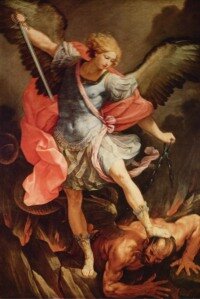
Archangel

An Archangel is a superior or higher-ranking angel; chief of the angels. They are to be found in a number of religious traditions, including Zoroastrianism, Judaism, Christianity, and Islam.

The word archangel derives from the Greek αρχαγγελος archangelos = αρχ- arch- ("first, primary") and αγγελος angelos ("messenger").

In Judaism
There are no explicit references to archangels in the canonical texts of the Hebrew Bible (Old Testament). Indeed even angels are uncommon except in later works like Daniel. The earliest references to archangels are in the literature of the intertestamental period.

It is therefore widely speculated that Jewish interest in angels was learned during the Babylonian exile. According to Rabbi Simeon ben Lakish of Tiberias (230–270 CE), all the specific names for the angels were brought back by the Jews from Babylon, and some modern commentators would argue that the details of the angelic hierarchy were largely Zoroastrian in origin.

Within the rabbinic tradition and the Kabbalah, the usual number given is at least seven: Michael, Raphael, Gabriel, Uriel, Sariel,Raguel and Remiel (possibly the Ramiel of the Apocalypse of Baruch, said to preside over true visions). Zadkiel, Jophiel, Haniel and Chamuel are also listed as archangels.

In Christianity
The New Testament rarely speaks of angels, and makes only two references to archangels,

1. Michael in Jude 1:9, (which is referring in passing to a Jewish legend)
9 But even the archangel Michael, when he was disputing with the devil about the body of Moses, did not dare to bring a slanderous accusation against him, but said, "The Lord rebuke you!"

I Thessalonians 4:16, where the "voice of an archangel" will be heard at the return of Christ
16 For the Lord himself will come down from heaven, with a loud command, with the voice of the archangel and with the trumpet call of God, and the dead in Christ will rise first.

More...

Wednesday, December 15, 2010

Faith

"God is a Consuming Fire"
The word faith has various uses; its central meaning is similar to "belief", "trust" or "confidence", "certainty", "sureness," but unlike these terms, "faith" tends to imply eclipsing or rising above the personal rather than an interpersonal relationship – with God. The object of faith can be a person (or even an inanimate object or state of affairs) or a proposition (or body of propositions, such as a religious credo). In each occurrence, though, faith is in an aspect of the object and cannot be logically or "scientifically" proven or known with impartiality. Faith can also be defined as accepting as true something which one has been told by someone who is believed to be trustworthy, honorable, principled and so forth. In its proper sense faith means trusting the word of another.

Faith under extreme adversity
The "world" considers that the righteous are not worthy to live in the world, and God declares the world is not worthy of them. Though the righteous and the worldlings widely differ in their judgment, they agree in this, it is not fit that good men should have their rest in this world. Therefore God receives them out of it. The apostle tells the Hebrews, that God had provided some better things for them, therefore they might be sure that he had the expectation that they provide some good as well. As our advantages, with the better things God has provided for us, are so much beyond their own, so should our obedience of faith, patience of hope, and labor of love, be preeminent. And unless we get true faith as these early church believers had, they will rise up to condemn us at the last day. Let us then pray continually for the increase of our faith, that we might imitate these shimmering examples, finding ourselves, along with them, unblemished in holiness and gladness, and shine like the Son, our King, who reigns at the right hand of God the Father for evermore.

More...

 Why did God decide to save us through faith? (John Piper)

Tuesday, December 14, 2010

Johannes Brahms

Johann Strauss II and Johannes Brahms
Johannes Brahms (pronounced [joːˈhanəs ˈbʁaːms]) (May 7, 1833 – April 3, 1897) was a German composer of the Romantic period. Born in Hamburg, he eventually settled in Vienna, Austria.

His first and most devoted supporter, Robert Schumann (1810-56), called him "another John the Baptist, whose revelations will puzzle many of the Pharisees, and every one else, for centuries."

Brahms's father, Johann Jakob Brahms, came to Hamburg from Schleswig-Holstein, seeking a career as a town musician. He was proficient on several instruments, but found employment mostly playing the horn and double bass. He married Johanna Henrika Christiane Nissen, a seamstress, who was seventeen years older than he was. Initially, they lived near the city docks, in the Gängeviertel quarter of Hamburg, for six months before moving to a small house on the Dammtorwall, located on the northern perimeter of Hamburg in the Inner Alster.

Johann Jakob gave his son his first musical training. He studied piano from the age of seven with Otto Friedrich Willibald Cossel. Brahms showed early promise (his younger brother Fritz also became a pianist) and helped to supplement the rather meager family income by playing the piano in restaurants and theaters, as well as by teaching. It is a long-told tale that Brahms was forced in his early teens to play the piano in bars that doubled as brothels; recently Brahms scholar Kurt Hoffman has suggested that this legend is false. Since Brahms himself clearly originated the story, however, some have questioned Hoffman's theory.


More...


 Johannes Brahms, Hungarian Dance No. 5

Monday, December 13, 2010

The Magi

The Magi (singular Magus, from Latin, via Greek μάγος ; Old English: Mage; from Old Persian maguš) was a tribe from ancient Media, who - prior to the absorption of the Medes into the Persian Empire in 550 BC - were responsible for religious and funerary practices. Later they accepted the Zoroastrian religion (Zoroastrianism), however, not without changing the original message of its founder, Zarathustra (Zoroaster), to what is today known as "Zurvanism", which would become the predominant form of Zoroastrianism during the Sassanid era (AD 226–650). No traces of Zurvanism exist beyond the 10th century.

The best known Magi are the "Wise Men from the East" in the Bible, whose graves Marco Polo claimed to have seen in what is today the district of Saveh, in Tehran, Iran. In English, the term may refer to a shaman, sorcerer, or wizard; it is the origin of the English words magic and magician.

1 After Jesus was born in Bethlehem in Judea, during the time of King Herod, Magi from the east came to Jerusalem 2 and asked, "Where is the one who has been born king of the Jews? We saw his star in the east and have come to worship him."

3 When King Herod heard this he was disturbed, and all Jerusalem with him.
(Matthew 2:1-3)

More...

 Leonardo da Vinci's Adoration of the Magi Motion Sensing Visualization Demo

Sunday, December 12, 2010

Hebron

Hebron (Al-Khalil) (Hebrew: חברון Chebrown "association" derived from the root word חֶבֶר cheber, meaning "association, company, band") is a town in the Southern Judea region of the West Bank of around 166,000 Palestinians and 500 Israeli settlers. It lies 3,050 feet (930 m) above sea level.

Geographic coordinates: 31°32' N, 35°6' E

Hebron is located 30km south of Jerusalem. Its elevation from sea level is about 1000m. Hebron is famous for its grapes, limestones, pottery workshops and glassblowing factories. It is also home of the nationally famous Al-Juneidi factory for dairy products.

The old city of Hebron is characterized by its narrow and winding streets, the flat-roofed stone houses, and the old bazaars. It is the home of Hebron University and Palestine Polytechnic University.

Hebron is one of most ancient cities in the Middle East, and one of the oldest continuously inhabited cities in the world and was an ancient Canaanite royal city:

After this David inquired of the Lord , "Shall I go up into any of the cities of Judah?" And the Lord said to him, "Go up." David said, "To which shall I go up?" And he said, "To Hebron." -2 Sam. 2:1

More...


 "Palestinian" Arab Crimes against Humanity

Saturday, December 11, 2010

Islamism

Islamism or "Radical Islam" is a controversial term and definitions of it sometimes vary. Leading Islamist thinkers emphasized the desire to apply many aspects of sharia (Islamic law) to modern society; of pan-Islamic political unity; and of the elimination of non-Muslim, particularly western, military, economic, political, social, or cultural influences in the Muslim world, which they believe to be incompatible with Islam.

In an article titled, "Jews and Christians under Islam Dhimmitude and Marcionism*" by Egyptian-born British writer and political commentator, who writes about the history of non-Muslims in the Middle East, Bat Ye'or:
" According to the theory of jihad, inhabitants of the lands of war (dar al-harb) are infidels to be combated because they oppose the establishment of Islamic law in their countries. As enemies of Allah they have no rights: they themselves and their property become licit (mubah) for all Muslims. As the opportunity arises they can be taken as slaves, kidnapped for ransom, robbed or killed. War is waged against them to Islamize their territory which, according to the will of Allah, must belong to the Islamic community. If they resist, Islamic law provides for the deportation or massacre of the men and the enslavement of women and children. "
Some observers suggest Islamism's tenets are less strict and can be defined as a form of identity politics or "support for [Muslim] identity, authenticity, broader regionalism, revivalism, [and] revitalization of the community". Still others define it as "an Islamic militant, anti-democratic movement, bearing a holistic vision of Islam whose final aim is the restoration of the caliphate".

Attributes of sharia law supported by many Islamists include "enforcement of Islamic punishments, including prohibitions on charging interest on loans, playing music, showing television", and enforcing traditional dress and prayer attendance.


More...

 Out of time: Radical Islam Taking Over Europe & West

Friday, December 10, 2010

Irreducible complexity

Refers to the argument that certain biological systems are too complex to have evolved from simpler, or "less complete" predecessors, and are at the same time too complex to have arisen naturally through chance mutations. An "irreducibly complex" system is defined by the term's originator, biochemistry professor Michael J. Behe, as one "composed of several well-matched, interacting parts that contribute to the basic function, wherein the removal of any one of the parts causes the system to effectively cease functioning". These examples are said to demonstrate that modern biological forms could not have evolved naturally. The argument is used in a broader context to support the idea that an intelligent designer was involved, at some point, in the creation of life, against the theory of evolution which argues no designer is required. In a manner of speaking, the IC argument is a definition of the "designer", or at least "what was designed", a definition that has proven elusive in the past. The most common examples used in argument are the complexity of the eye (right), the Blood clotting cascade, or the motor in a cell's flagellum.

The examples offered to support the irreducible complexity argument have generally been found to fail to meet the definition and intermediate precursor states have been identified for several structures purported to exhibit irreducible complexity.

For instance, precursors to the flagellum's motor can be found being used as ionic channels within bacteria, known as the Type III Secretory System. This is true for most of the structure of the flagellum in general; of the 42 proteins found in the flagellum, 40 have already been found in use in different biological pathways. Even Behe's toy model used to illustrate the concept, the mouse trap, was countered by critics including biology professor John McDonald, who produced examples of how he considered the mousetrap to be "easily reducable", eventually to a single part. Critics consider that most, or all, of the examples were based on misunderstandings of the workings of the biological systems in question, and consider the low quality of these examples excellent evidence for the argument from ignorance.

More...
 Irreducible Complexity 01/04–04/04

Thursday, December 09, 2010

Mary, mother of Jesus

According to the New Testament, Mary (Greek: Μαρία Maria, of Hebrew origin: מִרְיָם Miryam "their rebellion") was the mother of Jesus of Nazareth, who at the time of his conception was the betrothed wife of Joseph of Nazareth (Greek: Ἰωσήφ Iōsēph of Hebrew origin: יוֹסֵף Yowceph "Jehovah has added") (cf. Matt 1:18-20, Luke 1:35). According to non-canonical works, her parents were Saint Joachim and Saint Anne. A theory says that her father's name was Heli, mentioned in the lineage of Jesus in Luke 3:23-38. According to the Gospel of Luke, Mary, being a virgin at time, learned from Gabriel the archangel, a divine messenger sent by God, that she would conceive Jesus, "the Son of God", through a miracle of the Holy Spirit.

Mary is the subject of much veneration due to Luke 1:48 ("for, behold, from henceforth all generations shall call me blessed") in the Christian faith, particularly in the Roman Catholic Church and Orthodox Church, and is also highly regarded by Muslims. The area of Christian theology concerning her is Mariology.

The feast of the nativity of Mary is celebrated in the Orthodox, Roman Catholic, and Anglican Churches on 8 September. The Orthodox and Catholic Churches also celebrate many other feast days in honour of Mary.

Mary's most common titles include The Blessed Virgin Mary or Our Lady (Notre Dame, Nuestra Señora, Madonna).

Mary is frequently referred to by the Orthodox Church and related traditions within the Catholic Church as Theotokos, a title recognized at the Third Ecumenical Council held at Ephesus in 431. Theotokos is often translated into English as "Mother of God," or more literally as "Godbearer" or "Birthgiver of God." The theological significance of the title is that Mary's son, Jesus, is fully God as well as fully human, and that Jesus' two natures (divine and human) were united in a single Person.

More...
 

Subscribe


LifeNews.com

Desiring God Blog

Youth for Christ International