Showing posts with label Mary. Show all posts

Thursday, December 09, 2010

Mary, mother of Jesus

According to the New Testament, Mary (Greek: Μαρία Maria, of Hebrew origin: מִרְיָם Miryam "their rebellion") was the mother of Jesus of Nazareth, who at the time of his conception was the betrothed wife of Joseph of Nazareth (Greek: Ἰωσήφ Iōsēph of Hebrew origin: יוֹסֵף Yowceph "Jehovah has added") (cf. Matt 1:18-20, Luke 1:35). According to non-canonical works, her parents were Saint Joachim and Saint Anne. A theory says that her father's name was Heli, mentioned in the lineage of Jesus in Luke 3:23-38. According to the Gospel of Luke, Mary, being a virgin at time, learned from Gabriel the archangel, a divine messenger sent by God, that she would conceive Jesus, "the Son of God", through a miracle of the Holy Spirit.

Mary is the subject of much veneration due to Luke 1:48 ("for, behold, from henceforth all generations shall call me blessed") in the Christian faith, particularly in the Roman Catholic Church and Orthodox Church, and is also highly regarded by Muslims. The area of Christian theology concerning her is Mariology.

The feast of the nativity of Mary is celebrated in the Orthodox, Roman Catholic, and Anglican Churches on 8 September. The Orthodox and Catholic Churches also celebrate many other feast days in honour of Mary.

Mary's most common titles include The Blessed Virgin Mary or Our Lady (Notre Dame, Nuestra Señora, Madonna).

Mary is frequently referred to by the Orthodox Church and related traditions within the Catholic Church as Theotokos, a title recognized at the Third Ecumenical Council held at Ephesus in 431. Theotokos is often translated into English as "Mother of God," or more literally as "Godbearer" or "Birthgiver of God." The theological significance of the title is that Mary's son, Jesus, is fully God as well as fully human, and that Jesus' two natures (divine and human) were united in a single Person.

More...
Wednesday, December 16, 2009

virgin birth of Jesus

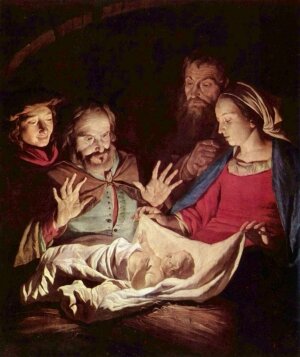
The infant Jesus in Adoration of the Shepherds, Gerard van HonthorstThe virgin birth of Jesus is a religious tenet of Christianity and Islam which holds that Mary miraculously conceived Jesus while remaining a virgin. A universally held belief in the Christian church by the second century, this doctrine was included in the two most widely used Christian creeds, which state that Jesus "was incarnate of the Holy Spirit and the Virgin Mary" (the Nicene Creed as revised by the First Council of Constantinople) and was "born of the Virgin Mary" (Apostles' Creed), and was not seriously challenged, except by some minor sects, before the Enlightenment theology of the eighteenth century.

The gospels of Matthew and Luke say that Mary was a virgin and that Jesus was conceived by the Holy Spirit. These gospels, later tradition and current doctrine present Jesus' conception as a miracle involving no natural father, no sexual intercourse, and no male seed in any form. The Gospel of Matthew (Matthew 1:18) additionally presents the virgin birth of Jesus as fulfilling a prophecy from the Book of Isaiah:
13 And he said, "Hear then, O house of David! Is it too little for you to weary men, that you weary my God also? 14 Therefore the Lord himself will give you a sign. Behold, the virgin shall conceive and bear a son, and shall call his name Immanuel. (Isaiah 7:13-14 ESV)
More...

Friday, December 11, 2009

Mary, mother of Jesus

Annunciation, Artist: Andrea Del Sarto, c. 1528. Galleria Palatina (Palazzo Pitti), FlorenceAccording to the New Testament, Mary was the mother of Jesus of Nazareth, who at the time of his conception was the betrothed wife of Joseph of Nazareth (cf. Matt 1:18-20, Luke 1:35). According to non-canonical works, her parents were Saint Joachim and Saint Anne. A theory says that her father's name was Heli, mentioned in the lineage of Jesus in Luke 3:23-38. According to the Gospel of Luke, Mary, being a virgin at time, learned from Gabriel the archangel, a divine messenger sent by God, that she would conceive Jesus, "the Son of God", through a miracle of the Holy Spirit.

Mary is the subject of much veneration due to Luke 1:48 ("for, behold, from henceforth all generations shall call me blessed") in the Christian faith, particularly in the Roman Catholic Church and Orthodox Church, and is also highly regarded by Muslims. The area of Christian theology concerning her is Mariology.

The feast of the nativity of Mary is celebrated in the Orthodox, Roman Catholic, and Anglican Churches on 8 September. The Orthodox and Catholic Churches also celebrate many other feast days in honour of Mary.

Titles Given to Mary
Mary's most common titles include The Blessed Virgin Mary or Our Lady (Notre Dame, Nuestra Señora, Madonna).

Mary is frequently referred to by the Orthodox Church and related traditions within the Catholic Church as Theotokos, a title recognized at the Third Ecumenical Council held at Ephesus in 431. Theotokos is often translated into English as "Mother of God," or more literally as "Godbearer" or "Birthgiver of God." The theological significance of the title is that Mary's son, Jesus, is fully God as well as fully human, and that Jesus' two natures (divine and human) were united in a single Person.

More...

Thursday, December 11, 2008

Mary, mother of Jesus

Annunciation, Artist: Andrea Del Sarto, c. 1528. Oil on wood, 96 x 189 cm. Galleria Palatina (Palazzo Pitti), FlorenceAccording to the New Testament, Mary was the mother of Jesus of Nazareth, who at the time of his conception was the betrothed wife of Joseph of Nazareth (cf. Matt 1:18-20, Luke 1:35). According to non-canonical works, her parents were Saint Joachim and Saint Anne. A theory says that her father's name was Heli, mentioned in the lineage of Jesus in Luke 3:23-38. According to the Gospel of Luke, Mary, being a virgin at time, learned from Gabriel the archangel, a divine messenger sent by God, that she would conceive Jesus, "the Son of God", through a miracle of the Holy Spirit.

Mary is the subject of much veneration due to Luke 1:48 ("for, behold, from henceforth all generations shall call me blessed") in the Christian faith, particularly in the Roman Catholic Church and Orthodox Church, and is also highly regarded by Muslims. The area of Christian theology concerning her is Mariology.

The feast of the nativity of Mary is celebrated in the Orthodox, Roman Catholic, and Anglican Churches on 8 September. The Orthodox and Catholic Churches also celebrate many other feast days in honour of Mary.

More...

Saturday, December 23, 2006

Mary, mother of Jesus

Gabriel delivering the Annunciation to Mary. Painting by El Greco (1575)According to the New Testament, Mary was the mother of Jesus of Nazareth, who at the time of his conception was the betrothed wife of Saint Joseph (cf. Matt 1:18-20, Luke 1:35). According to non-canonical works, her parents were Saint Joachim and Saint Anne. A theory says that her father's name was Heli, mentioned in the lineage of Jesus in Luke 3:23-38. According to the Gospel of Luke, Mary, being a virgin at time, learned from the angel Gabriel, a divine messenger sent by God, that she would conceive Jesus, "the Son of God", through a miracle of the Holy Spirit.

Mary is the subject of much veneration due to Luke 1:48 ("for, behold, from henceforth all generations shall call me blessed") in the Christian faith, particularly in the Roman Catholic Church and Orthodox Church, and is also highly regarded by Muslims. The area of Christian theology concerning her is Mariology.


More...


Subscribe


LifeNews.com

Desiring God Blog

Youth for Christ International