Thursday, October 07, 2010

Aaron

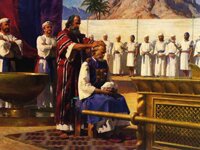
Aaron (אַהֲרֹן, a word meaning "bearer of martyrs" in Hebrew (perhaps also, or instead, related to the Egyptian "Aha Rw," "Warrior Lion"), was one of two brothers who play a unique part in the history of the Hebrew people. He was the elder son (and second child) of Amram and Jochebed of the tribe of Levi; Moses, the other son, being three years younger, and Miriam, their sister, several years older. Aaron was the great-grandson of Levi and represented the priestly functions of his tribe, becoming the first High Priest. While Moses was receiving his education at the Egyptian court and during his exile among the Midianites, Aaron and his sister remained with their kinsmen in the eastern border-land of Egypt.

Here he gained a name for eloquent and persuasive speech; so that when the time came for the demand upon Pharaoh to release Israel from captivity, Aaron became his brother’s Nabi, (in this case "spokesman" sometimes also referred to as a prophet), to his own people and, after their unwillingness to hear, to Pharaoh himself.

Moses' brother and born into the Tribe of Levi, first mentioned in the bible in Exodus 4:14. Spoke on behalf of Moses in front of Pharaoh when trying to persuade him to let the Israelites go free from Egypt. Became the first of the Levite priests and the first high priest of Israel. He died while Israel was still on the exodus (deuteronomy 10:4).

More...

includes Arnold Schoenberg: "Moses Und Aron" Music from Act Two. Scene Three: The Golden Calf and the Altar

Wednesday, October 06, 2010

Secular humanism

Secular humanism is a humanist philosophy that upholds reason, ethics, and justice and specifically rejects rituals and ceremonies as a means to affirm a life stance. The term was coined in the 20th century to make a clear distinction from "religious humanism". A perhaps less confrontational synonym is scientific humanism, which the biologist Edward O. Wilson claimed to be "the only worldview compatible with science's growing knowledge of the real world and the laws of nature.

When humanists use the phrase secular humanism it is typically to emphasize differences relative to religion or religious humanism. There are a number of ways in which secular and religious humanism can differ:
  • Religious humanists may value rituals and ceremonies as means of affirming their life stance. Secular humanists are typically not interested in using rituals and ceremonies.
  • Some religious humanists may seek profound "religious" experiences, such as those that others would associate with the presence of God, despite interpreting these experiences differently. Secular humanists would generally not pursue such experiences.
  • Some varieties of nontheistic religious humanism may conceive of the word divine as more than metaphoric even in the absence of a belief in a traditional God; they may believe in ideals that transcend physical reality; or they may conceive of some experiences as "numinous" or uniquely religious. Secular humanism regards all such terms as, at best, metaphors for truths rooted in the material world.
  • Some varieties of religious humanism, such as Christian humanism include belief in God, traditionally defined. Secular humanism is skeptical about God and the supernatural and believes that these are not useful concepts for addressing human problems.
While some humanists embrace calling themselves secular humanists, others prefer the term Humanist, capitalized and without any qualifying adjective. The terms secular humanism and Humanism overlap, but have different connotations. The term secular humanism emphasizes a non-religious focus, whereas the term Humanism de-emphasizes this and may even encompass some non-theistic varieties of religious humanism. The term Humanism also emphasizes considering one's humanism to be a life stance. Secular humanism advocates secularism but is a broader concept. Secularism has a number of usages but generally emphasize limits on the role of religious or supernatural considerations in the affairs of society or government. Secular humanism adds to these positions a comprehensive perspective on life, including affirmation of human dignity and the importance of ethics.

More...
 ...includes Julie Andrews singing "something good" and "your crowning glory"

Tuesday, October 05, 2010

Ancient Egypt

Ancient Egypt was a civilization located along the Lower Nile, reaching from the Nile Delta in the north to as far south as Jebel Barkal at the time of its greatest extension (15th century BC). It lasted for three millennia, from circa 3200 BC to 343 BC, ending when Artaxerxes III conquered Egypt. As a civilization based on irrigation it is the quintessential example of an "hydraulic empire."

Egypt was a transcontinental nation located mostly in North Africa, with the Sinai Peninsula lying in Asia.

There are several words used in the bible that refer to Egypt, 2 are Hebrew/Aramaic and 2 are Greek.


Hebrew/Aramaic (Old Testament)
Strongs # Hebrew Transliteration Pronunciation English
H4714 מִצְרַיִם dual for מָצוֹר Mitsrayim mits·rah'·yim Egypt, Egyptian, Mizraim, Egyptians
H4713 מִצְרִי Mitsriy mits·rē' Egyptian, Egyptian, Egypt, Egyptian women

Greek (New Testament)
Strongs # Greek Transliteration Pronunciation English
G125 Αἴγυπτος Aigyptos ī'-güp-tos Egypt
G124 Αἰγύπτιος Aigyptios ī-gü'p-tē-os Egyptian, Egyptians
(blueletterbible.org)


More...

Sunday, October 03, 2010

Pontius Pilate

Pontius Pilate (Latin: Pontius Pilatus') was the governor of the Roman Iudaea Province from 26 until 36. In modern times he is best known as the man who, according to the canonical Christian Gospels, presided over the trial of Jesus and ordered his crucifixion, instigating the Passion.

Pilate's biographical details before and after his appointment to Iudaea are unknown, but have been supplied by tradition, which include the detail that his wife's name was Procula (she is canonized as a saint in Orthodox Christianity) and competing legends of his birthplace.

1 Now on the same occasion there were some present who reported to Him about the Galileans whose blood Pilate had mixed with their sacrifices. 2 And Jesus said to them, "Do you suppose that these Galileans were greater sinners than all other Galileans because they suffered this fate? 3 "I tell you, no, but unless you repent, you will all likewise perish. 4 "Or do you suppose that those eighteen on whom the tower in Siloam fell and killed them were worse culprits than all the men who live in Jerusalem? 5 "I tell you, no, but unless you repent, you will all likewise perish." Luke 13:1-5 (NASB)

The famous Pilate Inscription found at Caesarea Palaestina refers to Pilate as prefect, while Tacitus speaks of him as procurator of the province. The explanation of the differences in title is fairly straightforward.

In the first historical period in which the setting of the New Testament became the Roman Iudaea Province (a compound of Samaria, Judea and Idumea), from 6 to the outbreak of the Great Jewish Revolt in 66, officials of the equestrian order (the lower rank of governors) governed. They held the Roman title of prefect until Herod Agrippa I was named King of the Jews by Claudius.

More...

Saturday, October 02, 2010

Goliath

Goliath גלית Golyath "exile, an exile") the Philistine giant who is famous for his battle in the 11th century BC where he was killed in single combat by David, using one of five smooth stones taken from from the brook, the young Israelite boy who would later be chosen by God and anointed by Samuel to become King of Israel following Saul, Israel's first King. Goliath was from Gath, one of five ancient city states in Philistia.

3 The Philistines stood on the mountain on one side while Israel stood on the mountain on the other side, with the valley between them. 4 Then a champion came out from the armies of the Philistines named Goliath, from Gath, whose height was six cubits and a span. 5 He had a bronze helmet on his head, and he was clothed with scale-armor which weighed five thousand shekels of bronze. 6 He also had bronze greaves on his legs and a bronze javelin slung between his shoulders. 7 The shaft of his spear was like a weaver's beam, and the head of his spear weighed six hundred shekels of iron; his shield-carrier also walked before him. 8 He stood and shouted to the ranks of Israel and said to them, "Why do you come out to draw up in battle array? Am I not the Philistine and you servants of Saul? Choose a man for yourselves and let him come down to me. 9 "If he is able to fight with me and kill me, then we will become your servants; but if I prevail against him and kill him, then you shall become our servants and serve us." 10 Again the Philistine said, "I defy the ranks of Israel this day; give me a man that we may fight together."11 When Saul and all Israel heard these words of the Philistine, they were dismayed and greatly afraid. 1 Samuel 17:3-11 NASB

According to the First Book of Samuel in the Hebrew Bible, the Philistine army marched into southern Israel to make war on the Israelites, but instead of immediately engaging in battle, went into camp in the Valley of Elah. The Israelites under King Saul made camp nearby. Goliath, who is described as a "champion" in the Biblical text, positioned himself between the two armies and challenged the Israelites to send out a warrior to challenge him. If that man won, the Philistines would become the subjects of Saul's army. If Goliath won, the converse would occur. For forty days, in both the morning and evening, Goliath issued his challenge. However, no man came forward to accept it.

More...

cosmological argument

The cosmological argument is a metaphysical argument for the existence of God, or a first mover of the cosmos. It is traditionally known as an "argument from universal causation," an "argument from first cause," and also as an "uncaused cause" argument and sometimes referred to as the Kalam cosmological argument. Whichever term is used, there are three basic variants of this argument, each with subtle but important distinctions: the argument from causation in esse, the argument from causation in fieri, and the argument from contingency. The cosmological argument does not attempt to prove anything about the first cause or about God, except to argue that such a cause must exist. This cause is known in Latin as "causa sui."

Origins of the argument
Plato and Aristotle both posited first cause arguments, though each had certain notable caveats. Plato (c. 427–c. 347 BCE) posited a basic cosmological argument in The Laws (Book X).

More...

Plus: "Irrational Youtube Users on the Cosmological Argument"

Thursday, September 30, 2010

Judah

Judah ("Praise") is the name of several Biblical and historical figures. The original Greek text of the New Testament makes no difference between the names "Judah", "Judas" and "Jude", rendering them all as Yĕhuwdah; but in many English translations "Judah" is used for the Old Testament figure and the tribe (tribe of Judah) named after him, "Judas" is used primarily for Judas Iscariot, and "Jude" for other New Testament persons of the same name.
  • One of the sons of the Biblical patriarch Jacob.
  • The tribe of Judah formed by Judah's offspring
The kingdom ruled by the house of David after the Kingdom of Israel broke off following the death of King Solomon.

Judah (Hebrew: יהודה Yĕhuwdah from the root word יָדָה yadah "to throw, to confess, to point out with hand extended") was, according to the Book of Genesis, the fourth son of Jacob and Leah, and the founder of the Israelite Tribe of Judah; however some Biblical scholars view this as postdiction, an eponymous metaphor providing an etiology of the connectedness of the tribe to others in the Israelite confederation. With Leah as a matriarch, Biblical scholars regard the tribe as having been believed by the text's authors to have been part of the original Israelite confederation; however, it is worthy of note that the tribe of Judah was not purely Israelite, but contained a large admixture of non-Israelites, with a number of Kenizzite groups, the Jerahmeelites, and the Kenites, merging into the tribe at various points.

More...

Wednesday, September 29, 2010

G.K. Chesterton

Gilbert Keith Chesterton (May 29, 1874–June 14, 1936) was an influential English writer of the early 20th century. His prolific and diverse output included journalism, poetry, biography, Christian apologetics, fantasy, and detective fiction.

Chesterton has been called the "prince of paradox." He wrote in an off-hand, whimsical prose studded with startling formulations. For example:

"Thieves respect property. They merely wish the property to become their property that they may more perfectly respect it."

He is one of the few Christian thinkers who are admired and quoted equally by liberal and conservative Christians, and indeed by many non-Christians. Chesterton's own theological and political views were far too nuanced to fit comfortably under the "liberal" or "conservative" banner. And in his own words he cast aspersions on the labels saying,

"The whole modern world has divided itself into Conservatives and Progressives. The business of Progressives is to go on making mistakes. The business of the Conservatives is to prevent the mistakes from being corrected."
He is not to be confused with his cousin, A. K. Chesterton.

More...

Video: GK Chesterton - "Orthodoxy - The Paradoxes of Christianity"

Tuesday, September 28, 2010

Philistines

The historic Philistines (Hebrew פלשתים פלשתי Pĕlishtiy "immigrants") an inhabitant of Philistia; descendants of Mizraim who immigrated from Caphtor (Hebrew: כפתור Kaphtor Caphtor = "a crown" the original home of the Philistines, perhaps on the southwest coast of Asia Minor, maybe in Egypt or close by, or more probably on the island of Cret) is a locality mentioned in the Bible and related literature, their territory being named Philistia in later contexts. Their origin has been debated among scholars, but modern archaeology has suggested early cultural links with the Mycenean world in mainland Greece (descendants of Mizraim who immigrated from Caphtor to the western seacoast of Canaan, Strong's H6430 - Pĕlishtiy). Though the Philistines adopted local Canaanite culture and language before leaving any written texts, an indo-European origin has been suggested for a handful of known Philistine words.

If the Philistines are to be identified as one of the "sea peoples", then their occupation of Canaan will have taken place during the reign of Rameses III of the twentieth dynasty, ca. 1180 to 1150 bce. Their maritime knowledge presumably would have made them important to the phoenicians.

More...

Monday, September 27, 2010

Gospel of John

The Gospel of John, (literally, According to John; Greek, Κατά Ιωαννην, Kata Iōannēn) is the fourth gospel in the biblical canon of the New Testament, traditionally ascribed to John the Apostle. Like the three synoptic gospels, it contains an account of some of the actions and sayings of Jesus, but differs from them in ethos and theological emphases. The purpose is expressed in the conclusion, 20:30-31: "..these [Miracles of Jesus] are written so that you will put your faith in Jesus as the Messiah and the Son of God. If you have faith in Him, you will have true life."

According to Trinitarianism, of the four gospels, John presents the highest christology, implicitly declaring Jesus to be God (see The Word).

Compared to the synoptics, John focuses on Jesus' cosmic mission to redeem humanity. Only in John does Jesus talk at length about himself, and John includes a substantial amount of material that Jesus shared with the disciples only. Certain elements of the synoptics (such as the parables of Jesus, exorcisms, and the Second Coming of Christ) are not found in John.

Since the "higher criticism" of the 19th century, historians have largely rejected the gospel of John as a reliable source of information about the historical Jesus. "Some commentators regard the work as anonymous."

More...

Sunday, September 26, 2010

Edom

Edom (אֱדוֹם), a Hebrew word meaning "red," "ruby," "scarlet," or "Edom, geographical region southwest of the Dead Sea," is a name given to Esau in the Hebrew Bible (see Gen. 25:30), as well as to the nation purportedly descended from him. The nation's name in Assyrian was Udumi; in Greek, Idoumaía; in Latin, Idumæa or Idumea.

The Edomite people were a Semitic-speaking tribal group inhabiting the Negev Desert and the Aravah valley of what is now southern Israel and adjacent Jordan. The region has much reddish sandstone, which may have given rise to the name "Edom". The nation of Edom is known to have existed back to the 8th or 9th Century BCE, and the Bible dates it back several centuries further. Recent archeological evidence may indicate an Edomite nation as long ago as the 11th Century BCE, but the topic is controversial. The nation ceased to exist with the Jewish-Roman Wars.

The Edomites
And the Lord said to her, "Two nations are in your womb, and two peoples from within you shall be divided; the one shall be stronger than the other, the older shall serve the younger." When her days to give birth were completed, behold, there were twins in her womb. The first came out red, all his body like a hairy cloak, so they called his name Esau. Gen. 25:23-25
The Edomites may have been connected with the Shasu and Shutu, nomadic raiders mentioned in Egyptian sources. Indeed, a letter from an Egyptian scribe at a border fortress in the Wadi Tumilat during the reign of Merneptah reports movement of nomadic "shasu-tribes of Edom" to watering holes in Egyptian territory.

More...

Saturday, September 25, 2010

Jacob

Jacob (Hebrew: יעקב Ya`aqob) (יַעֲקֹב "Holder of the heel"), later known as Israel (יִשְׂרָאֵל "Prince of God") is the third Biblical Patriarch. His father was Isaac and his grandfather was Abraham. His story is told in the Book of Genesis, beginning at Gen 25:19 which describes Jacob's father Isaac, the son of Abraham.

Isaac was forty years old when he married Rebekah, sixty years old when Esau and Jacob were born, and Abraham was 160 years old. He and his twin brother, Esau, were markedly different in appearance and behavior. Esau was a ruddy hunter, while Jacob was a gentle man who "dwelled in tents," interpreted by most biblical scholars as a mark of his studiousness in the "tents" of Torah.

During Rebekah's pregnancy, "the children struggled together within her" (Genesis 25:22).

According to Rashi, whenever Rebekah passed a house of learning, Jacob would struggle to get out; whenever she passed a house of idolatry, Esau would struggle to get out.

Fearing that she was carrying one tenacious child, Rebekah questioned God about the tumult and learned that two children were in her womb, who would become two very different nations.

They would always be in competition, and eventually, the elder would serve the younger. She did not tell her husband Isaac about this prophecy, but remembered it later when she told Jacob to go to his father in place of Esau to receive the paternal blessing.

Esau was born first. Right behind was his brother Jacob, who was grasping onto Esau's heel. Thus he was named Ya`aqob - יעקב, from the Hebrew root עקב, "heel." The commentators explain that Jacob was trying to hold Esau back from being the firstborn and claiming the Abrahamic legacy for himself.

More...

Friday, September 24, 2010

Constantine the Great

Gaius Flavius Valerius Aurelius Constantinus (Latin: IMP CÆSAR FLAVIVS CONSTANTINVS PIVS FELIX INVICTVS AVGVSTVS) (February 27, 272–May 22, 337), commonly known as Constantine I, Constantine the Great, or (among Orthodox Christians) Saint Constantine, was proclaimed Augustus by his troops on July 25, 306 and ruled an ever-growing portion of the Roman Empire until his death. Constantine is famed for his refounding of Byzantium (modern Istanbul) as "Nova Roma" (New Rome) or Constantinople (Constantine's City).

Constantine is best remembered in modern times for the Edict of Milan in 313 and the Council of Nicaea in 325, which fully legalized Christianity in the Empire for the first time.

These actions are considered major factors in that religion's spread, and his reputation as the "first Christian Emperor" has been promulgated by historians from Lactantius and Eusebius of Caesarea to the present day, though he himself was baptized only on his death bed. He had planned be baptized in the Jordan River before crossing into Persia. Persian diplomats came to Constantinople over the winter of 336–7, seeking peace, but Constantine turned them away. The campaign was called off however, when Constantine fell sick in the spring of 337.

More...

Thursday, September 23, 2010

An die Freude

"To Joy" (German: "An die Freude," first line: "Freude, schöner Götterfunken", in English often called Ode to Joy) is an ode written in 1785 by the German poet, playwright and historian Johann Christoph Friedrich von Schiller. The poem celebrates the ideal of unity and brotherhood of all mankind.

It is best known for its musical setting by Ludwig van Beethoven in the final movement of his Symphony No. 9 in D minor, Op. 125 "Choral" (completed in 1824), for four solo voices, and choir.

"One day he [Beethoven] burst into the room and shouted at me: 'I got it!  I have it!' He held his sketchbook out to me so that I could read: 'Lassst uns das Lied des unsterblichen Schiller singen' —Let us sing the song of the immortal Schiller; then a solo voice began the hymn of joy."

The Beethoven setting of "An die Freude" is the official anthem of the European Union.

Despite Beethoven’s influence and his overwhelming popularity in Vienna his Ninth Symphony was still greeted with some criticism, chiefly for the use of human voices in the final movement. For example, Friedrich Wieck, the notorious father of Clara Schumann, said that the symphony was of “unpalatable chaos” that was “simply unpleasant and must remain so” (Schott 3). Even Wagner, who regarded Beethoven, Liszt, and himself as the only great composers in history, spoke not entirely positively of the symphony.

Leonard Bernstein conducts
Beethoven Symphony No. 9 in D Minor
Op. 125 4th movement

Listen...

Wednesday, September 22, 2010

The Muslim Brotherhood

The Muslim Brothers (Arabic: الإخوان المسلمون al-ikhwān al-muslimūn, full title The Society of the Muslim Brothers, often simply الإخوان al-ikhwān, the Brotherhood, Muslim Brotherhood or MB) is a transnational Sunni movement and the largest political opposition organization in many Arab states, particularly Egypt. The world's oldest and largest Islamist group was founded by the Egyptian schoolteacher Hassan al-Banna in 1928.

These groups are dedicated to the credo:
Allah is our objective. The Prophet is our leader. Qur'an is our law. Jihad is our way. Dying in the way of Allah is our highest hope.

The Brotherhood's stated goal is to instill the Qur'an and Sunnah as the "sole reference point for . ordering the life of the Muslim family, individual, community . and state".[2]
The Brotherhood's official position of opposing most terror against civilians and condemning the 9/11 attacks is a matter of international controversy. Its position on violence has also caused disputes within the movement, with more radical, violent members at times breaking away to form groups such as the Al-Gama'a al-Islamiyya (The Islamic Group) and Al Takfir Wal Hijra (Excommunication and Migration).

As noted by Discover The Networks:
In recent years, the Brotherhood has attempted to forge a reputation as a moderate and reformist Islamic group that has renounced its violent past. Lending plausibility to this reputation has been criticism of the organization by radical Islamist groups, who have condemned the Brotherhood’s willingness to participate in the political process as heretical. These groups have also criticized the Brotherhood for supposedly abandoning violent struggle as a means of establishing an Islamic empire.[20]


More...

includes video: The Muslim Brotherhood in America

Tuesday, September 21, 2010

The Tribes of Israel

Israel had 12 sons, as follows: Reuben, (ראובן Rĕ'uwben, Jacob's firstborn); Simeon, (שמעון Shim`own); Levi, (לוי Leviy); Judah, (יהודה Yĕhuwdah); Dan, (דן Dan); Naphtali, (נפתלי Naphtaliy); Gad, גד (Gad); Asher, (אשר 'Asher); Issachar, (יששכר Yissaskar); Zebulun, (זבולון Zĕbuwluwn); Joseph, (יוסף Yowceph);  –Manasseh, (מנשה Mĕnashsheh); and Ephraim– (אפרים 'Ephrayim); and Benjamin (בנימין Binyamiyn). (Jacob was renamed Israel Gen. 32:27-29)

The House of Joseph (sometimes referred to as the Tribe of Joseph) were the Old Testament tribes of Ephraim and Manasseh. Both of these tribes were descendants of Joseph's two sons, Ephraim and Manasseh, who are both first mentioned in Genesis 41:50-52. In Genesis 48 Ephraim and Manasseh are taken to see a dying Jacob, who blesses Ephraim (the younger son) with his right hand and Manasseh with his left hand (see Genesis 48:14,19).

The Tribe of Levi was set apart from the others in the sense that, the members of the Tribe of Levi were to be in charge of the tabernacle of the Testimony.

The Tribe of Joseph is not usually listed with the Hebrew tribes although Joseph is one of Jacobs twelve sons, the eldest of Rachel. It is sometimes referred to as the House of Joseph. Rather, the two tribes founded by his sons Ephraim and Manasseh are listed separately.

Tribal Divisions

Politically, the Israelites were composed of thirteen tribes: Reuben, Simeon, Levi, Judah, Dan, Naphtali, Gad, Asher, Issachar, Zebulun, Manasseh, Ephraim, and Benjamin. In parts of the Bible, Ephraim and Manasseh are treated as together constituting the House of Joseph, while the Levi have a special religious role and had only scattered cities as territory; whence traditionally either Ephraim and Manasseh were counted as one tribe, or Levi wasn't counted, so that together the tribes were the Twelve Tribes of Israel (see also: Gen. 32: 27-29, Gen. 48:5).

More...

Monday, September 20, 2010

Four Quarters of Jerusalem

The Old City (Hebrew: העיר העתיקה‎, HaEer HaAtika, Arabic: البلدة القديمة‎, al-Balda al-Qadimah) is a 0.9 square kilometre (0.35 square mile) walled area within the modern city of Jerusalem; it lies within East Jerusalem. Until the 1860s this area constituted the entire city of Jerusalem. The Old City is home to several sites of key religious importance: the Temple Mount and its Western Wall for Jews, the Church of the Holy Sepulchre for Christians, and the Dome of the Rock and al-Aqsa Mosque for Muslims.

Traditionally, the Old City has been divided into four uneven quarters, although the current designations were introduced only in the 19th century. Today, the Old City is roughly divided into the Muslim Quarter, the Christian Quarter, the Jewish Quarter and the Armenian Quarter. Following the 1948 Arab-Israeli War the Old City found itself located entirely on the Jordanian side of the demarcation line. During the Six Day War in 1967, which saw hand to hand fighting on the Temple Mount, the Old City transferred to Israeli control.

In 1980, Jordan proposed the Old City to be inscribed on the UNESCO World Heritage Site List. It was added to the List in 1981. In 1982, Jordan requested that it be added to the List of World Heritage Sites in danger.

More...

Sunday, September 19, 2010

New Testament view on the life of Jesus

The four canonical gospels of the New Testament are the main sources of information for the traditional Christian narrative of Jesus' life.

Genealogy and family

The Gospels give two accounts of Jesus' genealogy: one in the male line through his legal father Joseph of Nazareth (Matt 1:2–16 and one through his mother, Mary, while referencing his supposed father; Luke 3:23–38). Both accounts trace his line back to King David and from there to Abraham. These lists are identical between Abraham and David, but they differ between David and Joseph. Matthew starts with Solomon and proceeds through the kings of Judah to the last king, Jeconiah. After Jeconiah the line of kings terminated when Babylon conquered Judah. Thus, Matthew shows that Jesus is the legal heir to the throne of Israel. Luke's genealogy is longer than Matthew's; it goes back to Adam and provides more names between David and Jesus, thus giving us direct descendants from Adam to Jesus through Mary.

Joseph of Nazareth appears only in descriptions of Jesus' childhood. With Jesus commending Mary into the care of the beloved disciple during his crucifixion (John 19:25–27), it is likely that he had died by the time of Jesus' ministry. Both Matthew 13:55–56 and Mark 6:3 tell of Jesus' relatives. Mark 6:3 reports that those hearing Jesus asked, "Isn't this the carpenter? Isn't this Mary's son and the brother of James, Joseph, Judas and Simon? Aren't his sisters here with us?" The apostle Paul, in his letter to the Galatians, mentions at 1:19 that "I saw none of the other apostles—only James, the Lord's brother." The first-century Jewish historian Flavius Josephus also describes James the Just as "the brother of Jesus, who was called Christ" (translation of William Whiston), though this passage has been suggested as an interpolation (see Josephus on Jesus). Additionally, the Christian historian Eusebius (who wrote in the 4th century but quoted earlier sources that are now lost) refers to James the Just as Jesus' brother (see Desposyni). However, Epiphanius argued that they were "Joseph's children by his (unrecorded) first wife", while Jerome argued that they were "Jesus' cousins". The Greek word adelphos in these verses is often translated as brother in many Bible translations. However, the word can refer to any familial relation, and Roman Catholic and Eastern Orthodox traditions, along with certain other Christians, cite later revelations concerning the perpetual virginity of Mary, contend the correct translation of adelphos is kinsman or cousin.

More...
Includes Mark Farner's remake of his own classic Grand Funk Railroad song, "Some Kind of Wonderful"

Saturday, September 18, 2010

Witch of Endor

In the Hebrew Bible, the Medium or Witch of Endor in 1 Samuel 28:1-8 and 1 Samuel 28:3-25, was a woman "who possesses a talisman", through which she called up the ghost of the recently deceased prophet Samuel, at the demand of King Saul of Israel.

In order to understand the context of the story of Saul and the Witch of Endor, it is necessary to first understand what lead up to it—where The LORD Rejects Saul as King.  If you are not familiar, read this first: 1 Samuel 15.

After Samuel's death and burial with due mourning ceremonies in Ramah, Saul had driven all necromancers and magicians from Israel. Then, in a bitter irony, Saul sought out the witch, anonymously and in disguise, only after he received no answer from God from dreams, prophets or the Urim and Thummim as to his best course of action against the assembled forces of the Philistines. The prophet's ghost offered no advice but predicted Saul's downfall as king; Saul calmly accepted his doom and fell in battle the next day with his sons dying with him too.

Following the orders of the king, the woman summons the ghost of Samuel from the abode of the dead, to give him advice. This, however, is not given. After complaining of being awakened from his long sleep, the prophet's ghost berates him for disobeying God, and predicts Saul's downfall, with his whole army, in battle the next day, and adds that Saul and his sons will join him, then, in the abode of the dead. Saul is shocked and afraid, and the next day the army is defeated and Saul commits suicide after being wounded.

More...

Friday, September 17, 2010

The abomination of desolation

The abomination of desolation (or desolating sacrilege) is a term found in the Hebrew Bible, in the book of Daniel. It also occurs in the book of 1 Maccabees and in the New Testament gospels, for example:

And he said unto them, Ye are they which justify yourselves before men; but God knoweth your hearts: for that which is highly esteemed among men is abomination in the sight of God. –Luke 16:15

The woman was arrayed in purple and scarlet, and adorned with gold and precious stones and pearls, having in her hand a golden cup full of abominations and the filthiness of her fornication. –Rev 17:4

But there shall by no means enter it anything that defiles, or causes an abomination or a lie, but only those who are written in the Lamb's Book of Life. Rev 21:27
from the Greek βδέλυγμα bdelygma a foul thing, a detestable thing, of idols and things pertaining to idolatry.
More...

Thursday, September 16, 2010

Canaan

Canaan (Arabic کنعان, Hebrew כְּנַעַן, Septuagint Greek Χανααν) is an ancient term for a region roughly corresponding to present-day Israel/Palestine including the West Bank, Western Jordan, southern and coastal Syria and Lebanon continuing up until the border of modern Turkey.

Various Canaanite sites have been excavated by archaeologists, most notably the Canaanite town of Ugarit, which was rediscovered in 1928. Much of our modern knowledge about the Canaanites stems from excavation in this area.

In linguistic terms, Canaanite refers to the common ancestor of closely related semitic languages including Hebrew, and Ugaritic, and was the first language to use a semitic alphabet, from which the others derived their scripts; see Canaanite languages.

The name Canaan is of obscure origins but is extremely ancient; the first known references appear in the 3rd millennium bc, possibly from hurrian sources in the Mesopotamian city of Nuzi.

The biblical explanation is that it derives from Canaan, the son of Ham and the grandson of Noah, whose offspring correspond to the names of Canaanite tribes in Genesis 10.

More...

Wednesday, September 15, 2010

Gaza

Gaza (Arabicغزة Ġazzah; Hebrew עזה `Azzah "the strong", From עָזַז `az "strong, mighty, fierce") is the largest city within the Gaza Strip, part of the Palestinian Territories. The city, which has a population of approximately 400,000, is frequently termed "Gaza City" in order to distinguish it from the larger Gaza Strip.

15 Canaan fathered Sidon his firstborn and Heth, 16 and the Jebusites, the Amorites, the Girgashites, 17 the Hivites, the Arkites, the Sinites, 18 the Arvadites, the Zemarites, and the Hamathites. Afterward the clans of the Canaanites dispersed. 19 And the territory of the Canaanites extended from Sidon in the direction of Gerar as far as Gaza, and in the direction of Sodom, Gomorrah, Admah, and Zeboiim, as far as Lasha. 20 These are the sons of Ham, by their clans, their languages, their lands, and their nations. –Genesis 10:15-20

Inhabited since at least the 15th century BCE, Gaza has been dominated by several different peoples and empires throughout its history. The Philistines made it a part of their pentapolis after the Ancient Egyptians had ruled it for nearly 350 years. Under the Romans and later the Byzantines, Gaza experienced relative peace and its port flourished. In 635, it became the first city in Palestine to be conquered by the Rashidun army and quickly developed into a center of Islamic law. However, by the time the Crusaders invaded the city, it was in ruins. In later centuries, Gaza experienced several hardships from Mongol raids to floods and locusts, reducing it to a village by the 16th century when it was incorporated into the Ottoman Empire. During the first half of Ottoman rule, the Ridwan dynasty controlled Gaza and under them the city went through an age of great commerce and peace.

More...

includes MEMRI.org Video: Hamas Leader Mahmoud Al Zahhar Our Plan Is to Establish a Palestinian State Without Recognizing Israel and Without Giving Up the Right of Return

Tuesday, September 14, 2010

Virtue

Virtue (Latin virtus; Greek ἀρετή) is moral excellence. Personal virtues are characteristics valued as promoting individual and collective well-being, and thus good by definition. The opposite of virtue is vice.

Etymologically the word virtue (Latin virtus) first signified manliness or courage. In its widest sense, virtue refers to excellence, just as vice, its contrary, denotes its absence. The term as used by moral philosophers and theologians signifies an operative habit essentially good, in contrast to an operative habit essentially evil. What are traditionally known as the four cardinal virtues, enumerated by the classical Greek philosophers have been translated into English as Justice, Courage, Wisdom, and Moderation. The three virtues of faith, hope and love (or charity) are central aspects of the  Abrahamic religions.

Virtue may also be identified from another perspective: it can have either normative or moral value; i.e. the virtue of a judge is to justly convict criminals; the virtue of an excellent judge is to specialise in justly convicting criminals, this being its normative value, whereas the virtues of reason, prudence, chastity, etc. have moral value.

In classical Greek, virtue is more properly called ἠθικὴ ἀρετή (ēthikē aretē), or "habitual excellence", something practiced at all times. The virtue of perseverance is itself a necessary adjunct to each and every individual virtue, since, overall, virtue is a species of habit which, in order to maintain oneself in virtue, needs to be continuously sustained. Self-proclaimed immoralist Friedrich Wilhelm Nietzsche, however, expressed the view that "when virtue has slept, it will arise all the more vigorous."

More...

Monday, September 13, 2010

The Kingdom of God


The Kingdom of God and the Kingdom of heaven seem to be variations of the same idea. A kingdom implies a king. Our king is Jesus. Jesus said His kingdom was not of this world (John 18:36).  Jesus' authority did not come from man but from God (Luke 22:29).

The Kingdom of God (or the Kingdom of Heaven) is a key concept in Christianity based on a phrase attributed to Jesus of Nazareth in the gospels. The phrase occurs in the New Testament more than 100 times. Basileia tou theou was commonly translated into English as “Kingdom of God” in the New Testament, and refers to the reign or sovereignty of God over all things.

This was as opposed to the reign of earthly powers, especially the Roman empire, which occupied Nazareth and Capernaum, where Jesus lived, as well as other cities mentioned in the Bible as visited by Jesus, most notably, Jerusalem.

Discussion of the basileia dates backs for centuries. Eusebius identified basileia with monarchy while Augustine of Hippo foresaw a merger of the church and basileia. Aquinas, however, ignores the concept and, considering its prominence in Jesus dialectic, it was relatively little discussed by Christian theologians until Johannes Cocceius (1660} and Hermann Samuel Reimarus in the 18th century, during what has become known as the "first quest" for the historical Jesus.

More...

Sunday, September 12, 2010

Moses

According to the Hebrew Bible, Moses (Hebrew: משה Mosheh "to draw out, pull out") led the Israelites out of Egypt, and received the Torah of Judaism from God on Mount Sinai. The Torah contains the life story of Moses and his people until his death at the age of 120 years, according to some calculations in the year 2488, or 1272 BC. Consequently, "may you live to 120" has become a common blessing among Jews.

Moses's greatest legacy was probably expounding the doctrine of monotheism, which was not widely accepted at the time, codifying it in Jewish religion with the 1st Commandment, and punishing polytheists. He is revered as a prophet in Judaism, Christianity, and Islam.

The birth of Moses occurred at a time when the current Egyptian monarch had commanded that all male children born to Hebrew captives should be killed by drowning in the Nile River.
22 And Pharaoh charged all his people, saying, Every son that is born ye shall cast into the river, and every daughter ye shall save alive. –Exodus 1:22

1. Exodus 1:22 Samaritan, Septuagint, Targum; Hebrew lacks to the Hebrews

The Torah leaves the identity of this Pharaoh unstated, but he is widely believed to be Ramses II; other, earlier pharaohs have also been suggested including a Hyksos pharaoh or one shortly after the Hyksos had been expelled.

More...

Saturday, September 11, 2010

The Temples of Jerusalem

The Temple in Jerusalem or the Holy Temple (Hebrew: בית המקדש, transliterated Bet HaMikdash) was built in ancient Jerusalem in c. 10th century BCE and was subsequently rebuilt twice, after the Babylonian exile and during Herod the Great's renovation. It was the center of Israelite Jewish worship, primarily for the offering of sacrifices known as the korbanot. It was located on Jerusalem's Temple Mount, was the center of ancient Judaism, and has remained a focal point for Jewish services over the millennia. Orthodox Judaism and Conservative Judaism anticipate the Third Temple being built in the future.

According to the Hebrew Bible, the Temple was built by Solomon. It replaced the Tabernacle of Moses

  • The First Temple (also known as Solomon's Temple)
  • The Second Temple, ( Herod's Temple: massive expansion of the Second Temple)
  • The Third Temple
(Since the destruction of the Second Temple in 70 CE, religious Jews have prayed that God will allow for the rebuilding of a Third Temple.)

The Temple Mount was the site of the first and second Jewish Temple in Jerusalem and according to Judaism is to be the site of the third and final Temple in the time of the Messiah. It is also the site of two major Muslim religious shrines, the Dome of the Rock and Al-Aqsa Mosque, taken over through Islamic conquest in the 7th century. Jews and Christians are not allowed to enter the Al-Aqsa Mosque, even though it is built upon the ground where God authorized the building of the First Temple.

It is the holiest site in Judaism, the third holiest site in Islam, and has special significance to Christianity. It is thus one of the most contested religious sites in the world.

More...

Friday, September 10, 2010

Solomon

King David in Prayer
The Books of Kings (Hebrew: מֶלֶךְ‎ melek) are books included in the Hebrew Bible. They were originally written in Hebrew and are recognized as scripture by Judaism and Christianity (as part of the Old Testament). According to Biblical chronology, the events in the Books of Kings occurred between the 10th and 6th centuries BC.

The books contain accounts of the kings of the ancient Kingdom of Israel and the Kingdom of Judah. They contain the annals of the Jewish commonwealth from the accession of Solomon until the subjugation of the kingdom by Nebuchadnezzar and the Babylonians (apparently a period of about four hundred and fifty-three years). The Books of Kings synchronize with 1 Chronicles 28 – 2 Chronicles 36:21. While in the Chronicles greater prominence is given to the priestly or Levitical office, in the Kings greater prominence is given to the royal and prophetic offices. Kings appears to have been written considerably earlier than Chronicles and as such is generally considered a more reliable historical source.

During his old age, King David spends his nights with Abishag, a woman appointed for the purpose of keeping him warm. Adonijah, a son of David, gathers attendants and persuades Joab and Abiathar to support his claim to be David's heir. Opposed to this are Zadok, Benaiah, Nathan, and Shimei, as well as the army generals, who favour Solomon, another son of David. Adonijah invites his supporters, neutral court officials, and his other brothers excepting Solomon, to the Zoheleth stone. Nathan persuades Bathsheba, the mother of Solomon, to trick David into announcing that Solomon is his heir. After having done this, David has Solomon anointed as the next king. When Adonijah is told, he and his guests flee, and Adonijah seeks sanctuary at the Jerusalem altar. Begging not to be harmed by Solomon, Adonijah is only told that he will not be harmed if he is guiltless. Dying, David instructs Solomon to take revenge on Joab, a supporter of Adonijah, and Shimei, and to be kind to the sons of Barzillai. Adonijah approaches Bathsheba asking for a conciliatory gesture from Solomon, namely he asks for Abishag, but when Bathsheba asks Solomon about this, Solomon has Benaiah slaughter Adonijah. Abiathar, who had supported Adonijah, is then deposed from being head priest of the Jerusalem altar and exiled to his homeland, and he is replaced by Zadok. Joab, another of Adonijah's supporters, seeks sanctuary at the Jerusalem altar, but Solomon has Benaiah slaughter Joab at the altar. As for Shimei, Solomon orders him to remain in Jerusalem, but when Shimei later retrieves his servants who had fled to Gath, Solomon has Benaiah slaughter Shimei for leaving.

More...
Thursday, September 09, 2010

Noah

(Hebrew: נוֹחַ or נח Noach "rest") biblical patriarch, son of Lamech, father of Shem, Ham, and Japheth; builder of the ark which saved his family from the destruction of the world which God sent on the world by the flood; became the new seminal head of mankind. He and his family alone survived the deluge by means of an ark, which he had been commanded to build and to place therein:
"2 Take with you seven of every kind of clean animal, a male and its mate, and two of every kind of unclean animal, a male and its mate,.." (Gen. 7:2)

While the Deluge and Noah's Ark are the best-known element of the story of Noah, he is also mentioned as the "first husbandman" and the inventor of wine, as well as in connection with the somewhat mysterious episode of his drunkenness and the subsequent Curse of Ham.

Some analyses of the text of the story have suggested that its present form combines two originally separate sources, possibly relating to two separate stories, and that it contains elements of earlier Mesopotamian mythology, although both of these points are disputed and controversial.

The story of Noah was the subject of much elaboration in the later Abrahamic traditions, and was immensely influential in Western culture.

More...

Wednesday, September 08, 2010

Assyria


Simo Parpola about Assyrians
Assyria in earliest historical times referred to a region on the Upper Tigris river, named for its original capital, the ancient city of Assur. Later, as a nation and Empire, it also came to include roughly the northern half of Mesopotamia (the southern half being Babylonia). The capital is Nineveh.

Assyria proper was located in a mountainous region, extending along the Tigris as far as the high Gordiaean or Carduchian mountain range of Armenia, sometimes called the "Mountains of Ashur".

The Assyrian kings controlled a large kingdom at three different times in history. These are called the Old, Middle, and Neo-Assyrian kingdoms, or periods. The most powerful and best-known nation of these periods is the Neo-Assyrian kingdom, 911-612 BC.

Early history
The most important prehistoric (Neolithic) site in Assyria is at Tell Hassuna, the center of the Hassuna culture.

Of the early history of the kingdom of Assyria, little is positively known. According to some Judeo-Christian traditions, the city of Ashur (also spelled Assur or Aššur) was founded by Ashur (also Asshur) the second son of Shem, who was deified by later generations as the city's patron god.

The upper Tigris river valley seems to have been ruled from Sumer, Akkad, and northern Babylonia in its earliest stages, being part of Sargon of Akkad's empire. Destroyed by barbarians in the Gutian period, it was rebuilt, and ended up being governed as part of the Empire of the 3rd dynasty of Ur.

More...

Tuesday, September 07, 2010

Islam

Islam (Arabic: الإسلام, "submission (to the will of Allah") has long been considered a monotheistic faith–one of the Abrahamic religions, and the world's second-largest religion. Followers of Islam are known as Muslims. Muslims believe that Allah revealed his divine word directly to mankind through many prophets and that Muhammad was the final prophet of Islam.

In Arabic, Islām derives from the three-letter root Sīn-Lām-Mīm (س-ل-م), which means "submission; to surrender; to obey; peace". Islām is a verbal abstract to this root, and literally means "submission/obedience," referring to submission to Allah.

There can be little doubt that one of the most contentious propositions that may be encountered across the broad spectrum of Muslim-Christian debate is the suggestion that, rather than being the omnipotent God of creation, the God of Abraham, the sole and all-powerful Ruler of the universe, Allah might merely be instead the evolutionary development of a native Arab god from being a high god in a previously polytheistic, or at best henotheistic, religious environment to being the monotheistic deity now worshipped by over a billion Muslims the world over. As a theological system, Islam has invested quite a lot of emotional and spiritual capital into the belief that it is the final revelation of Allah, the return to the true religion of the only God from the apostate departures which are represented by every other system on earth. Therefore, any suggestion that the god of Islam may have merely been elevated to his present exalted status from a previous position of being one among many in the pagan system found in the Jahiliya, the so-called “Times of Ignorance”, will naturally meet with a negative response from Muslims.

More...

includes video: The Third Jihad Wake Up America!

Sunday, September 05, 2010

The First Intifada

The First Intifada (1987-1993) (also "intifada" and "war of the stones") was a mass Palestinian uprising against Israeli rule that began in the Jabalia refugee camp and quickly spread throughout Gaza, the West Bank and East Jerusalem .

Intifada (انتفاضة intifāḍat) is an Arabic word for shaking off, though it is generally translated into English as rebellion. According to a 2007 article in the Washington Post, "the word "intifada" crystallized in its current Arabic meaning during the first Palestinian uprising in the late 1980s and early 1990s. It is often used as a term for popular resistance to oppression.

Palestinian actions ranged from civil disobedience to violence. In addition to general strikes, boycotts on Israeli products, graffiti, and barricades, Palestinian demonstrations that included stone-throwing by youths against the heavily-armed Israel Defense Forces brought the intifada international attention. Intra-Palestinian violence was also a prominent feature of the Intifada, with widespread executions of alleged Israeli collaborators contributing almost half of the death toll among Palestinians.

More...  plus video...IDF Soldiers...

Hubal


Hubal (Arabic: هبل‎) was a moon god worshipped in Arabia, notably at Mecca before the arrival of Islam.

Hubal in Mesopotamia
Tracing the origins of ancient gods can be quite nebulous. If the name Hubal is related to an Aramaic word for spirit, as suggested by Philip K. Hitti, then Hubal may have come from the north of Arabia.

In Sumer, in southernmost Mesopotamia north of Arabia, the moon-god figures in the creation epic, the Enuma Elish. In a variant of it, Hubal is chief among the elder gods. According to Hitti, a tradition recorded by Muhammad's early biographer ibn Ishaq, which makes ˤAmr ibn-Luhayy the importer of an image of Hubal from Moab or Mesopotamia, may have a kernel of truth insofar as it retains a memory of such an Aramaic origin of the deity.

Outside South Arabia, Hubal's name appears just once, in a Nabataean inscription; there hbl is mentioned along with the gods Đu sh-Sharā (ذو الشراة) and Manawatu—the latter, as Manat, was also popular in Mecca. On the basis of such slender evidence, it has been suggested that Hubal "may actually have been a Nabataean", but the Nabataeans were cosmopolitan traders who drew on many traditions in every aspect of life.

More...

includes video How will people recognize Imam Mahdi (AS) & how 70,000 Scholars will accept Dajjal as Imam Mahdi?

Thursday, September 02, 2010

Jeremiah

Jeremiah or Yermiyahu (יִרְמְיָהוּ) His writings are collected in the book of Jeremiah, and the Book of Lamentations. Jeremiah is considered by some modern scholars (as well as some Ancient Rabbis) to have written, or redacted much of the Old Testament, as we have it today. His language in "Jeremiah" and "Lamentations" is quite similar to that in Deuteronomy and the "Deuteronomic history" of Joshua, Judges, the Books of Samuel, and the Books of Kings. Jeremiah is also famous as "the broken-hearted prophet" (who wrote or dictated a "broken book", which has been difficult for scholars to put into chronological order), whose heart-rending life, and true prophecies of dire warning went largely-unheeded by the people of Judah. YHWH told Jeremiah, "You will go to them; but for their part, they will not listen to you".

According to the Book of Jeremiah, he was called to the prophetical office when still young; in the thirteenth year of Josiah (628 BC). He left his native place, Anatoth, (where Jeremiah was perhaps a member of the priesthood) and went to reside in Jerusalem; where he assisted Josiah in his work of reformation.

More... 
YouTube:

LEONARD BERNSTEIN 1918-1990 SYMPHONY NO.1 "JEREMIAH" 2nd Mvt.

Wednesday, September 01, 2010

Tower of Babel

The tower constructed by the builders at Babel (that is, Babylonia - modern day Iraq) became a symbol of their defiance against God, (Gen. 11:1-6). It was probably modeled after a ziggurat which is a mound of sun-dried bricks and was probably constructed before 4,000 B.C.

According to the narrative in Genesis 11 of the Bible, the Tower (Strong's H4026: מִגְדָּל migdal, nm. a tower so called for its height (Gen. 11:4), especially used of the tower of fortefied cities and castles. Also adj. great, large, big, huge; strong; rich; grand. From primitive root: גָּדַל gadal: to grow, become great or important, promote, make powerful, praise, magnify, do great things) of Babel (Strongs H894 בבל Babel, "confusion (by mixing)") was a tower built by a united humanity "whose top [may reach] unto heaven."(Gen. 11:4)

Because the hearts of men were said to be inherently evil and disobedient, they were striving to make a name for themselves instead of worshiping the God who created them.  Because of this open defiance, God stopped their efforts by confusing languages so that no one could understand each other. As a result, they could no longer communicate and the work was halted. The builders were then scattered to different parts of Earth. This story is used to explain the existence of many different languages and races.


More...

Tuesday, August 31, 2010

Satan

Satan (שָׂטָן Standard Hebrew Satan, from the proper name Σατανάς Sátanas, Arabic شيطان Shaitan: both words mean "Adversary; accuser") is a Judeo-Christian term which is, together with the Islamic term Shaitan, traditionally applied to an angel, demon, or minor god in many religions. The idea of this ultimate agent of evil was most likely introduced by the Iranian (Persian) prophet Zoroaster as the Prince of Darkness, whose ideas for the first time introduced Demons and Angels to humanity, and would later influence Judeo-Christian beliefs. Although, Zoroaster’s beliefs concentrated on the duality and the struggle of the ultimate good and the ultimate evil, it would be the Jews, having adapted these beliefs, who would later portray Satan as the inferior enemy of God, and not the all power evil fighting the all powerful creator of man, which is what Zoroasterians believed. Satan plays various roles in the Hebrew Bible, the Apocrypha and the New Testament. In the Hebrew Bible, Satan is an angel that God uses to test man for various reasons usually dealing with his level of piety (i.e. the test in the Book of Job).

In the Apocrypha and New Testament, Satan is portrayed as an evil, rebellious demon who is the enemy of God and mankind. However, in both Jewish and Christian theology Satan is no longer understood as a true equal to God.

Since both religions are intentionally monotheistic, Satan is seen, rather, as a creature created by God-originally good, but now fallen of his own choosing. This prevents a true dualism in both religions. Good is the original status of all things made by God. Corruption comes later at the hand of created moral agents (consider Augustine of Hippo's notion of privation here).  Thus Satan is always under God's providential control and at times even his unwilling agent.

More...
Monday, August 30, 2010

Babylonia

The Great Ziggurat of UR
(January 17, 2004) as viewed
from Royal tombs of UR
Babylonia, named for its capital city, Babylon, was an ancient state in the south part of Mesopotamia (in modern Iraq), combining the territories of Sumer and Akkad. The earliest mention of Babylon can be found in a tablet of the reign of Sargon of Akkad, dating back to the 23rd century BC. Babylonia emerged when Hammurabi created an empire out of the territories of the former Akkadian Empire. Babylonia adopted the written Semitic Akkadian language for official use, and retained the Sumerian language for religious use, which by that time was no longer a spoken language. The Akkadian and Sumerian traditions played a major role in later Babylonian culture, and the region would remain an important cultural center, even under outside rule, throughout the Bronze Age and the Early Iron Age.

Biblical patriarch Abraham and his grandson, Lot, were originally from Ur.
27 This is the account of Terah. Terah became the father of Abram, Nahor and Haran. And Haran became the father of Lot. 28 While his father Terah was still alive, Haran died in Ur of the Chaldeans, in the land of his birth. 29 Abram and Nahor both married. The name of Abram's wife was Sarai, and the name of Nahor's wife was Milcah; she was the daughter of Haran, the father of both Milcah and Iscah. –Genesis 11:27-29
31 Terah took his son Abram, his grandson Lot son of Haran, and his daughter-in-law Sarai, the wife of his son Abram, and together they set out from Ur of the Chaldeans to go to Canaan. But when they came to Haran, they settled there. –Genesis 11:31
Historically, two ethnic groups, the Sumerians and Akkadians, had dominated the region. An area rich in natural resources, and strategically located for trade routes and commerce, it was often under threat from outsiders throughout the region's history.

At around 1900 BC, following the Sumerian revival under Ur-III, Semitic Amorites from west of the Euphrates gained control over most of Mesopotamia. During the first centuries of their rule, Mesopotamia was not unified, and the most powerful city state was Isin. Some Amorites eventually formed a monarchical government in the city-state of Babylon, which would ultimatly take over the Amorite kingdoms and form the first Babylonian empire. The three centuries of their rule is known as the Old Babylonian Period.

More...

Sunday, August 29, 2010

The Ottoman Empire

The Ottoman Empire (Ottoman Turkish: دولت عليه عثمانيه Devlet-i Âliye-i Osmâniyye; literally, "The Sublime Ottoman State"), also sometimes known in the West as the Turkish Empire. At the height of its power in the 16th and 17th centuries, its territory included Anatolia, the Middle East, parts of North Africa, and much of south-eastern Europe to the Caucasus. It comprised an area of about 5.6 million km² (though if adjoining territories where the empire's suzerainty was recognised, dominated mainly by nomadic tribes, are included it controlled a much larger area). The empire interacted with both Eastern and Western cultures throughout its 624-year history.

In the 16th and 17th centuries, the Ottoman Empire was among the world's most powerful political entities, with the powers of eastern Europe constantly threatened by its steady advance through the Balkans, the Kingdom of Hungary and the southern part of the Polish-Lithuanian Commonwealth. Its navy was also a powerful force in the Mediterranean. On several occasions, the Ottoman army invaded central Europe, laying siege to Vienna in 1529 and again in 1683 in an attempt to conquer the Habsburg domain, and was finally repulsed only by great coalitions of European powers at sea and on land. It was the only non-European power to seriously challenge the growing influence of the West between the 15th and 20th centuries, eventually becoming an integral part of European balance of power politics, hence blurring the distinctions.

The dissolution of the empire was a direct consequence of World War I, when the Allied Powers defeated the Central Powers in Europe as well as the Ottoman forces in the Middle Eastern theatre. At the end of the war, the Ottoman government collapsed and Ottoman territory was divided among the victorious powers. Subsequent years saw the creation of new states from the remnants of the Ottoman Empire, the Republic of Turkey among them. The new republic declared most of the former ruling elite, including the Ottoman Dynasty, persona non grata. In 1974, after 50 years, the Grand National Assembly of Turkey granted the right to re-acquire Turkish citizenship to the descendants of the former ruling dynasty, (Ertuğrul Osman V, head of the House of Ottoman, repatriated in 2004).

More...

Epistle to the Romans

The Epistle of St. Paul the Apostle to the Romans (often referred to as "Romans") is one of the letters of the New Testament canon of the Christian Bible. It is one of the seven currently undisputed letters of Paul. It is even counted among the four letters accepted as authentic (known in German scholarship as Hauptbriefe) by Ferdinand Christian Baur and the Tübingen School of historical criticism of texts in the 19th century.

The book, according to Joseph Fitzmyer, "overwhelms the reader by the density and sublimity of the topic with which it deals, the gospel of the justification and salvation of Jew and Greek alike by the grace of God through faith in Jesus Christ, revealing the uprightness and love of God the father." N.T. Wright notes that Romans is "neither a systematic theology nor a summary of Paul's lifework, but it is by common consent his masterpiece.

Paul's Epistle to the Romans dwarfs most of his other writings, an Alpine peak towering over hills and villages. Not all onlookers have viewed it in the same light or from the same angle, and their snapshots and paintings of it are sometimes remarkably unalike. Not all climbers have taken the same route up its sheer sides, and there is frequent disagreement on the best approach. What nobody doubts is that we are here dealing with a work of massive substance, presenting a formidable intellectual challenge while offering a breathtaking theological and spiritual vision".

More...
 

Subscribe


LifeNews.com

Desiring God Blog

Youth for Christ International