rss rss Follow Jesus
Subscribe

Share/Save/Bookmark

Restore The Republic - The Home of the Freedom Movement!

Saturday, March 10, 2007

King David

David and Goliath by Caravaggio, <br />c. 1599King David (Standard Hebrew דָּוִד, Davíd, "Beloved", Tiberian Hebrew Dāwíð; Arabic داوود, Dā'ūd, "Beloved") was the second king of the united kingdom of Israel (c. 1005 BC – 965 BC) and successor to King Saul. His life and rule are recorded in the Hebrew Bible's books of First Samuel (from chapter 16 onwards), Second Samuel, First Kings and Second Kings (to verse 4). First Chronicles gives further stories of David, mingled with lists and genealogies.

He is depicted as the most righteous of all the ancient kings of Israel - although not without fault - as well as an acclaimed warrior, musician and poet (he is traditionally credited with the authorship of many of the Psalms). 2 Samuel 7:12-16 states that God was so pleased with David that He promised that the Davidic line would endure forever; Jews therefore believe that the Jewish Messiah will be a direct descendant of King David, and Christians trace the lineage of Jesus back to him through both Mary and Joseph.

More...

Friday, March 09, 2007

Kingdom of Israel

10th century BCE: The Land of Israel, including the United Kingdom of IsraelThe Kingdom of Israel Hebrew: מַלְכוּת יִשְׂרָאֵל) was the Kingdom proclaimed by the Israelite nation around 1030-1020 BCE.

According to the Biblical account (see bible), Israel is descended from Hebrew slaves who left the Land of Goshen, Egypt during the Exodus at an uncertain date, often considered to be in the late 13th century BCE. Prior to the establishment of the kingdom, the Hebrew people, (the Israelites) were led by the patriarchs and later by Judges. The notion of kingship was for a long time anathemetised, as it was seen as one man being put in a position of reverence and power that in their faith was reserved for the one true God. According to the bible, it was Samuel, one of last of the judges, to whom the nation appealed for a king, as his sons, who had been appointed judges over Israel, misused the office. Although he tried to dissuade them, they were resolute and Samuel anointed Saul ben Kish from the tribe of Benjamin as king.


More...

Thursday, March 08, 2007

Solomon's Temple

A Dutch engraver’s depiction of Solomon’s Temple. Solomon brought in masons and architects from Tyre to build the temple, which took seven years to complete.Solomon's Temple (Hebrew: בית המקדש, transliterated Beit HaMikdash), also known as the First Temple, was, according to the Bible, the first Jewish Temple in Jerusalem. It functioned as a religious focal point for worship and the sacrifices known as the korbanot (see korban) in ancient Judaism. Completed in the 10th century BCE, it was destroyed by the Babylonians in 586 BCE.

Before his death King David had provided materials in great abundance for the building of the temple on the summit of Mount Moriah (1 Chronicles 22:14; 29:4; 2 Chronicles 3:1), where he had purchased a threshing floor from Araunah the Jebusite (2 Sam. 24:21 et seq.), on which he offered sacrifice.

The Bible states that in the beginning of his reign, King Solomon of the united Kingdom of Israel, set about giving effect to the ideas of his father, and prepared additional materials for the building. From subterranean quarries at Jerusalem he obtained huge blocks of stone for the foundations and walls of the temple. These stones were prepared for their places in the building under the eye of Tyrian master-builders.


More...

Tuesday, March 06, 2007

history of ancient Israel

Map of the southern Levant, c.830 BCE.Early History The Semitic culture followed on from the Ghassulians. People became urbanized and lived in city-states, one of which was Jericho. The area's location at the center of routes linking three continents made it the meeting place for religious and cultural influences from Egypt, Syria, Mesopotamia, and Asia Minor.

It was also the natural battleground for the great powers of the region.

It was also subject to domination by adjacent empires, beginning with Egypt in the late 3rd millennium BCE. Traditions regarding the early history found in later works such as the Kebra Nagast and commentaries of Rashi, Philo of Alexandria, and numerous others, (besides of course, the Tanakh) refer to the early inhabitants as the sons of Shem and also speak of an invasion by the people known as Canaanites (see Canaan) descended from Ham.

More...

Monday, March 05, 2007

tribes of Israel

Map of the twelve tribes of IsraelIsrael had 12 sons, as follows: Reuben, Simeon, Levi, Judah, Dan, Naphtali, Gad, Asher, Issachar, Zebulun, Joseph, and Benjamin. (Jacob was renamed Israel Gen. 32:27-29). The Tribe of Levi was set apart from the others in the sense that, the members of the Tribe of Levi were to be in charge of the tabernacle of the Testimony. (see: Num. 1). The Tribe of Joseph is not usually listed with the Hebrew tribes although Joseph is one of Jacobs twelve sons, the eldest of Rachel. It is sometimes referred to as the House of Joseph. Rather, the two tribes founded by his sons Ephraim and Manasseh are listed separately.

The Ten Lost Tribes are those from the northern Kingdom of Israel who were deported by the Assyrians in the 8th century BC to Khorason. In Jewish popular culture, the ten tribes disappeared from history, leaving only the tribes of Benjamin and Judah and Levi who evolved into the modern day Jews.

More...

Ark of the Covenant

The Ark of the Covenant may have looked similar to this chest - found in the Tomb of Tutankhamun.The Ark of the Covenant (ארון הברית in Hebrew: aron habrit) is described in the Hebrew Bible as a sacred container, wherein rested the stone tablets containing the Ten Commandments. It may have looked similar to this chest (right) - found in the Tomb of Tutankhamun. The Ark was built at the command of God, in accord with Moses's prophetic vision on Mount Sinai (Exodus 25:9-10). Its primary function was for God to communicate with Moses, "from between the two cherubim" on the Ark's cover (Exodus 25:22). The Ark and its sanctuary were "the beauty of Israel" (Lamentations 2:1). Rashi and some Midrashim suggest that there were two arks - a temporary one made by Moses and a later one made by Bezalel (Hertz 1936).

During the journeys of the Israelites, the Ark was carried by the priests in advance of the host (Numbers 4:5, 6; 10:33-36; Psalms 68:1; 132:8). The Ark was borne by priests into the bed of the Jordan, which separated, opening a pathway for the whole of the host to pass over (Joshua 3:15, 16; 4:7, 10, 11, 17, 18). The Ark was moreover borne in the procession round Jericho (Josh. 6:4, 6, 8, 11, 12). When carried, the Ark was always wrapped in a veil, in badger skins, a blue cloth, and was carefully concealed, even from the eyes of the Levites who carried it.


More...

Saturday, March 03, 2007

Joshua

Moses names Joshua his successorJoshua or Yehoshúa (יְהוֹשֻׁעַ "The LORD of/is help/court") is a Biblical character, much of whose life is described in the Book of Joshua. The lack of a vav after the shin would normally indicate a pronunciation of Yehoshēa`, and in three places he is actually called Hoshēa. In Greek he is called Ιησούς (Iēsoûs) του Ναυή, the same as the name of Jesus of Nazareth and others bearing the Hebrew name Yēshua`. He is a historical figure, and would have lived sometime between the 18th century BC and the late 13th century BC.

Joshua was the son of Nun, of the tribe of Ephraim and the successor to Moses as the leader of Israel. See also History of ancient Israel and Judah. He is called Jehoshua in Num. 13:16 (A.V.), and Jesus in Acts 7:45 and Heb. 4:8 (R.V., Joshua).


He was born in Egypt, and was probably of the age of Caleb, with whom he is generally associated. He shared in all the events of the Exodus, and held the place of commander of the host of the Israelites at their great battle against the Amalekites in Rephidim (Ex. 17:8-16).


He became Moses' minister, and accompanied him part of the way when he ascended Mount Sinai to receive the (Exodus 32:17). He was also one of the twelve spies who were sent on by Moses to explore the land of Canaan (Num. 13:16, 17), and only he and Caleb gave an encouraging report.


More...

Friday, March 02, 2007

Achaemenid Empire

This clay cylinder is inscribed in Babylonian cuneiform with an account by Cyrus, king of Persia (559-530 BC) of his conquest of Babylon in 539 BC and capture of Nabonidus, the last Babylonian kingThe Achaemenid Empire (Old Persian: Hakhāmanishiya) was a dynasty in the ancient Persian Empire with high cultural and economical achievements during its highest power. At the height of their power, around 500 BC, the Achaemenid rulers of Persia ruled over territories roughly encompassing today's Iran, Iraq, Armenia, Afghanistan, Turkey, Bulgaria, eastern parts of Greece, Egypt, Syria, much of what is now Pakistan, Jordan, Israel, Palestine, Lebanon, Caucasia, Central Asia, Libya, and northern parts of Arabia. The empire ruled by Persia eventually became the largest empire of the ancient world.

More...

Thursday, March 01, 2007

Seleucid Empire

Seleucid empire shown in yellow The Seleucid Empire was a Hellenistic successor state of Alexander the Great's dominion. There were over 30 kings of the Seleucid dynasty from 323 to 60 BC.


The partition of Alexander's empire (323-281 BC)
Alexander the Great had conquered the Persian Empire within a short time-frame and died young, leaving an expansive empire of partly Hellenized culture without an adult heir. The empire was put under the authority of a regent in the person of Perdiccas in 323 BC, and the territories were divided between Alexander's generals, who thereby became satraps, at the Partition of Babylon in 323 BC.


More...

Wednesday, February 28, 2007

Ottoman Empire

Ottoman Empire, 1299–1683The Ottoman Empire (Ottoman Turkish: دولت عليه عثمانيه Devlet-i Âliye-i Osmâniyye; literally, "The Sublime Ottoman State"), also sometimes known in the West as the Turkish Empire, existed from 1299 to 1923. At the height of its power in the 16th and 17th centuries, its territory included Anatolia, the Middle East, parts of North Africa, and much of south-eastern Europe to the Caucasus. It comprised an area of about 5.6 million km² (though if adjoining territories where the empire's suzerainty was recognised, dominated mainly by nomadic tribes, are included it controlled a much larger area). The empire interacted with both Eastern and Western cultures throughout its 624-year history.

More...

Tuesday, February 27, 2007

The Roman Empire

The Roman Empire at its greatest extent  The Roman Empire is the term conventionally used to describe the Ancient Roman society in the centuries following its reorganization under the leadership of Caesar Augustus in the late 1st century BC. After Constantinople had been made capital and the Western parts were lost, the Eastern part continued its existence, in what is currently known as Byzantine Empire.

"Roman Empire" is also used as translation of the expression, Imperium Romanum, probably the best known Latin expression where the word imperium is used in the meaning of a territory, the "Roman Empire", as that part of the world under Roman rule.

The expansion of this Roman territory beyond the borders of the initial city-state of Rome had started long before the state organization turned into an Empire. In its territorial peak after the conquest of Dacia by Trajan, the Roman Empire controlled approximately 5.

More...

Monday, February 26, 2007

Persian Empire

The Persian Empire about 500 B.C.The term Persian Empire refers to a series of historical empires that ruled over the Iranian plateau. The political entity which was ruled by these kingdoms has been known as Persia throughout history.

Generally, the earliest entity considered the Persian Empire is Persia's Achaemenid Empire (648-330 BC) a united Aryan-indigenous Kingdom that originated in the region known as Pars (Persis) and was formed under Cyrus the Great. Successive states in Iran before 1935 are collectively called the Persian Empire by Western historians.


Prior to this, Persia's earliest known kingdom was the indigenous proto-Elamite Empire whose rule was limited to western provinces of what is modern-day Iran, while the indigenous Jiroft Kingdom ruled the eastern provinces. In the 1st millenium BC, with the arrival of Indo-European Aryans on the Iranian plateau, indigenous kingdoms in Iran successively fell to the outnumbering Aryans in wars of settlement.

More...

Byzantine Empire

Map of the Roman Empire ca. 395, showing the dioceses and praetorian prefectures of Gaul, Italy, Illyricum and Oriens (east), roughly analogous to the four Tetrarchs‘ zones of influence after Diocletian's reforms.Byzantine Empire (Greek: Βασιλεία) is the term conventionally used since the 19th century to describe the Greek-speaking Roman Empire (see Rome) during the Middle Ages, centered at its capital in Constantinople. In certain specific contexts, usually referring to the time before the fall of the Western Roman Empire, it is also often referred to as the Eastern Roman Empire. There is no consensus on the starting date of the Byzantine period. Some place it during the reign of Diocletian (284–305) due to the administrative reforms he introduced, dividing the empire into a pars Orientis and a pars Occidentis. Some consider Constantine the Great its founder. Others place it during the reign of Theodosius I (379–395) and Christendom's victory over Roman religion, or, following his death in 395, with the division of the empire into western and eastern halves.

Others place it yet further in 476, when the last western emperor, Romulus Augustus, was forced to abdicate, thus leaving sole imperial authority to the emperor in the Greek East.

In any case, the changeover was gradual and by 330, when Constantine inaugurated his new capital, the process of further Hellenization and increasing Christianization.

more...

Friday, February 23, 2007

Alexandria

Alexandria, courtesy Microsoft Virtual Earth, click for moreAlexandria (Greek: Αλεξάνδρεια), (population of 3.5 to 5 million), is the second-largest city in Egypt (see ancient Egypt), and its largest seaport. Alexandria extends about 20 miles (32 km) along the coast of the Mediterranean sea in the northwest of Egypt. It is home to the Bibliotheca Alexandrina, the New Library of Alexandria, and is an important industrial centre because of its natural gas and oil pipelines from Suez.

In ancient times, the city was known for the Lighthouse of Alexandria (one of the Seven Wonders of the Ancient World) and the Library of Alexandria (the largest library in the ancient world). Ongoing maritime archaeology in the harbour of Alexandria (which began in 1994) is revealing details of Alexandria both before the arrival of Alexander, when a city named Rhakotis existed there, and during the Ptolemaic dynasty.

More...

Pharaoh

Moses and Aaron before Pharoah by Gustov DoréPharaoh is a title used to refer to any ruler, usually male, of the Egyptian kingdom in the pre-Christian, pre-Islamic period. An absolute, all powerful, all providing ruler. Such rulers were believed to be the reincarnation of Horus.

From the Twelfth Dynasty onwards the word appears in a wish formula 'Great House, may it live, prosper and be in health', but only with reference to the buildings of the court rather than the king himself.

10So Moses and Aaron went to Pharaoh and did just as the LORD commanded. Aaron threw his staff down in front of Pharaoh and his officials, and it
became a snake. - Exodus 7:10

However, the earliest certain instance where pr-`3 is used specifically to address the king is in a letter to Amenhotep IV (Akhenaten) in the mid-Eighteenth Dynasty (1539-1292 BC) which is addressed to 'Pharaoh, given life, prosperity and health, the Master'.

More...

Thursday, February 22, 2007

Joseph

face of Joseph from Joseph and the Wife of Potiphar, by Philipp VeitJoseph, in the Hebrew Bible (Old Testament), appears in the Book of Genesis (his name Yosef, Hebrew: יוֹסֵף means "The Lord increases", later called Zaphnath-paaneah or Tzáfnat panéach צפנת פענח: Egyptian origin "Discoverer of hidden things"), the eleventh son of Jacob, born of Rachel. (see also: sons of Jacob).

Joseph is one of the best-known figures in the Hebrew Bible, famous for his coat of many colours and his God-given ability to interpret dreams. Owing to jealousy from his brothers, he was sold as a slave, eventually working under the Egyptian Potiphar, but was later freed, and became the chief adviser (vizier) to the Egyptian Pharaoh around 1600 BC.

According to Genesis, Joseph was the elder of the two sons of Jacob by Rachel (Gen. 30:23, 24), who, on the occasion of his birth, said, "The Lord shall add [Heb. yoseph] to me another son" (Gen. 30:24). He was born in Padan-Aram when Jacob was about ninety years old. He was probably six years old when his father returned from Haran to Canaan and took up his residence in the town of Hebron.

More...

Tuesday, February 20, 2007

Nile

In the image of the Red Sea and Nile River shown above, several features are also labeled. The delta of the Nile River is prominent on the coast of the Mediterranean Sea, above Cairo, Egypt. The fertility of the Nile Delta and the banks of the Nile River provided stable agriculture for the Egyptian civilization of the Pyramids and the Pharoahs. To the south of the broad green Nile River valley is the dark water of Lake Nasser, formed by the Aswan High Dam. The reduction of sediments in the Nile north of the river, due to trapping of the sediments in Lake Nasser behind the Aswan dam, is one reason that the Nile River delta is slowly sinking.The Nile, in Africa, is one of the two longest rivers on Earth.

The word "Nile" ('nIl) comes from the word Neilos (Νειλος), a Greek name for the Nile. Another Greek name for the Nile was Aigyptos (Αιγυπτος), which itself is the source of the name "Egypt."
The birth of Moses
1 Now a man of the house of Levi married a Levite woman, 2and she became pregnant and gave birth to a son. When she saw that he was a fine child, she hid him for three months. 3 But when she could hide him no longer, she got a papyrus basket for him and coated it with tar and pitch. Then she placed the child in it and put it among the reeds along the bank of the Nile. 4 His sister stood at a distance to see what would happen to him.

5 Then Pharaoh's daughter went down to the Nile to bathe, and her attendants were walking along the river bank. She saw the basket among the reeds and sent her slave girl to get it. 6 She opened it and saw the baby. He was crying, and she felt sorry for him. "This is one of the Hebrew babies," she said.

7 Then his sister asked Pharaoh's daughter, "Shall I go and get one of the Hebrew women to nurse the baby for you?"

8 "Yes, go," she answered. And the girl went and got the baby's mother. 9 Pharaoh's daughter said to her, "Take this baby and nurse him for me, and I will pay you." So the woman took the baby and nursed him. 10 When the child grew older, she took him to Pharaoh's daughter and he became her son. She named him Moses, saying, "I drew him out of the water." -Exodus 2:1-10


More...

Monday, February 19, 2007

Alexandria

Alexandria, EgyptAlexandria (Greek: Αλεξάνδρεια), (population of 3.5 to 5 million), is the second-largest city in Egypt, and its largest seaport. Alexandria extends about 20 miles (32 km) along the coast of the Mediterranean sea in the northwest of Egypt. It is home to the Bibliotheca Alexandrina, the New Library of Alexandria, and is an important industrial centre because of its natural gas and oil pipelines from Suez.

In ancient times, the city was known for the Lighthouse of Alexandria (one of the Seven Wonders of the Ancient World) and the Library of Alexandria (the largest library in the ancient world). Ongoing maritime archaeology in the harbour of Alexandria (which began in 1994) is revealing details of Alexandria both before the arrival of Alexander, when a city named Rhakotis existed there, and during the Ptolemaic dynasty.

More...

Moses

Statue of Moses near Vor Frue Kirke, Copenhagen, Denmark. Sculptor: H. W. Bissen (1798-1853)According to the Hebrew Bible, Moses led the Israelites out of Egypt, and received the Torah of Judaism from God on Mount Sinai. The Torah contains the life story of Moses and his people until his death at the age of 120 years, according to some calculations in the year 2488, or 1272 BC. Consequently, "may you live to 120" has become a common blessing among Jews.

Moses's greatest legacy was probably expounding the doctrine of monotheism, which was not widely accepted at the time, codifying it in Jewish religion with the 1st Commandment, and punishing polytheists. He is revered as a prophet in Judaism, Christianity, and Islam.

The birth of Moses
The birth of Moses occurred at a time when the current Egyptian monarch had commanded that all male children born to Hebrew captives should be killed by drowning in the Nile River.

More...

Friday, February 16, 2007

Ramesses II

The unwrapped mummy of Ramses II, photographed in 1889 by the German Egyptologist Emil Brugsch (1842-1930).Ramesses II (also known as Ramesses the Great and alternatively transcribed as Ramses and Rameses) was an Egyptian pharaoh of the Nineteenth dynasty. He was born ca. 1302 BC. At age fourteen, Ramses II was appointed Prince Regent by his father. He is believed to have taken the throne in his early 20s and to have ruled Egypt from 1279 BC to 1213 BC for a total of 66 years and 2 months. He was once said to have lived to be 99 years old, but it is more likely that he died in his 90th or 92nd year. Ancient Greek writers such as Herodotus attributed his accomplishments to the semi-mythical Sesostris, and he is traditionally believed to have been the Pharaoh of the Exodus due to a tradition started by Eusebius of Caesarea. If he became king in 1279 BC as most Egyptologists today believe, he would have taken the throne on May 31, 1279 BC based on his known accession date of III Shemu day 27.

As with most pharaohs, Ramesses had a number of royal names.


More...

Thursday, February 15, 2007

Job

Job and his friends, Gustav DoreJob (Hebrew אִיּוֹב), is a character in the Book of Job in the Hebrew Bible. In brief, the book begins with an introduction to Job's character — he is described as a rich, blessed man who fears God and lives righteously. Satan, however, challenges Job's integrity, and so God gives Job into Satan's hand, ending in tragedy for Job: the loss of his children, wealth, and physical soundness. The main portion of the text consists of the discourse of Job and his three friends concerning why Job was so punished, ending in God answering Job. Job is also a prophet in Islam.

In the Hebrew Bible
Job is a figure in the Hebrew Bible, his story concentrated in the book bearing his name. Described as upright, virtuous, and religious, he was wealthy in terms of slaves and cattle, which at the time were the principal wealth of princes in Arabia and Edom. He is said to have lived in the land of Uz. He had seven sons and three daughters and was "the greatest man among all the people of the East." (Job 1:1-3)

More...

Wednesday, February 14, 2007

Sea of Galilee

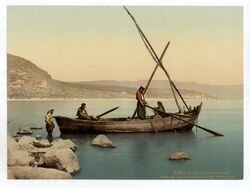
Fisherman in the Sea of Galilee, 1890-1900The Sea of Galilee is Israel's largest freshwater lake, approximately 53 kilometers (33 miles) in circumference, about 21 km (13 miles) long, and 13 km (8 miles) wide; it has a total area of 166 km², and a maximum depth of approximately 43 meters. At 209 meters below sea level, it is the lowest freshwater lake on Earth and the second-lowest lake in the world after the Dead Sea, a saltwater lake. It is not a sea by any normal definition; it is called a sea by tradition. The lake is also known on modern maps as Lake Galilee or Lake Tiberias. The name Galilee refers to the region of Galilee in which it is located. In modern Hebrew it is known by its biblical name, Yam Kinneret (ים כנרת), "Sea of Kinnereth" (Numbers 34:11; Joshua 13:27). The name may originate from the Hebrew word kinnor ("harp" or "lyre") - which the lake's shape resembles. It has also been called the Lake of Gennesaret or the Sea of Gennesaret (Luke 5:1) after the name of a small fruitful plain which lies on its western side.


More...

Tuesday, February 13, 2007

John the Apostle

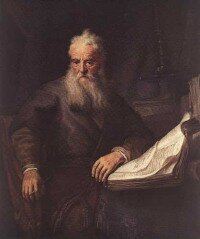
St. John at Patmos - Pine panel - Pinakothek at MunichJohn the Apostle (יוחנן "The LORD is merciful", Greek Ευαγγελιστής Ιωάννης), was one of the twelve apostles of Jesus. Christian tradition proclaims he is the same person who wrote:

  • the Gospel of John and first epistle of John (the author of these is also referred to as John the Evangelist, John the Theologian or John the Divine)

  • the second and third Epistle of John (the author of these is sometimes distinguished under the name of John the Presbyter).

  • the Book of Revelation (the author is sometimes referred to as John of Patmos or John the Revelator).

In the Bible
John the Apostle was the son of Zebedee, and the brother of James. One tradition gives his mother's name as Salome.

John and James were originally fishermen and fished with their father in the Lake of Genesareth (the Sea of Galilee).


More...

Monday, February 12, 2007

Simon Peter

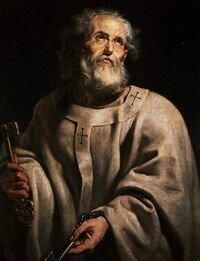
Saint Peter, also known as Simon ben Jonah/BarJonah, Simon Peter, Cephas and Kepha — original name Simon or SimeonSaint Peter, also known as Simon ben Jonah/BarJonah, Simon Peter, Cephas and Kepha — original name Simon or Simeon (Acts 15:14) — was one of the Twelve Apostles whom Jesus chose as his original disciples. His life is prominently featured in the New Testament Gospels and the Acts of the Apostles. A Galilean fisherman, he (with his brother Andrew) was literally "called" by Jesus to be a disciple. Above all the other disciples, Peter was assigned a leadership role by Jesus (Matt 16:18; John 21:15–16); and many within the early Church, such as St Clement of Rome and St Irenaeus (Adversus Haereses 3:3:20), mention his primacy.

The ancient Christian Churches, Roman Catholic, Eastern Orthodox and Oriental Orthodox, consider Simon Peter a saint and associate him with the foundation of the Church in Rome, even if they differ on the significance of this for the position of the see of Rome and of the Pope in present-day Christianity.

Some who recognize his office as Bishop of Antioch and, later, as Bishop of Rome hold that his episcopacy held a primacy only of honour, as a first among equals.

More...

Carthage

Ruins of Roman-era CarthageThe term Carthage (Greek: Καρχηδών, Arabic: قرطاج also قرطاجة, Latin: Carthago) refers both to an ancient city in North Africa located in modern day Tunis and to the civilization that developed within the city's sphere of influence. The city of Carthage was located on the eastern side of Lake Tunis across from the center of modern Tunis in Tunisia.

Settlement
Originally a settlement of Phoenician colonists, Carthage grew into a vast economic and political power throughout the Mediterranean Sea, accumulating wealth and influence through its economic (trading) prowess. Carthage was a superpower, contemporaneously with the Roman Republic of the 2nd and 3rd Century BC, and was its rival for dominance of the western Mediterranean. Eventually this rivalry led to a series of three wars known as the Punic Wars, each of which Carthage lost. These losses led to a decline in Carthage's political and economic strength, mostly due to the harsh penalties imposed on Carthage by Rome as conditions of the cessation of hostilities.


More...

Recent Comments

Powered by Disqus

Blog Archive

Techledo Consulting

Techledo Consulting, LLC

Prevail Magazine

My Photo
Timothy Ministries
View my complete profile