Showing posts with label heresy. Show all posts

Saturday, November 12, 2011

Heresy

according to the Oxford English dictionary, is a "theological or religious opinion or doctrine maintained in opposition, or held to be contrary, to the 'Catholic' or Orthodox doctrine of the Christian church, or, by extension, to that of any church, creed, or religious system, considered as orthodox. by extension, [heresy is an] opinion or doctrine in philosophy, politics, science, art, etc., at variance with those generally accepted as authoritative."

Urgent concerns with the uniformity of belief and practice have characterized Christianity from the outset.

The process of establishing orthodox Christianity was set in full swing when Paul wrote the epistles that comprise a large part of the New Testament.

On many occasions in Paul's epistles, he defends his own apostleship, and urges Christians in various places to beware of false teachers, or of anything contrary to what was handed to them by him. The epistles of John and Jude also warn of false teachers or prophets, as does:


In the middle of the 2nd century, three unorthodox groups of Christians adhered to a range of doctrines that divided the Christian communities of Rome: the teacher Marcion, the pentecostal outpourings of ecstatic Christian prophets of a continuing revelation, in a movement that was called "Montanism" because it had been initiated by Montanus and his female disciples, and the Gnostic teachings of Valentinus.

More...

Walid Shoebat-Islam Prophesied In The Bible
Presented by: Chuck Missler and Koinonia Institute

Tuesday, February 02, 2010

Pelagius

Pelagius (ca. 354 - ca. 420/440) was an ascetic monk and reformer who denied the doctrine of original sin from Adam and was declared a heretic (see heresy) by the Roman Catholic Church. His interpretation of a doctrine of free will became known as Pelagianism. He was well educated, fluent in both Greek and Latin, and learned in theology. He spent time as an ascetic, focusing on practical asceticism, which his teachings clearly reflect. He was not, however, a cleric. He was certainly well known in Rome, both for the harsh asceticism of his public life as well as the power and persuasiveness of his speech. His reputation in Rome earned him praise early in his career even from such pillars of the Church as Augustine of Hippo, who referred to him as a "saintly man." However, he was later accused of lying about his own teachings in order to avoid public condemnation. Most of his later life was spent defending himself against other theologians and the Catholic Church.

More...

Saturday, January 23, 2010

heresy

Heresy, according to the Oxford English dictionary, is a "theological or religious opinion or doctrine maintained in opposition, or held to be contrary, to the 'Catholic' or Orthodox doctrine of the Christian church, or, by extension, to that of any church, creed, or religious system, considered as orthodox. by extension, [heresy is an] opinion or doctrine in philosophy, politics, science, art, etc., at variance with those generally accepted as authoritative."

Urgent concerns with the uniformity of belief and practice have characterized Christianity from the outset.

The process of establishing orthodox Christianity was set in full swing when Paul wrote the epistles that comprise a large part of the New Testament.

On many occasions in Paul's epistles (see also the letters of Paul), he defends his own apostleship, and urges Christians in various places to beware of false teachers, or of anything contrary to what was handed to them by him. The epistles of John and Jude also warn of false teachers, as does the writer of the book of Revelation.

In the middle of the 2nd century, three unorthodox groups of Christians adhered to a range of doctrines that divided the Christian communities of Rome: the teacher Marcion, the pentecostal outpourings of ecstatic Christian prophets of a continuing revelation, in a movement that was called "Montanism" because it had been initiated by Montanus and his female disciples, and the Gnostic teachings of Valentinus.

More...

Monday, February 05, 2007

heresy

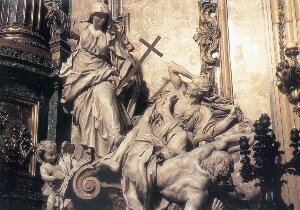
Pierre Le Gros, Religion Overthrowing Heresy and Hatred, 1695-99 RomeHeresy, according to the Oxford English dictionary, is a "theological or religious opinion or doctrine maintained in opposition, or held to be contrary, to the 'Catholic' or Orthodox doctrine of the Christian church, or, by extension, to that of any church, creed, or religious system, considered as orthodox. by extension, [heresy is an] opinion or doctrine in philosophy, politics, science, art, etc., at variance with those generally accepted as authoritative."

Urgent concerns with the uniformity of belief and practice have characterized Christianity from the outset.

The process of establishing orthodox Christianity was set in full swing when Paul wrote the epistles that comprise a large part of the New Testament.

More...
 

Subscribe


LifeNews.com

Desiring God Blog

Youth for Christ International