rss rss Follow Jesus
Subscribe

Share/Save/Bookmark

Restore The Republic - The Home of the Freedom Movement!

Tuesday, January 23, 2007

Galileo Galilei

Galileo GalileiGalileo Galilei (15 February 1564 – 8 January 1642) was an Italian physicist, astronomer, astrologer, and philosopher who is closely associated with the scientific revolution. His achievements include improvements to the telescope, a variety of astronomical observations, and effective support for Copernicanism. According to Stephen Hawking, Galileo probably contributed more to the creation of the modern natural sciences than anybody else. He is often referred to as the "father of modern astronomy," as the "father of modern physics", and as the "father of science". The work of Galileo is considered to be a significant break from that of Aristotle. The motion of uniformly accelerated objects, treated in nearly all high school and introductory college physics courses, was studied by Galileo as the subject of kinematics.

He once said, "I render infinite thanks to God for being so kind as to make me alone the first observer of marvels kept hidden in obscurity for all previous centuries."


More...

Monday, January 22, 2007

Pharisee

(l. to r.) Nicodemus the Pharisee, an unidentified helper, Mary Magdalene, Mary, mother of Jesus, John the apostle, Joseph of Arimathea placing the body of Jesus in a tomb, sculpture at church Groß St. Martin (Köln Germany), 1509.The Pharisees (from the Hebrew perushim, from parash, meaning "to separate") were, depending on the time, a political party, a social movement, and a school of thought among Jews that flourished during the Second Temple Era (536 BCE–70 CE). After the destruction of the Second Temple, the Pharisaic sect was re-established as Rabbinic Judaism — which ultimately produced normative, traditional Judaism, the basis for all contemporary forms of Judaism. The relationship between the Pharisees and Rabbinic Judaism (exemplified by the Talmud) is so close that many do not distinguish between the two.

Nevertheless, the social standing and beliefs of the Pharisees changed over time, as political and social conditions in Judea changed. It is thus impossible to understand the Pharisees without understanding their historical context.

More...

anthropic principle

The Carina Nebula (NGC 3372) courtesy, NASA National Space Science Data CenterIn physics and cosmology, the anthropic principle is an umbrella term for various dissimilar attempts to explain the structure of the universe by way of coincidentally balanced features that are necessary and relevant to the existence on Earth of biochemistry, carbon-based life, and eventually human beings to observe such a universe. The common (and "weak") form of the anthropic principle is a truism or tautology that begins with the observation that the universe appears surprisingly hospitable to the emergence of life, particularly complex multicellular life, that can make such an observation and concludes with that premise that in only such a fine-tuned universe can such living observers be.

Given the extreme simplicity of the universe at the start of the Big Bang, the friendliness of the universe to complex structures such as galaxies, planetary systems, and biology is unexpected by any normal model of turbulence driven structuring that science has been able to derive.


Much of the controversy arises from the perception that some versions of the Principle re-introduce the Argument from Intelligent Design for the existence of God.

More...

Friday, January 19, 2007

Irreducible complexity

Schematic diagram of the human eyeIrreducible complexity (IC) is the argument that certain biological systems are too complex to have evolved from simpler, or "less complete" predecessors, and are at the same time too complex to have arisen naturally through chance mutations. An "irreducibly complex" system is defined by the term's originator, biochemistry professor Michael J. Behe, as one "composed of several well-matched, interacting parts that contribute to the basic function, wherein the removal of any one of the parts causes the system to effectively cease functioning". These examples are said to demonstrate that modern biological forms could not have evolved naturally. The argument is used in a broader context to support the idea that an intelligent designer was involved, at some point, in the creation of life, against the theory of evolution which argues no designer is required. In a manner of speaking, the IC argument is a definition of the "designer", or at least "what was designed", a definition that has proven elusive in the past. The most common examples used in argument are the complexity of the eye (right), the Blood clotting cascade, or the motor in a cell's flagellum.

The examples offered to support the irreducible complexity argument have generally been found to fail to meet the definition and intermediate precursor states have been identified for several structures purported to exhibit irreducible complexity.

More...

Intelligent design

M 17 Omega Nebula, © NASA / HubbleIntelligent design (ID) is the concept that "certain features of the universe and of living things are best explained by an intelligent cause, not an undirected process such as natural selection." Its leading proponents, all of whom are affiliated with the Discovery Institute, say that intelligent design is a scientific theory that stands on equal footing with, or is superior to, current scientific theories regarding the origin of life.

More and more of the scientific community are beginning to view intelligent design as a valid scientific theory.

Stephen C. Meyer, Ph.D. (Cambridge) said,

"...if it's true there's a beginning to the universe, as modern cosmologists agree, then this implies a cause that transcends the universe. If the laws of Physics are fine-tuned to permit life, as contemporary physicists are discovering, then perhaps there's a designer who fine tuned them. If there's information in the cell, as molecular biology shows, then this suggests intelligent design. To get life going in the first place would have required biological information; the implications point beyond the material realm to a prior intelligent cause." A Case for a Creator, Lee Stobel


More...

Wednesday, January 17, 2007

Olivet discourse

The Mount of OlivesThe Olivet discourse or Little Apocalypse is a passage found in the Synoptic Gospels of Matthew 24 Mark 13 and Luke 21, occurring just before the narrative of Jesus's passion beginning with the Anointing of Jesus. In the narrative is a discourse or sermon given by Jesus on the Mount of Olives, hence the name. According to most textual scholars, the versions of the discourse in Matthew and Luke are based on the version in Mark.


The discourse contains a number of statements which at face value appear to refer to future events, and most modern Christians interpret as having been intended as prophecy.

The topics involved are:

  1. The future destruction of the Temple in Jerusalem
  2. Tribulation in Israel and the nations of the world
  3. Various signs of the coming of the Son of Man

More...

Tuesday, January 16, 2007

Siege of Jerusalem (70)

Jerusalem Temple Destruction, AD 70, by Nicolas PoussinThe siege of Jerusalem in the year 70 was a conclusive event in the first Jewish-Roman War.

Despite early successes in repelling the Roman sieges, the Zealots fought among themselves, lacking proper leadership, discipline, training, and preparation for the battles that were to follow.
Titus surrounded the city, with three legions (Legio V Macedonica, Legio XII Fulminata, Legio XV Apollinaris) on the western side, and a fourth (Legio X Fretensis) on the Mount of Olives to the east. He put pressure on the food & water supplies of the inhabitants by allowing pilgrims to enter the city to celebrate Passover, and then refusing them egress. After Jewish sallies killed a number of Roman soldiers, Titus sent Flavius Josephus, a former Jewish commander, now loyal to Rome, to negotiate with the defenders; this failed, and another sally was launched.

More...

Mount of Olives

The Mount of OlivesThe Mount of Olives (also Mount Olivet, Hebrew: Har HaZeitim הר הזיתים, sometimes Jebel et-Tur, "Mount of the Summit," or Jebel ez-Zeitun, "Mount of Olives") is a mountain ridge to the east of Jerusalem. It is named from the olive trees with which its sides are clothed. Jesus entered Jerusalem, gave his final teaching, and ascended to heaven from the Mount. It is the site of many important Biblical events.

In the Book of Zechariah the Mount of Olives is identified as the place from which God will begin to redeem the dead at the end of days. For this reason, Jews have always sought to be buried on the mountain, and from Biblical times to the present day the mountain has been used as a cemetery for the Jews of Jerusalem.
The Mount of Olives is first mentioned in connection with David's flight from Jerusalem through the rebellion of Absalom (2 Samuel 15:30), and is only once again mentioned in the Old Testament, in Zechariah 14:4.


More...

Monday, January 15, 2007

Martin Luther King, Jr.

Martin Luther King addressing the press in 1964.Martin Luther King, Jr. (January 15, 1929–April 4, 1968) was a Baptist minister and American political activist who was the most famous leader of the American civil rights movement. King won the Nobel Peace Prize before being assassinated in 1968. In 1977, King was posthumously awarded the Presidential Medal of Freedom, by Jimmy Carter. For his promotion of non-violence and racial equality, King is considered a peacemaker and martyr by many people around the world. Martin Luther King Day was established in his honor.


King was born in Atlanta, Georgia (on Auburn Avenue) to the Rev. Martin Luther King, Sr. and Alberta Williams King. (Birth records for Martin Luther King Jr. list his first name as Michael, apparently due to some confusion on the part of the family doctor regarding the true name of King's father, who was known as Mike throughout his childhood.) He graduated from Morehouse College with a Bachelor of Arts degree in Sociology in 1948. At Morehouse, King was mentored by President Benjamin Mays, a civil rights leader.


Later he graduated from Crozer Theological Seminary in Chester, Pennsylvania with a Bachelor of Divinity degree in 1951. In 1955 he received his Ph.D. in Systematic Theology from Boston University.

More...

Saturday, January 13, 2007

prophecy

The prophet Elijah in the wilderness Christianity and Jewish prophecy is: Old Testament Bible prophecies interpreted by some to concern a Messiah, which are thought by Christians to have been fulfilled by Jesus during his time on earth, as described in the New Testament.

Following is a list of verses from the Tanakh (Hebrew Bible, Old Testament) that show Christian interpretations regarding Messianic prophecies, supporting the claim that Jesus has been promised by God to be born as a human, and is the awaited Messiah.

Prophecy, in a broad sense, is the prediction of future events. The etymology of the word is ultimately Greek, from pro- "before" plus the root of phanai "speak", i. e. "speaking before" or "foretelling" (proclamation), but prophecy can be supernatural, subnatural, or natural phenomena, whether it is communication with a deity, the reading of magical signs, astrology, or guesswork. It is also used as a general term for the revelation of divine will.

More...

Thursday, January 11, 2007

Acts of the Apostles

Statue of Apostle Luka on Saint Isaac’s cathedral. Saint Petersburg, RussiaThe Acts of the Apostles (Greek Praxeis Apostolon) is a book of the Bible, which now stands fifth in the New Testament after the four gospels. This book describes the development of the early church from Christ's Ascension to Paul's sojourn at Rome. It is commonly referred to as simply Acts. The traditional view is that it was written by the Macedonian Christian physician and historian Luke the Evangelist (also the author of the gospel of Luke).

An alternative name for the book is Acts of the Holy Spirit. It describes many of the journeys and actions taken by the apostles, meaning "those who have been sent" by God, to be His witnesses. This was originally applied exclusively to those who had personally seen and/or lived with Jesus of Nazareth. The book of Acts contains many descriptions of miraculous events (which were given as signs from God to validate the apostles' teachings), which were performed by the Holy Spirit through the apostles. These included miraculous healings, casting out evil spirits, the raising of the dead, and also historical descriptions of everyday life in The Roman Empire and in ancient Jerusalem.

More...

Wednesday, January 10, 2007

Africa

Physical map of Africa.Africa is the world's second-largest and second most populous continent, after Asia. At about 30,370,000 km² (11,730,000 sq mi) including its adjacent islands, it covers 5.9% of the Earth's total surface area, and 20.3% of the total land area. With over 840,000,000 people (as of 2005) in 61 territories, it accounts for more than 12% of the world's human population.
The name Africa came into Western use through the Romans, who used the name Africa terra — "land of the Afri" (plural, or "Afer" singular) — for the northern part of the continent, as the province of Africa with its capital Carthage, corresponding to modern-day Tunisia. The Afri were a tribe — possibly Berber — who dwelt in North Africa in the Carthage area. The origin of Afer may be connected with Phoenician `afar, dust (also found in most other Semitic languages); some other etymologies that have been postulated for the ancient name 'Africa' that are much more debatable include:
  • the Latin word aprica, meaning "sunny";

  • the Greek word aphrike, meaning "without cold". The historian Leo Africanus (1495-1554) attributed the origin to the Greek word phrike (φρίκη, meaning "cold and horror"), combined with the negating prefix a-, so meaning a land free of cold and horror. However, the change of sound from ph to f in Greek is datable to about the first century, so this is unlikely to be the origin.
More...

Tuesday, January 09, 2007

Isaiah

Isaiah the Prophet in Hebrew Scriptures was depicted on the Sistine Chapel ceiling by Michelangelo.Isaiah (hebrew ישׁעיהו yeshayahu) is a book of the Jewish Hebrew bible as well as the Christian Old Testament, containing prophecies attributed to Isaiah. This book is often seen by scholars as being divided into at least two sections. The first section, consisting of chapters 1-39, is generally accepted as being written by the prophet Isaiah of Jerusalem, or by his followers who took down his words.

Isaiah (יְשַׁעְיָהוּ "Salvation of/is the Lord") was the son of Amoz, and commonly considered the author of the Book of Isaiah.

Isaiah prophesied during the reigns of four kings -- Uzziah (Azariah), Jotham, Ahaz, and Hezekiah. Legend has it that he was martyred during the reign of Manasseh, who came to the throne in 687 BCE. That he is described as having ready access to the kings would suggest an aristocratic origin.

This was the time of the divided kingdom, with Israel in the north and Judah in the south.


More...

Monday, January 08, 2007

Jerusalem

From Palestine and Syria. Handbook for Travellers by Karl Baedeker, 5th Edition, 1912Jerusalem is the holiest city of Judaism (since the 10th century BCE) and some denominations of Christianity (since the 5th century CE) and, after Mecca and Medina, the third holiest city of Islam (since the 7th century CE). A heterogeneous city, Jerusalem represents a wide range of national, religious, and socioeconomic groups. The section called the "Old City" is surrounded by walls and consists of four quarters: Armenian, Christian, Jewish, and Muslim.

The status of the united Jerusalem as Israel's capital is not widely recognized by the international community, and Israel's annexation of East Jerusalem is particularly controversial.

Jerusalem has long been embedded into the religious consciousness of the Jewish people. Jews have always studied and personalized the struggle by King David to capture Jerusalem and his desire to build the Jewish temple there, as described in the Book of Samuel and the Book of Psalms.

More...

Gaza


Gaza is the largest city within the Gaza Strip, part of the Palestinian Territories. The city, which has a population of approximately 400,000, is frequently termed "Gaza City" in order to distinguish it from the larger Gaza Strip.
History
40 So Joshua subdued the whole region, including the hill country, the Negev, the western foothills and the mountain slopes, together with all their kings. He left no survivors. He totally destroyed all who breathed, just as the LORD, the God of Israel, had commanded. 41 Joshua subdued them from Kadesh Barnea to Gaza and from the whole region of Goshen to Gibeon. 42 All these kings and their lands Joshua conquered in one campaign, because the LORD, the God of Israel, fought for Israel. -Joshua 10:40-42


Strategically located on the Mediterranean coastal route, ancient Gaza was a prosperous trade center and a stop on the caravan route between Egypt and Syria. The city was occupied by Egypt around the 15th century BCE.


More...


Saturday, January 06, 2007

U2

U2 - The Edge, Bono, Adam Clayton, and Larry Mullen Jr.U2 is an Irish rock band formed in Dublin, whose members are Christians. The band features Bono (Paul David Hewson) on vocals, rhythm guitar and harmonica; The Edge (David Howell Evans) on lead guitar, keyboards and backing vocals; Adam Clayton on bass guitar; and Larry Mullen, Jr. on drums and occasional backing vocals.

Formed in 1976, U2 has consistently remained among the most popular acts in the world since the mid 1980s.

@U2 Links
Recent U2 News PodCast Forum U2 Calendar

The band has sold approximately 50.5 million albums in the U.S., according to the RIAA, and upwards of 170 million worldwide, has had six #1 albums in the US and nine #1 albums in the UK and is one of the most successful bands of the rock era. The band has won 22 Grammy awards, more than any other recording artist.

The band is also politically active in human rights causes, such as the Make Poverty History campaign as well as Live Aid, Live 8, One.org, and Bono's DATA (Debt, AIDS, Trade in Africa) campaign.

More...

Friday, January 05, 2007

New Testament view on Jesus‘ Life

Jesus Christ being nailed to the crossThe four canonical gospels of the New Testament are the main sources of information for the traditional Christian narrative of Jesus' life.

Genealogy and family


The Gospels give two accounts of Jesus' genealogy: one in the male line through his legal father Joseph of Nazareth (Matt 1:2–16 and one through his mother, Mary, while referencing his supposed father; Luke 3:23–38). Both accounts trace his line back to King David and from there to Abraham. These lists are identical between Abraham and David, but they differ between David and Joseph. Matthew starts with Solomon and proceeds through the kings of Judah to the last king, Jeconiah. After Jeconiah the line of kings terminated when Babylon conquered Judah. Thus, Matthew shows that Jesus is the legal heir to the throne of Israel. Luke's genealogy is longer than Matthew's; it goes back to Adam and provides more names between David and Jesus, thus giving us direct descendants from Adam to Jesus through Mary.


More...

Wednesday, January 03, 2007

That Hideous Strength

That Hideous Strength, First edition coverThat Hideous Strength is a novel by C. S. Lewis first published in 1945. It is the third in Lewis's theological science fiction series, the Space Trilogy which features the philologist Elwin Ransom. This novel follows Out of the Silent Planet and Perelandra (a.k.a. Voyage to Venus). It is heavily influenced by the writing of Lewis's friend Charles Williams. The book is heavily dystopian in style (A dystopia (alternatively, cacotopia, kakotopia or anti-utopia) is a fictional society that is the antithesis of utopia.).

Plot summary
This final novel in the trilogy is a parable of the battle between man’s sinful pride and God’s will. It is set in post-war England in a small university town in which a research agency called N.I.C.E. (National Institute for Coordinated Experiments), led by fallen eldila, attempts to destroy the true nature of mankind.


More...

Creation

And God said, “Let there be light,“ and there was light. - Genesis 1:3, M 17 Omega Nebula, © NASA / HubbleThe act of creating; especially, in a theological sense, the original act of God in bringing the world or universe into existence.

Creation is a doctrinal position in many religions and philosophical belief systems which maintains that a single God, or a group of gods or deities is responsible for creating the universe. Creationism affirms this belief, but the doctrinal belief is not necessarily synonymous with creationism.

Judaism & Christianity
Genesis 2:4-25
Mainstream Biblical scholarship maintains that the creation story found in Genesis 2 is the earlier of the two Genesis accounts. Filled with ancient and rich imagery, it is believed that the basic story once circulated among the early nomadic Hebrews, told perhaps around simple, intimate campfire settings, answering questions about life and the origins of humankind. The story also reflects Israel's belief in its covenant relationship with God. The concern in Genesis 2 is not in the creation of the cosmos but in the origins of humankind and their environment. There is a clear connection between humans and the land (Gen. 2:7) and the notion that people are a special creation of God. "Jehovah" is that name of God, which plainly means that he alone has His being of himself, and that He gives being to all creatures and things.

7And Jehovah Elohim formed Man, dust of the ground, and breathed into his nostrils the breath of life; and Man became a living soul. -Genesis 2:7 (Darby)


More...

Tuesday, January 02, 2007

Richard the Lionheart

Richard I. Cœur de Lion (Lionheart, Löwenherz)Richard I (September 8, 1157 – April 6, 1199) was King of England from 1189 to 1199. In his own time, the troubadour Bertran de Born called him Oc-e-Non (Yes-and-No), while some later writers referred to him as Richard the Lionheart, Cœur de Lion, as he is still known in France.

Family
The third of King Henry II's legitimate sons, Richard was never expected to ascend to the throne. He is generally considered to have been the favourite son of his mother, Eleanor of Aquitaine. Richard was a younger maternal half-brother of Marie de Champagne and Alix of France. He was a younger brother of William, Count of Poitiers, Henry the Young King and Matilda of England. He was also an older brother of Geoffrey II, Duke of Brittany, Leonora of England, Joan Plantagenet and John Lackland of England.

Early life
Although born at Beaumont Palace, Oxford, England, like most of the Royal Family at the time he was, for all intents and purposes, French.


More...

Saturday, December 30, 2006

Cush

Aerial view of the pyramids at MeroëCush (כּוּשׁ "Dark,") was the eldest son of Ham, brother of Canaan and the father of Nimrod, mentioned in the "Table of Nations" in the Genesis 10:6 and in I Chronicles 1:8. It is usually considered to be the eponym of the people of Kush. Six Arabian tribes are also sons of Cush.
In Genesis, Cush was the father of the Seba, Havilah, Sabtah, Raamah, and Sabteca. He is also the father of Nimrod.

Another person named Cush in the Bible is a Benjamite (see Tribe of Benjamin) who is mentioned only in Psalm 7 and is believed to be a follower of Saul.

Cush is first mentioned in Genesis 2:12-14,


12(The gold of that land is good; aromatic resin and onyx are also there.) 13The name of the second river is the Gihon; it winds through the entire land of Cush. 14The name of the third river is the Tigris; it runs along the east side of Asshur. And the fourth river is the Euphrates.

More...

Friday, December 29, 2006

Solomon

Legend of the True Cross - the Queen of Sheba Meeting with Solomon; (c. 1452-66, Fresco, San Francesco, Arezzo, Italy)Solomon (Latin name) or Shlomo (Hebrew: שְׁלֹמֹה, Arabic: سليمان, Sulayman; "peace") was Israel's third king, son of King David, who's "...wisdom was greater than the wisdom of all the men of the East, and greater than all the wisdom of Egypt." -1 Kings 4:30

The names "Shlomo" and "Solomon" are usually associated with the Biblical account of his life.


The First Temple
Solomon's Temple (Hebrew: בית המקדש, transliterated Beit HaMikdash), also known as the First Temple, was, according to the Bible, the first Jewish Temple in Jerusalem. It functioned as a religious focal point for worship and the sacrifices known as the korbanot (see korban) in ancient Judaism. Completed in the 10th century BCE, it was destroyed by the Babylonians in 586 BCE.


More...

Thursday, December 28, 2006

seven churches of Asia

The Seven Churches of AsiaThe seven churches of Asia (properly Asia Minor) are seven major churches of the early Christianity, as mentioned in the New Testament Book of Revelation. All sites are in modern-day Turkey. In Revelation, Jesus Christ instructs 'Saint John the Evangelist' to:

Write in a book what you see and send it to the seven churches, to Ephesus, to Smyrna, to Pergamum, to Thyatira, to Sardis, to Philadelphia, and to Laodicea. (Revelation 1:11)


It should be understood that "churches" in this context refers to the community of Christians living in each city, and not merely to the building or buildings in which they gathered for worship.


The seven churches are located in:


  1. Ephesus
  2. Smyrna, modern day Izmir
  3. Pergamum, modern-day Bergama
  4. Thyateira, modern-day Akhisar
  5. Sardis
  6. Philadelphia, modern-day Alasehir
  7. Laodicea, near modern-day Denizli


More...

Wednesday, December 27, 2006

Pharaoh

Moses and Aaron before Pharoah by Gustov DoréPharaoh is a title used to refer to any ruler, usually male, of the Egyptian kingdom in the pre-Christian, pre-Islamic period. An absolute, all powerful, all providing ruler. Such rulers were believed to be the reincarnation of Horus.
From the Twelfth Dynasty onwards the word appears in a wish formula 'Great House, may it live, prosper and be in health', but only with reference to the buildings of the court rather than the king himself.

10So Moses and Aaron went to Pharaoh and did just as the LORD commanded. Aaron threw his staff down in front of Pharaoh and his officials, and it became a snake. - Exodus 7:10


More...


Tuesday, December 26, 2006

Tertullian

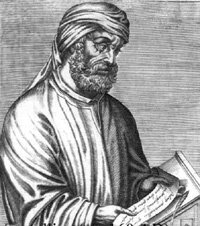
Tertullian ca. 160 ACQuintus Septimius Florens Tertullianus, anglicized as Tertullian, (ca. 155–230) was a church leader and prolific author during the early years of Christianity. He was born, lived, and died in Carthage, in what is today Tunisia.

Tertullian denounced Christian doctrines he considered heretical, but later in life adopted views that came to be regarded as heretical themselves. He was the first great writer of Latin Christianity, thus sometimes known as the "father of the Latin Church".


He introduced the term Trinity, as the Latin trinitas, to the Christian vocabulary and also probably of the formula "three Persons, one Substance" as the Latin "tres Personae, una Substantia" (itself from the Koine Greek "treis Hypostases, Homoousios") and also the terms vetus testamentum ("old testament") and novum testamentum ("new testament").

More...

Sunday, December 24, 2006

Christmas

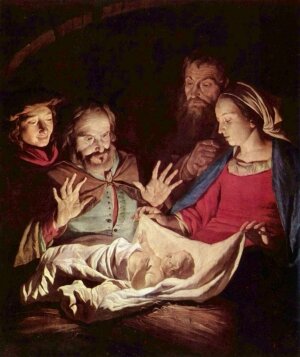
Wise Men visiting Jesus on Twelfth<br />Night after his birth on ChristmasChristmas (literally, the Mass of Christ) is a traditional holiday commonly observed on 25 December. In most Eastern Orthodox Churches, even where the civil calendar used is the Gregorian, the event is observed according to the Julian calendar, which coincides with the predominant reckoning of 7 January. It is celebrated by most Christians to mark the birth of Jesus, which is believed to have occurred in Bethlehem in the Roman Province of Judea between 6 BC and AD 6. Christ's birth, or nativity, was said by his followers to fulfill the prophecies of Judaism that a messiah would come, from the house of David, to redeem the world from sin. Efforts to decide upon a date on which to celebrate his birth began some centuries later.


The word Christmas is a contraction of Christ's Mass, derived from the Old English Cristes mæsse.


It is sometimes abbreviated Xmas, probably because X resembles the Greek letter Χ (chi) which has often historically been used as an abbreviation for Christ (Χριστός in Greek).

More...

Recent Comments

Powered by Disqus

Blog Archive

Techledo Consulting

Techledo Consulting, LLC

Prevail Magazine

My Photo
Timothy Ministries
View my complete profile