Friday, July 31, 2009

Tribes of Israel

Map of the twelve tribes of IsraelIsrael had 12 sons, as follows: Reuben, (ראובן Rĕ'uwben, Jacob's firstborn); Simeon, (שמעון Shim`own); Levi, (לוי Leviy); Judah, (יהודה Yĕhuwdah); Dan, (דן Dan); Naphtali, (נפתלי Naphtaliy); Gad, גד( Gad); Asher, (אשר 'Asher); Issachar, (יששכר Yissaskar); Zebulun, (זבולון Zĕbuwluwn); Joseph, (יוסף Yowceph); Manasseh, (מנשה Mĕnashsheh); Ephraim, (אפרים 'Ephrayim); Benjamin (בנימין Binyamiyn). (Jacob was renamed Israel Gen. 32:27-29)

The Tribe of Levi was set apart from the others in the sense that, the members of the Tribe of Levi were to be in charge of the tabernacle of the Testimony.
(see: Num. 1).

The Tribe of Joseph is not usually listed with the Hebrew tribes although Joseph is one of Jacobs twelve sons, the eldest of Rachel. It is sometimes referred to as the House of Joseph. Rather, the two tribes founded by his sons Ephraim and Manasseh are listed separately. (see Tribe of Joseph)

Politically, the Israelites were composed of thirteen tribes: Reuben, Simeon, Levi, Judah, Dan, Naphtali, Gad, Asher, Issachar, Zebulun, Manasseh, Ephraim, and Benjamin. In parts of the Bible, Ephraim and Manasseh are treated as together constituting the House of Joseph, while the Levi have a special religious role and had only scattered cities as territory; whence traditionally either Ephraim and Manasseh were counted as one tribe, or Levi wasn't counted, so that together the tribes were the Twelve Tribes of Israel (see also: Gen. 32: 27-29, Gen. 48:5).

More...
Thursday, July 30, 2009

epistle

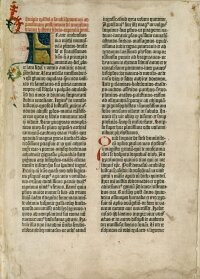
The beginning of the Gutenberg Bible, Epistle of St. JeromeAn epistle (pronounced [ɪˈpɪsəl]) (Greek επιστολη, epistolē, 'letter') is a writing directed or sent to a person or group of people, usually a letter and a very formal, often didactic and elegant one. The epistle genre of letter-writing was common in ancient Egypt as part of the scribal-school writing curriculum. The letters in the New Testament from Apostles to Christians are usually referred to as epistles. Those traditionally attributed to Paul of Tarsus are known as Pauline epistles and the others as 'catholic' or general epistles.

The ancient Egyptians wrote epistles, most often for pedagogical reasons. Egyptologist Edward Wente (1990) speculates that the Fifth-dynasty Pharaoh Djedkare Isesi—in his many letters sent to his viziers—was a pioneer in the epistolary genre. It's existence is firmly attested during the Sixth Dynasty of the Old Kingdom, and is prominently featured in the educational guide The Book of Kemit written during the Eleventh Dynasty. A standardized formulae for epistolary compositions existed by the time of the Middle Kingdom of Egypt. The epistolary formulae used in the Ramesside Period found its roots in the letters composed during the Amarna Period of the Eighteenth Dynasty. Wente describes the "Satirical Letter" found on the Papyrus Anastasi I of the Nineteenth Dynasty as an epistle which was commonly copied as a writing exercise by Egyptian schoolchildren on ceramic ostraca (over eighty examples of which have been found so far by archaeologists). Epistle letters were also written to the dead, and, by the Ramesside Period, to the gods; the latter became even more widespread during the eras of Persian and Greek domination.

More...

Wednesday, July 29, 2009

Salvation

Two Trinities, Bartolomé Estéban Murillo (1618 - 1682).Salvation refers to deliverance from an undesirable state or condition. In theology, the study of salvation is called soteriology and is a vitally important concept in several religions. Christianity regards salvation as deliverance from the bondage of sin and from condemnation, resulting in eternal life with God.

Salvation is arguably one of the most important Christian spiritual concepts, perhaps second only to the deity of Jesus Christ, the lamb of God.

Among many Christians, the primary goal of religion is to attain salvation. Others maintain that the primary goal of Christians is to do the will of God, or that the two are equivalent. In many traditions, attaining salvation is synonymous with going to heaven after death, while most also emphasize that salvation represents a changed life while on Earth as well. Many elements of Christian theology explain why salvation is needed and how to attain it.

In Western Christianity the doctrine of salvation, or soteriology, involves topics such as atonement, reconciliation, grace, justification, God's sovereignty, and the free will of human beings. Various understandings on each may be found in Catholicism and Protestantism. Especially within Protestantism, this may be seen in the differences between the theologies of Calvinism and Arminianism as well as mediating versions of the two.

More...

Tuesday, July 28, 2009

William F. Albright

William F. AlbrightWilliam Foxwell Albright (May 24, 1891–September 19/September 20, 1971) was an American Orientalist, pioneer archaeologist, biblical scholar, linguist and expert on ceramics. From the early twentieth century until his death, he was the dean of biblical archaeologists and the universally acknowledged founder of the Biblical archaeology movement. His student George Ernest Wright followed in his footsteps as the leader of that movement, while others, notably Frank Moore Cross and David Noel Freedman, became international leaders in the study of the Bible and the ancient Near East, including Northwest Semitic epigraphy and paleography. Nevertheless, although Albright is assured of a place in the history of the development of Middle Eastern archaeology, his concepts and conclusions, especially those relating to biblical archaeology, have been overturned by developments after his death.

Albright argued that the Abraham, Isaac, and Jacob were real historical figures, and he believed that Joshua's exploits were historical as well. He insisted that "as a whole, the picture in Genesis is historical, and there is no reason to doubt the general accuracy of the biographical details."

Monday, July 27, 2009

Sheol

Fallen angels in Hell. Artist: John Martin Date: c. 1841.Sheol (pronounced "Sheh-ole"), in Hebrew שאול (Sh'ol), is the "abode of the dead", the "underworld", or "pit". Sheol is the common destination of both the righteous and the unrighteous dead, as recounted in Ecclesiastes and Job.

Sheol is sometimes compared to Hades, the gloomy, twilight afterlife of Greek mythology. The word "hades" was in fact substituted for "sheol" when the Hebrew bible was translated into Greek (see Septuagint). The New Testament (written in Greek) also uses "hades" to refer to the abode of the dead.

By the second century BC, Jews who accepted the Oral Tradition had come to believe that those in sheol awaited the resurrection either in comfort (in the bosom of Abraham) or in torment. This belief is reflected in Jesus' story of Lazarus and Dives. At that time Jews who rejected the Oral Tradition believed that Sheol meant simply the grave.

More...

Sunday, July 26, 2009

Four Horsemen of the Apocalypse

Four Horsemen of the Apocalypse, by Viktor Vasnetsov (1887).The Four Horsemen of the Apocalypse is a term used to describe four horsemen that appear in the Christian Bible in chapter six of the Book of Revelation. The four horsemen are traditionally named after what the verses describe them bringing: Strife, War, Famine and Death; only Death, however, is directly named in the Bible.

1 Now I watched when the Lamb opened one of the seven seals, and I heard one of the four living creatures say with a voice like thunder, "Come!" 2 And I looked, and behold, a white horse! And its rider had a bow, and a crown was given to him, and he came out conquering, and to conquer.

3 When he opened the second seal, I heard the second living creature say, "Come!" 4 And out came another horse, bright red. Its rider was permitted to take peace from the earth, so that people should slay one another, and he was given a great sword.

More...

Saturday, July 25, 2009

Roman legion

The Roman Empire in 125 under emperor Hadrian.The Roman legion (from Latin legio, legionis, f., from lego, legere, legi, lectus — to collect) was the basic military unit of the ancient Roman army. It consisted of a core of heavy infantry (legionaries), with auxiliary cavalry and ranged troops, typically skirmishers. The size of a typical legion varied widely throughout the history of ancient Rome [] , with complements ranging from 5000-6000 men in the republican period of Rome, to the fairly standard number of around 5,400 in the early and middle imperial period and finally to on average 1000-2000 men in the very late imperial period. As legions were not standing armies until the Marian reforms (c. 107 BC), and were instead created, used, and disbanded again, several hundred Legions were named and numbered throughout Roman history. To date, about 50 have been identified. In the time of the Early Roman Empire, there were usually about 28 standing Legions plus their Auxiliaries, with more raised as needed.

Due to the enormous military successes of the Roman Republic and the Roman Empire the legion has long been regarded as the prime ancient model for military efficiency and ability.

More...

Friday, July 24, 2009

Pauline Christianity

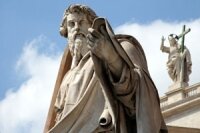
St. Paul statue in front of St. Peters Basilica, VaticanPauline Christianity is a term used to refer a branch of Early Christianity associated with the beliefs and doctrines espoused by Paul the Apostle through his writings. Most of mainstream Christianity relies heavily on these teachings and considers them to be amplifications and explanations of the teachings of Jesus. Others perceive in Paul's writings teachings that are radically different from the original teachings of Jesus documented in the canonical gospels, early Acts and the rest of the New Testament, such as the Epistle of James.

Proponents of the perceived Pauline distinctive include Marcion of Sinope, the 2nd century theologian who asserted that Paul was the only apostle who had rightly understood the new message of salvation as delivered by Christ.

Opponents of the same era include the Ebionites and Nazarenes, who rejected Paul for straying from "normative" Judaism.

Thursday, July 23, 2009

Philo of Alexandria

Philo of AlexandriaPhilo (20 BCE - 40 CE), known also as Philo of Alexandria and as Philo Judeaus, was a Hellenized Jewish philosopher born in Alexandria, Egypt. The few biographical details concerning him are found in his own works, especially in Legatio ad Caium, ("embassy to Caius") and in Flavius Josephus (Antiquities" xviii. 8, § 1; comp. ib. xix. 5, § 1; xx. 5, § 2).

The only event that can be determined chronologically is his participation in the embassy which the Alexandrian Jews sent to the emperor Caligula at Rome for the purpose of asking protection against the attacks of the Alexandrian Greeks. This occurred in the year 40 CE.

Philo included in his philosophy both Greek wisdom and Judaism, which he sought to fuse and harmonize by means of the art of allegory that he had learned as much from Jewish exegesis as from the Stoics. His work was not widely accepted. "The sophists of literalness," as he calls them (De Somniis, i. 16-17), "opened their eyes superciliously" when he explained to them the marvels of his exegesis. Philo's works were enthusiastically received by the early Christians, some of whom saw in him a Christian. Eusebius speculated that the Therapeutae, the Jewish group of ascetic hermits in the Egyptian desert that Philo describes in De vita contemplativa ("Contemplative Life") was in fact a Christian group.

More...

Monday, July 20, 2009

Jonathan (son of Saul)

Saul Throws Spear at David by George TinworthDavid and Jonathan were heroic figures of the Kingdom of Israel, whose intimate relationship was recorded favorably in the Old Testament books of Samuel.

According to the Bible, true friendship involves loyalty, sacrifice, compromise, and yes, emotional attachment.

12 If an enemy were insulting me, I could endure it; if a foe were raising himself against me, I could hide from him. 13 But it is you, a man like myself, my companion, my close friend, 14 with whom I once enjoyed sweet fellowship as we walked with the throng at the house of God.
(Psalm 55:12-14)

24 A man of many companions may come to ruin, but there is a friend who sticks closer than a brother.
(Proverbs 18:24)

13 "Greater love has no one than this, that he lay down his life for his friends. 14 You are my friends if you do what I command. 15 I no longer call you servants, because a servant does not know his master's business. Instead, I have called you friends, for everything that I learned from my Father I have made known to you."
(John 15:13-15)

7 Very rarely will anyone die for a righteous man, though for a good man someone might possibly dare to die. 8 But God demonstrates his own love for us in this: While we were still sinners, Christ died for us.
(Romans 5:7-8)
More...

Sunday, July 19, 2009

Christian mysticism

Philo of AlexandriaChristian mysticism is traditionally practised through the disciplines of:
  • prayer (including oratio, meditation and contemplation);
  • self-denial, including fasting, broadly called asceticism; and
  • service to others, again broadly called almsgiving.
Christian mystics interpret sacred texts and the life, sermons and parables of Jesus metaphorically: e.g. Jesus' Sermon on the Mount (Matthew 5–7) in its totality contains the way for direct union.

Whereas Christian doctrine generally maintains that God dwells in all Christians and that they can experience God directly through belief in Jesus, Christian mysticism aspires to apprehend spiritual truths inaccessible through intellectual means, typically by emulation of Christ. William Ralph Inge divides this scala perfectionis into three stages:
  1. the "purgative" or ascetic stage,
  2. the "illuminative" or contemplative stage, and
  3. the "unitive" stage, in which God may be beheld "face to face."
More...

Saturday, July 18, 2009

Oral Tradition

The Rylands Library Papyrus P52 is the earliest manuscript fragment found from John's Gospel; dated to about 125The Oral Torah, Oral Law, or Oral Tradition (Hebrew: תורה שבעל פה, Torah she-be-`al peh), according to Rabbinic Judaism, is an oral tradition received in conjunction with the written Torah (and the rest of the Hebrew Bible), which is known in this context as the "Written Torah" (Hebrew: תורה שבכתב, Torah she-bi-khtav). The traditions of the Oral Torah are believed to be the same as those recorded in the Mishnah and Talmud during the 2nd-5th centuries CE.

According to classical Judaism and the tenets of Orthodox Judaism, Moses and the Jews at Mount Sinai received an Oral as well as a written Torah ("teaching") from God. The books of the Tanakh (Hebrew Bible) were relayed with an oral tradition passed on by the scholarly and other religious leaders of each generation, and according to classical Rabbinic interpretation, the teachings of the Oral Law are a guide to that interpretation of the Written Law which is considered the authoritative reading. Jewish law and tradition thus is not based on a strictly literal reading of the Tanakh, but on combined oral and written traditions. Further, the basis of halakha (Jewish law) includes the premise that the Written Law is inherently bound together with an Oral Law.

More...

Friday, July 17, 2009

Exodus

View from Mount SinaiThe (Greek: "departure") book of Exodus is the second book of the Torah (the Pentateuch).

The Hebrew names of the five books of the Torah are taken from initial words of the first verse of each book. For example, the Hebrew name of the first book, ראשית re'shiyth, is the first word of Genesis 1:1:
  1. Re'shiyth (בראשית, adj. main, chief, principal, head, major, prime, top, leading, grand, master, prima, arch, capital, cardinal)
  2. Shemot (שמות, or שם shem v. to put, place, lay, set; make, cause; appoint; nm. name, reputation, fame, moniker, denomination, distinction)
  3. Vayikra (ויקרא, or קרא qara' v. to call, call out, recite, read, cry out, proclaim)
  4. Bamidbar (במדבר, מדבר midbar nm. desert, wilderness, waste, wildness, large tracts of wilderness)
  5. Devarim (דברים דבר dabar nm. word, speech, saying, utterance, say, speech; oratory; commandment)
More...

Thursday, July 16, 2009

New Testament view on the life of Jesus

Flight into Egypt, Rembrandt Harmensz. van RijnThe four canonical gospels of the New Testament are the main sources of information for the traditional Christian narrative of Jesus' life.

Genealogy and family

The Gospels give two accounts of Jesus' genealogy: one in the male line through his legal father Joseph of Nazareth (Matthew 1:2–16) and one through his mother, Mary, while referencing his supposed father; (Luke 3:23–38). Both accounts trace his line back to King David and from there to Abraham. These lists are identical between Abraham and David, but they differ between David and Joseph. Matthew starts with Solomon and proceeds through the kings of Judah to the last king, Jeconiah. After Jeconiah the line of kings terminated when Babylon conquered Judah. Thus, Matthew shows that Jesus is the legal heir to the throne of Israel. Luke's genealogy is longer than Matthew's; it goes back to Adam and provides more names between David and Jesus, thus giving us direct descendants from Adam to Jesus through Mary.

More...

Wednesday, July 15, 2009

Reformation

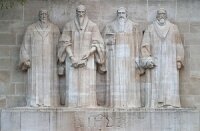
The Reformation Wall in Geneva. From left: William Farel, John Calvin, Theodore Beza, and John KnoxThe Protestant Reformation was a movement that emerged in the 16th century as a series of attempts to reform the Roman Catholic Church in Western Europe. The main front of the reformation was started by Martin Luther and his 95 Theses. The reformation ended in division and the establishment of new institutions, most importantly Lutheranism, the Reformed churches, and Anabaptists, a radical branch whose name means "those who baptize again".

Martin Luther's spiritual predecessors included men such as John Wycliffe and Jan Hus, who had attempted to reform the church along similar lines, though their efforts had been largely unsuccessful. The Reformation can be said to have begun in earnest on October 31, 1517, in Wittenberg, Saxony (in present-day Germany). There, Luther nailed his Ninety-Five Theses to the door of the All Saints' Church, which served as a notice board for university-related announcements. These were points for debate that criticized the Church and the Pope. The most controversial points centered on the practice of selling indulgences and the Church's policy on purgatory. Other reformers, such as Huldrych Zwingli, soon followed Luther's lead. Church beliefs and practices under attack by Protestant reformers included purgatory, particular judgment, devotion to Mary (Mariology), the intercession of and devotion to the saints, most of the sacraments, the mandatory celibacy requirement of its clergy (including monasticism), and the authority of the Pope.

More...

Monday, July 13, 2009

Love

loveLove (Greek: agape) is a primary characteristic of God's nature (1 John 4:8, 16) and the highest expression of Christian faith and action (1 Cor. 13:13; Gal. 5:14; Eph. 5:2; 1 John 4:7-21). In the New Testament, agape is charitable, selfless, altruistic, and unconditional.
And we have known and believed the Love that God hath to us. GOD IS LOVE; and he that dwelleth in Love dwelleth in God, and God in him. (1 John 4:16)
It is parental love seen as creating goodness in the world, it is the way God is seen to love humanity, and it is seen as the kind of love that Christians aspire to have for others. (Greek: Philia) - also used in the New Testament, Philia is a human response to something that is found to be delightful. Also known as "brotherly love".

Two other words for love in the Greek language -- (Greek: eros) (sexual love) and storge (needy child-to parent love) were never used in the New Testament.

Whether religious love can be expressed in similar terms to interpersonal love is a matter for philosophical debate. Religious 'love' might be considered a euphemistic term, more closely describing feelings of deference or acquiescence. Love can be expressed by prayer, service, good deeds, and personal sacrifice.

More...

Saturday, July 11, 2009

historicity of Jesus

Jesus, aged 12, teaching the doctors of the FaithThe historicity of Jesus (i.e., his existence as an actual historical figure), is accepted as a theological axiom by three world religions, Christianity, Islam and the Bahá’í Faith, based on their respective scriptures.

The earliest known sources are Christian writings - the New Testament - which, according to modern historians, were written only 20-30 years after Jesus died.

However, while Christianity considers Jesus to be the Christ (Messiah) and Son of God, and Islam views him only as a prophet, secular historians and followers of most other world religions (including Judaism) tend to regard him as an ordinary human. Messianic Judaism, however, also considers Jesus (Yeshua HaMashiach) to be the Jewish Messiah.

More...

Thursday, July 09, 2009

Fertile Crescent

City-states of the Fertile Crescent in the 2nd millennium BCE The Fertile Crescent is a historical region in the Middle East incorporating Ancient Egypt, the Levant, and Mesopotamia. The term "Fertile Crescent" was coined by University of Chicago archaeologist James Henry Breasted.

Watered by the Nile, Jordan, Euphrates and Tigris rivers and covering some 400-500,000 square kilometers, the region extends from the eastern shore of the Mediterranean Sea around the north of the Syrian Desert and through the Jazirah and Mesopotamia to the Persian Gulf. These areas correspond to the present-day Egypt, Israel, West Bank, Gaza strip, and Lebanon and parts of Jordan, Syria, Iraq (see also: Iraq Maps), south-eastern Turkey and south-western Iran.

The population of the Nile River Basin is about 70 million, the Jordan River Basin about 20 million, and the Tigris and Euphrates Basins about 30 million, giving the present-day Fertile Crescent a total population of approximately 120 million, or at least a third of the population of the Middle East.

More...

Wednesday, July 08, 2009

Joseph Lister

Joseph Lister, 1st Baron Lister, OM , FRS (5 April 1827 – 10 February 1912) was an English surgeon who promoted the idea of sterile surgery while working at the Glasgow Royal Infirmary.Joseph Lister, 1st Baron Lister, OM , FRS (5 April 1827 – 10 February 1912) was an English surgeon who promoted the idea of sterile surgery while working at the Glasgow Royal Infirmary. He successfully introduced carbolic acid (phenol) to sterilize surgical instruments and to clean wounds.

Joseph Lister came from a prosperous Quaker home in Upton, Essex, a son of Joseph Jackson Lister, the pioneer of the compound microscope, and Isabella Harris.

He attended the University of London, one of only a few institutions which was open to Quakers at that time. He initially studied the Arts but at the age of 25 became a Bachelor of Medicine and entered the Royal College of Surgeons.

In 1854, Lister became first assistant surgeon to James Syme, at the University of Edinburgh in Scotland. The two became close friends and Lister ended up marrying Syme's daughter Agnes, a member of the Scottish Episcopal Church, leaving the Quakers, perhaps because his religion did not permit marriages with non-members. He once stated,

“I am a believer in the fundamental doctrines of Christianity.”

More...

Tuesday, July 07, 2009

Korban

The lamb is one of the animals that was used as a sacrificial animal prior to 70 CEKorban (קרבן (nm. victim, prey, butt; sacrifice, offering, oblation, immolation) (plural: Korbanot קרבנות) is a Jewish practice of sacrificing an animal or of making an offering at the Temple. It is known as a Korban in Hebrew because its Hebrew root K [a] R [o] V (קרב) means to "[come] Close (or Draw Near) [to God]", which the English words "sacrifice" or "offering" do not fully convey. There were many different types of korbanot. Once performed as part of the religious ritual in the Temple in Jerusalem in Ancient Israel, the practice was stopped in 70 CE, after the destruction of the Second Temple.

A Korban was usually an animal sacrifice, such as a lamb or a bull that was ritually slaughtered, and (usually) cooked and eaten by the offerer, with parts given to the Kohanim (priests) and parts burned on an altar. Korbanot could also consist of turtle-doves or pigeons, grain, incense, fruit, and a variety of other offerings.

More...
 

Subscribe


LifeNews.com

Desiring God Blog

Youth for Christ International