Sunday, January 31, 2010

Friedrich Wilhelm Joseph Schelling


Friedrich Wilhelm Joseph Schelling (January 27, 1775 – August 20, 1854), later von Schelling, was a German philosopher. Standard histories of philosophy make him
the midpoint in the development of German Idealism, situating him between Fichte, his mentor prior to 1800, and Hegel, his former university roommate and erstwhile friend. Interpreting Schelling's philosophy is often difficult because of its ever-changing nature.

Some scholars characterize him as a protean thinker who, although brilliant, jumped from one subject to another and lacked the synthesizing power needed to arrive at a complete philosophical system. Others challenge the notion that Schelling's thought is marked by profound breaks, instead arguing that his philosophy always focused on a few common themes, especially human freedom, the absolute, and the relationship between spirit and nature. Schelling's thought has often been neglected, especially in the English- speaking world. This stems not only from the ascendancy of Hegel, whose mature works portray Schelling as a mere footnote in the development of Idealism, but also from his Naturphilosophie, which positivist scientists have often ridiculed for its "silly"
analogizing and lack of empirical orientation. In recent years, Schelling scholars have forcefully attacked both of these sources of neglect.

More...
Saturday, January 30, 2010

The Letters of Paul


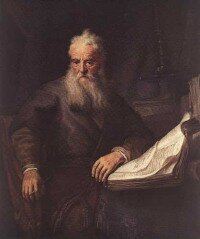
The Pauline epistles are the thirteen or fourteen letters in the New Testament of the Christian Bible traditionally believed to have been written by the apostle Paul. Among them are some of the earliest extant (still existing) Christian documents. They provide an insight into the beliefs and controversies of formative Christianity and, as part of the biblical canon of the New Testament, they have also been, and continue to be, hugely influential in Christian theology and Christian ethics.

The Letters of Paul are as follows:
  • Romans
  • 1 Corinthians
  • 2 Corinthians
  • Galatians
  • Ephesians
  • Philippians
  • Colossians
  • 1 Thessalonians
  • 2 Thessalonians
  • 1 Timothy
  • 2 Timothy
  • Titus
  • Philemon


More...

Thursday, January 28, 2010

Syria

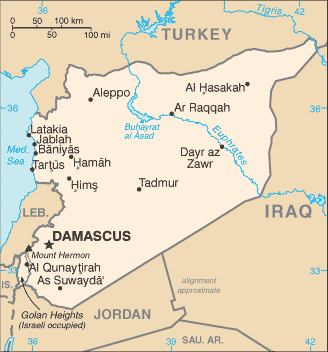
Syria (Arabic: سوريا ‎or سورية ), officially the Syrian Arab Republic (Arabic: الجمهورية العربية السورية ), is a country in the Middle East, bordering Lebanon to the west, Palestine to the southwest, Jordan to the south, Iraq to the east (see also: Iraq Maps), and Turkey to the north. The modern state of Syria attained independence from the French mandate of Syria in 1946, but can trace its historical roots to the fourth millennium BC; its capital city, Damascus, was the seat of the Umayyad Empire and a provincial capital of the Mamluk Empire.

Syria has a population of 19 million, of whom the majority are Arabic-speaking Sunni Muslims, as well as 16% other Muslim groups, including the Alawi, Shiite, and Druze, and 10% Christian.

Since 1963 the country has been governed by the Baath Party; the head of state since 1970 has been a member of the Assad family. Syria's current President is Bashar al-Assad, son of Hafez al-Assad, who held office from 1970 until his death in 2000.

More...

Wednesday, January 27, 2010

Shekhinah

Shekhinah (Hebrew: שכינה - alternative transliterations Shekinah, Shechinah, Shekina, Shechina, Schechinah, sometimes spelled Shchinah in Judaism) is the English spelling of a feminine Hebrew language word that means the dwelling or settling, and is used to denote the dwelling or settling presence of God, especially in the Temple in Jerusalem. Shekhinah is the "gentle" or "feminine aspect" of the Divine.

Etymology
Shechinah is derived from the Hebrew verb 'sakan' or 'shachan'.

In Biblical Hebrew the word means literally to settle, inhabit, or dwell, and is used frequently in the Hebrew Bible. (See e.g. Genesis 9:27, 14:13, Psalms 37:3, Jeremiah 33:16), as well as the weekly Shabbat blessing recited in the Temple in Jerusalem ("May He who causes His name to dwell [shochan] in this House, cause to dwell among you love and brotherliness, peace and friendship"). In Mishnaic Hebrew the word is often used to refer to bird's nesting and nests. ("Every bird nests [shechinot] with its kind, and man with its like, Talmud Baba Kammah 92b.) and can also mean "neighbor" ("If a neighbor and a scholar, the scholar is preferred" Talmud Ketubot 85b). The word "Shechinah" also means "royalty" or "royal residence" ( The Greek word 'skene' - dwelling - is thought to be derived from 'shekinah' and 'sakan'. The word for Tabernacle, mishcan, is a derivative of the same root and is also used in the sense of dwelling-place in the Bible, e.g. Psalm 132:5 ("Before I find a place for God, mishcanot (dwelling-places) for the Strong One of Israel.") Accordingly, in classic Jewish thought, the Shekhina refers to a dwelling or settling in a special sense, a dwelling or settling of divine presence, to the effect that, while in proximity to the Shekhinah, the connection to God is more readily perceivable.

More...

Tuesday, January 26, 2010

Patriarchs

The Patriarchs, known as the Avot in Hebrew, are Abraham, his son Isaac and his grandson Jacob. Collectively, they are referred to as the three patriarchs (sh'loshet ha-avot) of Judaism, and the period in which they lived is known as the patriarchal period.

Their primary wives — Sarah (wife of Abraham), Rebekah (wife of Isaac), and Leah and Rachel (the wives of Jacob — are known as the Matriarchs. Thus, classical Judaism considers itself to have three patriarchs and four matriarchs.

The word has mainly taken on specific ecclesiastical meanings. In particular, the highest-ranking bishops in Eastern Orthodoxy, Oriental Orthodoxy, the Roman Catholic Church (above Major Archbishop and primate), and the Assyrian Church of the East are called patriarchs.

The office and ecclesiastical conscription (comprising one or more provinces, though outside his own (arch)diocese he is often without enforceable jurisdiction, unlike the Pope of Rome) of such a patriarch is called a patriarchate. Historically, a Patriarch may often be the logical choice to act as Ethnarch, representing the community that is identified with his religious confession within a state or empire of a different creed (as Christians within the Ottoman Empire).

More...

Monday, January 25, 2010

Christlike

To be like Christ; showing the spirit of Christ.
Very early in the morning, while it was still dark, Jesus got up, left the house and went off to a solitary place, where he prayed. Simon Peter and his companions went to look for him, and when they found him, they exclaimed: “Everyone is looking for you!”
—Mark 1:35-37, NIV
We know about Jesus...
  • healing the sick;

  • raising the dead;

  • throwing the money-changers out of the House of God;

  • having mercy on the woman caught in the act of adultery;

  • feeding the multitude from a few pieces of bread and a few fish;

  • performing many miracles


More...

Sunday, January 24, 2010

Galileo Galilei

Galileo Galilei (15 February 1564 – 8 January 1642) was an Italian physicist, astronomer, astrologer, and philosopher who is closely associated with the scientific revolution. His achievements include improvements to the telescope, a variety of astronomical observations, and effective support for Copernicanism. According to British theoretical physicist Stephen Hawking,
"Galileo probably contributed more to the creation of the modern natural sciences than anybody else. "
He is often referred to as the "father of modern astronomy," as the "father of modern physics", and as the "father of science". The work of Galileo is considered to be a significant break from that of Aristotle. The motion of uniformly accelerated objects, treated in nearly all high school and introductory college physics courses, was studied by Galileo as the subject of kinematics.

He once said, "I render infinite thanks to God for being so kind as to make me alone the first observer of marvels kept hidden in obscurity for all previous centuries."

More...

Saturday, January 23, 2010

heresy

Heresy, according to the Oxford English dictionary, is a "theological or religious opinion or doctrine maintained in opposition, or held to be contrary, to the 'Catholic' or Orthodox doctrine of the Christian church, or, by extension, to that of any church, creed, or religious system, considered as orthodox. by extension, [heresy is an] opinion or doctrine in philosophy, politics, science, art, etc., at variance with those generally accepted as authoritative."

Urgent concerns with the uniformity of belief and practice have characterized Christianity from the outset.

The process of establishing orthodox Christianity was set in full swing when Paul wrote the epistles that comprise a large part of the New Testament.

On many occasions in Paul's epistles (see also the letters of Paul), he defends his own apostleship, and urges Christians in various places to beware of false teachers, or of anything contrary to what was handed to them by him. The epistles of John and Jude also warn of false teachers, as does the writer of the book of Revelation.

In the middle of the 2nd century, three unorthodox groups of Christians adhered to a range of doctrines that divided the Christian communities of Rome: the teacher Marcion, the pentecostal outpourings of ecstatic Christian prophets of a continuing revelation, in a movement that was called "Montanism" because it had been initiated by Montanus and his female disciples, and the Gnostic teachings of Valentinus.

More...

Friday, January 22, 2010

The Big Bang

In physical cosmology, the Big Bang is the scientific "theory" that the universe emerged from a tremendously dense and hot state about 13.7 billion years ago.

Observational evidence for the Big Bang includes the analysis of the spectrum of light from galaxies which reveal a shift towards longer wavelengths proportional to each galaxy's distance in a relationship described by Hubble's law. If this observation that galaxies are moving away from us is not at any special position in the universe (the Copernican principle), then this suggests that space itself is expanding. Extrapolation of this expansion back in time yields an initial state in the distant past in which all matter and energy was at an immense temperature and density. This initial state is the key premise of Big Bang theory.

More...

Thursday, January 21, 2010

Lineage of Jesus

The lineage of Jesus is recorded in two places in the bible:

1) Matthew 1:1-17, and

2) Luke 3:23-38 (in addition to several other new testament references: Mark 10:47, Luke 1:32, Acts 2:29-30, Rev. 5:5, 22:16).

The Matthew 1:1-17 and Luke 3:23-38 accounts differ because, Luke follows Mary's lineage (Jesus' blood mother), through David's son Nathan (Luke's genealogy focused on Jesus' descent from God through the virgin birth. It placed no emphasis on Jesus being the descendant of king David) and the Matthew genealogy follows Joseph's line (Joseph being the legal father of Jesus, see below) through David's son Solomon.

God's promise to David was fulfilled because Mary was the biological parent of Jesus.

More...

Wednesday, January 20, 2010

Biblical Archaeology

Biblical archaeology involves the recovery and scientific investigation of the material remains of past cultures that can illuminate the periods and descriptions in the Bible. As with the historical records from any other civilization, the manuscripts must be compared to other accounts from contemporary societies in Europe, Mesopotamia, and Africa; additionally, records from neighbors must be compared with them. The scientific techniques employed are those of archaeology in general including excavations as well as chance discoveries.

By contrast Near Eastern archaeology is simply the archaeology of the Ancient Near East without any particular consideration of how its discoveries relate to the Bible.

More...

Monday, January 18, 2010

Masada

Masada (a romanization of the Hebrew מצדה, Metzada, from מצודה, metzuda, "fortress") is the name for a site of ancient palaces and fortifications in Israel on top of an isolated rock plateau on the eastern edge of the Judean Desert overlooking the Dead Sea.

Masada became famous for its significance in the First Jewish-Roman War (Great Jewish Revolt), when a siege of the fortress by troops of the Roman Empire led to a mass suicide of the site's Jewish defenders when defeat became imminent.

Geography
The cliffs on the east edge of Masada are about 451 m high, dropping off to the Dead Sea, and the cliffs on the west are about 100 m high; the natural approaches to the cliff top are very difficult. The top of the plateau is flat and rhomboid-shaped, about 600 by 300 m. The center of the plateau is at 31°18′55″N, 35°21′13″E. There was a casemate wall around the top of the plateau totaling 1400 m long and 4 m thick with many towers, and the fortress included storehouses, barracks, an armory, the palace, and cisterns that were refilled by rainwater. Three narrow, winding paths led from below to fortified gates.

History
According to Flavius Josephus, a First century Jewish Roman historian, Herod the Great fortified Masada between 37 and 31 BCE as a refuge for himself in the event of a revolt. In 66 CE, at the beginning of the First Jewish-Roman War (also called the Great Jewish Revolt) against the Roman Empire, a group of Jewish rebels called the Zealots (kana'im, "zealous ones") who objected to Roman rule of Judea (as the Roman province of Iudaea, its Latin name). Commanded by Elazar ben Ya'ir (who may have been the same person as Eleazar ben Simon), the Zealots took Masada in 68 from the Roman garrison (see also Roman Legion) stationed there. After they persuaded the Romans to disarm they then slaughtered every man of it. In 70, they were joined by additional Zealots and their families who were expelled from Jerusalem by the other Jews living there shortly before the destruction of Jerusalem (and the Second Temple), and for the next two years used Masada as their base for raiding and harassing Roman and Jewish settlements alike.

More...

Sunday, January 17, 2010

Huldrych Zwingli

Huldrych (or Ulrich) Zwingli (1 January 1484 – 11 October 1531) was a leader of the Reformation in Switzerland. He attended the University of Vienna and the University of Basel. He continued his studies while he served as a pastor in Glarus and later in Einsiedeln where he was influenced by the writings of Erasmus, a humanist scholar and theologian.

In 1519, Zwingli became the pastor of the Grossmünster in Zürich where he began to preach ideas on reforming the church. In his first public controversy in 1522, he attacked the custom of fasting during Lent. In his publications, he noted problems in the corruption of the ecclesiastical hierarchy, promoted clerical marriage, and attacked the use of images. In 1525, Zwingli introduced a new communion liturgy to replace the mass. Zwingli also clashed with the radical wing of the Reformation, the Anabaptists, which resulted in their persecution.

More...

Saturday, January 16, 2010

The Exodus

The Exodus, more fully The Exodus of Israel out of Egypt, was the departure of the Hebrew slaves from Egypt under the leadership of Moses and Aaron as described in the biblical Book of Exodus. It forms the basis of the Jewish holiday of Passover.

Although we cannot be 100% certain, we have a general idea how many people were among the Israelites during the Exodus because
1 The LORD spoke to Moses in the Tent of Meeting in the Desert of Sinai on the first day of the second month of the second year after the Israelites came out of Egypt. He said: 2 "Take a census of the whole Israelite community by their clans and families, listing every man by name, one by one. 3 You and Aaron are to number by their divisions all the men in Israel twenty years old or more who are able to serve in the army. -Num 1:1-3
And Moses and Aaron and one man from each tribe proceeded to count them:

Numbers from each of the tribes
(note: the alotment of the tribes happened after the Exodus.)
  • Reuben: ראובן
    —46,500 men
  • Simeon: שמעון
    —59,300 men
  • Gad: גד
    —45,650 men
  • Judah: יהודה
    —74,600 men
  • Issachar: יששכר —54,400 men
  • Zebulun: זבולן
    —57,400 men
  • Ephraim: אפרים
    —40,500 men
  • Manasseh: מנשה —32,200 men
  • Benjamin: בנימין —35,400 men
  • Dan: דן —62,700 men
  • Asher: אשר —41,500 men
  • Naphtali: נפתלי —53,400 men
  • Levi: לוי —not counted

More...

Friday, January 15, 2010

Spiritual Formation

Spiritual formation is the growth and development of the whole person by an intentional focus on one’s (1) spiritual and interior life, (2) interactions with others in ordinary life, and (3) the spiritual practices (prayer, the study of scripture, fasting, simplicity, solitude, confession, worship, etc.). In Care of Mind, Care of Spirit, Gerald G. May has written, “Spiritual formation is a rather general term referring to all attempts, means, instruction, and disciplines intended towards deepening of faith and furtherance of spiritual growth. It includes educational endeavors as well as the more intimate and in-depth process of spiritual direction.”

Introduction
Spiritual formation is a universal experience. Dallas Willard writes that
“it is a process that happens to everyone…. Terrorists as well as saints are the outcome of spiritual formation. Their spirits or hearts have been formed.”
A study of various world religions such as:
  • Judaism,
  • Islam,
  • Hinduism,
  • Buddhism,
  • Confucianism, and
  • Taoism
and others would enable one to understand specifically how each religion views spiritual formation or spiritual growth within its unique belief system.

More...

Thursday, January 14, 2010

Philistines

The historic Philistines (פלשתים Hebrew פלשתי Pĕlishtiy) were a people who inhabited the southern coast of Canaan around the time of the arrival of the Israelites, their territory being named Philistia in later contexts. Their origin has been debated among scholars, but modern archaeology has suggested early cultural links with the Mycenean world in mainland Greece (descendants of Mizraim who immigrated from Caphtor (Crete?) to the western seacoast of Canaan, Strong's H6430 - Pĕlishtiy). Though the Philistines adopted local Canaanite culture and language before leaving any written texts, an indo-European origin has been suggested for a handful of known Philistine words.

If the Philistines are to be identified as one of the "sea peoples", then their occupation of Canaan will have taken place during the reign of Rameses III of the twentieth dynasty, ca. 1180 to 1150 bce. Their maritime knowledge presumably would have made them important to the phoenicians.

In egypt, a people called the "peleset" (or, more precisely, prst), generally identified with the philistines, appear in the medinet habu inscription of ramesses iii, where he describes his victory against the sea peoples, as well as the onomastica of amenope (late twentieth dynasty) and the great Papyrus Harris (papyrus harris i), a summary of ramses iii's reign written in the reign of Ramses IV. Nineteenth-century bible scholars identified the land of the philistines (Philistia) with Palastu and Pilista in Assyrian inscriptions, according to Easton's Bible Dictionary (1897).

More...

Wednesday, January 13, 2010

Jericho

Jericho (Arabic أريحا , Hebrew ירחו Yĕriychow "city of the moon" from the masculine noun: ירח yareach "moon" ) - is a town in the West Bank, Palestine near the Jordan River.

The first mention of Jericho in the Bible is from Numbers 22:
1 Then the people of Israel set out and camped in the plains of Moab beyond the Jordan at Jericho. 2 And Balak the son of Zippor saw all that Israel had done to the Amorites. 3 And Moab was in great dread of the people, because they were many. Moab was overcome with fear of the people of Israel. -Numbers 22:1-3


Jericho has a population of approximately 19,000. It is believed by some to be the oldest continuously occupied settlement in the world. The current mayor of Jericho is Hassan Saleh.

The present city was captured by Israel after the Six-Day War in 1967. It was the first city handed over to Palestinian Authority control in 1994, in accordance with the Oslo accords. After a period of Israeli readministration, it was returned to the Palestinian Authority on 16 March 2005.

Jericho has a population of approximately 1900. It is believed, by some, to be the oldest continually occupied settlement in the world.

More...

Tuesday, January 12, 2010

Persian Empire

DariusThe term Persian Empire refers to a series of historical empires that ruled over the Iranian plateau. The political entity that was ruled by these kingdoms has been known as Persia throughout history.

Generally, the earliest entity considered the Persian Empire is Persia's Achaemenid Empire (648-330 BC) a united Aryan-indigenous Kingdom that originated in the region known as Parac (Strong's H6539, Heb. פרס) and was formed under Cyrus the Great. Successive states in Iran before 1935 are collectively called the Persian Empire by Western historians.

Biblical usage


Persia = "pure" or "splendid"

1) the empire Persia; encompassed the territory from India on the east to Egypt and Thrace on the west, and included, besides portions of Europe and Africa, the whole of western Asia between the Black Sea, the Caucasus, the Caspian and the Jaxartes on the north, the Arabian desert, the Persian Gulf and the Indian Ocean on the south

a) Persia proper was bounded on the west by Susiana or Elam, on the north by Media, on the south by the Persian Gulf and on the east by Carmania Persian = see Persia "pure" or "splendid"

2) the people of the Persian empire

Strong's H6539

More...

Sunday, January 10, 2010

Ishmael

Ishmael or Yishma'el (יִשְׁמָעֵאל "God hears or obeys") is Abraham's eldest son, born by his servant Hagar. Ishmael the son of Abraham, is first mentioned in the Hebrew Bible's Book of Genesis as the eldest son of Abraham by Hagar, Sarah's female Egyptian maid-servant or slave.

"I will give you a son, who will be called Ishmael, because I have heard your cry for help." (Genesis 16:11)

In the Hebrew Bible (Old Testament), Ishmael's life is described in the Book of Genesis (Genesis 16, 17, 21, 25) and later texts. In Genesis 16 Sarai (Abram's wife) gives him her maid-servant Hagar to bear him children, since she believed that God had kept her from having children (Genesis 16:2).

Hagar became pregnant and despised Sarai (Genesis 16:4) who then expelled Hagar from the home of Abraham in retaliation.

More...

Saturday, January 09, 2010

Jihad

Jihad (Arabic: جهاد‎), an Islamic term, is a religious duty of Muslims. In Arabic, the word jihād is a noun meaning "struggle." Jihad appears frequently in the Qur'an and common usage as the idiomatic expression "striving in the way of Allah (al-jihad fi sabil Allah)". A person engaged in jihad is called a mujahid, the plural is mujahideen.

A minority among the Sunni scholars sometimes refer to this duty as the sixth pillar of Islam, though it occupies no such official status. In Twelver Shi'a Islam, however, Jihad is one of the 10 Practices of the Religion.

According to scholar John Esposito, Jihad requires Muslims to "struggle in the way of God" or "to struggle to improve one's self and/or society." Jihad is directed against Satan's inducements, aspects of one's own self, or against a visible enemy. The four major categories of jihad that are recognized are Jihad against one's self (Jihad al-Nafs), Jihad of the tongue (Jihad al-lisan), Jihad of the hand (Jihad al-yad), and Jihad of the sword (Jihad as-sayf). Islamic military jurisprudence focuses on regulating the conditions and practice of Jihad as-sayf, the only form of warfare permissible under Islamic law, and thus the term Jihad is usually used In fiqh manuals in reference to military combat.

More...


Subscribe


LifeNews.com

Desiring God Blog

Youth for Christ International