Tuesday, October 20, 2009

The Word

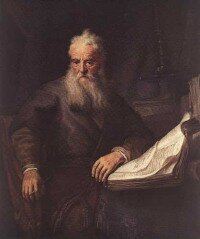
Christ with the crown of thorns, 1623, Oil on canvas, 106 cm x 136 cm, Catharijneconvent, Utrecht1 In the beginning was the Word, and the Word was with God, and the Word was God. 2 He was in the beginning with God. 3 All things were made through him, and without him was not any thing made that was made. (John 1:1-3 ESV)

Textus Receptus
1:1 Ἐν ἀρχῇ ἦν ὁ λόγος καὶ ὁ λόγος ἦν πρὸς τὸν θεόν καὶ θεὸς ἦν ὁ λόγος. 1:2 οὗτος ἦν ἐν ἀρχῇ πρὸς τὸν θεόν. 1:3 πάντα δι᾽ αὐτοῦ ἐγένετο καὶ χωρὶς αὐτοῦ ἐγένετο οὐδὲ ἕν ὃ γέγονεν.
Jesus1 (8–2 BC/BCE to 29–36 AD/CE) is the central figure of Christianity. He is also called Jesus Christ, where "Jesus" is an Anglicization of the Greek: Ίησους (Iēsous), itself a Hellenization of the Hebrewיהושע (Yehoshua) or Aramaic ישוע (Yeshua), meaning "YHVH is salvation"; and where "Christ" is a title derived from the Greek christós, meaning the "Anointed One," which corresponds to the Hebrew-derived "Messiah." Jesus is the incarnate Son of God, the second person of the Trinity, and the prophesied Hebrew Messiah (Anointed One, deliverer of Israel). Jesus is also known as "Jesus Christ", "Jesus of Nazareth", and "Jesus the Nazarene."

Christian views of Jesus (known as Christology) are both diverse and complex. Most Christians are Trinitarian and affirm the Nicene Creed, believing that Jesus is both the Son of God and God made incarnate1, sent to provide salvation and reconciliation with God by atoning for the sins of humanity (see also Christian worldview).


More...
Monday, October 19, 2009

The Genealogy of Jesus

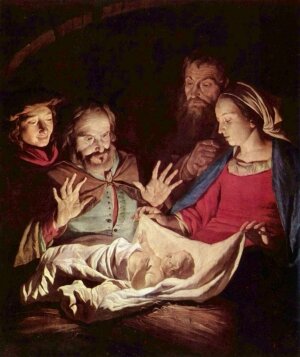
The infant Jesus in Adoration of the Shepherds, Gerard van HonthorstThe Genealogy of Jesus is recorded in two places in the bible:

1) Matthew 1:1-17, and

2) Luke 3:23-38 (in addition to several other new testament references: Mark 10:47, luke 1:32, Acts 2:29-30, Rev. 5:5, 22:16).

The Matthew 1:1-17 and Luke 3:23-38 accounts differ because, Luke follows Mary's lineage (Jesus' blood mother), through David's son Nathan (Luke's genealogy focused on Jesus' descent from God through the virgin birth. It placed no emphasis on Jesus being the descendant of king David) and the Matthew genealogy follows Joseph's line (Joseph being the legal father of Jesus, see below) through David's son Solomon.

God's promise to David was fulfilled because mary was the biological parent of Jesus.

The virgin birth also addressed the curse God had pronounced upon Jehoiakim. Kingship was an inherited right. By Joseph, Jesus inherited a legal claim to the throne of David. However, he was exempt from the curse of Jehoiakim (Jeremiah 36:1-32, i.e. Joseph's offspring could not claim David's throne because of the curse) because Joseph was not the genetic father of Jesus.

The Spiritual significance of the comment in Luke 3:23 "as was supposed" (in some translations "so it was thought") (of Joseph's fatherhood) is in the fact that God is letting us know that Jewish society did NOT understand the real paternity of Jesus.. that of the Holy Spirit.. thus was incapable of understanding His ministry.. as was certainly exhibited by the actions and attitudes of the scribes, Pharisees, lawyers, etc. to whom parentage and ancestry had become a cumbersome and burdensome legalism that blighted New Testament Judaism.

More...

Sunday, October 18, 2009

Mount Sinai

View from Mount Sinai, Egypt. Photograph by Mark A. Wilson (Department of Geology, The College of Wooster).Mount Sinai (Hebrew: סיני Ciynay, "thorny") has an Etymology of uncertain derivation [map of the Mount Sinai area], also known as "Gebel Musa" or "Jabal Musa" by the Bedouins, is the name of a mountain in the Sinai Peninsula. It is 2,629 m metres high and is located in a mountain range in the southern part of the peninsula. It is near a protruding lower bluff known as the Ras Sasafeh (Sufsafeh), and rises almost perpendicularly from the plain, the tallest peak on the Sinai peninsula.

The Biblical Mount Sinai is an ambiguously located mountain at which the Hebrew Bible states that the Ten Commandments were given to Moses by God. In certain biblical passages these events are described as having transpired at Horeb, but though there is a small body of opinion that Sinai and Horeb were different locations, they are generally considered to have been different names for the same place.

Judaism teaches that as soon as the Jewish people received the Bible at Mt. Sinai, they would be hated by the rest of the world for having been the ones to receive divine word (a state of affairs presented as a pun: Sinai as Seen-ah, which means hatred). The area was reached by the Hebrews in the third month after the Exodus. Here they remained encamped for about a year. The last twenty-two chapters of Exodus, together with the whole of Leviticus and Numbers ch. 1-11, contain a record of all the transactions which occurred while they were at Mount Sinai.

From Rephidim (Hebrew רפידים Rĕphiydiym), "rests" or "stays" or "resting places", a station of Israel in the wilderness between Egypt and Sinai (Ex. 17:8-13) the Israelites journeyed to "the desert of Sinai," and encamped there "before the mountain."In the Bible, Mt. Sinai is also called Mt. Horeb and the "Mount of God".

More...

Saturday, October 17, 2009

Hebron

Cave of the PatriarchsHebron (Al-Khalil) (Arabic الخليل, Hebrew חֶבְרוֹן, Chebrown "association" derived from the root word cheber, meaning "association, company, band") is a town in the Southern Judea region of the West Bank of around 166,000 Palestinians and 500 Israeli settlers. It lies 3,050 feet (930 m) above sea level.

Geographic coordinates : 31°32' N, 35°6' E. [map of Hebron]

Hebron is located 30km south of Jerusalem. Its elevation from sea level is about 1000m. Hebron is famous for its grapes, limestones, pottery workshops and glassblowing factories. It is also home of the nationally famous Al-Juneidi factory for dairy products.

The old city of Hebron is characterized by its narrow and winding streets, the flat-roofed stone houses, and the old bazaars. It is the home of Hebron University and Palestine Polytechnic University.

Hebron is one of most ancient cities in the Middle East, and one of the oldest continuously inhabited cities in the world and was an ancient Canaanite royal city:
After this David inquired of the Lord , "Shall I go up into any of the cities of Judah?" And the Lord said to him, "Go up." David said, "To which shall I go up?" And he said, "To Hebron." -2 Sam. 2:1

More...

Friday, October 16, 2009

theophany

The Pillar of Fire. Artist: Tintoretto. Date: 1577-78. Oil on canvas, 370 x 275 cm. Scuola Grande di San Rocco, Venice.From the Greek, theo (God), and phainein (to show forth), theophany means an appearance of a God to man, or a divine disclosure.

While the Iliad is our earliest source for descriptions of theopanies in the Classical tradition (and they occur throughout Greek mythology), probably the earliest description of a theophany is in the Epic of Gilgamesh. There, the protagonist meets Siduri, a goddess associated with brewing and fermentation. In the Judeo-Christian tradition, the Bible is the primary source of events which both Britannica and the New Catholic Encyclopedia cite as being theophanies.

The appearance of Zeus to Semele in his full godhead, "all his glory", is more than a mortal can stand and she is burned to death by the flames of his power. However, most Greek theophanies were less deadly. Unusual for Greek mythology is the story of the immortal Prometheus, not an Olympian but a Titan, who brought knowledge of fire to humanity. There are no descriptions of the humans involved in this theophany, but Prometheus was severely punished by Zeus.

The New Catholic Encyclopedia cites examples such as Gen 3:8a. The same source then quotes Gen 16:7-14. In this case, initially it is an angel which appears to Hagar, however it then says that God spoke directly to her, and that she saw God and lived (Gen 16:13). The next example the New Catholic Encyclopedia cites is Gen 22:11-15, which states explicitly that it was the angel of the Lord speaking to Abraham (Gen 22:11a). However, the angel addressing Abraham speaks the words of God in the first person (Gen 22:12b). In both of the last two examples, although it is an angel present, the voice is of God spoken through the angel, and so this is a manifestation of God Himself.

More...


Thursday, October 15, 2009

Michael Whitaker Smith

Michael W. SmithMichael Whitaker Smith (born October 7, 1957, to Paul and Barbara Smith in Kenova, West Virginia), often nicknamed "Smitty", is an American singer, songwriter, guitarist, and keyboardist.

Since his first solo project in 1983, Smith has become one of the most popular artists in the Contemporary Christian music world, while also finding considerable success in the mainstream.

"Life's not all about the stuff we can accumulate or the honors people heap on us. Serving people in the name of Jesus is what really matters in the world. We have to step into peoples' lives so that they can be changed by God.

But we really have to start believing this is our mission - that this is the authority that is ours as children of God. Simple acts can start to change thousands of peoples' lives.

So I'm taking a stand - and I hope others will - to stand outside of the walls of the church, rubbing shoulders with the lost and to really live what I believe and embrace who I am in Jesus Christ. We are called to share our joy by serving the lost. The poor. The sick. The brokenhearted. The least of these. In Christ, we are given the courage and strength to change the world."
-ONE Music: Michael W. Smith
Official Website: michaelwsmith.com

More...

Wednesday, October 14, 2009

ex nihilo

artistic view of creationism Ex nihilo is a Latin term meaning "out of nothing". It is often used in conjunction with the term creation as in Creatio ex Nihilo, "Creation out of nothing." God created merely by speaking it into existence.
1 In the beginning, God created the heavens and the earth. 2 The earth was without form and void, and darkness was over the face of the deep. And the Spirit of God was hovering over the face of the waters.

3 And God said, "Let there be light," and there was light. 4 And God saw that the light was good. And God separated the light from the darkness. 5 God called the light Day, and the darkness he called Night. And there was evening and there was morning, the first day (Genesis 1:1-5 ESV).
Due to the nature of this, the term is often used in creationistic arguments, as some religions believe that God created the universe from nothing. It has also been argued that this concept cannot be deduced from the Hebrew and that the Book of Genesis, chapter 1, speaks of God "making" or "fashioning" the universe. However, Rabbi Schneur Zalman of Liadi (1745-1812) refuted these arguments in section II of his book titled "Tanya".

More...

Jonah

Jonah (detail), Artist: Buonarroti Michelangelo, Date: 15111. Jonah (יוֹנָה pigeon, dove; darling, sweetheart) was a person in the Biblical Old Testament and Jewish Tanakh, the son of Amittai ("My Truth"), from the Galilean village of Gath-hepher, near Nazareth.

2. In the Hebrew Bible, the Book of Jonah is the 5th book in a series of books called the Minor Prophets (itself a subsection of the Nevi'im or Prophets). Unlike other prophetic books however, this book is not a record of a prophet's words toward Israel. Instead of the poetry and prophetic prose of Isaiah or Lamentations, this book tells the story of an apparently inept prophet who becomes one of the most effective prophets in the entire Bible.

God ordered Jonah to preach at the city of Nineveh. Jonah did not want to, and tried to avoid God's command by sailing to Tarshish. A huge storm arises. The sailors, realizing this is no ordinary storm, cast lots, and learn that Jonah is to blame. Jonah admits this, and states that if he is thrown overboard, the storm will cease. The sailors throw him overboard, and the seas calm. Jonah is miraculously saved by being swallowed by a large fish. In chapter two, while in the great fish, Jonah prayed to God and asked forgiveness and thanked God for being so faithful, and the result was, God commanded the fish to vomit Jonah out.

God again orders Jonah to visit Nineveh and preach to its inhabitants. He therefore went there and walked through it, crying "In forty days Nineveh shall be destroyed." The Ninevites believed his word, and appointed a public fast, from the meanest of the people to the greatest; the king himself putting on sackcloth and sitting in ashes. God had compassion and did not bring His wrath against the city at that time.

More...

Monday, October 12, 2009

Bartholomew

The Martyrdom of St. Bartholomew, 1722, Artist: Giovanni Battista Tiepolo, Oil on canvas, 167 x 139 cm, San Stae, Venice"Bartholomew": in Aramaic "bar-Talemai?", Greek: "son of Tolmai" or from Ptolemais, often identified with the Nathanael of John 1:45-1:51.

The name Nathanael is derived from the Hebrew: "Nathanael" a male given name that means "gift of God" (from Hebrew natan "he gives" + el "God"). Based on this meaning, many have assumed it was not a given name, but a family name.

Bartholomew (Nathanael) was born in Cana of Galilee (John 21:2).

45 Philip found Nathanael and said to him, "We have found him of whom Moses in the Law and also the prophets wrote, Jesus of Nazareth, the son of Joseph." Nathanael said to him, "Can anything good come out of Nazareth?" Philip said to him, "Come and see." John 1:45-46
He was listed as one of Christ's twelve disciples (Matthew 10:2-4; Acts 1:13).

He was honest
47 Jesus saw Nathanael coming toward him and said of him, "Behold, an Israelite indeed, in whom there is no deceit!" (John 1:47)

More...

Sunday, October 11, 2009

Animism

Tribal peoples in Papua New GuineaIn religion, the term "Animism" is used in a number of ways.
  • Animism (from animus, or anima, mind or soul), originally means the doctrine of spiritual beings.
  • It is often extended to include the belief that personalized, supernatural beings (or souls) endowed with reason, intelligence and volition inhabit ordinary objects as well as animate beings, and govern their existence (pantheism or animatism). More simply, the belief is that "everything is alive", "everything is conscious" or "everything has a soul".
  • It has been further extended to mean a belief that the world is a community of living persons, only some of whom are human. It also refers to the culture or philosophy which these types of Animists live by, that is, to attempt to relate respectfully with the persons (human, rock, plant, animal, bird, ancestral, etc.) who are also members of the wider community of life.
"Animism" can refer to the religion or beliefs or philosophy of the above interpretations. It can also refer to the culture and practices related to Animism.

There are three differing definitions of what constitutes animism. The most widely held and accepted is that it is a belief in non-human souls.

More...

Saturday, October 10, 2009

Egyptian hieroglyphs

Egyptian characters and alphabets. Author: Carl Faulmann (1835-1894). German. The Book of the Book Containing the characters and alphabets of all ages and all peoples of the world. Second, increased and improvedEgyptian hieroglyphs (sometimes called hieroglyphics) were a writing system used by the Ancient Egyptians that contained a combination of logographic and alphabetic elements. Cartouches were also used by the Egyptians. The variety of brush-painted hieroglyphs used on papyrus and (sometimes) on wood for religious literature is known as cursive hieroglyphs; this should not be confused with hieratic.

Etymology
The word hieroglyph comes from the Greek ἱερογλυφικά (hieroglyphiká); the adjective hieroglyphic, as well as related words such as ἱερoγλυφος (hieroglyphos 'one who writes hieroglyphs', from ἱερός (hierós 'sacred') and γλύφειν (glýphein 'to carve' or 'to write', see glyph). Hieroglyphs themselves, were called τὰ ἱερογλυφικά (γράμματα) (tà hieroglyphiká (grámmata), 'engraved characters') on monuments (such as stelae, temples and tombs). The word hieroglyph has come to be used for the individual hieroglyphic characters themselves. While "hieroglyphics" is commonly used, it is discouraged by Egyptologists.

Hieroglyphs emerged from the preliterate artistic traditions of Egypt. For example, symbols on Gerzean pottery from circa 4000 BC resemble hieroglyphic writing. For many years the earliest known hieroglyphic inscription was the Narmer Palette, found during excavations at Hierakonpolis (modern Kawm al-Ahmar) in the 1890s, which has been dated to circa 3200 BC. However, in 1998 a German archaeological team under Günter Dreyer excavating at Abydos (modern Umm el-Qa'ab) uncovered tomb U-j of a Predynastic ruler, and recovered three hundred clay labels inscribed with proto-hieroglyphs, dating to the Naqada IIIA period of the 33rd century BC. The first full sentence written in hieroglyphs so far discovered was found on a seal impression found in the tomb of Seth-Peribsen at Umm el-Qa'ab, which dates from the Second Dynasty. In the era of the Old Kingdom, the Middle Kingdom and the New Kingdom, about 800 hieroglyphs existed. By the Greco-Roman period, they numbered more than 5,000.

More...

Friday, October 09, 2009

demon

The Guardian Angel Protecting a Child from the Empire of the DemonIn religion, folklore, and mythology a demon or demoness is a supernatural being that has generally been described as a malevolent spirit, or daemon and djinn. A demon is frequently depicted as a force that may be conjured and insecurely controlled. The "good" demon in recent use is largely a literary device (eg: Maxwell's demon). In common language, "demonizing" one's opponent is an aspersion.

The Greek conception of a daemon (δαίμων) appears in the works of Plato and many other ancient authors, but without the evil connotations which are apparent in the Septuagint translation of the Hebrew Bible and in the Greek originals of the New Testament. The medieval and neo-medieval conception of a "demon" in Western civilization (see the Medieval grimoire called the Ars Goetia) derives seamlessly from the ambient popular culture of Late (Roman) Antiquity: Greco-Roman concepts of daemons that passed into Christian culture are discussed in the entry daemon. The Hellenistic (see Hellenistic civilization) "Demon" eventually came to include many Semitic and Near Eastern gods as evaluated by Christianity.

The idea of demons is as old as religion itself, and the word "demon" seems to have ancient origins. The Merriam-Webster dictionary gives the etymology of the word as Greek daimon, probably from the verb daiesthai meaning "to divide, distribute." The Proto-Indo-European root *deiwos for god, originally an adjective meaning "celestial" or "bright, shining" has retained this meaning in many related Indo-European languages and cultures (Sanskrit deva, Latin deus, German Tiw), but also provided another other common word for demon in Avestan daeva.

In modern greek, the word 'δαίμων', is the greek word for demon. But, in ancient greek, the word "δαίμων" means somebody very clever....

More...

Thursday, October 08, 2009

Lot

Lot and His Daughters. Author: Orazio Gentileschi. Date: 1622-23.In the Bible, Lot (לוֹט "Hidden, enclosed, covering") was the nephew of the patriarch, Abraham or Abram. He was the son of Abraham's brother Haran. (Gen. 11:27)

The story of Lot is told in the
Book of Genesis 11-14, 19.

Lot followed his uncle from Haran. He accompanied Abram and his family in his journeys to Egypt.
When Abram traveled to the Land of Canaan at the command of God, Lot accompanied him. (Gen 12:1-5). Abram had always a great affection for him, and when they could not continue longer together in Canaan because they both had large flocks and their shepherds sometimes quarelled (Gen 13:6,7), he gave Lot the choice of his abode. Lot went southeast to plains near the cities of Sodom and Gomorrah, since the land there was well watered. (Gen. 13:10-12).

About eight years after this separation, Chedorlaomer and his allies attacked the kings of Sodom and the neighbouring cities, pillaged Sodom, and took many captives, including Lot. Abraham armed his servants, pursued the confederate kings, and overtook them near the springs of Jordan. He recovered the spoils they had taken and brought back Lot with the other captives. Abraham was offered a reward by the King of Sodom, but refused even a shoelace.

More...

Wednesday, October 07, 2009

Tower of Babel

The Tower of Babel by Pieter Brueghel the Elder (1563)The tower constructed by the builders at Babel (that is, Babylonia - modern day Iraq []) became a symbol of their defiance against God, (Gen. 11:1-6). It was probably modeled after a ziggurat which is a mound of sun-dried bricks and was probably constructed before 4,000 bc.

According to the narrative in Genesis 11 of the Bible, the Tower of Babel was a tower built by a united humanity to reach the heavens.

Because the hearts of men were said to be inherently evil and disobedient, they were striving to make a name for themselves instead of worshipping the God who created them.

Because of this open defiance, God stopped their efforts by confusing languages so that no one could understand each other. As a result, they could no longer communicate and the work was halted. The builders were then scattered to different parts of Earth. This story is used to explain the existence of many different languages and races.

More...

Tuesday, October 06, 2009

Hyksos

Territory of the Hyksos, 1750(?)-1575 A.C.The Hyksos (Egyptian heka khasewet meaning "foreign rulers") were an ethnically mixed group of Southwest Asiatic or Semitic people who appeared in the eastern Nile Delta during the Second Intermediate Period. They rose to power during the Second Intermediate Period, and ruled Lower and Middle Egypt for over one hundred years, forming the Fifteenth and Sixteenth Dynasties of Egypt, (ca. 1674-1548 B.C.E.).

Traditionally, only the six Fifteenth Dynasty rulers are called "Hyksos".

The Hyksos had names that bear strong similarities to Canaanite names, especially those which contain the names of Canaanite deities such as Anath or Ba'al. Archaeologists think of the Canaanites as being indistinguishable from the Phoenicians. The Hyksos introduced new tools of warfare into Egypt, most notably the composite bow and the horse-drawn chariot.

The numerous Sixteenth Dynasty princes are believed to be a mixed collection of "Hyksos", Asiatic Semites, and local native Egyptian princes. The names of the Fifteenth Dynasty Hyksos are known from Egyptian monuments, scarabs and other small objects, and Manetho's history of Egypt, written during the time of Ptolemy II.

More...

Monday, October 05, 2009

G.K. Chesterton

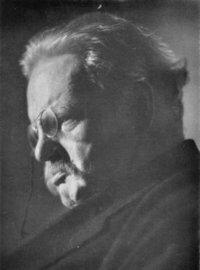
Gilbert Keith &rtquo;G.K.&ltquo; Chesterton (b. 29 May 1874—d. 14 June 1936), English writer.Gilbert Keith Chesterton (May 29, 1874–June 14, 1936) was an influential English writer of the early 20th century. His prolific and diverse output included journalism, poetry, biography, Christian apologetics, fantasy, and detective fiction.

Chesterton has been called the "prince of paradox." He wrote in an off-hand, whimsical prose studded with startling formulations. For example:

"Thieves respect property. They merely wish the property to become their property that they may more perfectly respect it."

He is one of the few Christian thinkers who are admired and quoted equally by liberal and conservative Christians, and indeed by many non-Christians. Chesterton's own theological and political views were far too nuanced to fit comfortably under the "liberal" or "conservative" banner. And in his own words he cast aspersions on the labels saying,


More...

Sunday, October 04, 2009

Judas Iscariot

Taking of Christ. Date: c. 1598. Artist: CaravaggioJudas Iscariot (died April AD 29–33) was, according to the New Testament, one of the twelve original apostles of Jesus, and the one who is said to have betrayed him.

Biblical narrative
Mark states that the chief priests were looking for a "sly" way to arrest Jesus. They determine not to do so during the feast because they were afraid that the people would riot. It is after the feast that they do end up arresting him.

According to the account given in the gospels, he carried the disciples' money box and betrayed Jesus for a bribe of "thirty pieces of silver" by identifying him with a kiss—the "kiss of Judas"— to arresting soldiers of the High Priest Caiaphas, who then turned Jesus over to Pontius Pilate's soldiers. These "pieces of silver" were most likely intended to be understood as silver Tyrian shekels (see also Biblical and Talmudic units of measurement).

Judas Iscariot, son of Simon, should not be confused with Jude Thomas (more commonly known as Saint Thomas the Apostle), or with Saint Jude who was also one of the twelve disciples and a brother of James the Less.

More...

Saturday, October 03, 2009

deconstructionism

Jacques DerridaDeconstruction is a term in contemporary philosophy, literary criticism, and the social sciences, denoting a process by which the texts and languages of Western philosophy (in particular) appear to shift and complicate in meaning when read in light of the assumptions and absences they reveal within themselves. Jacques Derrida coined the term in the 1960s, and proved more forthcoming with negative, rather than pined-for positive, analyses of the school.

Subjects relevant to deconstruction include the philosophy of meaning in Western thought, and the ways that meaning is constructed by Western writers, texts, and readers and understood by readers. Though Derrida himself denied deconstruction was a method or school of philosophy, or indeed anything outside of reading the text itself, the term has been used by others to describe Derrida's particular methods of textual criticism, which involved discovering, recognizing, and understanding the underlying—and unspoken and implicit—assumptions, ideas, and frameworks that form the basis for thought and belief, for example, in complicating the ordinary division made between nature and culture. Derrida's deconstruction was drawn mainly from the work of Martin Heidegger and his notion of Destruktion but also from Levinas and his ideas upon the Other.

More...

Friday, October 02, 2009

Childhood of Jesus

Presentation of the temple, Artist: Philippe de Champaigne. c. 1648The Child Jesus is a religious symbol based on the activities of Jesus as an infant up to the age of twelve that recurs throughout history, starting from around the third or fourth century. It includes religious figurines and icons of the infant Jesus, usually with his mother, Mary, and his legal father Joseph.

Holy Family
This "original nuclear family" symbolized the Holy Trinity to many early Christian believers. They solidified the family unit with such deep spiritual significance that the Holy Family eventually became an integral part of Roman Catholic religious dogma.

The Scriptures and many apocryphal works were passed down either by word of mouth or through song, and later in works of art. The symbolism of the Child Jesus in art reached its apex during the Renaissance: the holy family was a central theme in the works of Leonardo Da Vinci and many other masters.

More...

Thursday, October 01, 2009

Jesus

Jesus (8–2 BC/BCE to 29–36 AD/CE) is the central figure of Christianity.
Christ with the crown of thorns, 1623, Oil on canvas, 106 cm x 136 cm, Catharijneconvent, UtrechtHe is also called Jesus Christ, where "Jesus" is an Anglicization of the Greek: Ίησους (Iēsous), itself a Hellenization of the Hebrew יהושע (Yehoshua, Joshua) or Aramaic ישוע (Yeshua), meaning "YHVH is salvation"; and where "Christ" is a title derived from the Greek christós, meaning the "Anointed One," which corresponds to the Hebrew-derived "Messiah." Jesus is the incarnate Son of God, the second person of the Trinity, and the prophesied Hebrew Messiah (Anointed One, deliverer of Israel). Jesus is also known as "Jesus Christ", "Jesus of Nazareth", and "Jesus the Nazarene."

Christian views of Jesus (known as Christology) are both diverse and complex. Most Christians are Trinitarian and affirm the Nicene Creed, believing that Jesus is both the Son of God and God made incarnate1, sent to provide salvation and reconciliation with God by atoning for the sins of humanity (see also Christian worldview).

More...

Wednesday, September 30, 2009

Gospel of John

Apostle St John the Evangelist, artist EL GRECO, 1610-14, Oil on canvas, 97 x 77 cm, location Museo de El Greco, ToledoThe Gospel of John, (literally, According to John; Greek, Κατά Ιωαννην, Kata Iōannēn) is the fourth gospel in the biblical canon of the New Testament, traditionally ascribed to John the Apostle. Like the three synoptic gospels, it contains an account of some of the actions and sayings of Jesus, but differs from them in ethos and theological emphases. The purpose is expressed in the conclusion, 20:30-31: "..these [Miracles of Jesus] are written so that you will put your faith in Jesus as the Messiah and the Son of God. If you have faith in Him, you will have true life."

According to Trinitarianism, of the four gospels, John presents the highest Christology, implicitly declaring Jesus to be God.

Compared to the synoptics, John focuses on Jesus' cosmic mission to redeem humanity. Only in John does Jesus talk at length about himself, and John includes a substantial amount of material that Jesus shared with the disciples only. Certain elements of the synoptics (such as the parables of Jesus, exorcisms, and the Second Coming of Christ) are not found in John.

More...

Tuesday, September 29, 2009

The Temple Mount

Dome of the Rock, Temple MountThe Temple Mount (Hebrew: הַר הַבַּיִת (without niqqud: הר הבית) or Noble Sanctuary (Arabic: الحرم الشريف) is a hotly contested religious site in the Old City of Jerusalem.

It was the site of the first and second Jewish Temple in Jerusalem and according to Judaism is to be the site of the third and final Temple in the time of the Messiah. It is also the site of two major Muslim religious shrines, the Dome of the Rock and Al-Aqsa Mosque, built in the 7th century.

It is the holiest site in Judaism, the third holiest site in Islam, and has special significance to Christianity.

It is thus one of the most contested religious sites in the world.

More...

Monday, September 28, 2009

death of Jesus

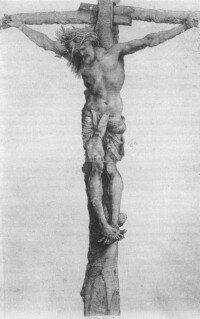
Crucifixion, Artist: Matthias GRÜNEWALD. Date: 1501-02The death of Jesus is an event described by the New Testament, as occurring after the Passion of Jesus, as a result of his crucifixion. In Christianity the quasi-annual day of commemoration of the event is a highly important feast day, known as Good Friday.

In the accounts, as Jesus is dying, a darkness appears over the land. The Gospel of Mark states it was at the sixth hour (noon). Some have interpreted the darkness as a solar eclipse, but this is astronomically impossible, since Jesus is described as dying around the time of the Passover, a date on the Hebrew calendar fixed to a full moon, while solar eclipses can only occur at a new moon. It is clearly phrased for dramatic effect, but it could simply mean that the day was overcast.

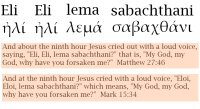
Both Matthew and Mark state that Jesus cried out his last words - My God, My God, why have you forsaken me, Mark indicating that it was the ninth hour (3 PM). John states that Jesus just said "I thirst." (John 19:28)

More...

Sunday, September 27, 2009

The Holy Land

the tribal allotments of Israel, c. 1759 ADThe expression "The Holy Land" (Hebrew: ארץ הקודש generally refers to the Land of Israel, otherwise known as the region of Palestine (sometimes including parts of Jordan, Syria and Egypt). It concerns the areas that hold significant religious importance to any or all three monotheistic Abrahamic religions: Judaism, Christianity and Islam.

The Holy Land is the territory where the Biblical stories took place, those described by the Tanakh or those by the New Testament.

The concept had its evolution in the same Scriptures. For some Biblical authors the territory was marked by the concept of Promised Land, but for others it refers to those events in any place related to the People of Israel.

Although the Zionism movement, the current State of Israel and the Israeli-Arab conflict are largely political, the dispute around the control of the Temple Mount in East Jerusalem is based on religious beliefs. Some have proposed the founding of a Federal Republic of the Holy Land as a one-state solution to the Israeli-Palestinian conflict.[1]

More...

Saturday, September 26, 2009

Sermon on the Mount

The Sermon on the Mount, Cosimo RosselliThe Sermon on the Mount was, according to the Gospel of Matthew, a particular sermon given by Jesus of Nazareth (estimated around AD 30) on a mountainside to his disciples and a large crowd (Matt 5:1; Matt. 7:28). The recounting of the Sermon on the Mount comes from Matthew 5-7.

The best-known portions of the Sermon to most is the Beatitudes, found at the beginning of the section.

It also contains the Lord's Prayer and the injunctions to "resist not evil" and "turn the other cheek", as well as Jesus' version of the Golden Rule. Other lines often quoted are the references to "salt of the Earth," "light of the world," and "judge not, lest ye be judged."

" ..'Our Father in heaven, hallowed be your name, 10your kingdom come,your will be done on earth as it is in heaven. 11Give us today our daily bread.12Forgive us our debts, as we also have forgiven our debtors. 13And lead us not into temptation, but deliver us from the evil one. 14For if you forgive men when they sin against you, your heavenly Father will also forgive you. 15But if you do not forgive men their sins, your Father will not forgive your sins. (Matthew 6:9-15)

see also: The Lord’s Prayer in other languages


More...

Friday, September 25, 2009

Aramaic of Jesus

Eloi Eloi lama sabachthani --which means, My God, my God, why have you forsaken me?Most scholars believe that Jesus spoke Aramaic with some Hebrew, and possibly Greek. Generally, scholars believe that the towns of Nazareth [] and Capernaum [] where Jesus lived were Aramaic-speaking communities, that he was knowledgeable enough in Hebrew to discuss the Hebrew Bible, and that he might have known some Greek through commerce as a carpenter in nearby Sepphoris (see Tzippori). Accordingly, Jesus is believed to have addressed primarily Aramaic-speaking audiences.

This article explores Aramaic reconstructions of phrases in the New Testament as attributed to Jesus (Hebrew-Aramaic ישוע Yeshua, meaning "YHVH is salvation") and New Testament figures.

It is generally accepted that Jesus was born a Jew, and grew up in a Jewish family in Roman-controlled Palestine. For over a half-millennium, the colloquial language for Palestinian Jews was Aramaic, stemming from the Babylonian exile and invading Assyrian empire. For some Jews Hebrew remained a colloquial language, until the end of the 3rd century AD.

More...

Thursday, September 24, 2009

The Kreutzer Sonata


Beethoven's "Kreutzer Sonata" Performed by Nathan Milstein (Sonata No. 9 in A Major for piano and violin, Op. 47)
In addition to being the Beethoven Sonata for Violin & Piano No. 9 in A Major, Op. 47 ("Kreutzer"), "The Kreutzer Sonata" (Russian: Крейцерова соната, Kreitzerova Sonata) is a novella by Leo Tolstoy, published in 1889 and promptly censored by the Russian authorities. The work is an argument for the ideal of sexual abstinence and an in-depth first-person description of jealous rage. The main character, Pozdnyshev, relates the events leading up to his killing his wife; in his analysis, the root cause for the deed were the "animal excesses" and "swinish connection" governing the relation between the sexes.

During a train ride, Pozdnyshev overhears a conversation concerning marriage, divorce and love. When a woman argues that marriage should not be arranged but based on true love, he asks "what is love?" and points out that, if understood as an exclusive preference for one person, it often passes quickly. Convention dictates that two married people stay together, and initial love can quickly turn into hatred. He then relates how he used to visit prostitutes when he was young, and complains that women's dresses are designed to arouse men's desires. He further states that women will never enjoy equal rights to men as long as men view them as objects of desire, but yet describes their situation as a form of power over men, mentioning how much of society is geared towards their pleasure and well-being and how much sway they have over men's actions.


More...

Wednesday, September 23, 2009

Hammurabi

Sumerian Code of laws of Hammurabi Louvre museum, Middle East antiquesHammurabi (Akkadian "the kinsman is a healer," ca. 1810 BC – 1750 BC), was the sixth king of Babylon. He became the first king of the Babylonian Empire, extending Babylon's control over Mesopotamia by winning a series of wars against neighboring kingdoms[1].

Hammurabi is known for the set of laws called Hammurabi's Code (see below), one of the first written codes of law in recorded history. Owing to his reputation in modern times as an ancient law-giver, Hammurabi's portrait is in many government buildings throughout the world. Although his empire controlled all of Mesopotamia by the time of his death, his successors were unable to maintain his empire.

Hammurabi was one of the first dynasty kings of the city-state of Babylon, and inherited the throne from his father, Sin-muballit, in 1792 BC[2].

Babylon was one of the many ancient city-states that dotted the Mesopotamian plain and waged war on each other for control of fertile agricultural land[3]. Though many cultures co-existed in Mesopotamia, Babylonian culture gained a degree of prominence among the literate classes throughout the Middle East[4] The kings who came before Hammurabi had begun to consolidate rule of central Mesopotamia under Babylonian hegemony and, by the time of his reign, had conquered the city-states of Borsippa, Kish, and Sippar. Thus Hammurabi ascended to the throne as the king of a minor kingdom in the midst of a complex geopolitical situation, surrounded by the more powerful kingdoms of Shamshi-Adad, Larsa, Eshnunna, and Elam.

More...

Tuesday, September 22, 2009

Balaam

Balaam's Ass. Artist: Rembrandt Harmenszoon van Rijn. Date: 1626.Balaam (Hebrew: בִּלְעָם, nm. absorption; swallowing) is a prophet in the Torah, his story occurring in Numbers 22-24)[1]. The etymology of his name is uncertain, and discussed below. Every ancient reference to Balaam considers him a non-Israelite, a prophet, and the son of Beor, though Beor is not so clearly identified. Though other sources describe the apparently positive blessings he delivers upon the Israelites, he is reviled as a "wicked man" in the major story concerning him.
Impure seducers and their abandoned followers, give themselves up to their own fleshly minds. Refusing to bring every thought to the obedience of Christ, they act against God's righteous precepts. They walk after the flesh, they go on in sinful courses, and increase to greater degrees of impurity and wickedness. They also despise those whom God has set in authority over them, and requires them to honour. Outward temporal good things are the wages sinners expect and promise themselves. And none have more cause to tremble, than those who are bold to gratify their sinful lusts, by presuming on the Divine grace and mercy. Many such there have been, and are, who speak lightly of the restraints of God's law, and deem themselves freed from obligations to obey it. Let Christians stand at a distance from such.[5]

(see 2 Peter 2:17-22 The Message)

More...

Monday, September 21, 2009

Four Quarters of Jerusalem

The Armenian Quarter is one of the four quarters of the Old City of Jerusalem. It might appear that the Armenian quarter would be a part of the Christian Quarter, since virtually all Armenians residing in Jerusalem are Christians, yet for historical reasons the Armenian quarter has remained separate and has not suffered the same disruptions as the other quarters over the last thousand years.

The Christian Quarter is situated in the north-western corner of the Old City, extending from the New Gate in the north, along the western wall of the Old City as far as the Jaffa Gate.

The Muslim Quarter is the largest and most populous of the four quarters and is situated in the north-eastern corner of the Old City.

The Jewish Quarter lies in the southeastern sector of the walled city, and stretches from the Zion Gate in the south, along the Armenian Quarter on the west, up to the Cardo in the north and and extends to the Western Wall and the Temple Mount in the east.

Sunday, September 20, 2009

Pontius Pilate

Christ before Pilate, Mihály Munkácsy, 1881Pontius Pilate (Latin: Pontius Pilatus') was the governor of the Roman Iudaea Province from 26 until 36. In modern times he is best known as the man who, according to the canonical Christian Gospels, presided over the trial of Jesus and ordered his crucifixion, instigating the Passion.

Pilate's biographical details before and after his appointment to Iudaea are unknown, but have been supplied by tradition, which include the detail that his wife's name was Procula (she is canonized as a saint in Orthodox Christianity) and competing legends of his birthplace.

The famous Pilate Inscription found at Caesarea Palaestina refers to Pilate as prefect, while Tacitus speaks of him as procurator of the province. The explanation of the differences in title is fairly straightforward.

In the first historical period in which the setting of the New Testament became the Roman Iudaea Province (a compound of Samaria, Judea and Idumea), from 6 to the outbreak of the Great Jewish Revolt in 66, officials of the equestrian order (the lower rank of governors) governed. They held the Roman title of prefect until Herod Agrippa I was named King of the Jews by Claudius.

More...

Saturday, September 19, 2009

Epistle to the Romans

St PaulThe Epistle of St. Paul the Apostle to the Romans (often referred to as "Romans") is one of the letters of the New Testament canon of the Christian Bible. It is one of the seven currently undisputed letters of Paul. It is even counted among the four letters accepted as authentic (known in German scholarship as Hauptbriefe) by Ferdinand Christian Baur and the Tübingen School of historical criticism of texts in the 19th century.

The book, according to Joseph Fitzmyer, "overwhelms the reader by the density and sublimity of the topic with which it deals, the gospel of the justification and salvation of Jew and Greek alike by the grace of God through faith in Jesus Christ, revealing the uprightness and love of God the father." N.T. Wright notes that Romans is "neither a systematic theology nor a summary of Paul's lifework, but it is by common consent his masterpiece.

Paul's Epistle to the Romans dwarfs most of his other writings, an Alpine peak towering over hills and villages. Not all onlookers have viewed it in the same light or from the same angle, and their snapshots and paintings of it are sometimes remarkably unalike. Not all climbers have taken the same route up its sheer sides, and there is frequent disagreement on the best approach. What nobody doubts is that we are here dealing with a work of massive substance, presenting a formidable intellectual challenge while offering a breathtaking theological and spiritual vision".

More...

Friday, September 18, 2009

Kings

King David in Prayer Artist: Pieter de Grebber, Date: 1635-40. Medium: Oil on canvas, 94 x 84 cm Location: Museum Catharijneconvent, UtrechtThe Books of Kings (Hebrew: Sefer Melachim, ספר מלכים are books included in the Hebrew Bible. They were originally written in Hebrew and are recognised as scripture by Judaism and Christianity (as part of the Old Testament). According to Biblical chronology, the events in the Books of Kings occurred between the 10th and 6th centuries BC.

The books contain accounts of the kings of the ancient Kingdom of Israel and the Kingdom of Judah. They contain the annals of the Jewish commonwealth from the accession of Solomon until the subjugation of the kingdom by Nebuchadnezzar and the Babylonians (apparently a period of about four hundred and fifty-three years). The Books of Kings synchronize with 1 Chronicles 28-2 Chronicles 36:21. While in the Chronicles greater prominence is given to the priestly or Levitical office, in the Kings greater prominence is given to the royal and prophetic offices. Kings appears to have been written considerably earlier than Chronicles and as such is generally considered a more reliable historical source.

More...

Thursday, September 17, 2009

archangel

Guido Reni's archangel Michael (in the Capuchin church of Sta. Maria della Concezione, Rome) tramples Satan with the vividly recognizable features of Pope Innocent X.An Archangel is a superior or higher-ranking angel; chief of the angels. They are to be found in a number of religious traditions, including Zoroastrianism, Judaism, Christianity, and Islam.

The word archangel derives from the Greek αρχαγγελος archangelos = αρχ- arch- ("first, primary") and αγγελος angelos ("messenger").

In Judaism

There are no explicit references to archangels in the canonical texts of the Hebrew Bible (Old Testament). Indeed even angels are uncommon except in later works like Daniel. The earliest references to archangels are in the literature of the intertestamental period.

It is therefore widely speculated that Jewish interest in angels was learned during the Babylonian exile. According to Rabbi Simeon ben Lakish of Tiberias (230–270 CE), all the specific names for the angels were brought back by the Jews from Babylon, and some modern commentators would argue that the details of the angelic hierarchy were largely Zoroastrian in origin.

More...

Wednesday, September 16, 2009

Levi

Tribe of Levi, the breastplate worn by the High PriestLevi/Levy (Hebrew: לוי Leviy, n. Levi, Levite, "joining") was, according to the Book of Genesis, the third son of Jacob and Leah:
Again she conceived and bore a son, and said, "Now this time my husband will be attached to me, because I have borne him three sons." Therefore his name was called Levi. Gen 29:34
Levi is also known the progenitor of the Israelite tribe of Levi (the Levites); however some Biblical scholars view this as postdiction, an eponymous metaphor providing an Etiology of the connectedness of the tribe to others in the Israelite confederation. Certain religious and political functions were reserved for the Levites, and, according to textual scholars, the early sources of the Torah - the Jahwist and Elohist - appear to treat the term Levi as just being a word meaning priest; scholars suspect that "levi" was originally a general term for a priest, and had no connection to ancestry, and that it was only later, for example in the priestly source and Blessing of Moses, that the existence of a tribe named Levi became assumed, in order to explain the origin of the priestly caste.

More...

Tuesday, September 15, 2009

Christianity

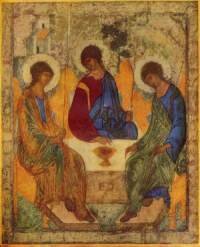
The “Hospitality of Abraham” by Andrei Rublev: The three angels represent the three persons of GodChristianity is a monotheistic religion centered on the life, teachings, and actions of Jesus, the Christ, as recounted in the New Testament.

With an estimated 2.1 billion adherents, Christianity is the world's largest religion. Its origins are intertwined with Judaism, with which it shares much sacred text and early history; specifically, it shares the Hebrew Bible, known in the Christian context as the Old Testament. Christianity is considered an Abrahamic religion, along with Judaism.

In the Christian scriptures, the name "Christian" (thus "Christianity") is first attested in Acts 11:25-27:

"25 So Barnabas went to Tarsus to look for Saul, 26 and when he had found him, he brought him to Antioch. For a whole year they met with the church and taught a great many people. And in Antioch the disciples were first called Christians."

(Greek χριστιανους, from Christ Χριστός, which means "the anointed").
Within Christianity, numerous distinct groups have developed, with diverse beliefs that vary widely by culture and place. Since the Reformation, Christianity is usually represented as being divided into three main branches:

More...

Monday, September 14, 2009

Mendelian inheritance

Gregor Johann MendelMendelian inheritance (or Mendelian genetics or Mendelism) is a set of primary tenets relating to the transmission of hereditary characteristics from parent organisms to their children; it underlies much of genetics. They were initially derived from the work of Gregor Mendel (a Christian Augustinian monk who belived in creationism) published in 1865 and 1866 which was "re-discovered" in 1900, and were initially very controversial. When they were integrated with the chromosome theory of inheritance by Thomas Hunt Morgan in 1915, they became the core of classical genetics.

The laws of inheritance were derived by Gregor Mendel, a 19th century Moravian monk conducting plant hybridity experiments. Between 1856 and 1863, he cultivated and tested some 28,000 pea plants. His experiments brought forth two generalizations which later became known as Mendel's Laws of Heredity or Mendelian inheritance. These are described in his essay "Experiments on Plant Hybridization" that was read to the Natural History Society of Brno on February 8 and March 8, 1865, and was published in 1866.

More...

Sunday, September 13, 2009

Fyodor Dostoyevsky

Fyodor Dostoyevsky in 1879 the year prior to his novel, The Brothers Karamazov.Fyodor Mikhaylovich Dostoyevsky (Russian: Фёдор Миха́йлович Достое́вский, Fёdor Mihajlovič Dosto'evskij, sometimes transliterated Dostoevsky, Dostoievsky, Dostojevskij, Dostoevski or Dostoevskii (November 11, [O.S. October 30] 1821 – February 9, [O.S. January 28] 1881) was a Russian writer, essayist and philosopher, known for his novels Crime and Punishment and The Brothers Karamazov.

Several Dostoyevsky Quotes:
“Love a man, even in his sin, for that love is a likeness of the divine love, and is the summit of love on earth”

“If God does not exist, then everything is permitted”

“What is hell? I maintain that it is the suffering of being unable to love”

“The soul is healed by being with children”
Dostoyevsky's literary output explores human psychology in the troubled political, social and spiritual context of 19th-century Russian society. Considered by many as a founder or precursor of 20th-century existentialism, his Notes from Underground (1864), written in the embittered voice of the anonymous "underground man", was called by Walter Kaufmann the "best overture for existentialism ever written." A prominent figure in world literature, Dostoyevsky is often acknowledged by critics as one of the greatest psychologists in world literature, although some fellow novelists have assessed his works as mediocre and full of platitudes.

More...

Saturday, September 12, 2009

Martin Heidegger

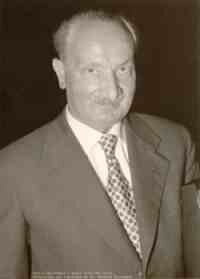
Martin Heidegger 1950’s, © Dr. Hermann HeideggerMartin Heidegger (September 26, 1889 – May 26, 1976) was an influential German philosopher. His best known book, Being and Time (German: Sein und Zeit, 1927), is generally considered to be one of the key philosophical works of the 20th century.

Heidegger claimed that Western philosophy has, since Plato, misunderstood what it means for something to be, tending to approach this question in terms of a being, rather than asking about being itself. In other words, Heidegger believed all investigations of being have historically focused on particular entities and their properties, or have treated being itself as an entity, or substance, with properties. A more authentic analytic of being would, for Heidegger, investigate "that on the basis of which beings are already understood," or that which underlies all particular entities and allows them to show up as entities in the first place.

But since philosophers and scientists have overlooked the more basic, pre-theoretical ways of being from which their theories derive, and since they have incorrectly applied those theories universally, they have confused our understanding of being and human existence. To avoid these deep-rooted misconceptions, Heidegger believed philosophical inquiry must be conducted in a new way, through a process of retracing the steps of the history of philosophy.

More...

Friday, September 11, 2009

Desert Fathers

Michelangelo, The Torment of Saint Anthony, c. 1487-88.The Desert Fathers were Hermits, Ascetics and Monks who lived mainly in the Scetes desert of Egypt, beginning around the third century. They were the first Christian hermits, who abandoned the cities of the pagan world to live in solitude. These original desert hermits were Christians fleeing the chaos and persecution of the Roman Empire's Crisis of the Third Century. They were men who did not believe in letting themselves be passively guided and ruled by a decadent state. Christians were often scapegoated during these times of unrest, and near the end of the century, the Diocletianic Persecution (or Great Persecution was the last and most severe Persecution by Diocletian and his colleagues Maximian, Galerius, and Constantius in the Roman empire) was more severe and systematic. In Egypt, refugee communities formed at the edges of population centers, far enough away to be safe from Imperial scrutiny.

In 313, when Christianity was made legal in Egypt by Diocletian's successor Constantine I, a trickle of individuals, many of them young men, continued to live in these marginal areas. The solitude of these places attracted them because the privations of the desert were a means of learning stoic self-discipline. Such self-discipline was modelled after the examples of Jesus' fasting in the desert and of his cousin John the Baptist (himself a desert hermit). These individuals believed that desert life would teach them to eschew the things of this world and allow them to follow God's call in a more deliberate and individual way.

More...

Thursday, September 10, 2009

Constantine the Great

Head of Constantine's colossal statue at Musei CapitoliniGaius Flavius Valerius Aurelius Constantinus (Latin: IMP CÆSAR FLAVIVS CONSTANTINVS PIVS FELIX INVICTVS AVGVSTVS) (February 27, 272–May 22, 337), commonly known as Constantine I, Constantine the Great, or (among Orthodox Christians) Saint Constantine, was proclaimed Augustus by his troops on July 25, 306 and ruled an ever-growing portion of the Roman Empire until his death. Constantine is famed for his refounding of Byzantium (modern Istanbul) as "Nova Roma" (New Rome) or Constantinople (Constantine's City).

Constantine is best remembered in modern times for the Edict of Milan in 313 and the Council of Nicaea in 325, which fully legalized Christianity in the Empire for the first time.

These actions are considered major factors in that religion's spread, and his reputation as the "first Christian Emperor" has been promulgated by historians from Lactantius and Eusebius of Caesarea to the present day, though he himself was baptized only on his death bed.

Constantine was born at Naissus in Upper Moesia (today's Niš, Serbia) on 27 February 272 or 273, to Greek general, Constantius I Chlorus, and his first wife Helena, an innkeeper's daughter who at the time was only sixteen years old. Theodora would give birth to six half-siblings of Constantine, including Julius Constantius.

More...

Wednesday, September 09, 2009

Christian Worldview

Christian WorldviewChristian worldview refers to a collection of distinctively Christian philosophical and religious beliefs. The term is typically used in one of three ways:
  1. A set of worldviews voiced by those identifying themselves as Christian;
  2. Common elements of worldviews predominant among those identifying themselves as Christian;
  3. The concept of a single "Christian worldview" on a range of issues.

There are some rather startling statistics, based upon the following definition of "worldview," including a firm belief in six specific religious views.

  1. Jesus Christ lived a sinless life;
  2. God is the all-powerful and all-knowing Creator of the universe and He stills rules it today;
  3. salvation is a gift from God and cannot be earned;
  4. Satan is real;
  5. a Christian has a responsibility to share their faith in Christ with other people; and
  6. the Bible is accurate in all of its teachings.


More...

Tuesday, September 08, 2009

Jeremiah

The figure of Jeremiah on the Sistine Chapel ceiling, by Michelangelo.Jeremiah or Yermiyahu (יִרְמְיָהוּ) His writings are collected in the book of Jeremiah, and the Book of Lamentations. Jeremiah is considered by some modern scholars (as well as some Ancient Rabbis) to have written, or redacted much of the Old Testament, as we have it today. His language in "Jeremiah" and "Lamentations" is quite similar to that in Deuteronomy and the "Deuteronomic history" of Joshua, Judges, the Books of Samuel, and the Books of Kings. Jeremiah is also famous as "the broken-hearted prophet" (who wrote or dictated a "broken book", which has been difficult for scholars to put into chronological order), whose heart-rending life, and true prophecies of dire warning went largely-unheeded by the people of Judah. YHWH told Jeremiah, "You will go to them; but for their part, they will not listen to you".

According to the Book of Jeremiah, he was called to the prophetical office when still young; in the thirteenth year of Josiah (628 BC). He left his native place, Anatoth, (where Jeremiah was perhaps a member of the priesthood) and went to reside in Jerusalem; where he assisted Josiah in his work of reformation.

Jeremiah was a Kohen (member of the priestly family, called to the prophetical office when still young; in the thirteenth year of Josiah (628 BC). He left his native place, Anathoth, to reside in Jerusalem, where he assisted Josiah in his work of reformation. Jeremiah wrote a lamentation upon the death of this pious king (2 Chr. 35:25).

More...
Monday, September 07, 2009

Fascism

left: Italian Fascist Dictator Benito Mussolini, Right: German Führer of GermanyFascism (in Italian, fascismo), capitalized, was the authoritarian political movement which ruled Italy from 1922 to 1943 under the leadership of Benito Mussolini. Similar political movements, including Nazism, spread across Europe between World War I and World War II.

The most restrictive definitions of fascism include only one government, that of Mussolini in Italy. However, the term is frequently applied to Nazi Germany under Adolf Hitler and is used to refer to similar regimes and movements across Europe in the same time period, such as Hungary's Arrow Cross Party, Romania's Iron Guard, Spain's Falange, and the French political movements led by Marcel Déat and Jacques Doriot.

More broadly, it is sometimes (by both supporters and opponents) applied to other authoritarian regimes of the period such as those of Imperial Japan under Hideki Tojo, Austria under Engelbert Dollfuss and Greece under Ioannis Metaxas. Its use for similar but longer-lived regimes such as Spain under Francisco Franco and the Estado Novo of António de Oliveira Salazar in Portugal is widespread among opponents of those regimes but is often disputed by their supporters. This trend toward the term being used only by opponents is amplified in the case of more recent authoritarian regimes such as Indonesia under Suharto, and Chile under Augusto Pinochet.

More...

Sunday, September 06, 2009

Summa Theologiae

Summa theologiae, Pars secunda, prima pars. (copy by Peter Schöffer, 1471)The Summa Theologiae (also sometimes referred to as the Summa Theologica) is the most famous work of Thomas Aquinas (c. 1225 – 7 March 1274). It was intended as a manual for beginners as a compilation of all of the main theological teachings of that time. It is not designed or ordered as an apologetic work, to convince non-Catholics, but it does contain a summary of the reasonings for almost all points of the Catholic Faith. It became so reputed that at the Council of Trent, it was consulted after the Bible itself on religious questions.

The Summa Theologiae is a more mature and structured version of an earlier work of Aquinas, the Summa Contra Gentiles. This former work was more apologetic in nature, and each article was a refutation of a specific belief of different heresies and other religions. The Summa Theologiae is famous for its quinquae viae which literally means "five streets," i.e. five ways to prove the existence of God. Some have called the Summa Theologiae the greatest Theologiael statement of the Middle Ages.

The Summa is composed of three major parts, each of which deals with a major subsection of Christian theology.

More...

Saturday, September 05, 2009

Simon the Zealot

Simon the Zealot was a brother of James the Great and St Jude ThaddeusThe apostle Simon, called Simon the Zealot in Luke 6:15 and Acts 1:13; and Simon Kananaios ("Simon" Hebrew: שמעון signifying "hearkening; listening", Standard Hebrew Šimʿon, Tiberian Hebrew Šimʿôn), was one of the most obscure among the apostles of Jesus; little is recorded of him aside from his name. Few pseudepigraphical (see pseudepigrapha) writings were connected to him (but see below), and Jerome does not include him in De viris illustribus.

The name of Simon occurs in all the passages of the synoptic gospels and Acts that give a list of apostles, without further details.

Simon the Zealot was listed as one the the twelve disciples of Christ (Matthew 10:4; Acts 1:13) sometimes referred to as "Simon the Cananean" (Mark 3:18; Luke 6:15) and some identify with Simeon of Jerusalem, which others dispute on the grounds that Simeon was described at the time of Jesus' birth some thirty years before, as an old man not far from death. . Simon, the name, stems from the Hebrew "Shimon" which means "hearing." The word "Cananean" stems from old Aramaic, meaning "zealous one."

More...
 

Subscribe


LifeNews.com

Desiring God Blog

Youth for Christ International