rss rss Follow Jesus
Subscribe

Share/Save/Bookmark

Restore The Republic - The Home of the Freedom Movement!

Monday, July 17, 2006

Israel

The Israeli flag is rooted in Jewish tradition. The white background symbolizes purity. The symbols on the flag are two stripes—one on the top and one on the bottom—and the Star of David emblem adorning the centerThe name "Israel" is rooted in the Hebrew bible, the Tanakh, where Jacob is renamed Israel after wrestling with a mysterious adversary ("a man", and later "God" according to Gen. 32:24-30; or "the angel", according to Hosea 12:4). Israel means "he who has wrestled with God." The Jews, the nation fathered by Jacob, were then called "the children of Israel" or the "Israelites."

The Israeli flag is rooted in Jewish tradition. The white background symbolizes purity. The symbols on the flag are two stripes—one on the top and one on the bottom—and the Star of David emblem adorning the center.

The stripes and blue color are inspired by the tallit (a jewish prayer shawl, used mainly in the shachrit (morning) and musaf (additional prayers, on a holiday or the Sabbath).

More...

Alexander the Great

Alexander the Great fighting Persian king Darius III (not in frame) Alexander Mosaic from Pompeii, from a 3rd century BC original Greek painting, now lostAlexander the Great (in Greek Μέγας Αλέξανδρος, transliterated Megas Alexandros) (Alexander III of Macedon) was born in Pella, Macedon, in July, 356 BC, died in Babylon, on June 10, 323 BC, King of Macedon 336–323 BC, is considered one of the most successful military commanders in world history (if not the greatest), conquering most of the known world before his death. Alexander is also known in the Zoroastrian Middle Persian work Ars "the accursed Alexander" due to his conquest of the Persian Empire and the destruction of its capital Persepolis.

He is also known in Middle Eastern traditions as Dhul-Qarnayn in Arabic and Dul-Qarnayim in Hebrew and Aramaic (the two-horned one), apparently due to an image on coins minted during his rule that seemingly depicted him with the two ram's horns of the Egyptian god Ammon. He is known as Sikandar in Hindi; in fact in India, the term Sikandar is used as a synonym for "expert" or "extremely skilled"; in the Malay Language he is known as Iskandar Zulkarnain.

More...

Friday, July 14, 2006

History of Ancient Israel

The Wailing WallThe Semitic culture followed on from the Ghassulians. People became urbanized and lived in city-states, one of which was Jericho. The area's location at the center of routes linking three continents made it the meeting place for religious and cultural influences from Egypt, Syria, Mesopotamia, and Asia Minor. It was also the natural battleground for the great powers of the region and subject to domination by adjacent empires, beginning with Egypt in the late 3rd millennium BCE.

Traditions regarding the early history found in later works such as the Kebra Nagast and commentaries of Rashi, Philo, and numerous others, (besides of course, the Tanakh) refer to the early inhabitants as the sons of Shem and also speak of an invasion by the people known as Canaanites (see Canaan) descended from Ham.

More...

Thursday, July 13, 2006

the Wailing Wall

The Wailing WallThe Western Wall (Hebrew: הכותל המערבי, HaKotel HaMa'aravi), or simply The Kotel, is a retaining wall from the time of the Jewish Second Temple of Jerusalem (see also Temple of Herod). It is sometimes referred to as the Wailing Wall, or as the al-Buraq Wall, in a mix of English and Arabic. The Temple was the most sacred building in Judaism. Herod the Great built vast retaining walls around Mount Moriah, expanding the small, quasi-natural plateau on which the First and Second Temples stood into the wide open spaces of the Temple Mount seen today.

In recent centuries, Jews were allowed little or no access to the site, such as when Turkey (the Ottoman Empire) ruled over it for 400 years (1515-1917), followed by the British Mandate of Palestine (1917-1948) and the Jordanian rule of Jerusalem (1948-1967). Only when the Israel Defense Forces won a victory in the 1967 Six Day War were Jews finally able to gain free access to the site.

More...

Canaan

Map of Canaan
Canaan (Arabic کنعان, Hebrew כְּנַעַן, Septuagint Greek Χανααν) is an ancient term for a region roughly corresponding to present-day Israel/Palestine including the West Bank, Western Jordan, southern and coastal Syria and Lebanon continuing up until the border of modern Turkey.

Various Canaanite sites have been excavated by archaeologists, most notably the Canaanite town of Ugarit, which was rediscovered in 1928. Much of our modern knowledge about the Canaanites stems from excavation in this area.

In linguistic terms, Canaanite refers to the common ancestor of closely related semitic languages including Hebrew, and Ugaritic, and was the first language to use a semitic alphabet, from which the others derived their scripts; see Canaanite languages.

More...

Wednesday, July 12, 2006

Lee Strobel

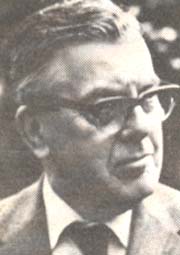
Former atheist and Christian Apologist Lee StrobelLee Strobel, a former legal editor for the Chicago Tribune, is a Christian apologist and former teaching pastor of Willow Creek Community Church. He is best known for writing the semi-autobiographical bestsellers The Case for Christ, The Case for Faith, and The Case for a Creator. Strobel also hosted a television program called Faith Under Fire on PAX TV. His daughter, Alison, is also a Christian writer.

Biography
Strobel earned a journalism degree from the University of Missouri and a Master of Studies in Law degree from Yale Law School. A journalist for fourteen years, he was awarded Illinois' highest honors from United Press International for both investigative reporting (shared with a team he led at the Chicago Tribune) and for public service journalism.

More...

Saturday, July 08, 2006

Thomas Aquinas

Saint Thomas Aquinas [Thomas of Aquin, or Aquino] (c. 1225 – 7 March 1274) was an Italian Catholic philosopher and theologian in the scholastic tradition, known as Doctor Angelicus, Doctor Universalis. He is the most famous classical proponent of natural theology. He gave birth to the Thomistic school of philosophy, which was long the primary philosophical approach of the Catholic Church. He is considered by the Catholic Church to be its greatest theologian and one of the thirty-three Doctors of the Church. There have been many institutions of learning named after him.

The life of Thomas Aquinas offers many interesting insights into the world of the High Middle Ages. He was born into a family of the south Italian nobility and was through his mother, Countess Theadora of Theate, related to the Hohenstaufen dynasty of Holy Roman emperors.

More...

Friday, July 07, 2006

Mount Sinai

Photo from the summit of Mount Sinai, taken by Ian Sewell in December 2004Mount Sinai, also known as "Gebel Musa" or "Jabal Musa" by the Bedouins, is the name of a mountain in the Sinai Peninsula. It is 2,285 metres high and is located in a mountain range in the southern part of the peninsula. It is near a protruding lower bluff known as the Ras Sasafeh (Sufsafeh), and rises almost perpendicularly from the plain.

To some scholars it is the same as the Biblical Mount Sinai, though this is not agreed upon.

The name Sinai comes probably from the Moon God Sin, similar to the Desert of Sin. Judaism teaches that as soon as the Jewish people received the Bible at Mt. Sinai, they would be hated by the rest of the world for having been the ones to receive divine word (a state of affairs presented as a pun: Sinai as Seen-ah, which means hatred).

More...

Thursday, July 06, 2006

William Whiston

William Whiston (December 9, 1667 - August 22, 1752), English divine and mathematician, was born at Norton in Leicestershire, of which village his father was rector. He is probably best known for his translation of the Antiquities of the Jews by Flavius Josephus, his A New Theory of the Earth, and his Arianism.

He was educated privately, partly on account of the delicacy of his health, and partly that he might act as amanuensis to his father, who had lost his sight. After his father's death, he entered at Clare College, Cambridge, where he applied himself to mathematical study, and obtained a fellowship in 1693. He next became chaplain to John Moore (1646-1714), the learned bishop of Ely, from whom he received the living of Lowestoft in 1698.

More...

Wednesday, June 28, 2006

Jesus

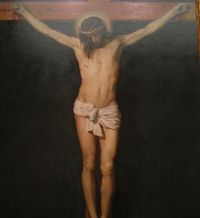
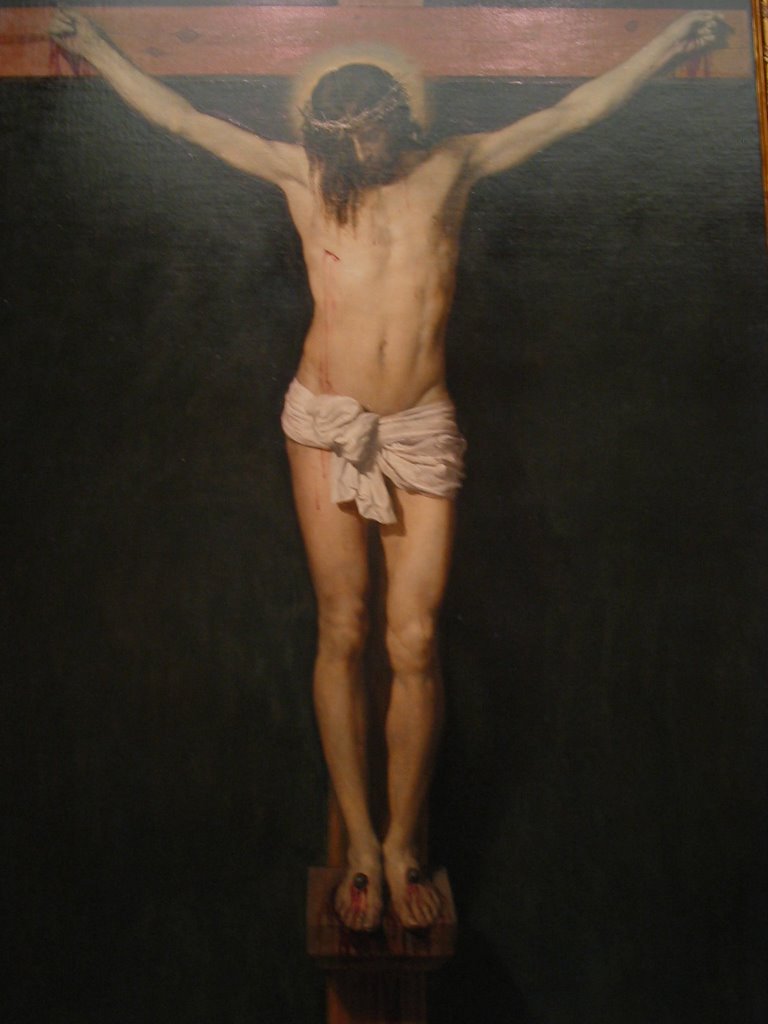
Jesus' crucifixion as portrayed by Diego VelázquezThe name of Jesus, meaning "Savior" in Christian usage, derived from the Aramaic and Hebrew Yeshua and Joshua, meaning Yahweh is salvation. Jesus is the incarnate Son of God, the second person of the Trinity, and the prophesied Hebrew Messiah (Anointed One, deliverer of Israel). Also known as "Jesus Christ", "Jesus of Nazareth", and "Jesus the Nazarene".

Christian views of Jesus (known as Christology) are both diverse and complex. Most Christians are Trinitarian and affirm the Nicene Creed, believing that Jesus is both the Son of God and God made incarnate, sent to provide salvation and reconciliation with God by atoning for the sins of humanity.

Other Christians, however, do not believe that the Nicene Creed correctly interprets Scripture.


More...
Reformation

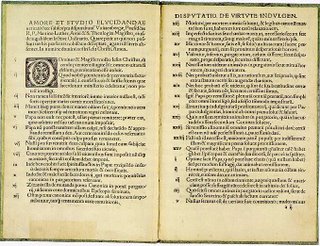
Martin Luther's 95 ThesesThe Protestant Reformation was a movement that emerged in the 16th century as a series of attempts to reform the Roman Catholic Church in Western Europe. The main front of the reformation was started by Martin Luther and his 95 Theses. The reformation ended in division and the establishment of new institutions, most importantly Lutheranism, the Reformed churches, and Anabaptists, a radical branch whose name means "those who baptize again".


It also led to the Counter-Reformation within the Roman Catholic Church, which theological draft and background were drawn up with the Council of Trent (1548–1563), when Rome struck back against the fundamental ideas defended by the Reformers, like Luther. The rift between Catholics and Protestants would lead to the break up of large European empires into the modern nation-state system.

More...

Monday, June 26, 2006

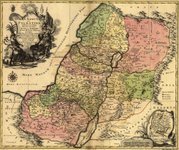
Tribes of Israel

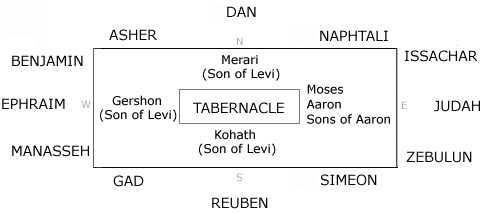
Israel had 12 sons, as follows: Reuben, Simeon, Levi, Judah, Dan, Naphtali, Gad, Asher, Issachar, Zebulun, Joseph, and Benjamin. (Jacob was renamed Israel Gen. 32:27-29)
The Tribe of Levi was set apart from the others in the sense that, the members of the Tribe of Levi were to be in charge of the tabernacle of the Testimony. (see: Num. 1).
The Tribe of Joseph is not usually listed with the Hebrew tribes although Joseph is one of Jacobs twelve sons, the eldest of Rachel. It is sometimes referred to as the House of Joseph. Rather, the two tribes founded by his sons Ephraim and Manasseh are listed separately.

The Ten Lost Tribes are those from the northern Kingdom of Israel who were deported by the Assyrians in the 8th century BC to Khorason. In Jewish popular culture, the ten tribes disappeared from history, leaving only the tribes of Benjamin and Judah and Levi who evolved into the modern day Jews.

More...

historicity of Jesus

The historicity of Jesus (i.e., his existence as an actual historical figure), is accepted as a theological axiom by three world religions, Christianity, Islam and the Bahá’í Faith, based on their respective scriptures.


The earliest known sources are Christian writings - the New Testament - which, according to modern historians, were written several decades after he is said to have died. However, while Christianity and the Bahá'í Faith also consider Jesus to be the Christ (Messiah) and Son of God, and Islam views him as a prophet, secular historians and followers of most other world religions (including Judaism) tend to regard him as an ordinary human. Most scholars, however, agree that Jesus was an historical figure regardless of their perspectives on His teaching, His message of salvation, or statements about Himself.

More...

Friday, June 23, 2006

The Western Wall

Jerusalem Western Wall by nightThe Western Wall (Hebrew: הכותל המערבי, HaKotel HaMa'aravi), or simply The Kotel, is a retaining wall from the time of the Jewish Second Temple of Jerusalem (see also Temple of Herod). It is sometimes referred to as the Wailing Wall, or as the al-Buraq Wall, in a mix of English and Arabic. The Temple was the most sacred building in Judaism. Herod the Great built vast retaining walls around Mount Moriah, expanding the small, quasi-natural plateau on which the First and Second Temples stood into the wide open spaces of the Temple Mount seen today.

In recent centuries, Jews were allowed little or no access to the site, such as when Turkey (the Ottoman Empire) ruled over it for 400 years (1515-1917), followed by the British Mandate of Palestine (1917-1948) and the Jordanian rule of Jerusalem (1948-1967). Only when the Israel Defense Forces won a victory in the 1967 Six Day War were Jews finally able to gain free access to the site.

More...

lineage of Jesus

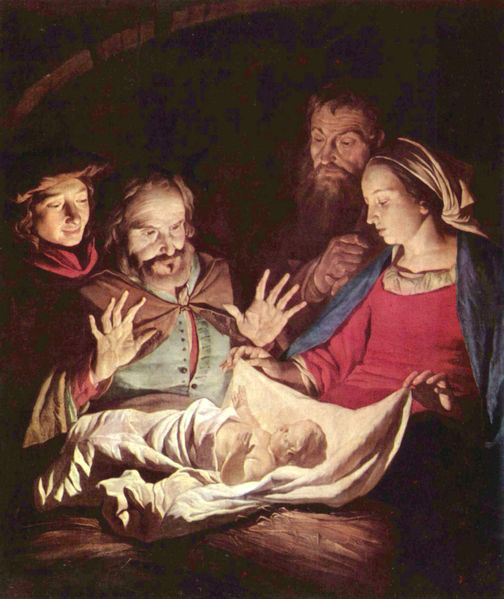
The infant Jesus in Adoration of the Shepherds, Gerard van HonthorstThe lineage of Jesus is recorded in two places in the bible:
1) Matthew 1:1-17, and 2) Luke 3:23-38 (in addition to several other new testament references: Mark 10:47, luke 1:32, Acts 2:29-30, Rev. 5:5, 22:16).

The Matthew 1:1-17 and Luke 3:23-38 accounts differ because, Luke follows Mary's lineage (Jesus' blood mother), through David's son Nathan (Luke's genealogy focused on Jesus' descent from God through the virgin birth. It placed no emphasis on Jesus being the descendant of king David) and the Matthew genealogy follows Joseph's line (Joseph being the legal father of Jesus, see below) through David's son Solomon. God's promise to David was fulfilled because mary was the biological parent of Jesus.


More...

Thursday, June 22, 2006

King David

David and Goliath by Caravaggio, c. 1599.King David (Standard Hebrew דָּוִד, Davíd, "Beloved") was the second king of the united kingdom of Israel (c. 1005 BC – 965 BC) and successor to King Saul. His life and rule are recorded in the Hebrew Bible's books of First Samuel (from chapter 16 onwards), Second Samuel, First Kings and Second Kings (to verse 4). First Chronicles gives further stories of David, mingled with lists and genealogies.

He is depicted as the most righteous of all the ancient kings of Israel - although not without fault - as well as an acclaimed warrior, musician and poet (he is traditionally credited with the authorship of many of the Psalms). 2 Samuel 7:12-16 states that God was so pleased with David that He promised that the Davidic line would endure forever; Jews therefore believe that the Jewish Messiah will be a direct descendant of King David, and Christians trace the lineage of Jesus back to him through both Mary and Joseph.

More...

Wednesday, June 21, 2006

Tower of David

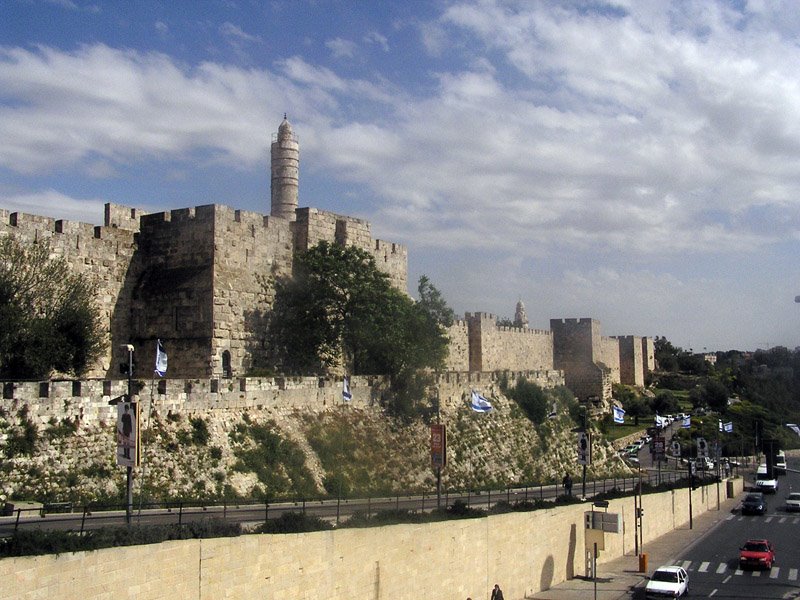
The Tower of David is Jerusalem's "citadel", a historical and archaeological site of world importance.

This is a medieval fortress, with later additions. Its towers and ramparts offer splendid views of that part of Jerusalem where Old and New meet, and East meets West. The site of the citadel has always been the weak point in the city's defenses, compelling its rulers throughout history to fortify the site.

This important historical and archeological site was built in the First Temple Period (960-586 BCE). Parts of a tower and the city wall were built by the Hasmonean (first century BCE). The base of the tower was built by Herod the Great (37-34 BCE).

More...

Tuesday, June 20, 2006

Qumran

Qumran (Khirbet Qumran) is located on a dry plateau about a mile inland from the northwestern shore of the Dead Sea in the disputed territory of the West Bank. The site was constructed sometime between 150 and 130 BC and saw various phases of occupation until, in the summer of 68, Titus and his X Fretensis destroyed it. It is best known as the settlement nearest to the hiding place of the Dead Sea Scrolls in the caves of the sheer desert cliffs. Location near 31°45'N 35°26'E.

The Dead Sea scrolls comprise roughly 825-870 documents, including texts from the Hebrew Bible, discovered between 1947 and 1956 in eleven caves in and around the Wadi Qumran (near the ruins of the ancient settlement of Khirbet Qumran, on the northwest shore of the Dead Sea).

More...

Monday, June 19, 2006

Martin Luther

Martin Luther (November 10, 1483–February 18, 1546) was a German theologian, an Augustinian monk, and an ecclesiastical reformer whose teachings inspired the Reformation and deeply influenced the doctrines and culture of the Lutheran and Protestant traditions. Luther's call to the Church to return to the teachings of the Bible led to the formation of new traditions within Christianity and to the Counter-Reformation, the Catholic reaction to these movements. His contributions to Western civilization went beyond the life of the Christian Church. His translations of the Bible helped to develop a standard version of the German language and added several principles to the art of translation. His hymns inspired the development of congregational singing in Christianity. His marriage on June 13, 1525, to Katharina von Bora began a movement of clerical marriage within many Christian traditions.

More...

Recent Comments

Powered by Disqus

Blog Archive

Techledo Consulting

Techledo Consulting, LLC

Prevail Magazine

My Photo
Timothy Ministries
View my complete profile