Sunday, February 15, 2009

Moses

Moses holding up his arms during the battle, assisted by Aaron and Hur. Painting by John Everett MillaisAccording to the Hebrew Bible, Moses (Hebrew: משה Mosheh "to draw out, pull out") led the Israelites out of Egypt, and received the Torah of Judaism from God on Mount Sinai. The Torah contains the life story of Moses and his people until his death at the age of 120 years, according to some calculations in the year 2488, or 1272 BC. Consequently, "may you live to 120" has become a common blessing among Jews.

Moses's greatest legacy was probably expounding the doctrine of monotheism, which was not widely accepted at the time, codifying it in Jewish religion with the 1st Commandment, and punishing polytheists. He is revered as a prophet in Judaism, Christianity, and Islam.

The birth of Moses occurred at a time when the current Egyptian monarch had commanded that all male children born to Hebrew[1] captives should be killed by drowning in the Nile River.
22 And Pharaoh charged all his people, saying, Every son that is born ye shall cast into the river, and every daughter ye shall save alive. Exodus 1:22

More...

Saturday, February 14, 2009

Sea of Galilee

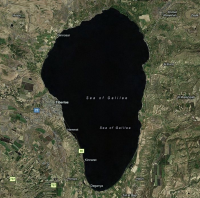
Sea of Galilee region interractive mapThe Sea of Galilee is Israel's largest freshwater lake, approximately 53 kilometers (33 miles) in circumference, about 21 km (13 miles) long, and 13 km (8 miles) wide; it has a total area of 166 km², and a maximum depth of approximately 43 meters. At 209 meters below sea level, it is the lowest freshwater lake on Earth and the second-lowest lake in the world after the Dead Sea, a saltwater lake. It is not a sea by any normal definition; it is called a sea by tradition. The lake is also known on modern maps as Lake Galilee or Lake Tiberias. The name Galilee refers to the region of Galilee in which it is located. In modern Hebrew it is known by its biblical name, Yam Kinneret (ים כנרת), "Sea of Kinnereth" (Numbers 34:11; Joshua 13:27). The name may originate from the Hebrew word kinnor ("harp" or "lyre") - which the lake's shape resembles. It has also been called the Lake of Gennesaret or the Sea of Gennesaret (Greek: Γεννησαρέτ Strong's G1082 - Gennēsaret, of Hebrew origin, cf H3672 כנרות Kinnĕrowth, Chinneroth or Cinneroth or Chinnereth = "harps"). (Luke 5:1) after the name of a small fruitful plain which lies on its western side.

The Kinnĕrowth is fed by underground springs, but its main source is the Jordan River, which flows through it from north to south.

More...

Friday, February 13, 2009

Christian worldview

Christian WorldviewChristian worldview refers to a collection of distinctively Christian philosophical and religious beliefs. The term is typically used in one of three ways:

  1. A set of worldviews voiced by those identifying themselves as Christian;
  2. Common elements of worldviews predominant among those identifying themselves as Christian;
  3. The concept of a single "Christian worldview" on a range of issues.

There are some rather startling statistics, based upon the following definition of "worldview," including a firm belief in six specific religious views.
  1. Jesus Christ lived a sinless life;
  2. God is the all-powerful and all-knowing Creator of the universe and He stills rules it today;
  3. salvation is a gift from God and cannot be earned;
  4. Satan is real;
  5. a Christian has a responsibility to share their faith in Christ with other people; and
  6. the Bible is accurate in all of its teachings.

Based upon the above definition, Barna and other polling organizations have observered a decline in Christian beliefs. A recent study indicates that only 4% of American adults have a biblical worldview as the basis of their decision-making -- while at the same time "spirituality" has been on the rise.

More...

Thursday, February 12, 2009

Alexandria

virtual map of Alexandria.Alexandria (Greek: Αλεξάνδρεια), (population of 3.5 to 5 million), is the second-largest city in Egypt (see ancient Egypt), and its largest seaport. Alexandria extends about 20 miles (32 km) along the coast of the Mediterranean sea in the northwest of Egypt. It is home to the Bibliotheca Alexandrina, the New Library of Alexandria, and is an important industrial centre because of its natural gas and oil pipelines from Suez.

In ancient times, the city was known for the Lighthouse of Alexandria (one of the Seven Wonders of the Ancient World) and the Library of Alexandria (the largest library in the ancient world). Ongoing maritime archaeology in the harbour of Alexandria (which began in 1994) is revealing details of Alexandria both before the arrival of Alexander, when a city named Rhakotis existed there, and during the Ptolemaic dynasty.

The city of Alexandria was named after its founder, Alexander the Great and as the seat of the Ptolemaic rulers of Egypt, quickly became one of the greatest cities of the Hellenistic civilization — second only to Rome in size and wealth.

More...

Wednesday, February 11, 2009

Antony van Leeuwenhoek

Microscopic Section through one year old ash (Fraxinus) wood.Antony (October 24, 1632 - August 30, 1723), full name Thonius Philips van Leeuwenhoek (pronounced 'vahn Laywenhook') was a Dutch tradesman and scientist from Delft, Netherlands. He is commonly known as "the Father of Microbiology". Born the son of a basket maker, at age 16 he secured an apprenticeship with a Scottish cloth merchant in Amsterdam. He is best known for his work on the improvement of the microscope and for his contributions towards the establishment of microbiology. Using his handcrafted microscopes he was the first to observe and describe single celled organisms, which he originally referred to as animalcules, and which we now refer to as microorganisms. He was also the first to record microscopic observations of muscle fibers, bacteria, spermatozoa and blood flow in capillaries (small blood vessels). He published his observations in a series of letters to the Royal Society. The name bacterium was introduced much later, by Christian Gottfried Ehrenberg in 1828, and is derived from the Greek word βακτήριον -α , bacterion -a , meaning "small staff".
His faith in God and love for His creation undergirded his science. Along with others, he exposed the fallacy of spontaneous generation (abiogenesis), the superstitious belief that life sprung from material objects, such as raw meat "birthing" maggots.
Van Leeuwenhoek was a Dutch Reformed Calvinist. He often referred with reverence to the wonders God designed in making creatures great and small. He believed that his amazing discoveries were merely further proof of the great wonder of God's creation.

More...

Tuesday, February 10, 2009

socialism

German economist Karl Marx German philosopher, political economist, historian, sociologist, humanist, political theorist and revolutionarySocialism refers to a broad set of economic theories of social organization advocating state or collective ownership and administration of the means of production and distribution of goods, and a society characterized by equal opportunities for all individuals with a fair or egalitarian method of compensation. Modern socialism originated in the late nineteenth-century working class political movement and the intellectual movement of that period which criticized the effects of industrialization and private ownership on society. Karl Marx posited that socialism would be achieved via class struggle and a proletarian revolution and would represent the transitional stage between capitalism and communism.

The first socialists predicted a world improved by harnessing technology and combining it with better social organization, and many modern socialists share this belief , although modern socialists have a bigger emphasis on egalitarianism whereas traditional socialists favored meritocracy. Socialists mainly share the belief that capitalism unfairly concentrates power and wealth among a small segment of society that controls capital, creates an unequal society and does not provide equal opportunities for everyone in society to attain such status. Therefore socialists advocate the creation of a society in which wealth and power are distributed more evenly based on the amount of work expended,although there is considerable disagreement among socialists over how, and to what extent this could be achieved.


More...

Monday, February 09, 2009

Iraq

virtual map of Iraq and surrounding areaIraq, officially the Republic of Iraq (pronounced Arabic: العراق Al-ʾIrāq), officially the Republic of Iraq (Arabic: جمهورية العراق Jumhūrīyat Al-ʾIrāq, Kurdish: كۆماری عێراق‎, Komara Iraqê), is a country in Western Asia spanning most of the northwestern end of the Zagros mountain range, the eastern part of the Syrian Desert and the northern part of the Arabian Desert. It shares borders with Kuwait and Saudi Arabia to the south, Jordan to the west, Syria to the northwest, Turkey to the north, and Iran to the east. It has a very narrow section of coastline measuring 58 km (35 miles) between Umm Qasr and Al Faw on the Persian Gulf. There are two major flowing rivers: the Tigris and the Euphrates. These provide Iraq with agriculturally capable land and contrast with the desert landscape that covers most of Western Asia.

The capital city, Baghdad (Arabic: بغداد‎ Baġdād), is in the center-east. Iraq's rich history dates back to ancient Mesopotamia. The region between the Tigris and Euphrates rivers is identified as the cradle of civilization and a birthplace of writing. Throughout its long history, Iraq has been the center of the Akkadian, Assyrian, Babylonian, Sassanid and Abbasid Caliphate, and part of the Achaemenid, Macedonian, Parthian, Roman, Rashidun, Umayyad, Mongol, Ottoman and British empires.

Beginning with the invasion in 2003, a multinational coalition of forces, mainly American and British, occupied Iraq. Under the Laws of War and UNSCR 1483, the occupying Coalition Provisional Authority completed the transfer of sovereignty on June 28th, 2004 to the Iraqi Interim Government in accordance with UNSCR 1546, formally ending the "occupation." Elections on January 30th, 2005 created the Iraqi Transitional Government, which drafted the Constitution of Iraq, approved by referendum on October 25th, 2005. Under this new Constitution, elections chose a new Iraqi National Assembly to form the Government of Iraq. Some dispute whether Iraq is de facto sovereign (see Iraqi sovereignty, United States-Iraq relations).

More...

Sunday, February 08, 2009

Paul the Apostle

St Paul Healing the Cripple at LystraPaul the Apostle, also known as Paul, Paulus, Paul of Tarsus, and Saint Paul the Apostle, (AD 3—67) is widely considered to be central to the early development and spread of Christianity, particularly westward from Judea. Many Christians view him as an important interpreter of the teachings of Jesus. Paul is described in the New Testament as a Hellenized Jew and Roman citizen from Tarsus (present-day Turkey), and as a persistent persecutor of early Christians, almost all of whom were Jewish, prior to his "Road to Damascus" experience, which brought about his conversion to faith in Jesus as Messiah, not only for Jews, but for all, regardless of ethnic background.

Paul made the first great effort, through his Epistles to Gentile Christian communities, to show that the God of Abraham is for all people, rather than for Jews only, though he did not originate the idea, for example see Isaiah 56:6-8 or proselyte or Great Commission, or Simon Peter's vision of the sheet descending from Heaven in Acts 10:9-23a.

Paul is venerated as a Saint by all the churches that honor saints, including those of the Roman Catholic, Eastern Orthodox, and Anglican traditions, and some Lutheran sects.

He is the 'patron saint' of the City of London and has also had several cities named in his honor, including Sao Paulo, Brazil and Saint Paul, Minnesota in the United States. He did much to advance Christianity among the Gentiles, and is considered to be one source (if not the primary source) of early Church doctrine, and the founder of Pauline Christianity. His epistles form a fundamental section of the New Testament. Some argue that he was instrumental in establishing Christianity as a distinct religion, rather than a sect of Judaism, as Christianity was first known.

Due to his body of work and his undoubted influence on the development of Christianity, some modern scholars have considered Paul to be the founder of Christianity, who modified Jesus' teachings and added important new doctrines. However, this view remains controversial. Most Christian scholars say that no teachings were modified, and assert that Paul taught in complete harmony with Jesus. Some Christians, however, particularly those who embrace dispensationalism, believe that Jesus' teachings are for the Jews — especially those teachings found in Matthew — and that Christians necessarily have a different belief system since Christianity, according to this perspective, only arose as a result of the rejection by the Jews of Jesus as their Messiah.

More...

Saturday, February 07, 2009

Atlas Shrugged

Atlas Shrugged is a novel by Ayn Rand, first published in 1957 in the United States. It was Rand's fourth, longest, and last novel. Afterward, she completed only non-fiction works, concentrating on philosophy, politics, and cultural criticism.

At over one thousand pages in length, she considered Atlas Shrugged to be her magnum opus. The book explores a number of philosophical themes that Rand would subsequently develop into the philosophy of Objectivism. It centers on the decline of Western civilization, and Rand described it as demonstrating the theme of "the role of man's mind in existence." In doing so it expresses many facets of Rand's philosophy, such as the advocacy of reason, individualism, and the market economy.

Atlas Shrugged, the three sections of the book:  Part 1 - Non-Contradiction;  Part 2 - Either-Or;  Part 3 - A Is A

The theme of Atlas Shrugged is the role of the mind in man's life and, consequently, presentation of a new morality: the morality of rational self-interest.

The main crux of the book surrounds the decision of the "men of the mind" to go on strike, refusing to contribute their inventions, art, business leadership, scientific research, or new ideas of any kind to the rest of the world. Each man of ability eventually reasons (or is convinced) that society hampers him with unnecessary, burdensome regulations and undervalues his contributions to the world, confiscating the profits and sullying the reputations he has rightfully earned. The peaceful cohesiveness of the world begins to disintegrate as each of these men of ability slowly disappears and society loses those individuals whose mental effort allows it to continue functioning. The strikers believe that they are crucial to a society that exploits them, denying them freedom or failing to acknowledge their right to self-interest, and the gradual collapse of civilization is triggered by their strike. This is not to say that they believed that giving the creators their due would cost civilization. Rather, the strikers believe that the current irrational altruist/collectivist culture impeded them and therefore the rest of society as well. As such it would serve no one's interest to continue to allow himself to be exploited, although the strike is not primarily motivated by the harm the current state of society does to others as well.

More...

Liberty

Depiction of Jesus, reading the prophecy of Isaiah concerning Himself.
Liberty, the freedom to act or believe without being oppressed.

freedom

  1. the state of being free, esp. to enjoy political and civil liberties
  2. exemption or immunity: freedom from government control
  3. liberation, such as from slavery
  4. the right or privilege of unrestricted access: freedom of the skies
  5. self-government or independence
  6. the power to order one's own actions
  7. ease or frankness of manner

oppression

  1. to burden with cruel or unjust impositions or restraints; subject to a burdensome or harsh exercise of authority or power: a people oppressed by totalitarianism.
  2. to lie heavily upon (the mind, a person, etc.): Care and sorrow oppressed them.
  3. to weigh down, as sleep or weariness does.
  4. Archaic. to put down; subdue or suppress.
  5. Archaic. to press upon or against; crush.

Individualist and liberal conceptions of liberty relate to the freedom of the individual from outside compulsion or coercion; A collectivist perspective, on the other hand, associates liberty with equality across a broader array of societal interests. As such, a collectivist redefines liberty as being connected to the reasonably equitable distribution of wealth, arguing that the unrestrained concentration of wealth (the means of production) into only a few hands negates liberty. In other words, without relatively equal ownership, the subsequent concentration of power and influence into a small portion of the population inevitably results in the domination of the wealthy and the subjugation of the poor. Thus, freedom and material equality are seen as intrinsically connected, a line of thought that finds its home in the philosophy of Jean-Jacques Rousseau. On the other hand, the individualist argues that wealth cannot be evenly distributed without force being used against individuals which reduces individual liberty.

The words liberty and freedom are also mentioned numerous times in both the Hebrew Bible (Old Testament) and the New Testament.

More...

Thursday, February 05, 2009

for the love of money

Silver Denarius, Augustus Caesar, 29BC to 14 ADBoth the Hebrew bible (containing common portions of the Jewish and Christian canons) and Christian New Testament have a substantial amount to say about money and finances; evidence that these principles are something God considers important for us to be aware of.

10 For the love of money is a root of all kinds of evil. Some people, eager for money, have wandered from the faith and pierced themselves with many griefs. (1 Timothy 6:10 NIV)

φιλαργυρία philargyria: for the love of money (avarice)

ῥίζα rhiza: is a root (that which like a root springs from a root, a sprout, shoot)

πᾶς pas: of all (each, every, any, all, the whole, everyone, all things, everything)

κακός kakos: sorts of evil

  1. of a bad nature
    * not such as it ought to be
  2. of a mode of thinking, feeling, acting
    * base, wrong, wicked
  3. troublesome, injurious, pernicious, destructive, baneful


More...

Wednesday, February 04, 2009

The Wailing Wall

Jews praying at the Wailing WallThe Wailing Wall (Hebrew: הכותל המערבי HaKotel HaMa'aravi), also The Western Wall or simply The Kotel, is a retaining wall from the time of the Jewish Second Temple of Jerusalem (see also Temple of Herod). It is sometimes referred to as the Wailing Wall, or as the al-Buraq Wall, in a mix of English and Arabic. The Temple was the most sacred building in Judaism. Herod the Great built vast retaining walls around Mount Moriah, expanding the small, quasi-natural plateau on which the First and Second Temples stood into the wide open spaces of the Temple Mount seen today.

In recent centuries, Jews were allowed little or no access to the site, such as when Turkey (the Ottoman Empire) ruled over it for 400 years (1515-1917), followed by the British Mandate of Palestine (1917-1948) and the Jordanian rule of Jerusalem (1948-1967).

Only when the Israel Defense Forces won a victory in the 1967 Six-Day War were Jews finally able to gain free access to the site.

More...

Tuesday, February 03, 2009

Holocaust denial

April 12, 1945: Generals Eisenhower, Omar Bradley and George S. Patton inspect, at Ohrdruf forced labor camp, an improvised crematory pyre.Holocaust denial is the claim that the genocide of Jews during World War II—usually referred to as the Holocaust—did not occur in the manner or to the extent described by current scholarship.

Key elements of this claim are the rejection of any of the following:
  • that the Nazi government had a policy of deliberately targeting Jews and people of Jewish ancestry for extermination as a people;
  • that between five and seven million Jews were systematically killed by the Nazis and their allies; and
  • that genocide was carried out at extermination camps using tools of mass murder, such as gas chambers.
Holocaust deniers do not accept the term "denial" as an appropriate description of their point of view, and use the term Holocaust revisionism instead. Scholars, however, prefer the term "denial" to differentiate Holocaust deniers from historical revisionists, who use established historical methodologies.

More...

Monday, February 02, 2009

Asceticism

Jawaharlal Nehru sitting next to Gandhi at the AICC General Session, 1942.Asceticism (Greek: askēsis) refers to the idea that a higher spiritual and moral state is attainable through the practice of self-denial. It is characterized by abstinence from various sorts of worldly pleasures such as cultivating power, engaging in sexual activity or consumption of alcohol. It is often accompanied with the objective of pursuing religious and spiritual goals.

Some non- Judaeo-Christian religions teach that salvation and liberation involve a process of mind-body transformation that is effected through practicing restraint with respect to actions of body, speech and mind. The founders and earliest practitioners of these religions (e.g. Buddhism, Jainism, the Christian desert fathers) lived extremely austere lifestyles refraining from sensual pleasures and the accumulation of material wealth. This is to be understood not as an eschewal of the enjoyment of life but a recognition that spiritual and religious goals are impeded by such indulgence.

Asceticism is closely related to the Christian concept of chastity and might be said to be the technical implementation of the abstract vows of renunciation. Those who practice ascetic lifestyles do not consider their practices as virtuous but pursue such a life-style in order to satisfy certain technical requirements for mind-body transformation. There is remarkable uniformity among the above religions with respect to the benefits of sexual continence. Religions teach that purifying the soul also involves purification of the body which thereby enables connection with the divine and the cultivation of inner peace. In the popular imagination asceticism is considered a sort of perversion (self-flagellation by birch twigs as the archetypal stereotype of self-mortification) but the askēsis enjoined by religion functions in order to bring about greater freedom in various areas of one's life, such as freedom from compulsions and temptations bringing about peacefulness of mind with a concomitant increase in clarity and power of thought.

The adjective "ascetic" derives from the ancient Greek term askesis (practice, training or exercise). Originally associated with any form of disciplined practice, the term ascetic has come to mean anyone who practices a renunciation of worldly pursuits to achieve higher intellectual and spiritual goals.

More...

Sunday, February 01, 2009

Founders of Modern Science

Earthrise over the Moon, Apollo 8, NASA. This image helped create awareness of the finiteness of Earth, and the limits of its natural resources.Science (from the Latin scientia, 'knowledge') is a system of acquiring knowledge based on the scientific method, as well as the organized body of knowledge gained through such research. Science as defined here is sometimes termed pure science to differentiate it from applied science, which is the application of scientific research to specific human needs.

The renewal of learning in Europe, that began with 12th century Scholasticism, came to an end about the time of the Black Death, and the initial period of the subsequent Italian Renaissance is sometimes seen as a lull in scientific activity. The Northern Renaissance, on the other hand, showed a decisive shift in focus from Aristoteleian natural philosophy to chemistry and the biological sciences (botany, anatomy, and medicine). Thus modern science in Europe was resumed in a period of great upheaval: the Protestant Reformation and Catholic Counter-Reformation; the discovery of the Americas by Christopher Columbus; the Fall of Constantinople; but also the re-discovery of Aristotle during the Scholastic period presaged large social and political changes.

Thus, a suitable environment was created in which it became possible to question scientific doctrine, in much the same way that Martin Luther and John Calvin questioned religious doctrine. The works of Claudius Ptolemaeus (astronomy) and Galen (medicine) were found not always to match everyday observations. Work by Vesalius on human cadavers found problems with the Galenic view of anatomy.

Approximately 1,000 years ago, modern science began to supplant superstition (the commonly held irrational beliefs emerging from ignorance or fear). What follows is a list of some of the "Founders of Modern Science" who were, with the exception of one, of the Christian faith. The links below provide information regarding each person's faith and contributions to humanity.

More...

Saturday, January 31, 2009

Job

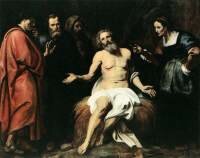
Job is seen refuting the idea of retributive justice endorsed by his friends. Job’s misfortunates were indeed undeserved and he will later confront God in a second whirlwind (Job 40:6 - 41:34)Job (Hebrew אִיּוֹב, Iyowb, "hated"), is a character in the Book of Job in the Hebrew Bible. In brief, the book begins with an introduction to Job's character — he is described as a rich, blessed man who fears God and lives righteously. Satan, however, challenges Job's integrity, and so God gives Job into Satan's hand, ending in tragedy for Job: the loss of his children, wealth, and physical soundness. The main portion of the text consists of the discourse of Job and his three friends concerning why Job was so punished, ending in God answering Job. Job is also a prophet in Islam.

Job had Seven sons and three daughters and

He possessed 7,000 sheep, 3,000 camels, 500 yoke of oxen, and 500 female donkeys, and very many servants, so that this man was the greatest of all the people of the east. (Job 1:3)
His sons took turns entertaining each other with feasts; each time they completed a cycle of feast days, Job sent to them and purified them, offering burn-offerings for each one in case any of them had cursed God in their hearts. He was "blameless and upright; he feared God and shunned evil. His good character is discussed in depth later in the book. (Job 1:1;4,5).

Satan asserts that Job does not really love God, but fears God for blessing. To show that this is not so, God tested Job by giving Satan power over his property and family. In rapid succession, Job is suddenly informed by four servants of four different tragedies to strike his household.

In one assembly of the angels before God, Satan also comes, having patrolled the earth.

More...

Friday, January 30, 2009

Huldrych Zwingli

Huldrych Zwingli in an oil portrait from 1531 by Hans Asper, Kunstmuseum Winterthur.Huldrych (or Ulrich) Zwingli (1 January 1484 – 11 October 1531) was a leader of the Reformation in Switzerland. He attended the University of Vienna and the University of Basel. He continued his studies while he served as a pastor in Glarus and later in Einsiedeln where he was influenced by the writings of Erasmus, a humanist scholar and theologian.

In 1519, Zwingli became the pastor of the Grossmünster in Zürich where he began to preach ideas on reforming the church. In his first public controversy in 1522, he attacked the custom of fasting during Lent. In his publications, he noted problems in the corruption of the ecclesiastical hierarchy, promoted clerical marriage, and attacked the use of images. In 1525, Zwingli introduced a new communion liturgy to replace the mass. Zwingli also clashed with the radical wing of the Reformation, the Anabaptists, which resulted in their persecution.

The Reformation spread to other parts of the Swiss Confederation, but several cantons resisted preferring to remain Catholic. Zwingli formed an alliance of Reformed cantons which divided the Confederation along religious lines. In 1529, a war between the two sides was averted at the last moment. Meanwhile, Zwingli’s ideas came to the attention of Martin Luther and other reformers.

They met at the Marburg Colloquy and although they agreed on many points of doctrine, they could not reach an accord on the doctrine of the presence of Christ in the Eucharist.

Thursday, January 29, 2009

Gates of Jerusalem

The Damascus GateDuring the era of the crusader Kingdom of Jerusalem, there were four gates to the Old City, one on each side. The current walls, built by Suleiman the Magnificent, have a total of eleven gates, but only seven are open. Until 1887, each gate was closed before sunset and opened at sunrise. These gates have been known by a variety of names used in different historic periods and by different community groups.

The New Gate (Arabic: Bab al-Jedid‎; Hebrew: HaSha'ar HeChadash‎) is the newest gate in Jerusalem's Old City Walls, built in 1898 to provide direct access to the Christian Quarter for the visit of the German Emperor William II.

It is also called the Gate of Hammid after the Ottoman Sultan Abdul Hamid II. The gate is located in the northwestern part of the wall and faces north.

During the 1948 Arab-Israeli war, when Jordan captured East Jerusalem (which includes the Old City of Jerusalem) it was sealed off. It was reopened again in 1967 after Israel's capture of East Jerusalem during the Six-Day War.

The Huldah Gates are the two sets of now-blocked gates in the south wall of the Temple Mount, which is also one of Jerusalem's Old City walls. The western set is a double arched gate (the double gate), and the eastern is a triple arched gate (the triple gate). Each arch of the double gate led into an aisle of a passageway leading from the gate into the Mount, and to steps leading to the Mount's surface; when the al-Aqsa Mosque was built, the old steps were blocked, and the eastern aisle lengthened so that new steps from its end would exit north of the Mosque. The triple gate is similar, though the longer aisle is to the west, and its third aisle, on the east, forms the western boundary of the vaulted area known as Solomon's Stables.

More...

Wednesday, January 28, 2009

Jericho

The Taking of Jericho, by Jean FouquetJericho (Arabic أريحا , Hebrew ירחו Yĕriychow "city of the moon" from the masculine noun: ירח yareach "moon") - is a town in the West Bank, Palestine near the Jordan River.

The first mention of Jericho in the Bible is from Numbers 22:
1 Then the people of Israel set out and camped in the plains of Moab beyond the Jordan at Jericho. 2 And Balak the son of Zippor saw all that Israel had done to the Amorites. 3 And Moab was in great dread of the people, because they were many. Moab was overcome with fear of the people of Israel. -Numbers 22:1-3
Jericho has a population of approximately 19,000. It is believed by some to be the oldest continuously occupied settlement in the world. The current mayor of Jericho is Hassan Saleh.

The present city was captured by Israel after the Six-Day War in 1967. It was the first city handed over to Palestinian Authority control in 1994, in accordance with the Oslo accords. After a period of Israeli readministration, it was returned to the Palestinian Authority on 16 March 2005.

On March 14, 2006, the Israel Defense Forces took captive six inmates from a Jericho prison following a 10-hour siege. The IDF said the reason for taking the prisoners, who were wanted for participation in the assassination of Israeli tourism minister Rehavam Zeevi, was to keep them from being released. Both sides of the siege were armed and at least two people were killed and 35 wounded in the incident.

More...

Tuesday, January 27, 2009

Lot

Lot and his Daughters, Artist: Orazio Gentileschi, Date: c. 1621. Oil on canvas. Location: Museo Thyssen-Bornemisza, MadridIn the Bible, Lot (לוֹט "Hidden, enclosed, covering") was the nephew of the patriarch, Abraham or Abram. He was the son of Abraham's brother Haran. (Gen. 11:27)

Lot followed his uncle from Haran. He accompanied Abram and his family in his journeys to Egypt.

When Abram traveled to the Land of Canaan at the command of God, Lot accompanied him. (Gen 12:1-5). Abram had always a great affection for him, and when they could not continue longer together in Canaan because they both had large flocks and their shepherds sometimes quarelled (Gen 13:6,7), he gave Lot the choice of his abode. Lot went southeast to plains near the cities of Sodom and Gomorrah, since the land there was well watered. (Gen. 13:10-12).

About eight years after this separation, Chedorlaomer and his allies attacked the kings of Sodom and the neighbouring cities, pillaged Sodom, and took many captives, including Lot. Abraham armed his servants, pursued the confederate kings, and overtook them near the springs of Jordan. He recovered the spoils they had taken and brought back Lot with the other captives. Abraham was offered a reward by the King of Sodom, but refused even a shoelace.

In Gen. 19, when God decided to overturn and destroy the five cities of the plain, he sent angels to rescue Lot and his family. The men of Sodom sought to rape (in some translations, meet) the angels (Gen. 19:5). Lot offers the men his virgin daughters instead (Gen. 19:8), but the men are not interested.

Monday, January 26, 2009

Tribe of Benjamin

Map of the Tribe of BenjaminThe Tribe of Benjamin (בִּנְיָמִין "son of my right hand" but in some rabbinical Judaism traditions "son of the south") is one of the Hebrew tribes of Israel, founded by Benjamin (below), son of Jacob. (see also sons of Jacob).

The book of Judges 19-21 describes an episode in which all of the rest of Israel attacks and defeats the Benjamites in the battle at Gibeah, in retaliation following a disgraceful incident. To complete the defeat, all the civilians, including women and children, in the Benjamite towns and villages are then killed, and the other tribes vow that they will never allow their women to marry benjamites ever again. however, so as to not exterminate a tribe of Israel, they then provide four hundred virgins, spoil from another town they have massacred, as wives to the Benjamites, and also allow them to raid a festival and carry off some of the women.
21The tribe of Benjamin, clan by clan, had the following cities:

Jericho, Beth Hoglah, Emek Keziz, 22Beth Arabah, Zemaraim, Bethel, 23Avvim, Parah, Ophrah, 24Kephar Ammoni, Ophni and Geba—twelve towns and their villages. 25Gibeon, Ramah, Beeroth, 26Mizpah, Kephirah, Mozah, 27Rekem, Irpeel, Taralah, 28Zelah, Haeleph, the Jebusite city (that is, Jerusalem see Joshua 18:8, 15:63, 2 Sam 5:6), Gibeah and Kiriath—fourteen towns and their villages.

This was the inheritance of Benjamin for its clans. -Joshua 18:21-28
Later, when the kingdom of Israel was divided, the Tribe of Benjamin joined with the Tribe of Judah to form the kingdom of Judah, while the other tribes formed the reduced kingdom of Israel which was subsequently conquered and the people exiled. Benjamin was very much the minor partner, as the ruling house of David came from the far more numerous and powerful Tribe of Judah. Thus it was the Tribe of Judah who in time became identified with the entire people of the southerly Israelite kingdom, and gave their name to the Jews.

Notable members of the tribe of benjamin include the judge Ehud, Israel's first king saul, and the apostle Paul.

More...

Sunday, January 25, 2009

Anti-Zionism

Palestine map created by the British War Office in 1924. The original map is in the National Library Of Scotland in Edinburgh.Anti-Zionism is often characterized by opposition to the establishment of, existance of, or development of a national homeland for Jews in Palestine, as a Jewish state.

While "anti-Zionism" is not defined in modern dictionaries, its use dates back to at least 1902, and it was regularly used in the 1920s and 1930s in relation to events in the British Mandate of Palestine, when some Arab organizations opposed Jewish immigration to the area.

The earliest biblical reference to Zion is found in the book of 2 Samuel:

Nevertheless, David took the stronghold of Zion, that is, the city of David. 2 Sam. 5:7.


So, Zion is the City of David. The City of David is the original site of Jerusalem from the time of King David. It lies South of the Temple Mount and is surrounded by hills on all sides, hence where it says in Psalms, "Jerusalem with hills around her". The water source of Temple of Solomon Jerusalem, the Gihon Spring, lies here.

More...

Saturday, January 24, 2009

Beersheba

location of BeershebaBeersheba (Hebrew: בְּאֵר שֶׁבַע‎, Be'er Sheva, Arabic: بئر السبع, Bir' as-Sabi) is the largest city in the Negev desert of Israel. It is often referred to as the "Capital of the Negev." In 2005, when the population reached 185,000, it became the sixth largest city in Israel.

Beersheba is the administrative centre for the southern region of Israel and home of Ben-Gurion University of the Negev, Soroka Medical Center, and the Israel Sinfonietta Beersheba.

Beersheba has grown considerably since the founding of the state in 1948. A large portion of the population is made up of Jews who immigrated to Israel from Arab countries after 1948, and newcomers from Ethiopia and the former Soviet Union. Beersheba is surrounded by a number of satellite towns: the mainly Jewish Omer, Lehavim and Metar and several Bedouin towns, the largest of which are Rahat, Tel Sheva and Lakiya.

There are several etymologies for the origin of the name "Beersheba":

More...

Thursday, January 22, 2009

Edom

Map of the southern Levant, c. 830s BC.Edom (אֱדוֹם), a Hebrew word meaning "red", is a name given to Esau in the Hebrew Bible (see Gen. 25:30), as well as to the nation purportedly descended from him. The nation's name in Assyrian was Udumi; in Greek, Idoumaía; in Latin, Idumæa or Idumea.

The Edomite people were a Semitic-speaking tribal group inhabiting the Negev Desert and the Aravah valley of what is now southern Israel and adjacent Jordan. The region has much reddish sandstone, which may have given rise to the name "Edom". The nation of Edom is known to have existed back to the 8th or 9th Century BCE, and the Bible dates it back several centuries further. Recent archeological evidence may indicate an Edomite nation as long ago as the 11th Century BCE, but the topic is controversial. The nation ceased to exist with the Jewish-Roman Wars.

The Edomites may have been connected with the Shasu and Shutu, nomadic raiders mentioned in Egyptian sources. Indeed, a letter from an Egyptian scribe at a border fortress in the Wadi Tumilat during the reign of Merneptah reports movement of nomadic "shasu-tribes of Edom" to watering holes in Egyptian territory.

More...

Jacob

Isaac Blessing Jacob, Govert Flinck, 1638 Jacob or Ya'akov, (יַעֲקֹב "Holder of the heel"), later known as Israel (יִשְׂרָאֵל "Prince of God") is the third Biblical patriarch. His father was Isaac and his grandfather was Abraham. His story is told in the Book of Genesis.

Jacob was born 20 years after Isaac and Rebekah were married, at which time his father was 60 (Gen. 25:26), and Abraham, 160 years old. He and his twin brother, Esau, were markedly different in appearance and behavior. Esau was a ruddy hunter, while Jacob was a gentle man who "dwelled in tents," interpreted by most biblical scholars as a mark of his studiousness in the "tents" of Torah.

During Rebekah's pregnancy, "the children struggled together within her" (Genesis 25:22).

According to Rashi, whenever Rebekah passed a house of learning, Jacob would struggle to get out; whenever she passed a house of idolatry, Esau would struggle to get out.

Fearing that she was carrying one rather schizophrenic child, Rebekah questioned God about the tumult and learned that two children were in her womb, who would become two very different nations.

More...

Tuesday, January 20, 2009

abortion

An abortion is the removal or expulsion from the uterus of an embryo or fetus, resulting in or caused by its death. This can occur spontaneously as a miscarriage, or be artificially induced through chemical, surgical or other means.

Commonly, "abortion" refers to an induced abortion procedure at any point in the pregnancy; medically, it is defined as a miscarriage or induced termination before twenty weeks gestation, which is considered nonviable.

...

And Genesis 9:6 sharply distinguishes between animal life and the life of man who is made in the image of God, teaching that, "Whoso sheddeth man's blood, by man shall his blood be shed: for in the image of God made he man.".

6 "Whoever sheds the blood of man, by man shall his blood be shed, for God made man in his own image.

Such passages of the Bible are not taken in a proof-text manner by Christian tradition (that is, they are applicable to the question, although they do not mention abortion), but as illustrations of a basic ethical principle of the created order — a unity of instruction, or "Christian worldview". And this provides for a principle, which forms the basis of the modern Christian prolife movement. Scripture condemns the shedding of innocent human blood.

When the time came for her to give birth, there were twin boys in her womb. Genesis 38:27
The biblical insight into the order of things is that man is distinct from, and above an animal; and man is uniquely subject to God, whereas animals are given to man; and an unborn child is human and known to God.
1 Listen to me, O coastlands, and give attention, you peoples from afar. The LORD called me from the womb, from the body of my mother he named my name. (Isaiah 49:1,3 ESV);

13 For you formed my inward parts; you knitted me together in my mother’s womb. (Psalm 139:13).
Therefore, even an unborn child is protected by God, as made in the image of God because it is human (an issue distinct from all speculations of "when life begins").
More...

Monday, January 19, 2009

Philistines

Map of the southern Levant, c.830s BCE.The historic Philistines (פלשתים Hebrew פלשתי Pĕlishtiy) were a people who inhabited the southern coast of Canaan around the time of the arrival of the Israelites, their territory being named Philistia in later contexts. Their origin has been debated among scholars, but modern archaeology has suggested early cultural links with the Mycenean world in mainland Greece (descendants of Mizraim who immigrated from Caphtor (Crete?) to the western seacoast of Canaan, Strong's H6430 - Pĕlishtiy). Though the Philistines adopted local Canaanite culture and language before leaving any written texts, an indo-European origin has been suggested for a handful of known Philistine words.

If the Philistines are to be identified as one of the "sea peoples", then their occupation of Canaan will have taken place during the reign of Rameses III of the twentieth dynasty, ca. 1180 to 1150 bce. Their maritime knowledge presumably would have made them important to the phoenicians.

In egypt, a people called the "peleset" (or, more precisely, prst), generally identified with the philistines, appear in the medinet habu inscription of ramesses iii, where he describes his victory against the sea peoples, as well as the onomastica of amenope (late twentieth dynasty) and the great Papyrus Harris (papyrus harris i), a summary of ramses iii's reign written in the reign of Ramses IV. Nineteenth-century bible scholars identified the land of the philistines (Philistia) with Palastu and Pilista in Assyrian inscriptions, according to Easton's Bible Dictionary (1897).

The Philistines occupied the five cities of Gaza, Ashkelon, Ashdod, Ekron, and Gath (1 Samuel 6:16-18), along the coastal strip of southwestern Canaan, that belonged to Egypt up to the closing days of the nineteenth dynasty (ended 1185 bce). The biblical stories of Samson, Samuel, Saul and David include accounts of philistine-israelite conflicts. The Philistines long held a monopoly on iron smithing (a skill they possibly acquired during conquests in Anatolia), and the biblical description of goliath's armor is consistent with this iron-smithing technology.

More...

Sunday, January 18, 2009

Nation of Islam

The Nation of Islam (NOI) (Arabic: أمة الإسلام‎, Ummah al-Islāmu) is a religious Black Supremacist group founded in Detroit, Michigan, United States by Wallace Fard Muhammad in July 1930 with the self-proclaimed goal of resurrecting the spiritual, mental, social, and economic condition of the black men and women of America. NOI also promotes the belief that Allah will bring about a universal government of peace.

From 1978 to the present, Louis Farrakhan has been the leader of a reconstituted Nation of Islam, the original organization having been renamed and dissolved by Warith Deen Muhammad. The Nation of Islam's National Center and headquarters is located in Chicago, Illinois, and is also home to its flagship Mosque No. 2, Mosque Maryam.

The original Nation of Islam was founded in Detroit, Michigan in 1930 by Wallace Fard Muhammad also known as Master W. D. Fard Muhammad (1877-1934 or later). The Nation of Islam teaches that W. Fard Muhammad is both the "Messiah" of Christianity and the Mahdi of Islam. One of Fard's first disciples was Elijah Muhammad (1897-1975), who led the organization from 1935 through 1975.

The original Nation of Islam was founded in Detroit, Michigan in 1930 by Wallace Fard Muhammad also known as Master W. D. Fard Muhammad (1877-1934 or later). The Nation of Islam teaches that W. Fard Muhammad is both the "Messiah" of Christianity and the Mahdi of Islam. One of Fard's first disciples was Elijah Muhammad (1897-1975), who led the organization from 1935 through 1975.

By the time Elijah Muhammad died in 1975, there were 75 centers across America.

More...

Saturday, January 17, 2009

Kingdom of Judah

Map of the southern Levant, c.830s BCE.The Kingdom of Judah (Hebrew מַלְכוּת יְהוּדָה) in the times of the Hebrew Bible, was the nation formed from the territories of the tribes of Judah, Simeon, and Benjamin after the Kingdom of Israel was divided, and was named after Judah, son of Jacob (Israel, see sons of Jacob). The name Judah itself means "Praise of God."

Judah is often referred to as the Southern Kingdom to distinguish it from the Northern Kingdom (the Kingdom of Israel) after the division of the Kingdom. Judah's capital was Jerusalem.

After the death of king Saul (2 Samuel 2:1-11), around 920 BCE, Jeroboam led the revolt of the northern tribes, and established the Kingdom of Israel (1 Kings 11-14), consisting of nine tribes: Zebulun, Issachar, Asher, Naphtali, Dan, Menasseh, Ephraim, Reuben and Gad (and some of Levi), with Samaria as its capital.>. But very soon after the tribe of Benjamin joined the tribe of Judah, and Jerusalem became the capital of the new kingdom (Joshua 18:28), which was called the kingdom of Judah.

For the first sixty years the kings of Judah aimed at re-establishing their authority over the kingdom of the other ten tribes, so that there was a state of perpetual war between them. For the following eighty years there was no open war between them. For the most part they were in friendly alliance, co-operating against their common enemies, especially against Damascus. After the destrution of Israel, Judah continued to exist for about a century and a half until its final overthrow in (586 BC) by Nebuzar-adan, who was captain of Nebuchadnezzar's body-guard (2 Kings 25:8-21), an event which also saw the destruction of the First Temple.

More...

Friday, January 16, 2009

Malcolm X

Malcolm X portrait Malcolm X (born Malcolm Little; May 19, 1925 – February 21, 1965), also known as El-Hajj Malik El-Shabazz, was an African American Muslim minister, public speaker, and human rights activist. To his admirers, he was a courageous advocate for the rights of African Americans, a man who indicted white America in the harshest terms for its crimes against black Americans. His detractors accused him of preaching racism and violence. He has been described as one of the greatest and most influential African Americans in history.

Malcolm X was born in Omaha, Nebraska. By the time he was 13, his father had died and his mother had been committed to a mental hospital. After living in a series of foster homes, Malcolm X became involved in the criminal underworld in Boston and New York. In 1945, Malcolm X was sentenced to eight to ten years in prison.

While in prison, Malcolm X became a member of the Nation of Islam. After his parole in 1952, he became one of the Nation's leaders and chief spokesmen. For nearly a dozen years, he was the public face of the Nation of Islam. Tension between Malcolm X and Elijah Muhammad, head of the Nation of Islam, led to his departure from the organization in March 1964.

After leaving the Nation of Islam, Malcolm X made the pilgrimage, the Hajj, to Mecca and became a Sunni Muslim. He traveled extensively throughout Africa and the Middle East. He founded Muslim Mosque, Inc., a religious organization, and the secular, black nationalist Organization of Afro-American Unity. Less than a year after he left the Nation of Islam, Malcolm X was assassinated while giving a speech in New York.

More...

Thursday, January 15, 2009

Martin Luther King, Jr.

Martin Luther King, Jr. and Malcolm X, March 26, 1964.Martin Luther King, Jr. (January 15, 1929–April 4, 1968) was a Baptist minister and American political activist who was the most famous leader of the American civil rights movement. King won the Nobel Peace Prize before being assassinated in 1968. In 1977, King was posthumously awarded the Presidential Medal of Freedom, by Jimmy Carter. For his promotion of non-violence and racial equality, King is considered a peacemaker and martyr by many people around the world. Martin Luther King Day was established in his honor.

King was born in Atlanta, Georgia (on Auburn Avenue) to the Rev. Martin Luther King, Sr. and Alberta Williams King. (Birth records for Martin Luther King Jr. list his first name as Michael, apparently due to some confusion on the part of the family doctor regarding the true name of King's father, who was known as Mike throughout his childhood.) He graduated from Morehouse College with a Bachelor of Arts degree in Sociology in 1948. At Morehouse, King was mentored by President Benjamin Mays, a civil rights leader.

Later he graduated from Crozer Theological Seminary in Chester, Pennsylvania with a Bachelor of Divinity degree in 1951. In 1955 he received his Ph.D. in Systematic Theology from Boston University.

More...

Wednesday, January 14, 2009

archaeology of Israel

Tel DanThe archaeology of Israel is a national passion that also attracts considerable international interest on account of the region's Biblical links.Each university in Israel possesses a strong department or institute of archaeology and is involved in research, excavation, conservation and training.

Israeli archaeologists frequently achieve a high profile, both at home and internationally.

Yigael Yadin, one-time Deputy Prime Minister of Israel, was one of the more influential amongst the older generation of Israeli archaeologists before his death. Eilat Mazar, granddaughter of the pioneering Israeli archaeologist Benjamin Mazar, has emerged as a frequent spokesperson for concerns regarding the archaeology of the Temple Mount in Jerusalem.

Stemming from its Biblical possibilities, controversy remains a hallmark of Israeli archaeology. Recent issues have centered on the veracity of such artefacts as the Tel Dan Stela, the Jehoash Inscription and the James Ossuary, as well as the validity of whole chronological schemes. In regard to the latter, Amihai Mazar and Israel Finkelstein represent the leading lights in a debate regarding the nature and chronology of the United Monarchy.

Excavation in Israel continues at a relatively rapid pace and is conducted according to generally high standards. Excavators return each year to a number of key sites that have been selected for their potential scientific and cultural interest.

Current excavated sites of importance are listed in the table to the right.


More...

Tuesday, January 13, 2009

Judah

Tribe of JudahJudah (יְהוּדָה "Praise") is the name of several Biblical and historical figures. The original Greek text of the New Testament makes no difference between the names "Judah", "Judas" and "Jude", rendering them all as Yĕhuwdah; but in many English translations "Judah" is used for the Old Testament figure and the tribe (tribe of Judah) named after him, "Judas" is used primarily for Judas Iscariot, and "Jude" for other New Testament persons of the same name.

The kingdom ruled by the house of David after the Kingdom of Israel broke off following the death of King Solomon, see Kingdom of Judah.

Judah/Yehuda (Hebrew: יְהוּדָה)) was, according to the Book of Genesis, the fourth son of Jacob and Leah, and the founder of the Israelite Tribe of Judah; however some Biblical scholars view this as postdiction, an eponymous metaphor providing an etiology of the connectedness of the tribe to others in the Israelite confederation. With Leah as a matriarch, Biblical scholars regard the tribe as having been believed by the text's authors to have been part of the original Israelite confederation; however, it is worthy of note that the tribe of Judah was not purely Israelite, but contained a large admixture of non-Israelites, with a number of Kenizzite groups, the Jerahmeelites, and the Kenites, merging into the tribe at various points.

The text of the Torah argues that the name of Judah refers to Leah's intent to praise Yahweh, on account of having achieved four children, and derived from odeh, meaning I will give praise. In classical rabbinical literature, the name is interpreted as just being a combination of Yahweh and a dalet (the letter d); in Gematria, the dalet has the numerical value 4, which these rabbinical sources argue refers to Judah being Jacob's fourth son.

More...

Monday, January 12, 2009

Persian Empire

The Persian Empire about 500 B.C.The term Persian Empire refers to a series of historical empires that ruled over the Iranian plateau. The political entity that was ruled by these kingdoms has been known as Persia throughout history.

Generally, the earliest entity considered the Persian Empire is Persia's Achaemenid Empire (648-330 BC) a united Aryan-indigenous Kingdom that originated in the region known as Parac (Strong's H6539, Heb. פרס) and was formed under Cyrus the Great. Successive states in Iran before 1935 are collectively called the Persian Empire by Western historians.

Persia = "pure" or "splendid"

1) the empire Persia; encompassed the territory from India on the east to Egypt and Thrace on the west, and included, besides portions of Europe and Africa, the whole of western Asia between the Black Sea, the Caucasus, the Caspian and the Jaxartes on the north, the Arabian desert, the Persian Gulf and the Indian Ocean on the south

a) Persia proper was bounded on the west by Susiana or Elam, on the north by Media, on the south by the Persian Gulf and on the east by Carmania Persian = see Persia "pure" or "splendid"

2) the people of the Persian empire

Strong's H6539
Prior to this, Persia's earliest known kingdom was the indigenous proto-Elamite Empire whose rule was limited to western provinces of what is modern-day Iran, while the indigenous Jiroft Kingdom ruled the eastern provinces. In the 1st millennium BC, with the arrival of Indo-European Aryans on the Iranian plateau, indigenous kingdoms in Iran successively fell to the outnumbering Aryans in wars of settlement.

More...

Sunday, January 11, 2009

The Golan Heights


The Golan Heights (Arabic: الجولان‎ al-Jūlān, Hebrew: הגולן‎ HaGolan) is a strategic plateau and mountainous region at the southern end of the Anti-Lebanon Mountains. The geographic area lies within, or borders, the countries of Israel, Syria, Lebanon and Jordan. The Golan plateau encompasses about 1,800 square kilometres (690 sq mi); it is situated south of the mountains and extends to the east. Since 1967, the term generally refers to a somewhat different 1,200 square kilometres (460 sq mi) area that includes the western portion of the plateau, a small portion of the Jordan River Valley in the northwest, and higher, mountainous areas in the north, which descend to the southeast from Mount Hermon. The Golan Heights are of great strategic importance in the region. The Golan Heights were undisputed Syrian territory until Israel captured the region on 9-10 June 1967 during the Six-Day War. The area has remained under Israeli occupation since then. The territory was successfully defended by Israel in the 1973 Yom Kippur War, though a portion was later returned to Syria. In 1981 the area was unilaterally annexed by Israel, a move condemned internationally. The Golan Heights remain disputed, with an ongoing Syrian claim for the land to be returned.

The name "Golan" refers to both Biblical and historical names for the southern portion of the area. (See Etymology, below). In contemporary usage, the “Golan Heights” refers to the territory captured by Israel from Syria.

More...

Saturday, January 10, 2009

Ishmael

Hagar and Ishmael Banished by Abraham.Ishmael or Yishma'el (יִשְׁמָעֵאל "God hears or obeys") is Abraham's eldest son, born by his servant Hagar. Ishmael the son of Abraham, is first mentioned in the Hebrew Bible's Book of Genesis as the eldest son of Abraham by Hagar, Sarah's female Egyptian maid-servant or slave.

"I will give you a son, who will be called Ishmael, because I have heard your cry for help." (Genesis 16:11)
In the Hebrew Bible (Old Testament), Ishmael's life is described in the Book of Genesis (Genesis 16, 17, 21, 25) and later texts. In Genesis 16 Sarai (Abram's wife) gives him her maid-servant Hagar to bear him children, since she believed that God had kept her from having children (Genesis 16:2).

Hagar became pregnant and despised Sarai (Genesis 16:4) who then expelled Hagar from the home of Abraham in retaliation.

Both Jewish and Islamic traditions consider Ishmael as the ancestor of Arab people.

Judaism has generally viewed Ishmael as wicked though repentant. Judaism maintains that Isaac (the father of the Jewish people) rather than Ishmael was the true heir of Abraham. The New Testament contains few references to Ishmael. Islamic tradition, however, has a very positive view of Ishmael, giving him a larger and more significant role. The Qur'an views him as an Islamic prophet. According to the interpretation of some early Islamic theologians whose view prevailed later, Ishmael was the actual son that Abraham was called on to sacrifice, as opposed to Isaac.

More...

Friday, January 09, 2009

Shahada

An Islamic Flag, known as the “Flag of Islam”The Shahada, also spelled shahadah, from the verb šahida "to testify") is the Islamic creed. The Shahada is the Muslim declaration of belief in the oneness of Allah and acceptance of Muhammad as his prophet. The declaration reads: Lā ilaha illa al-Lāh, Muhammadun rasūlu l-Lāh “There is no allah but Allah, Muhammad is the Messenger of Allah" in English. This declaration is called the Kalima, which literally means "words." Recitation of the Shahadah is the most important of the Five Pillars of Islam for Muslims and is performed daily.

Non-Muslims wishing to convert to Islam do so by a public recitation of the creed. Technically the Shi'a do not consider the Shahadah to be a separate pillar, but connect it to the beliefs.
The Muslims claim that Allah in PRE-ISLAMIC times was the biblical God of the Patriarchs, Prophets, and The Twelve Apostles. The issue is thus one of continuity. Was "Allah" the biblical God or a pagan god in Arabia during PRE-ISLAMIC times? The Muslim's claim of continuity is essential to their attempt to convert Jews and Christians for if "Allah" is part of the flow of divine revelation in Scripture, then it is the next step in biblical religion. Thus we should all become Muslims. But, on the other hand, if Allah was A PRE-ISLAMIC PAGAN DEITY, then its core claim is refuted. Religious claims often fall before the results of hard sciences such as archeology. We can endlessly speculate about the past or go and dig it up and see what the evidence reveals. This is the only way to find out the truth concerning THE ORIGINS OF ALLAH. As we shall see, the hard evidence demonstrates that the god Allah was a pagan deity. In fact, he was the Moon-god who was married to the sun goddess and the stars were his daughters.

When the popularity of the Moon-god waned elsewhere, the Arabs remained true to their conviction that the Moon-god was the greatest of all gods. While they worshipped 360 gods at the Kabah in Mecca, the Moon-god was the chief deity. Mecca was in fact built as a shrine for the Moon-god.

from www.answering-islam.org

More...

Thursday, January 08, 2009

Hamas

Flag of Hamas with the Shahada calligraphy, frequently used by Hamas supporters. Author: Guilherme Paula, Oren neu dagHamas (Ḥarakat al-Muqāwamat al-Islāmiyyah, meaning "Islamic Resistance Movement") is a Palestinian Sunni Islamist paramilitary organization and political party which holds a majority of seats in the elected legislative council of the Palestinian National Authority.

Hamas was created in 1987 by Sheikh Ahmed Yassin, Abdel Aziz al-Rantissi and Mohammad Taha of the Palestinian wing of the Muslim Brotherhood at the beginning of the First Intifada. Notorious for its suicide attacks and other attacks on Israeli civilians and security forces, Hamas also runs extensive social programs and has gained popularity in Palestinian society by establishing hospitals, education systems, libraries and other services throughout the West Bank and Gaza Strip. Hamas' charter calls for the destruction of the State of Israel and its replacement with a Palestinian Islamic state in the area that is now Israel, the West Bank, and the Gaza Strip. Hamas describes its conflict with Israel as political and not religious or antisemitic. However, its founding charter, writings, and many of its public statements reflect the influence of antisemitic conspiracy theories.

"Israel will exist, and will continue to exist, until Islam abolishes it [emphasis added], as it abolished that which was before it." [From the words of] The martyr, Imam Hasan al-Banna', Allah's mercy be upon him.

From the "The Covenant of the Islamic Resistance Movement – Hamas"
Hamas's political wing has won many local elections in Gaza, Qalqilya, and Nablus. In January 2006, Hamas won a surprise victory in the Palestinian parliamentary elections, taking 76 of the 132 seats in the chamber, while the previous ruling Fatah party took 43. Many perceived the preceding Fatah government as corrupt and ineffective, and Hamas's supporters see it as an "armed resistance" movement defending Palestinians from the Israeli occupation of Palestinian territories. However, since Hamas's election victory, particularly sharp infighting has occurred between Hamas and Fatah.

More...

Wednesday, January 07, 2009

The Gaza Strip

screen shot of the Gaza Strip, thanks for Microsoft Virtual EarthThe Gaza Strip is a narrow coastal strip of land along the Mediterranean, in the Middle East. It takes its name from Gaza, its main city, and has about 1.4 million residents, all Palestinians, in an area of 360 km².

The Gaza Strip is not currently recognized internationally as a de jure part of any sovereign country. According to the international community the Gaza Strip is occupied by Israel. The Israeli government disputes this, especially after the withdrawal of Israel and the liquidation of its settlements in the strip in 2005.

Israel governed the Gaza Strip from 1967-2005. Pursuant to the Oslo Accords signed between Israel and the Palestinian Authority, Israel maintains control of the strip's airspace, territorial waters, and offshore maritime access, as well as its side of the Gaza-Israel border. This continued control has allowed the Israeli state, which opposes Hamas, to control the inflow and outflow of Gaza's essential resources, including food. When food is in short supply, Gazans have taken in food supplied by World Food Programme workers in the area. Israel's position is that reports of food or fuel crisis are "created and promoted by Hamas." According to Israel, "there is no humanitarian crisis in Gaza" and Hamas purposely shuts down electricity and confiscates the fuel supplied by Israel to Gaza.

Geographically, the Strip forms the westernmost portion of the Palestinian territories in Southwest Asia, having land borders with Egypt on the south-west and Israel on the north and east. On the west, it is bounded by the Mediterranean Sea.

More...

Tuesday, January 06, 2009

The Serpent

depiction by Michelangelo of the serpent staff on the Sistine Chapel ceilingSerpent is a word of Latin origin (serpens, serpentis) which is ultimately derived from the Sanskrit term serp, that is normally substituted for "snake" in a specifically mythic or religious context, in order to distinguish such creatures from the field of biology.

In the Hebrew Bible (the Tanakh) of Judaism, the speaking Serpent (nachash) in the Garden of Eden brought forbidden knowledge, but was not identified with Satan in the Book of Genesis. Nor is there any indication there in Genesis that the Serpent was a deity in his own right, aside from the fact that the Pentateuch is not teeming with talking animals.

1"Now the serpent was more cunning than any beast of the field which the Lord God has made," (Genesis 3:1)


Moses lifts up the brass snake, curing the Israelites from Snake Bites. Hezekiah called the snake Nehushtan though he was cursed for his role in the Garden, this was not the end of the Serpent, who continued to be venerated in the folk religion of Judah and was tolerated by official religion until the in time of king Hezekiah. The Book of Numbers provides an origin for an archaic bronze serpent associated with Moses, with the following narrative:

6 "And the LORD sent fiery serpents among the people, and they bit the people; and much people of Israel died.

7 "Therefore the people came to Moses, and said, We have sinned, for we have spoken against the LORD, and against thee; pray unto the LORD, that he take away the serpents from us. And Moses prayed for the people.

8 And the LORD said unto Moses, Make thee a fiery serpent, and set it upon a pole: and it shall come to pass, that every one that is bitten, when he looketh upon it, shall live.

9 And Moses made a serpent of brass, and put it upon a pole, and it came to pass, that if a serpent had bitten any man, when he beheld the serpent of brass, he lived."
(Numbers 21:6-9 KJV)
More...

Monday, January 05, 2009

Wahhabism

The core Religions in the Middle EastWahhabism (Arabic: Al-Wahhābīyya‎ الوهابية) or Wahabism is a conservative form of Sunni Islam attributed to Muhammad ibn Abd-al-Wahhab (1703–91), an 18th century scholar from what is today known as Saudi Arabia, who advocated a return to the practices of the first three generations of Islamic history.

Wahhabism is the dominant form of Islam in Saudi Arabia, and is also popular in Kuwait and the United Arab Emirates. It is often referred to as a "sect" or "branch" of Islam, though both its supporters and its opponents reject such designations. It has developed considerable influence in the Muslim world through the funding of mosques, schools and other means from Persian Gulf oil wealth.

The primary doctrine of Wahhabism is Tawhid, or the uniqueness and unity of Allah. Ibn Abdul Wahhab was influenced by the writings of Ibn Taymiyya and questioned medieval interpretations of Islam, claiming to rely on the Qur'an and the Hadith. He preached against a "perceived moral decline and political weakness" in the Arabian Peninsula and condemned idolatry, the popular cult of saints, and shrine and tomb visitation.

More...

Sunday, January 04, 2009

History of Iran

History of Iran and Greater Iran (also referred to as the "Iranian Cultural Continent" by the Encyclopedia Iranica) consists of the area from the Euphrates in the west to the Indus River and Jaxartes in the east and from the Caucasus, Caspian Sea, and Aral Sea in the north to the Persian Gulf and the Gulf of Oman in the south. It includes the modern nations of Iran, Azerbaijan, Afghanistan, Pakistan, Turkmenistan, Tajikistan, Uzbekistan, the eastern parts of Turkey and Iraq. It is one of the world's oldest continuous major civilizations, covering thousands of years, from the ancient civilization on the Iranian plateau, Mannaeans civilization in Azarbaijan, Shahr-i Sokhta (Burned City) near Zabol in Sistan va Baluchestan, and the ancient Jiroft civilization in Kerman (more than 5000 BCE) followed by the kingdom of Elam (more than 3000 BCE) and the Median, Achaemenid, the Parthian, the Sassanian dynasties and following Empires to the modern Islamic Republic of Iran.

Once a major empire of superpower proportions , Persia has been overrun frequently and has had its territory altered throughout the centuries. Invaded and occupied by Arabs, Turks, Mongols, British and Russians, and others -- and often caught up in the affairs of larger powers -- Persia has always reasserted its national identity and has developed as a distinct political and cultural entity.

Iran is home to one of the world's oldest continuous major civilizations, with historical and urban settlements dating back to 4000 BC. The Medes unified Iran as a nation and empire in 625 BC.. Achaemenid Empire (550–330 BC) was the first of the Persian Empires to rule over Middle east, Greece and central Asia. They were succeeded by the Seleucid Empire, Parthians and Sassanids which governed Iran for more than 1000 years.

More...

Saturday, January 03, 2009

Islamism (Radical Islam)

An Islamic Flag, known as the “Flag of Islam” ('Alam al-Islam) or “Flag of Shahada”Islamism or "Radical Islam" is a controversial term and definitions of it sometimes vary. Leading Islamist thinkers emphasized the desire to apply many aspects of sharia (Islamic law) to modern society; of pan-Islamic political unity; and of the elimination of non-Muslim, particularly western, military, economic, political, social, or cultural influences in the Muslim world, which they believe to be incompatible with Islam.

Some observers suggest Islamism's tenets are less strict and can be defined as a form of identity politics or "support for [Muslim] identity, authenticity, broader regionalism, revivalism, [and] revitalization of the community". Still others define it as "an Islamic militant, anti-democratic movement, bearing a holistic vision of Islam whose final aim is the restoration of the caliphate".

Attributes of sharia law supported by many Islamists include "enforcement of Islamic punishments, including prohibitions on charging interest on loans, playing music, showing television", and enforcing traditional dress and prayer attendance.

Central figures of modern Islamism include Muhammad Iqbal, Jamal al-Din al-Afghani, Abul Ala Maududi, Sayyid Qutb and Ayatollah Khomeini.

The following discussion is taken from
"Heeding David Littman: Confronting Hamas’ Genocidal Jew-Hatred (Part 1)"
January 1st, 2009 by Andrew Bostom

More...

Friday, January 02, 2009

Ancient Egypt

The Great Sphinx Giza Plateau, Cairo. The Khafre pyramid in the background.Ancient Egypt was a civilization located along the Lower Nile, reaching from the Nile Delta in the north to as far south as Jebel Barkal at the time of its greatest extension (15th century BC). It lasted for three millennia, from circa 3200 BC to 343 BC, ending when Artaxerxes III conquered Egypt. As a civilization based on irrigation it is the quintessential example of an "hydraulic empire."

Egypt was a transcontinental nation located mostly in North Africa, with the Sinai Peninsula lying in Asia.

The Oxyrhynchus papyri are the most numerous group of the earliest copies of the New Testament. They are surviving portions of codices (books) written in Greek language uncial (capital) letters on papyrus (see also Greek alphabet). The first of these were excavated by Bernard Pyne Grenfell and Arthur Surridge Hunt in Oxyrhynchus Egypt, over the turn of the 20th century. Of the 118 registered New Testament papyri, 44 (37%) are from Oxyrhynchus. The earliest are dated to the middle of the second century, so were copied within a century of the writing of the original New Testament documents.

The Turin Papyrus is an ancient Egyptian map, generally considered the oldest surviving map of topographical interest from the ancient world.

More...

Thursday, January 01, 2009

cantillation

Gen. 1:9 And God said, “Let the waters be collected.” Letters in black, vowel points and d’geshim (letter doublings) in red, cantillation signs in blueCantillation is the ritual chanting of readings from the bible in synagogue services.

The chants are rendered in accordance with the special signs or marks printed in the Masoretic text of the Hebrew Bible (or Tanakh) to complement the letters and vowel points. These marks are known in English as accents and in Hebrew as טעמי המקרא ta`amei ha-mikra or just טעמים te`amim. (Some of these signs were also sometimes used in medieval manuscripts of the Mishnah.) The musical motifs associated with the signs are known in Hebrew as niggun and in Yiddish as טראָפ trop: the equivalent word trope is sometimes used in English with the same meaning.

A primary purpose of the cantillation signs is to guide the chanting of the sacred texts during public worship. Very roughly speaking, each word of text has a cantillation mark at its primary accent and associated with that mark is a musical phrase that tells how to sing that word. The reality is more complex, with some words having two or no marks and the musical meaning of some marks dependent upon context. There are different sets of musical phrases associated with different sections of the Bible. The music varies with different Jewish traditions and individual cantorial styles.

More...
 

Subscribe


LifeNews.com

Desiring God Blog

Youth for Christ International