rss rss
Subscribe

Share/Save/Bookmark

Tuesday, November 21, 2006

Christian worldview

Christian WorldviewChristian worldview refers to a collection of distinctively Christian philosophical and religious beliefs. The term is typically used in one of three ways:
  1. A set of worldviews voiced by those identifying themselves as Christian;
  2. Common elements of worldviews predominant among those identifying themselves as Christian;
  3. The concept of a single "Christian worldview" on a range of issues.

There are some rather startling statistics, based upon the following definition of "worldview," including a firm belief in six specific religious views.

  1. Jesus Christ lived a sinless life;
  2. God is the all-powerful and all-knowing Creator of the universe and He stills rules it today;
  3. salvation is a gift from God and cannot be earned;
  4. Satan is real;
  5. a Christian has a responsibility to share their faith in Christ with other people;
  6. and the Bible is accurate in all of its teachings.

Based upon the above definition, Barna and other polling organizations have observered a decline in Christian beliefs. A recent study indicates that only 4% of American adults have a biblical worldview as the basis of their decision-making -- while at the same time "spirituality" has been on the rise. This most recent study revealed the following percentages of church goers who adhere to a biblical worldview:

  • Protestants -- 7%
  • Those in mainline denominations -- 2%
  • Catholics -- less than 1/2 of 1%
  • Baptists - 8%
  • Pentecostals -- 10%
  • Non-denominational - 13%

More...

Monday, November 20, 2006

Samaria

Israel in New Testament times, 1st Century A.D., Samaria left centerSamaria, or Shomron (Hebrew: שֹׁמְרוֹן) is a term used for the mountainous northern part of the area on the west bank of the Jordan River. The word is perhaps from shâmar, 'to watch,' hence meaning something like 'outlook'; but, according to 1 Kings 16:24, derived from the individual [or clan] Shemer, from whom Omri purchased the site.

Samaria is one of the several standard statistical "areas" utilized by the Central Bureau of Statistics of the State of Israel. "The CBS also collects statistics on Judea-Samaria and the Gaza District. It has produced various basic statistical series on the territories, dealing with population, employment, wages, external trade, national accounts, and various other topics." Samaria is used by people who want to emphasize Israel's and the Jewish people's relationship with their land. For example, Samaria, along with Judea, is now more widely known, outside of Israel, by the neologism "West Bank."

According to Paul, the last words of Jesus before His ascension included Samaria:

6So when they met together, they asked him, "Lord, are you at this time going to restore the kingdom to Israel?" 7He said to them: "It is not for you to know the times or dates the Father has set by his own authority. 8But you will receive power when the Holy Spirit comes on you; and you will be my witnesses in Jerusalem, and in all Judea and Samaria, and to the ends of the earth." 9After he said this, he was taken up before their very eyes, and a cloud hid him from their sight. -Acts 1:6-9
More...

Friday, November 17, 2006

Capernaum

Ruins of the synagogue at CapernaumCapernaum (pronounced k-pûrn-m; Hebrew כפר נחום Kefar Nachum, "Nahum's hamlet") was a settlement on the shore of the Sea of Galilee. The site is a ruin today, but was inhabited from 150 BC to about AD 750.

The town is mentioned in the New Testament: in the Gospel of Luke it was reported to have been the home of the apostles Peter, Andrew, James and John, as well as the tax collector Matthew.

In Matthew 4:13 the town was reported to have been the home of Jesus himself. According to Luke, Jesus taught in the synagogue in Capernaum, and a building which may have been a synagogue of that period has been found beneath the remains of a later synagogue.

More...

Rylands Library Papyrus P52

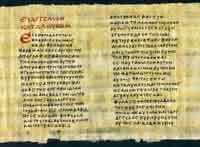
John Rylands Library Papyrus P52, rectoThe Rylands Library Papyrus P52, also known as the St John's fragment, is a papyrus conserved at the John Rylands Library, Manchester, UK. The front (recto) contains lines from the Gospel of John 18:31-33, in Greek, and the back (verso) contains lines from verses 37-38.

Although Rylands P52 is generally accepted as the earliest extant New Testament canonical record, the dating of the papyrus is by no means the subject of consensus among critical scholars. The style of the script is strongly Hadrian, which would suggest a date somewhere between 125 and 160 CE. But the difficulty of fixing the date of a fragment based solely on paleographic evidence allows for a range of dates that extends from before 100 CE to well into the second half of the 2nd century.

The original translation of the work was not done until 1934 by C.H. Roberts, who published the essay “An Unpublished Fragment of the Fourth Gospel in the John Rylands Library” in the Bulletin of the John Rylands Library XX, 1936, pp 45-55. Roberts found comparator hands in papyri then dated between 50 CE and 150 CE, with the closest match of Hadrianic date.

More...

Thursday, November 16, 2006

salvation

Two Trinities, Bartolomé Estéban Murillo (1618 - 1682)Salvation refers to deliverance from an undesirable state or condition. In theology, the study of salvation is called soteriology and is a vitally important concept in several religions. Christianity regards salvation as deliverance from the bondage of sin and from condemnation, resulting in eternal life with God.

Christian views of salvation
Salvation is arguably one of the most important Christian spiritual concepts, perhaps second only to the deity of Jesus Christ, the son of God.

Among many Christians, the primary goal of religion is to attain salvation. Others maintain that the primary goal of Christians is to do the will of God, or that the two are equivalent. In many traditions, attaining salvation is synonymous with going to heaven after death, while most also emphasize that salvation represents a changed life while on Earth as well. Many elements of Christian theology explain why salvation is needed and how to attain it.

More...

Wednesday, November 15, 2006

eschatology

Four Horsemen of the Apocalypse, by Albrecht Dürer.Eschatology (eschatos: "final" or "last" + (logos): "word") is a part of theology and philosophy concerned with the final events in the history of the world, (death and judgment, heaven and hell, the end of the world) or the ultimate destiny of human kind, commonly phrased as the end of the world. In many religions, the end of the world is a future event prophesied in sacred texts or folklore. More broadly, eschatology may encompass related concepts such as the Messiah or Messianic Age, the afterlife, and the soul.

As the time of Jesus' own death neared, this is what He said to His disciples to offer them comfort:

1"Do not let your hearts be troubled. Trust in God; trust also in me. 2In my Father's house are many rooms; if it were not so, I would have told you. I am going there to prepare a place for you. 3And if I go and prepare a place for you, I will come back and take you to be with me that you also may be where I am. 4You know the way to the place where I am going."


5Thomas said to him, "Lord, we don't know where you are going, so how can we know the way?" 6Jesus answered, "I am the way and the truth and the life. No one comes to the Father except through me. -John 14:1-6 (NIV)


In verse 6, Jesus is telling not only His disciples but He is telling the world that, He is the way to heaven; that there is no other way to share eternity with God.

Most Western monotheistic religions have doctrines claiming that "chosen" or "worthy" members of the one true faith will be "spared" or "delivered" from the coming judgment and wrath of God. They will be ushered into paradise either before, during, or after it depending upon the end-time scenario to which they hold.

More...

Tuesday, November 14, 2006

Christian Music

A Dove.  Click to read more...Christian music is music created by or adapted for the Christian church. It also includes Contemporary Christian music, in which the music explores Christian themes but is designed to be played in places other than churches. Music during service for many churches is a big part of the worship. Hymns are sung, psalms are vocalized and spiritual songs are uplifted to praise God. Sometimes, musical instruments are played while singing is implemented in the service. On the other hand, some times churches use just a cappella to worship God. At times, just musical instruments are only used to express praise towards God. All of these ways are used by one church or another in this period of time.

Being Jewish, Jesus and his disciples would most likely have sung the psalms from memory. However, without a centralised music industry, the repertoire of ordinary people was much greater than it is today, so they probably knew other songs too. Early Christians continued to sing the psalms much as they were sung in the synagogues in the first century.

More...

Monday, November 13, 2006

Jesus

the crucifixion of Jesus as portrayed by Diego VelázquezThe name of Jesus, meaning "Savior" in Christian usage, derived from the Aramaic and Hebrew Yeshua and Joshua, meaning Yahweh is salvation. Jesus is the incarnate Son of God, the second person of the Trinity, and the prophesied Hebrew Messiah (Anointed One, deliverer of Israel). Also known as "Jesus Christ", "Jesus of Nazareth", and "Jesus the Nazarene".

Christian views of Jesus (known as Christology) are both diverse and complex. Most Christians are Trinitarian and affirm the Nicene Creed, believing that Jesus is both the Son of God and God made incarnate, sent to provide salvation and reconciliation with God by atoning for the sins of humanity.

Other Christians, however, do not believe that the Nicene Creed correctly interprets Scripture.


More...

Saturday, November 11, 2006

The Temple Mount

Dome of the Rock, The Temple MountThe Temple Mount (Hebrew: הַר הַבַּיִת (without niqqud: הר הבית) or Noble Sanctuary (Arabic: الحرم الشريف) is a hotly contested religious site in the Old City of Jerusalem. It was the site of the first and second Jewish Temple in Jerusalem and according to Judaism is to be the site of the third and final Temple in the time of the Messiah. It is also the site of two major Muslim religious shrines, the Dome of the Rock and Al-Aqsa Mosque, built in the 7th century.

It is the holiest site in Judaism, the third holiest site in Islam, and has special significance to Christianity. It is thus one of the most contested religious sites in the world.

More...

Thursday, November 09, 2006

Reductionism

Pablo Picasso. The Lovers. 1923. Oil on canvas. The National Gallery of Art, Washington, DC, USAReductionism in philosophy describes a number of related, contentious theories that hold, very roughly, that the nature of complex things can always be reduced to (explained by) simpler or more fundamental things. This is said of objects, phenomena, explanations, theories, and meanings.

Roughly, this means that chemistry is based on physics, biology is based on chemistry, psychology and sociology are based on biology. The first two of these reductions are commonly accepted but the last step is controversial and therefore the frontier of reductionism: evolutionary psychology and sociobiology versus those who claim that such special sciences are inherently irreducible. Reductionists believe that the behavioral sciences should become a "genuine" scientific discipline by being based exclusively on genetic biology.

In this painting by the Spanish artist Pablo Picasso (1881-1973), titled "The Lovers," painted in 1923, we see that the two figures are rendered realistically and that they have the appearance of being a loving couple. But the hands and the faces have been innately simplified and are presented as simple lines rather than circumspectly imitated models.


More...

Wednesday, November 08, 2006

Sumer

Sumer, Akkad and Elam Sumer (or Shumer, Egyptian Sangar, biblical Shinar, native ki-en-gir, (from Ki = Earth, En = (title) usually translated as Lord, Gir = (cultured) usually translated as Civilised, thus "the land of the civilised lords") was an ancient civilization located in the southern part of Mesopotamia (modern day southeastern Iraq) from the time of the earliest records in the mid 4th millennium BC until the rise of Babylonia in the late 3rd millennium BC. The term "Sumerian" applies to all speakers of the Sumerian language. Sumer is considered the first settled society in the world to have manifested all the features needed to qualify fully as a "civilization".

Background
The term "Sumerian" is an exonym first applied by the Akkadians. The Sumerians called themselves "the black-headed people" (sag-gi-ga) and their land "land of the civilized lords" (ki-en-gir). The Akkadian word Shumer possibly represents this name in dialect. The Sumerians were a non-Semitic people and were at one time believed to have been invaders, as a number of linguists believed they could detect a substrate language beneath Sumerian. However, the archaeological record shows clear uninterrupted cultural continuity from the time of the Early Ubaid period (5200-4500 BC C-14, 6090-5429 calBC) settlements in southern Mesopotamia. The Sumerian people who settled here farmed the lands in this region that were made fertile by silt deposited by the Tigris and the Euphrates rivers.

More...

Ur

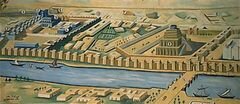
Ur seen across the Royal tombs, with the Great Ziggurat in the background, January 17, 2004Ur was an ancient city in southern Mesopotamia, located near the original mouth of the Euphrates and Tigris rivers on the Persian Gulf and close to Eridu. Because of marine regression, the remains are now well inland in present-day Iraq, south of the Euphrates on its right bank , and named Tell el-Mukayyar, near the city of Nasiriyah south of Baghdad.

6Abram believed the LORD, and he credited it to him as righteousness. 7He also said to him, "I am the LORD, who brought you out of Ur of the Chaldeans to give you this land to take possession of it." 8But Abram said, "O Sovereign LORD, how can I know that I will gain possession of it?"
-Genesis 15:6-8

The site is marked by the ruins of a ziggurat (right), still largely intact, and by a settlement mound. The ziggurat is a temple of Nanna, the moon deity in Sumerian mythology. It has has two stages constructed from brick: in the lower stage the bricks are joined together with bitumen, in the upper stage they are joined with mortar. Ur at its height had around 30,000 residents.

More...

Tuesday, November 07, 2006

The AIDS Crisis

Scanning electron micrograph of HIV-1 budding from cultured lymphocyte.Acquired Immune Deficiency Syndrome (AIDS or Aids) is a collection of symptoms and infections in humans resulting from the specific damage to the immune system caused by the human immunodeficiency virus (HIV). The late stage of the condition leaves individuals prone to opportunistic infections and tumors. Although treatments for AIDS and HIV exist to slow the virus's progression, there is no known cure. HIV is transmitted through direct contact of a mucous membrane or the bloodstream with a bodily fluid containing HIV, such as blood, semen, vaginal fluid, preseminal fluid, and breast milk.

This transmission can come in the form of anal, vaginal or oral sex, blood transfusion, contaminated hypodermic needles, exchange between mother and baby during pregnancy, childbirth, or breastfeeding, or other exposure to one of the above bodily fluids. Most researchers believe that HIV originated in sub-Saharan Africa during the twentieth century; it is now a pandemic, with an estimated 38.6 million people now living with the disease worldwide.

More...

Monday, November 06, 2006

Etruscan civilization

Map showing the extent of the Etruscan civilization and the twelve Etruscan League cities.The Etruscan civilization is the name given today to the culture and way of life of a people of ancient Italy whom ancient Romans called Etrusci or Tusci, ancient Greeks called Tyrrhenoi or Tyrrsenoi and who called themselves Rasenna, syncopated to Rasna. As distinguished by its own language, the civilization endured from an unknown prehistoric time prior to the foundation of Rome until its complete assimilation to Italic Rome in the Roman Republic; numerous vestiges of Etruscan culture do survive the Roman conquest. At its maximum extent during the foundation period of Rome and the Roman kingdom, it flourished in three confederacies: of Etruria, of the Po valley and Latium and of Campania. Rome was sited in Etruscan territory. There is considerable evidence that early Rome was dominated by Etruscans until the Romans sacked Veii in 396 BC.

Culture that is identifiably and certainly Etruscan developed in Italy after about 800 BC approximately over the range of the preceding Iron Age Villanovan culture.

More...

Friday, November 03, 2006

Ezra

‘Ezra in Prayer’, by Gustave Doré. And Ezra prayed, ‘O my God, I am too ashamed and disgraced to lift up my face to you, my God, because our sins are higher than our heads and our guilt has reached to the heavens.’ -Ezra 9:6Ezra is a name derived from Hebrew, written as עֶזְרָא Standard Hebrew Arabic: عزير.

Summary
The historical Ezra was a priestly scribe who is thought to have led about 5,000 Israelite exiles living in Babylon to their home city of Jerusalem in 459 BCE. Many scholars credit him as the author of the Book of Ezra and the Book of 1 Chronicles in the Bible.

Sources
Unless otherwise specified, all historical information about Ezra in this article is derived from the last four chapters of the Book of Ezra, and Chapter 8 of the Book of Nehemiah. More general historical information about the people and places Ezra would have interacted with is available at Israelites.

Ezra's accomplishments
Ezra was either the son or grandson of the Biblical character Seraiah (2 Kings 25:18-21), and a lineal descendant of Phinehas, the son of Aaron (Ezra 7:1-5). In the seventh year of the reign of Artaxerxes Longimanus (see also Darius I of Persia), Ezra obtained leave to go to Jerusalem and to take with him a company of Israelites (Ezra 8). Artaxerxes showed great interest in Ezra's undertaking, granting him "all his requests," and giving him gifts for the house of God. Ezra assembled a band of approximately 5,000 exiles to go to Jerusalem. They rested on the banks of the Ahava for three days and organized their four-month march across the desert.

More...

Macedonia

Macedonia province within the Roman Empire, c. 120.The Roman province of Macedonia was officially established in 146 BC, after the Roman general Quintus Caecilius Metellus defeated Andriscus of Macedon in 148 BC, and after the four client republics established by Rome in the region were dissolved. The province incorporated Epirus Vetus, Thessaly, and parts of Illyria and Thrace.

In the 3rd or 4th century, the province of Macedonia was divided into Macedonia Prima (in the south) and Macedonia Salutaris (in the north).

Macedonia Prima and Macedonia Salutaris were included in the Diocese of Macedonia, one of three dioceses which were included in the Prefecture of Illyricum, organized in 318. When the Prefecture of Illyricum was divided into a Western and Eastern Illyricum in 379, the Macedonian provinces were included in Eastern Illyricum. After the split of the Roman Empire into a Western and Eastern Empire in 395, Macedonia passed into the Byzantine Empire.

In his writings, Paul of Tarsus mentions Macedonia numerous times...
More...

Wednesday, November 01, 2006

Son of Man

Jesus Christ (the son of man) being nailed to the cross In the bible, Jesus often refers to Himself as the Son of Man.

32They were on their way up to Jerusalem, with Jesus leading the way, and the disciples were astonished, while those who followed were afraid. Again he took the Twelve aside and told them what was going to happen to him. 33"We are going up to Jerusalem," he said, "and the Son of Man will be betrayed to the chief priests and teachers of the law. They will condemn him to death and will hand him over to the Gentiles, 34who will mock him and spit on him, flog him and kill him. Three days later he will rise." -Mark 10:32-34 (NIV)

Christian interpretation
The phrase son of man took on Messianic significance within the Christian movement primarily due to the Jewish eschatology during the time of its early conception. Originating in the book of Daniel, in a vision, one like a son of man is described coming upon the clouds of the sky to unite the world. As a result, some Christians believe that in the body of the New Testament, son of man is used forty-three times as a distinctive title of Jesus within this Messianic context. Other Christians interpret it as Jesus showing humility, avoiding using titles like Messiah and Son of God. Still other Christians believe the title is meant to signify Jesus upholding his identification with his humanity and fellowship with mankind, perhaps also conveying the idea that Jesus is the man par excellence. In this last context it serves as putting humans and Jesus on the same level.

More...

Achaemenid Empire

Maximal extension of the Achaemenid EmpireThe Achaemenid Empire was a dynasty in the ancient Persian Empire with high cultural and economical achievements during its highest power. At the height of their power, around 500 BC, the Achaemenid rulers of Persia ruled over territories roughly encompassing today's Iran, Iraq, Armenia, Afghanistan, Turkey, Bulgaria, eastern parts of Greece, Egypt, Syria, much of what is now Pakistan, Jordan, Israel, Palestine, Lebanon, Caucasia, Central Asia, Libya, and northern parts of Arabia. The empire ruled by Persia eventually became the largest empire of the ancient world.

Darius I was the first to speak of Achaemenes, who he claimed was an ancestor of Cyrus the Great, (ca. 576 - 529 BC) and therefore the progenitor of the entire line of Achaemenid rulers.

More...

Monday, October 30, 2006

Cyrus the Great

An old Iranian portrait of Cyrus the Great.Cyrus the Great (Old Persian: Kuruš, modern Persian: کوروش, Kourosh; ca. 576 or 590 BC — July 529 BC), also known as Cyrus II of Persia and Cyrus the Elder, was the founder of the Persian Empire under the Achaemenid dynasty and the creator of the Cyrus Cylinder, considered to be the first declaration of human rights. As the ruler of the Persian people in Anshan, he conquered the Medes and unified the two separate Iranian kingdoms.

In historical artifacts discovered in the ancient ruins of Babylon and Ur, Cyrus identifies himself as King of Iran, where he reigned from 559 BC until his death. He is the first ruler whose name was suffixed with the words the Great (Vazraka in Old Persian, Bozorg in modern Persian), a title adopted by many others after him, including the eventual Acheamenid Shah, Darius the Great, and Alexander the Great, who overthrew the Achaemenid dynasty two centuries after the death of Cyrus.

More...

Patriarchs

The Patriarch AbrahamThe Patriarchs, known as the Avot in Hebrew, are Abraham, his son Isaac and his grandson Jacob. Collectively, they are referred to as the three patriarchs (sh'loshet ha-avot) of Judaism, and the period in which they lived is known as the patriarchal period.

Their primary wives – Sarah (wife of Abraham), Rebecca (wife of Isaac), and Leah and Rachel (the wives of Jacob - see also sons of Jacob) – are known as the Matriarchs. Thus, classical Judaism considers itself to have three patriarchs and four matriarchs.

The word has mainly taken on specific ecclesiastical meanings. In particular, the highest-ranking bishops in Eastern Orthodoxy, Oriental Orthodoxy, the Roman Catholic Church (above Major Archbishop and primate), and the Assyrian Church of the East are called patriarchs.

More...

Saturday, October 28, 2006

Palestine

The region in the 9th century BCE. Notice the coastal land of Philistia, from which the name ‘Palestine’ derivesPalestine is one of several names for the geographic region between the Mediterranean Sea and the banks of the Jordan River with various adjoining lands. Many different definitions of the region have been used in the past three millennia.

Boundaries and name
The region in the 9th century BCE. Notice the coastal land of Philistia, from which the name "Palestine" derives. Ancient Egyptian texts call the entire levantine coastal area R-t-n-u (conventionally Retenu), which stretched along the Mediterranean coast in between modern Egypt and Turkey.

It subdivided into three regions. Retenu's southern region (called Djahy) approximates modern Israel with the Palestinian Territories, the central region Lebanon, and the northern region (called Amurru) the Syrian coast as far north as the Orontes River near Turkey.

More...

Thursday, October 26, 2006

Aaron

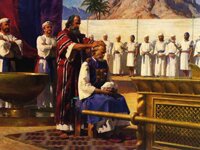
Moses Conferring Priesthood of Aaron upon his older brother, AaronAaron (אַהֲרֹן, a word meaning "bearer of martyrs" in Hebrew (perhaps also, or instead, related to the Egyptian "Aha Rw," "Warrior Lion"), was one of two brothers who play a unique part in the history of the Hebrew people. He was the elder son (and second child) of Amram and Jochebed of the tribe of Levi; Moses, the other son, being three years younger, and Miriam, their sister, several years older. Aaron was the great-grandson of Levi and represented the priestly functions of his tribe, becoming the first High Priest. While Moses was receiving his education at the Egyptian court and during his exile among the Midianites, Aaron and his sister remained with their kinsmen in the eastern border-land of Egypt. Here he gained a name for eloquent and persuasive speech; so that when the time came for the demand upon Pharaoh to release Israel from captivity, Aaron became his brother’s nabi , or spokesman, to his own people and, after their unwillingness to hear, to Pharaoh himself.

More...

Heaven

Paradiso 14, from Gustave Doré‘s illustrations to The Divine ComedyHeaven is an afterlife concept found in many religions or spiritual philosophies.

Those who believe in heaven, especially those of the Judeo-Christian faith, generally hold that it (or Hell) is one of the two possible afterlife destinations of many or all humans. In unusual instances, humans have had, according to many testimonies and traditions, personal knowledge of Heaven. They presume this is for the purpose of teaching the rest of humanity about life, Heaven, and God.

Conceptions
While there are abundant and varied sources for conceptions of Heaven, the typical believer's view appears to depend largely on his particular religious tradition. Various religions have described Heaven as being populated by angels, demons, gods and goddesses, and/or heroes (especially in Greek mythology). Heaven is generally thought of as a place of eternal happiness.


More...

Tuesday, October 24, 2006

The Letters of Paul

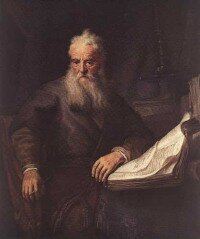
Portrait of St. Paul by RembrandtThe Letters of Paul are as follows:
  • Romans
  • 1 Corinthians
  • 2 Corinthians
  • Galatians
  • Ephesians
  • Philippians
  • Colossians
  • 1 Thessalonians
  • 2 Thessalonians
  • 1 Timothy
  • 2 Timothy
  • Titus
  • Philemon

More...

Bono

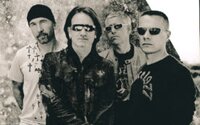
Bono talking to then Canadian Finance Minister Paul Martin in Prague, 2000.Paul David Hewson (born 10 May 1960), nicknamed Bono Vox (stage name) and Bono (pronounced Bonn-oh), is the lead singer and occasional rhythm guitarist of the Irish rock band U2. Bono lives south of Dublin with his family and shares a villa in Èze in the Alpes-Maritimes in the South of France with The Edge, as well as an apartment at The Dakota in Manhattan.

Bono doesn't attend church on a regular basis. However, he does pray regularly, usually before meals and he tries to have a "Sabbath hour" as often as he can. He likes Eugene Peterson's bible paraphrase, The Message. Sometimes he hangs out with Bruce Springsteen and the Rolling Stones, and sometimes he hangs out with Michael W. Smith and Amy Grant.

In a beliefnet.com interview, Bono said, "I often wonder if religion is the enemy of God. It's almost like religion is what happens when the Spirit has left the building."

More...

Monday, October 23, 2006

justification

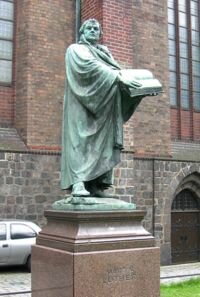
Statue of Martin Luther outside the Marienkirche in central BerlinIn Christian theology, justification is God's act making a sinner righteous before Him by His grace, received through the faith given to the person by God, for Christ's sake, because of his life, death, and resurrection. Because the meaning of the term is subject to dispute among Christians, simple definitions should be taken with a grain of salt.
Night and day I pondered until I saw the connection between the justice of God and the statement that 'the just shall live by his faith.' Then I grasped that the justice of God is that righteousness by which through grace and sheer mercy God justifies us through faith. Thereupon I felt myself to be reborn and to have gone through open doors into paradise. -Martin Luther

Considerable sectarian controversy exists as to its nature and definition.

More...

Techledo Consulting

Techledo Consulting, LLC

Prevail Magazine

My Photo
Timothy Ministries
View my complete profile