Thursday, December 04, 2008

Names and titles of Jesus in the New Testament

Christ the Redeemer, Artist: ANDREA DEL SARTO. Wood, 47 x 27 cm, SS. Annunziata, FlorenceA large variety of names and titles are used in the New Testament to describe Jesus.

Authors have put forward numerous explanations to explain the origin of the name 'Jesus', and have offered a still larger number of explanations for the meaning of the name. The name is related to the Hebrew יְהוֹשֻׁעַ Joshua, which is a theophoric name first mentioned within the Biblical tradition in Exodus 17:9 as one of Moses' companions (and, according to tradition, later successor). Breaking the name down, we see that there are two parts: יהו Yeho, a theophoric reference to YHWH, the distinctive personal name of the God of Israel, plus the three letter root שוע, relating to the noun shua. Due to disputes over how to render שוע lexically, there are a number of generally accepted phrases this combination can translate to:

* Yeho-shua
* Yhwh saves
* Yhwh (is) salvation
* "Yhwh" (is) a saving-cry
* "Yhwh" (is) a cry-for-saving
* "Yhwh" (is) a cry-for-help
* Yhwh (is) my help

More...

Tuesday, December 02, 2008

John the Baptist

St. John the Baptist, artist: Carvaggio, c. 1604, Oil on canvas, 172,5 x 104,5 cm, Nelson-Atkins Museum of Art, Kansas CityJohn the Baptist (also called John the Baptizer or Yahya the Baptizer) is regarded as a prophet by at least three religions: Christianity, Islam, and Mandaeanism. According to the Gospel of Luke (Luke 1:35-36), he was a relative of Jesus. That he was a prophet is asserted by the Synoptic Gospels and the Qur'an (see also Islam). He is also commonly referred to as John the Forerunner/Precursor because he was the forerunner of Christ (Tiphshut). In Mandaic he is called Yihja jahane. Isaiah 40:3-5 is commonly read as a prophecy of John. Muslim tradition maintains that the head of John the Baptist is interred in the Umayyad Mosque. In later times it was rumored that the Knights Templar also had possesion of the head of St. John. According to Luke 3:1, John began his ministry in the 15th year of the reign of Tiberius Caesar, which would have been the year 28 or 29.

As an adult John started to preach in public, and people from "every quarter" were attracted to his message. The essence of his preaching was the necessity of repentance and turning away from selfish pursuits. He denounced the Sadducees and Pharisees as a "generation of vipers," and warned them not to assume their heritage gave them special privilege (Luke 3:8). He warned tax collectors and soldiers against extortion and plunder. His doctrine and manner of life stirred interest, bringing people from all parts to see him on the banks of the Jordan River. There he baptized thousands unto repentance.

All four canonical gospels relate to John's ministry, his preaching and baptism in the Jordan River. Most notably he is the one who recognized Jesus as the Messiah, and on Jesus' request, baptised him. The baptism marked the beginning of Jesus' ministry. The Gospels of Matthew, Mark, and Luke relate that Jesus came from Galilee to John and was baptized by him, whereupon the Spirit descended upon him and a voice from Heaven told him he was God's Son.

More...

Monday, December 01, 2008

Advent

Many churches make use of Advent wreaths during this season, with one candle representing each of the four Sundays of Advent. The rose candle is lit on the 3rd Sunday of Advent. During Christmas Day, four lit white candles are used.Advent (from the Latin word adventus, meaning "coming") is a season of the Christian church, the period of expectant waiting and preparation for the celebration of the Nativity of Jesus, in other words, the period immediately before Christmas. It is the beginning of the Western Christian year and commences on Advent Sunday. The Eastern churches begin the liturgical year on 1 September. The Eastern Christian equivalent of Advent is called the Nativity Fast but it differs both in length and observances.

The progression of the season may be marked with an Advent calendar, a practice introduced by German Lutherans. At least in the Roman Catholic calendar, Advent starts on the fourth Sunday before December 25; in other words, the Sunday between November 27 and December 3 inclusive.

Latin adventus is the translation of the Greek word parousia, commonly used in reference to the Second Coming of Christ. Christians believe that the season of Advent serves a dual reminder of the original waiting that was done by the Hebrews for the birth of their Messiah as well as the waiting that Christians today endure as they await the second coming of Christ.

More...

Sunday, November 30, 2008

Isaiah

The Prophet Isaiah, Artist - Giovanni Battista Tiepolo, 1726-29. Fresco, 200 x 250 cm, in the Patriarchal Palace in Udine, c.1726Isaiah (יְשַׁעְיָהוּ Heb.: Jessaiahu "Salvation of/is the Lord" or "Yahweh Saves") was the son of Amoz, and commonly considered the author of the Book of Isaiah.

The Book of Isaiah is a book of the Hebrew Bible as well as the Christian Old Testament, containing prophecies attributed to Isaiah. This book is often seen by scholars as being divided into at least two sections. The first section, consisting of chapters 1-39, is generally accepted as being written by the prophet Isaiah of Jerusalem, or by his followers who took down his words.

Isaiah prophesied during the reigns of four kings -- Uzziah (Azariah), Jotham, Ahaz, and Hezekiah. Legend has it that he was martyred during the reign of Manasseh, who came to the throne in 687 BCE. That he is described as having ready access to the kings would suggest an aristocratic origin.

More...

Saturday, November 29, 2008

parables of Jesus

The Prodigal Son, Rembrandt Harmensz. van RijnThe parables of Jesus, found in the Synoptic Gospels, embody much of Jesus' teaching. Jesus' parables are quite simple, memorable stories, often with humble imagery, each with a single message. Jesus, for example, likened the Kingdom of God to leaven (an image usually meant as corruption) or a mustard seed. Like his aphorisms, Jesus' parables were often surprising and paradoxical. The parable of the good Samaritan, for example, turned expectations on their head with the despised Samaritan proving to be the wounded man's neighbor. The parables were simple and memorable enough to survive in an oral tradition before being written down years after Jesus' death.

His parables are sometimes interpreted as allegories in the gospels themselves and in Christian tradition. In such an allegory, each element corresponds metaphorically to a class of people (e.g., false Christians), a heavenly reward, or some other topic. The gospel of John includes allegories but no parables.

Parables are attributed to Jesus in the three synoptic gospels of the New Testament and the noncanonical Gospel of Thomas. According to some interpretations, the Gospel of John also contains a parable.

More...

Friday, November 28, 2008

Cyrus the Great

This clay cylinder is inscribed in Babylonian cuneiform with an account by Cyrus, king of Persia,  559-530 BC of his conquest of Babylon in 539 BC and capture of Nabonidus, the last Babylonian king.Cyrus the Great, ca. 576 or 590 BC — July 529 BC, also known as Cyrus II of Persia and Cyrus the Elder, was the founder of the Persian Empire under the Achaemenid dynasty and the creator of the Cyrus Cylinder, considered to be the first declaration of human rights. As the ruler of the Persian people in Anshan, he conquered the Medes and unified the two separate Iranian kingdoms.

In historical artifacts discovered in the ancient ruins of Babylon and Ur, Cyrus identifies himself as King of Iran, where he reigned from 559 BC until his death. He is the first ruler whose name was suffixed with the words the Great (Vazraka in Old Persian, Bozorg in modern Persian), a title adopted by many others after him, including the eventual Acheamenid Shah, Darius the Great, and Alexander the Great, who overthrew the Achaemenid dynasty two centuries after the death of Cyrus.

More...

Thursday, November 27, 2008

Lamb of God

Madonna and Child with the Lamb of God, Artist: CESARE da Sesto, c. 1515, Oil on panel, 37 x 30 cm, Museo Poldi Pezzoli, MilanLamb of God (Latin: Agnus Dei) is one of the titles given to Jesus in the New Testament and consequently in the Christian tradition. It is believed to refer to Jesus' role as a sacrificial lamb atoning for the sins of man in Christian theology, harkening back to ancient Korban Jewish Temple sacrifices in which a lamb was slain during the passover, the blood was sprinkled along the door, and the lamb was eaten. (see also Korban Pesach).

The Biblical significance of the title is rendered in the context of earlier lamb symbolism.

The blood of the paschal lamb of the Old Testament protects and saves the Israelites in Exodus 12. This link is made explicit in 1 Corinthians 5:7. For Paul, Christians are saved by Christ as their true paschal lamb.

The Hebrew Bible also testifies to the earlier practice of sin offerings as a possible means of atonement. Lambs could be used in these offerings (e.g. Leviticus 4:32-34 and 5:6), and this link is strongly suggested by John 1:29 and 1 Peter 1:19. Like the sin of a person could be forgiven through the offering and the pouring out of the blood of an "unblemished" lamb (cf. Lev 4:32), so Christians would be freed from sin by the blood of Jesus as the unblemished Lamb of God. See Sin for further discussion about the concept of sin and the means of atonement in Judaism.

More...

Tuesday, November 25, 2008

Paul Tillich

Paul TillichPaul Johannes Tillich (August 20, 1886 – October 22, 1965) was a German-American theologian and Christian existentialist philosopher. Tillich was one of the most influential Protestant theologians of the twentieth century.

Paul Tillich was born on August 20, 1886, in the province of Brandenburg in eastern Germany in the small village of Starzeddel. Tillich's Prussian father was a Lutheran pastor and his mother was from the Rhineland and more liberal, influenced heavily by Calvinist thinking. At an early age Tillich held an appreciation for nature and the countryside into which he had been born.

Tillich's approach to Protestant theology was highly systematic. He sought to correlate culture and faith such that "faith need not be unacceptable to contemporary culture and contemporary culture need not be unacceptable to faith". Consequently, Tillich's orientation is apologetic, seeking to make concrete theological answers that are applicable to ordinary daily life. This contributed to his popularity because it made him easily accessible to lay readers. In a broader perspective, revelation is understood as the fountainhead of religion. Tillich sought to reconcile revelation and reason by arguing that revelation never runs counter to reason (affirming Thomas Aquinas who said that faith is eminently rational), but both poles of the subjective human experience are complementary.

More...

kenosis

The Flagellation of Christ, Artist: Nicola Grassi, c. 1720, Oil on canvas, 105 x 159 cm, Museum of Fine Arts, Budapest Kenosis is a Greek word for emptiness, which is used as a theological term. The ancient Greek word κένωσις kénōsis means an "emptying", from κενός kenós "empty". The word is mainly used, however, in a Christian theological context, for example Philippians 2:7, using the verb form κενόω kenóō.
5 Have this mind among yourselves, which is yours in Christ Jesus, 6 who, though he was in the form of God, did not count equality with God a thing to be grasped, 7 but made himself nothing, taking the form of a servant, being born in the likeness of men. 8 And being found in human form, he humbled himself by becoming obedient to the point of death, even death on a cross.
In Christian theology, Kenosis is the concept of the 'self-emptying' of one's own will and becoming entirely receptive to God and His perfect will. It is used both as an explanation of the Incarnation, and an indication of the nature of God's activity and condescension. Mystical theologian John of the Cross' work "Dark Night of the Soul" is a particularly lucid explanation of God's process of transforming the believer into the icon or "likeness of Christ".

More...

Sunday, November 23, 2008

virtue

Virtue (Latin virtus; Greek ἀρετή) is moral excellence. Personal virtues are characteristics valued as promoting individual and collective well-being, and thus good by definition. The opposite of virtue is vice.

Etymologically the word virtue (Latin virtus) first signified manliness or courage. In its widest sense, virtue refers to excellence, just as vice, its contrary, denotes its absence. The term as used by moral philosophers and theologians signifies an operative habit essentially good, in contrast to an operative habit essentially evil. What are traditionally known as the four cardinal virtues, enumerated by the classical Greek philosophers have been translated into English as Justice, Courage, Wisdom, and Moderation. The three virtues of faith, hope and love (or charity) are central aspects of the of the Judaic, Christian and Muslim traditions.

Virtue may also be identified from another perspective: it can have either normative or moral value; i.e. the virtue of a judge is to justly convict criminals; the virtue of an excellent judge is to specialise in justly convicting criminals, this being its normative value, whereas the virtues of reason, prudence, chastity, etc. have moral value.

In classical Greek, virtue is more properly called ἠθικὴ ἀρετή (ēthikē aretē), or "habitual excellence", something practiced at all times. The virtue of perseverance is itself a necessary adjunct to each and every individual virtue, since, overall, virtue is a species of habit which, in order to maintain oneself in virtue, needs to be continuously sustained. Self-proclaimed immoralist Friedrich Wilhelm Nietzsche, however, expressed the view that "when virtue has slept, it will arise all the more vigorous."

More...

Friday, November 21, 2008

Tree of Jesse

Detail from Jesse - David - Solomon, MICHELANGELO Buonarroti, 1511, Fresco, Cappella Sistina, VaticanThe Tree of Jesse refers to a passage in the Biblical Book of Isaiah which describes metaphorically the descent of the Messiah and is accepted by Christians as pertaining to Jesus, and is often represented in art, particularly in that of the Medieval period, the earliest dating from the 11th century.
“1 There shall come forth a shoot from the stump of Jesse, and a branch from his roots shall bear fruit.

2 And the Spirit of the LORD shall rest upon him, the Spirit of wisdom and understanding, the Spirit of counsel and might, the Spirit of knowledge and the fear of the LORD.

3 And his delight shall be in the fear of the LORD. He shall not judge by what his eyes see, or decide disputes by what his ears hear,” (Isaiah 11:1-3 ESV)
In the New Testament the lineage of Jesus is traced by two of the Gospel writers, Matthew and Luke. Luke describes the "generations of Christ" in Luke 3:23-38, beginning with:
23 When Jesus began to preach, he was about thirty years old. Everyone thought he was the son of Joseph. But his family went back through Heli...


More...

Thursday, November 20, 2008

“LOVE” (I See Love - Third Day, Steven Curtis Chapman, Mercy Me)


I See Love - Third Day, Steven Curtis Chapman & Mercy Me
Love (Greek: agape) is a primary characteristic of God's nature (1 John 4:8, 16) and the highest expression of Christian faith and action (1 Cor. 13:13; Gal. 5:14; Eph. 5:2; 1 John 4:7-21). In the New Testament, agape is charitable, selfless, altruistic, and unconditional.

Love -1 Corinthians 13:1-8

It is parental love seen as creating goodness in the world, it is the way God is seen to love humanity, and it is seen as the kind of love that Christians aspire to have for others. (Greek: Philia) - also used in the new testament, Philia is a human response to something that is found to be delightful. Also known as "brotherly love".

Two other words for love in the Greek language -- (Greek: eros) (sexual love) and storge (needy child-to parent love) were never used in the New Testament.

More...

Wednesday, November 19, 2008

Lineage of Jesus

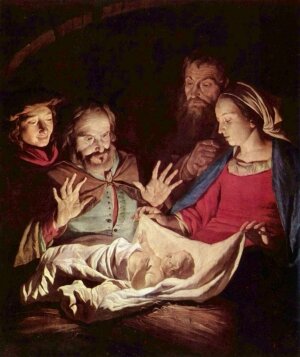
The infant Jesus in Adoration of the Shepherds, Gerard van HonthorstThe lineage of Jesus is recorded in two places in the bible:

1) Matthew 1:1-17, and

2) Luke 3:23-38 (in addition to several other new testament references: Mark 10:47, luke 1:32, Acts 2:29-30, Rev. 5:5, 22:16).

The Matthew 1:1-17 and Luke 3:23-38 accounts differ because, Luke follows Mary's lineage (Jesus' blood mother), through David's son Nathan (Luke's genealogy focused on Jesus' descent from God through the virgin birth. It placed no emphasis on Jesus being the descendant of king David) and the Matthew genealogy follows Joseph's line (Joseph being the legal father of Jesus, see below) through David's son Solomon.

God's promise to David was fulfilled because Mary was the biological parent of Jesus.

The spitirtual significance of the comment in Luke 3:23 "as was supposed" (in some translations "so it was thought") (of Joseph's fatherhood) is in the fact that God is letting us know that Jewish society did NOT understand the real paternity of Jesus... that of the Holy Spirit... thus was incapable of understanding His ministry...as was certainly exhibited by the actions and attitudes of the scribes, Pharisees, lawyers, etc. to whom parentage and ancestry had become a cumbersome and burdensome legalism that blighted New Testament Judaism. They completely missed the Messianic note in the lists of both Matthew and Luke... except for a very small minority like Nicodemus and Joseph of Arimathea, eventually...or Simeon or Anna of Luke 2.

More...

Pseudepigrapha

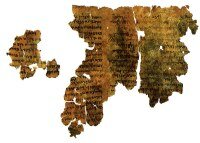
The Enoch Scroll, Hanokh, 4Q201, Parchment, Copied ca. 200-150 B.C.E., Courtesy of the Israel Antiquities AuthorityPseudepigrapha (from Ancient Greek pseudes = "false", epigraphe = "inscription"; see the related epigraphy) are falsely attributed works, texts whose claimed authorship is unfounded; a work, simply, "whose real author attributed it to a figure of the past." For instance, few Hebrew scholars would ascribe the Book of Enoch to the prophet Enoch, and few liberal Christian scholars would insist today that the Third Epistle of John was written by John the Evangelist, or that the Second Epistle of Peter was written by Saint Peter. Nevertheless, in some cases, especially for books belonging to a religious canon, the question of whether a text is pseudepigraphical or not elicits sensations of loyalty and can become a matter of heavy dispute. The authenticity or value of the work itself, which is a separate question for experienced readers, often becomes sentimentally entangled in the association. Though the inherent value of the text may not be called into question, the weight of a revered or even apostolic author lends authority to a text: in Antiquity pseudepigraphy was "an accepted and honored custom practiced by students/admirers of a revered figure". This is the essential motivation for pseudepigraphy in the first place.

More...

Sunday, November 16, 2008

Son of God

"Son of God" is a biblical phrase from the Hebrew bible, and the New Testament of the Christian bible. According to the bible, it refers to Jesus.

Throughout the New Testament the phrase "son of God" is applied repeatedly, in the singular, only to Jesus. "Sons of God" is applied to others only in the plural. The King James version of the New Testament calls Jesus God's "only begotten son"

(John 1:14, 3:16-18, 1 John 4:9 KJV)

"begotten"
Greek: μονογενής
single of its kind, only

"his own son" (Romans 8:3)

"own"
Greek: ἑαυτοῦ
himself, herself, itself, themselves

It also refers to Jesus simply as "the son" in contexts in which "the Father" is used to refer to God.

More...

Friday, November 14, 2008

omniscience

This is the day that the Lord has made.Omniscience is the capacity to know everything infinitely, or at least everything that can be known about a character including thoughts, feelings, life and the universe, etc. In monotheism, this ability is typically attributed to God. There is a distinction between:
  • inherent omniscience: the ability to know anything that one chooses to know and can be known and,
  • total omniscience: actually knowing everything that can be known.
Many modern theologians argue that God's omniscience is inherent rather than total, and that God chooses to limit his omniscience in order to preserve the freewill and dignity of his creatures.

Nontheism often claims that the very concept of omniscience is inherently contradictory.

Some theists argue that God created all knowledge and has ready access thereto. Some believe this statement invokes a circular time contradiction: presupposing the existence of God, before knowledge existed, there was no knowledge at all, which means that God was unable to possess knowledge prior to its creation. There are several flaws in this reasoning.

God "created" knowledge while eternally possessing it in full. Is this really any more paradoxical than God having no beginning and no end?

More...

Thursday, November 13, 2008

Ramesses II

The unwrapped mummy of Ramses II, photographed in 1889 by the German Egyptologist Emil BrugschRamesses II (also known as Ramesses the Great and alternatively transcribed as Ramses and Rameses) was the third Egyptian pharaoh of the Nineteenth dynasty. He is often regarded as Egypt's greatest, most celebrated, and most powerful pharaoh. His successors and later Egyptians called him the "Great Ancestor." He is traditionally believed to have been the Pharaoh of the Exodus.

At age fourteen, Ramses II was appointed Prince Regent by his father. He is believed to have taken the throne in his early 20s and to have ruled Egypt from 1279 BC to 1213 BC for a total of 66 years and 2 months. He was once said to have lived to be 99 years old, but it is more likely that he died in his 90th or 92nd year. Ancient Greek writers such as Herodotus attributed his accomplishments to the semi-mythical Sesostris, and he is traditionally believed to have been the Pharaoh of the Exodus due to a tradition started by Eusebius of Caesarea. If he became king in 1279 BC as most Egyptologists today believe, he would have taken the throne on May 31, 1279 BC.

More...

Wednesday, November 12, 2008

mission

Since the Lausanne Congress of 1974, a widely-accepted definition of a Christian mission has been "to form a viable indigenous church-planting movement." This definition is motivated by theological analyses of the acts required to enhance God's reputation (usually translated as "glory" or "honor"). The definition is claimed to summarize the acts of Jesus' ministry, which is taken as a model for all ministries. The motivation is said to be God's will, plainly stated throughout the Bible, including the Old Testament.

The movement must "plant" (start) churches because the process of forming Godly disciples is necessarily social. "Church" should be understood in the widest sense, as an organization of believers. It is not a building. Many churches start by meeting in houses. Discipling is required to grow the number of believers to the largest extent, and maximize their quality and therefore the acceptability of their worship to God and non-Christians.

More...

Monday, November 10, 2008

John Napier

John NapierJohn Napier of Merchistoun (1550 – 4 April 1617), nicknamed Marvellous Merchistoun, was a Scottish mathematician, physicist, astronomer/astrologer and 8th Laird of Merchistoun. He is most remembered as the inventor of logarithms and Napier's bones, and for popularizing the use of the decimal point. Napier's birth place, Merchiston Tower, Edinburgh, Scotland, is now part of Napier University. He is buried in St Cuthbert's Church, Edinburgh.

Napier is relatively little-known outside mathematical and engineering circles, where he made what is undoubtedly a key advance in the use of mathematics.

Logarithms made calculations by hand much easier and quicker, and thereby opened the way to many later scientific advances. His work, Mirifici Logarithmorum Canonis Descriptio, contained thirty-seven pages of explanatory matter and ninety pages of tables, which facilitated the furtherment of astronomy, dynamics, physics, and astrology. He also invented Napier's bones, a multiplication aid.

As a devout Christian, Napier was also fervent biblical scholar. His commentary on the Book of Revelation is titled, A Plaine Discourse on the Whole Revelation of St. John., and was published in 1593.

More...

Sunday, November 09, 2008

Simon the Zealot

Simon the Zealot was a brother of James the Great and St Jude Thaddeus. He is portrayed with a large, serrated saw. It was with this that he was eventually martyred for his faith. St Simon was cut in half by heathens in a most gruesome way. Image courtesy of www.art.nlThe apostle Simon, called Simon the Zealot in Luke 6:15 and Acts 1:13; and Simon Kananaios ("Simon" signifying שמעון "hearkening; listening", Standard Hebrew Šimʿon, Tiberian Hebrew Šimʿôn), was one of the most obscure among the apostles of Jesus; little is recorded of him aside from his name. Few pseudepigraphical (see pseudepigrapha) writings were connected to him (but see below), and Jerome does not include him in De viris illustribus.

The name of Simon occurs in all the passages of the synoptic gospels and Acts that give a list of apostles, without further details.

Simon the Zealot was listed as one the the twelve disciples of Christ (Matthew 10:4; Acts 1:13) sometimes referred to as "Simon the Cananean" (Mark 3:18; Luke 6:15) and some identify with Simeon of Jerusalem, which others dispute on the grounds that Simeon was described at the time of Jesus' birth some thirty years before, as an old man not far from death. . Simon, the name, stems from the Hebrew "Shimon" which means "hearing." The word "Cananean" stems from old Aramaic, meaning "zealous one."

He was chosen as one the Christ's twelve disciples (Matthew 10:2-4; Acts 1:13), sent on a mission to the the lost sheep of the house of Israel to preach "the kingdom of heaven is at hand," to heal the sick, cleanse the lepers, raise the dead, and cast out demons. He was told, "You received without paying; give without pay." (Matthew 10:5-8), present with the other disciples at the Last Supper (Matthew 26:20), and was with the other disciples for the Great Commission and Christ's Ascension (Matthew 28:16-20).

More...

Friday, November 07, 2008

Korban Pesach

The lamb is one of the animals that was used as a sacrificial animal prior to 70 CE. Korban Pesach (Hebrew: קרבן פסח "sacrifice of Passover") also known as the "Paschal Lamb," or "Passover Lamb" is the sacrifice that the Torah mandates to be brought on the eve of Passover, and eaten on the first night of the holiday with bitter herbs and matzo. According to the Torah, it was first offered on the night of the Israelites' Exodus from Egypt. In Christian theology, the "Lamb of God" harkens back to these ancient Jewish Temple sacrifices in which a lamb was slain during the passover, the blood was sprinkled along the door, and the lamb was eaten.
Passover in 2009 will start on Thursday, the 9th of April and will continue for 7 days until Wednesday, the 15th of April.
The blood of this sacrifice sprinkled on the door-posts of the Israelites was to be a sign to the angel of death, when passing through the land to slay the first-born of the Egyptians that night, that he should pass by the houses of the Israelites. This is called in the Mishnah the "Egyptian Passover sacrifice" ("Pesaḥ Miẓrayim"; Pes. ix. 5). It was ordained, furthermore (Ex. xii. 24-27), that this observance should be repeated annually for all time. This so-called "Pesaḥ Dorot," the Passover of succeeding generations (Pes. l.c.), differs in many respects from the Pesaḥ Miẓrayim. In the pre-exilic period, however, Pesaḥ was rarely sacrificed in accordance with the legal prescriptions (comp. II Chron. xxxv. 18). According to Rashi, only once during their forty years of wandering in the wilderness, one year after the Exodus, was the sacrifice offered.

More...

Wednesday, November 05, 2008

T. D. Jakes

T. D. Jakes, Founder and senior pastor of The Potter’s House church in Dallas, Texas, is a celebrated speaker and author with many bestselling books to his credit, including Woman, Thou Art Loosed! and So You Call Yourself a Man?Thomas Dexter "T. D." Jakes Sr. (born June 9, 1957) is an American pastor of the The Potter's House, a 30,000 member church in Dallas, Texas. It is a non-denominational megachurch.

His church services and evangelistic sermons are broadcast on The Potter's Touch, which airs on the Trinity Broadcasting Network, Black Entertainment Television and The Word Network, . Other aspects of Jakes' ministry include an annual revival called "MegaFest" (which draws more than 100,000 people during that period of time), an annual women's conference called "Woman Thou Art Loosed", and gospel music recordings.

Thomas Dexter Jakes was born on June 9, 1957 in South Charleston, West Virginia to Ernest Jakes, Sr., a janitor and entrepreneur , and Odith, an educator. Even as a child he was known in his West Virginian neighborhood as "the Bible boy." He was also told he would never be able to preach because of his bad lisp. Shortly after his father's death from kidney failure, Jakes decided to go into ministry. In 1979, with very little funds of his own and with only ten initial members, he founded Greater Emmanuel Temple of Faith as a storefront church in Montgomery, West Virginia. Jakes maintained his day job digging ditches in order to support his ministry until the church was able to support him. During its first 10 years, the church grew to over 1,000 members. In 1982, Jakes turned to full-time ministry.

More...

Monday, November 03, 2008

prophecy

Christianity and Jewish prophecy is: Old Testament Bible prophecies interpreted by some to concern a Messiah, which are thought by Christians to have been fulfilled by Jesus during his time on earth, as described in the New Testament.

Prophecy, in a broad sense, is the prediction of future events. The etymology of the word is ultimately Greek, from pro- "before" plus the root of phanai "speak", i. e. "speaking before" or "foretelling" (proclamation), but prophecy can be supernatural, subnatural, or natural phenomena, whether it is communication with a deity, the reading of magical signs, astrology, or guesswork. It is also used as a general term for the revelation of divine will.

Following is a list of verses from the Tanakh (Hebrew Bible, Old Testament) that show Christian interpretations regarding Messianic prophecies, supporting the claim that Jesus has been promised by God to be born as a human, and is the awaited Messiah:

More...

virgin birth of Jesus

The Birth of the Virgin, 1365, Artist: Giovanni Da Milano. Fresco, Rinuccini Chapel, Santa Croce, FlorenceThe virgin birth of Jesus is a religious tenet of Christianity and Islam which holds that Mary miraculously conceived Jesus while remaining a virgin. A universally held belief in the Christian church by the second century, this doctrine was included in the two most widely used Christian creeds, which state that Jesus "was incarnate of the Holy Spirit and the Virgin Mary" (the Nicene Creed as revised by the First Council of Constantinople) and was “born of the Virgin Mary” (Apostles’ Creed), and was not seriously challenged, except by some minor sects, before the Enlightenment theology of the eighteenth century.

The gospels of Matthew and Luke say that Mary was a virgin and that Jesus was conceived by the Holy Spirit. These gospels, later tradition and current doctrine present Jesus' conception as a miracle involving no natural father, no sexual intercourse, and no male seed in any form. The Gospel of Matthew (Matthew 1:18) additionally presents the virgin birth of Jesus as fulfilling a prophecy from the Book of Isaiah:

13 And he said, "Hear then, O house of David! Is it too little for you to weary men, that you weary my God also? 14 Therefore the Lord himself will give you a sign. Behold, the virgin shall conceive and bear a son, and shall call his name Immanuel. (Isaiah 7:13-14 ESV)


More...

Saturday, November 01, 2008

N.T. Wright

Tom (N.T.) Wright is the Bishop of Durham of the Anglican Church and a leading British New Testament scholar. Ordinarily he is known as "Tom Wright", although his academic work has always been published under the name "NT Wright" (Nicholas Thomas). He is generally perceived as coming from a moderately evangelical perspective. He is associated with the so-called Third Quest for the Historical Jesus, and the New Perspective on Paul (a complex movement with many unique positions, originating from the probing works of James Dunn and E. P. Sanders). He argues that the current understanding of Jesus must be connected with what is known to be true about him from the historical perspective of first century Judaism and Christianity.

Wright has written over 30 books.

He has completed three books in a projected six-volume scholarly series Christian Origins and the Question of God. These are:
  1. The New Testament and the People of God,
  2. Jesus and the Victory of God and
  3. The Resurrection of the Son of God.
He has also written books on a popular level, including The Challenge of Jesus and the projected twelve volume For Everyone Bible commentary series in a similar vein to William Barclay's Daily Study Bible series.

His work has been praised by scholars from a wide range of views, such as Professor James DG Dunn, Richard B. Hays and Rowan Williams, Archbishop of Canterbury. However, critics of his work are also found across the broad range of theological camps, from conservatives such as J. Ligon Duncan to liberals like Robert J. Miller.

Educated at Sedbergh School, then in Yorkshire, Wright specialised in Classics.

From 1968 to 1971, he studied theology and then Literae Humaniores (sometimes called "Greats", i.e. classical literature, philosophy and history) at Exeter College, Oxford. During that time he was president of the undergraduate Oxford Inter-Collegiate Christian Union.
More...

Bartholomew

The Martyrdom of St. Bartholomew, 1722, Artist: Giovanni Battista Tiepolo, Oil on canvas, 167 x 139 cm, San Stae, Venice"Bartholomew": in Aramaic "bar-Talemai?", Greek: "son of Tolmai" or from Ptolemais, often identified with the Nathanael of John 1:45-1:51.

The name Nathanael is derived from the Hebrew: "Nathanael" a male given name that means "gift of God" (from Hebrew natan "he gives" + el "God").

Bartholomew (Nathanael) was born in Cana of Galilee (John 21:2). When Philip told him, "We have found him of whom Moses in the Law and also the prophets wrote, Jesus of Nazareth, the son of Joseph." 46 Nathanael said to him, "Can anything good come out of Nazareth?" Philip said to him, "Come and see." (John 1:46)

He was listed as one of Christ's twelve disciples (Matthew 10:2-4; Acts 1:13).

He was honest
47 Jesus saw Nathanael coming toward him and said of him, "Behold, an Israelite indeed, in whom there is no deceit!" (John 1:47)

More...

Thursday, October 30, 2008

Abraham

Abraham (אַבְרָהָם "Father/Leader of many", (circa 1900 BCE) Standard Hebrew Avraham, Arabic ابراهيم) is regarded as the founding patriarch of the Israelites whom God chose to bless out of all the families of the earth. He is a critical figure in both Judaism and Christianity, and is a very important prophet in Islam. Accounts of his life are given in the Book of Genesis and also in the Qur'an.

Judaism, Christianity, and Islam are sometimes referred to as the "Abrahamic religions", because of the role Abraham plays in their holy books and beliefs. In the Hebrew Bible and the Qur'an, Abraham is described as a patriarch blessed by God (the Jewish people called him "Father Abraham"), and promised great things. Jews and Christians consider him father of the people of Israel through his son Isaac; Muslims regard him as the father of the Arabs through his son Ishmael. In Christian belief, Abraham is a model of faith, and his intention to obey God by offering up Isaac is seen as a foreshadowing of God's offering of his son, Jesus. In Islam, Abraham obeyed God by offering up Ishmael and is considered to be one of the most important prophets sent by God.

His original name was Abram (אַבְרָם "High/Exalted father/leader"); he was the foremost of the Biblical patriarchs. Later:
1 When Abram was ninety-nine years old the LORD appeared to Abram and said to him, "I am God Almighty; walk before me, and be blameless, 2 that I may make my covenant between me and you, and may multiply you greatly." 3 Then Abram fell on his face. And God said to him, 4 "Behold, my covenant is with you, and you shall be the father of a multitude of nations. 5 No longer shall your name be called Abram, but your name shall be Abraham, for I have made you the father of a multitude of nations. 6 I will make you exceedingly fruitful, and I will make you into nations, and kings shall come from you.


Abraham was commanded by God to offer his son up as a sacrifice in the land of Moriah (see Mount Moriah). Proceeding to obey, he was prevented by an angel as he was about to sacrifice his son, and slew a ram which he found on the spot.

More...

The Cambridge Declaration

The Cambridge Declaration is a statement of faith written in 1996 by the Alliance of Confessing Evangelicals, a group of Reformed and Lutheran Evangelicals who were concerned with the state of the Evangelical movement in America, and throughout the world.

Both the conference and the eventual declaration came about as a result of David F. Wells' 1993 book No Place for Truth or Whatever Happened to Evangelical Theology? (ISBN 0-8028-0747-X). This book was highly critical of the Evangelical church in America for abandoning its historical and theological roots, and instead embracing the philosophies and pragmatism of the world.

While not a best seller, the book was critically acclaimed by a number of important Evangelical leaders. In 1994 a number of these leaders formed the Alliance of Confessing Evangelicals. Since much of Wells' thesis stemmed from the modern church's abandonment of historical confessions of faith (such as the Westminster Confession of Faith and the 1689 Baptist Confession of Faith), the Alliance was based upon Evangelicals who not only adhered to these Reformed confessions of faith, but were able to direct their ministries accordingly.

More...

Wednesday, October 29, 2008

Caiaphas

Christ before Caiaphus. Oil on canvas, early 1630s. Artist: Matthias StomYehosef Bar Qayyafa (Hebrew יְהוֹסֵף בַּר קַיָּפָא), also known as Caiaphas (Greek: καϊάφας) in the New Testament, was the Jewish high priest to whom Jesus was taken after his arrest in the garden of Gethsemane, and who played a part in Jesus' trial before the Roman Governor, Pontius Pilate. Although Caiaphas acted individually, passages involving Caiaphas are among those cited over the years by those claiming a Biblical justification for anti-Semitism. He married the daughter of Annas.
12 Then the detachment of soldiers with its commander and the Jewish officials arrested Jesus. They bound him 13 and brought him first to Annas, who was the father-in-law of Caiaphas, the high priest that year. (John 18:10-13)
In Matthew chapter 26, Caiaphas, other chief priests, and the Sanhedrin are shown looking for "false evidence" with which to frame Jesus (Matthew 26:59). Jesus never declares he is the Son of God, but doesn't deny the charge and makes an allusion to the Son of Man, Caiaphas and the other men charge him with blasphemy and orders him beaten. (Matthew 26:66-67)

More...

Monday, October 27, 2008

Right Hegelians

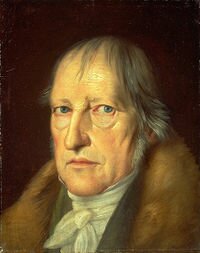
The Right Hegelians, Old Hegelians, or the Hegelian Right, were the followers of German philosopher Georg Wilhelm Friedrich Hegel who took his philosophy in a politically and religiously conservative direction. They are typically contrasted with the Young Hegelians, who interpreted Hegel's political philosophy to support innovations in politics or religion. Hegel's political philosophy could be read in liberal or conservative directions.

Hegel's historicism held that both ideas and nations could only be understood by understanding their history. Throughout his life, Hegel was an orthodox member of Prussia's Lutheran Church. He devoted considerable attention to the Absolute, his term for the totality of reality that was used in his philosophy to justify belief in God. In his Philosophy of Right, Hegel wrote that:
The State is absolutely rational inasmuch as it is the actuality of the substantial will which it possesses in the particular self-consciousness once that consciousness has been raised to consciousness of its universality. This substantial unity is an absolute unmoved end in itself, in which freedom comes into its supreme right. On the other hand this final end has supreme right against the individual, whose supreme duty is to be a member of the State.
— Philosophy of Right, "The State", s. 258

More...

Friday, October 24, 2008

Jesus of Nazareth

Flagellation, c. 1607, Oil on canvas, 390 x 260 cm, Museo Nazionale di Capodimonte, Naples, on loanBorn in Bethlehem and active in Nazareth; His life and sermons form the basis for Christianity (circa 4 bc - ad 29).

The principal sources of information regarding Jesus' life and teachings are the four canonical gospels though some scholars argue that other texts (such as the Gospel of Thomas) are as relevant as the canonical gospels to the historical Jesus. Most critical scholars in the fields of history and biblical studies believe that ancient texts on Jesus' life are at least partially accurate, agreeing that Jesus was a Galilean Jew who was regarded as a teacher and healer. They also generally accept that he was baptized by John the Baptist, and was crucified in Jerusalem on orders of the Roman Prefect of Judaea Pontius Pilate, on the charge of sedition against the Roman Empire.

Christian views of Jesus center on the belief that Jesus is divine, is the Messiah whose coming was prophesied in the Old Testament (e.g. Deuteronomy 18:15,Judges 13:5; Amos 2:11; Lam. 4:7,Isaiah:53,Isaiah 7:14, etc.), and that he was resurrected after his crucifixion. Christians predominantly believe that Jesus is the "Son of God" (generally meaning that he is God the Son, the second person in the Trinity), who came to provide salvation and reconciliation with God by his death for their sins.

Other Christian beliefs include Jesus' virgin birth, performance of miracles, ascension into Heaven, and future Second Coming. While the doctrine of the Trinity is widely accepted by Christians, a small minority instead hold various nontrinitarian beliefs concerning the divinity of Jesus.

In Islam, Jesus (Arabic: عيسى‎, commonly transliterated as Isa) is considered one of God's important prophets, a bringer of scripture, and a worker of miracles. Jesus is also called "Messiah," but Islam does not teach that he was divine. Islam denies the death and resurrection of Jesus, believing instead that he ascended bodily to heaven.

More...

Wednesday, October 22, 2008

Cain and Abel

According to Genesis, Cain (meaning "acquisition") and Abel (a biblical forename which may derive from the Hebrew Hebel, itself derived from hevel (breath or vapour), or from the Assyrian for son. In reference to the biblical story, the name Abel often occurs with that of his brother, as Cain and Abel. Cain and Abel were the first and second sons of Adam and Eve, born after the Fall of Man. Their story is told in Genesis 4:1-16, the Qur'an at 5:26-32, and Moses 5:16-41. In all versions, Cain, a farmer, commits the first murder by killing his brother Abel, a shepherd, after God rejects Cain's sacrifice but accepts Abel's.

The oldest known copy of the biblical narration is from the Dead Sea Scrolls (4QGenb = 4Q242, mid 1st century), inspected using infra-red photography and published by Jim R Davila as part of his doctoral dissertation in 1988. Cain and Abel appear in a number of other texts, and the story is the subject of various interpretations. Abel, the first murder victim, is sometimes seen as the first martyr; while Cain, the first murderer, is sometimes seen as a progenitor of evil. A few scholars suggest the pericope may have been based on a Sumerian story representing the conflict between nomadic shepherds and settled farmers.

Allusions to Cain and Abel as an archetype of fratricide persist in numerous references and retellings, through medieval art and Shakespearean works up to the present day.

More...

Tuesday, October 21, 2008

covenant

Rainbow by bluemist57, Adelaide, AustraliaCovenant, meaning a solemn contract, is the customary word used to translate the Hebrew word berith (ברית: pact, treaty, mise, league, alliance) as it is used in the Hebrew Bible.

While the word is used to identify treaties or similar contracts between rulers or individuals, the primary covenants mentioned in the Bible are the one between God and the Israelites (Old Testament) and the one between God and the Christian Church (New Testament).

This covenant was the basis for the Torah, and the claimed status of the Israelites as God's "chosen people."
God's promise to Israel in both the Old Testament and the New Testament that He would redeem the nation of Israel, give Israel the land of Zion, and "appear in his glory" and "come out of Zion" when "all Israel shall be saved" (cf. Psalm 102:15-18, Romans 11:25-27).
According to the terms of the covenant, Israelites understand that God had promised to undertake certain things on behalf of the people of Israel, and that the Israelites owed God obedience and worship in return.

More...

Christian anarchism

Christian anarchism is any of several traditions which combine anarchism with Christianity. Christian anarchists believe that freedom is justified spiritually through the teachings of Jesus. This has caused them to be critical of government and Church authority. Leo Tolstoy's The Kingdom of God Is Within You is a key text in modern Christian anarchism.

The Life and Teaching of Jesus

More than any other text, the four Gospels provide the basis for Christian anarchism. Dorothy Day, Ammon Hennacy, Leo Tolstoy and others constantly refer back to the words of Jesus in their social and political texts. For example, the title "The Kingdom of God is Within You" is a direct quote of Jesus from Luke 17:21. Dorothy Day and the Catholic Worker Movement particularly favored the Works of Mercy (Matthew 25:31–46), which were a recurring theme in both their writing and art.

Many Christian anarchists say that Jesus opposed the use of government power, even for supposedly good purposes like welfare point to Luke 22:25, which says:
25 Jesus said to them, "The kings of the Gentiles lord it over them; and those who exercise authority over them call themselves Benefactors. 26 But you are not to be like that.

More...

Saturday, October 18, 2008

U2

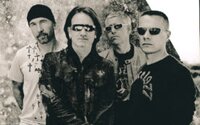
U2 is an Irish rock band formed in Dublin, whose members are Christians. The band features Bono (Paul David Hewson) on vocals, rhythm guitar and harmonica; The Edge (David Howell Evans) on lead guitar, keyboards and backing vocals; Adam Clayton on bass guitar; and Larry Mullen, Jr. on drums and occasional backing vocals.

"We've found different ways of expressing it, and recognized the power of the media to manipulate such signs. Maybe we just have to sort of draw our fish in the sand. It's there for people who are interested. It shouldn't be there for people who aren't."
-Bono, quoted from "U2 at the End of the World"


Formed in 1976, U2 has consistently remained among the most popular acts in the world since the mid 1980s. The band has sold approximately 50.5 million albums in the U.S., according to the RIAA, and upwards of 170 million worldwide, has had six #1 albums in the US and nine #1 albums in the UK and is one of the most successful bands of the rock era. The band has won 22 Grammy awards, more than any other recording artist.

More...

Friday, October 17, 2008

Ex nihilo

Ex nihilo is a Latin term meaning "out of nothing". It is often used in conjunction with the term creation (see creationism) as in Creatio ex Nihilo, "Creation out of nothing". God created merely by speaking it into existence.
1 In the beginning, God created the heavens and the earth. 2 The earth was without form and void, and darkness was over the face of the deep. And the Spirit of God was hovering over the face of the waters.

3 And God said, "Let there be light," and there was light. 4 And God saw that the light was good. And God separated the light from the darkness. 5 God called the light Day, and the darkness he called Night. And there was evening and there was morning, the first day. (Genesis 1:1-5)

Due to the nature of this, the term is often used in creationistic arguments, as some religions believe that God created the universe from nothing. It has also been argued that this concept cannot be deduced from the Hebrew and that the Book of Genesis, chapter 1, speaks of God "making" or "fashioning" the universe. However, Rabbi Schneur Zalman of Liadi (1745-1812) refuted these arguments in section II of his book titled "Tanya".

According to James Hartle and Stephen Hawking, creation ex nihilo is possible from the Hartle-Hawking state.

More...

Thursday, October 16, 2008

Money, a biblical perspective

The bible has quite a lot to say about money and finances, which is evidence that these principles are something God considers important for us to be aware of.
10 For the love of money is a root of all kinds of evil. Some people, eager for money, have wandered from the faith and pierced themselves with many griefs. (1 Timothy 6:10 NIV)

The Christian concept of stewardship refers to the management of the property or affairs of someone else. It is often associated with personal finances. However, the key is that "our money" is not ours to begin with. It belongs to God.

The narrative of Jesus and the Money Changers occurs in both the Synoptic Gospels and in the Gospel of John, although it occurs close to the end of the Synoptic Gospels at:
  • Mark 11:15–19, 11:27–33,
  • Matthew 21:12–17, 21:23–27 and
  • Luke 19:45–48, 20:1–8
The story of Jesus overturning the tables of the money changers in the Temple is related. Jesus goes to Jerusalem for the Passover, the first of three in John, the others being John 7, where he goes to the Feast of Tabernacles, and the final Passover during which he is crucified. He enters the Temple courts and sees people selling livestock and exchanging money. He explodes:
More...

Tuesday, October 14, 2008

Tyre

The Triumphal Arch of Tyre.Tyre (Hebrew צור Tzor, Greek Τύρος Týros also Es Sur, Soûr, Şūr, Tyr, صُور,) is a city in the South Governorate of Lebanon. With 117,100 inhabitants (it is reported only 10% of the population is left because of the Israel-Lebanon conflict), Tyre juts out from the coast of the Mediterranean Sea, about 23 miles north of Acre, and 20 miles south of Sidon. The name of the city means "rock".

Tyre is an ancient Phoenician city. Today it is the fourth largest city in Lebanon and houses one of the nation's major ports. Tyre is a popular destination for tourists.

The city has many ancient sites, including its Roman Hippodrome which was reportedly used for the film Ben-Hur, and was added to UNESCO's World Heritage list in 1979 (Resolution 459).

Tyre is near the southern border."The location of the city of Tyre is not in doubt, for it exists to this day on the same spot and is known as Sur." (Katzenstein, H.J., The History of Tyre, 1973, p9) Tyre originally consisted of two distinct urban centers, one on an island and the other on the adjacent coast (approximately 30 stadia apart or 3.5 miles according to Strabo in his Geography xvi, 2), before Alexander the Great connected the island to the coast during his siege of the city. One was a heavily fortified island city amidst the sea and the latter, originally called Ushu (later, Palaetyrus, by the Greeks) was actually more like a line of suburbs than any one city and was used primarily as a source of water and timber for the main island city. Flavius Josephus even records them fighting against each other, although most of the time they supported one another due to the island city’s wealth from maritime trade and the mainland area’s source of timber, water and burial grounds.

More...

Monday, October 13, 2008

lineage of Adam

The Adam half of Adam was the first man and Eve was the first woman.

At the time God made Earth and Heaven, before any grasses or shrubs had sprouted from the ground—God hadn't yet sent rain on Earth, nor was there anyone around to work the ground (the whole Earth was watered by underground springs)—God formed Man out of dirt from the ground and blew into his nostrils the breath of life. The Man came alive—a living soul!
-Genesis 2:5-7 (The Message)


His name, in Hebrew, is אדם (pronounced: ah-dahm) which has a basic meaning of "mankind," a related noun is אדמה (which means earth, land, terra; ground, soil; Earth). Adam was father to Cain (Gen. 4:1), Abel (Gen. 4:2), Seth (Gen. 4:25), and other children (Gen. 5:4). He lived to be 930 years old.

According to the biblical book of Genesis, God created Adam on the Sixth day:

5 When no bush of the field was yet in the land and no small plant of the field had yet sprung up—for the LORD God had not caused it to rain on the land, and there was no man to work the ground, 6 and a mist was going up from the land and was watering the whole face of the ground— 7 then the LORD God formed the man of dust from the ground and breathed into his nostrils the breath of life, and the man became a living creature. (Genesis 2:5-7 ESV)


This writer considers the biblical account to be the authority by which the lineage of Adam is determined.

The Ussher chronology is a 17th-century chronology of the history of the world formulated from a literal reading of the Bible by James Ussher's, the Anglican Archbishop of Armagh (in what is now Northern Ireland). The chronology is sometimes associated with Young Earth Creationism, which holds that the universe was created only a few millennia ago.

The chronologies of Ussher and other biblical scholars corresponded so closely because they used much the same methodology to calculate key events recorded in the Bible. Their task was complicated by the fact that the Bible was compiled from different sources over several centuries with differing versions and lengthy chronological gaps, making it impossible to do a simple totaling of Biblical ages and dates. In his article on the Ussher calendar, James Barr has identified three distinct periods that Ussher had to tackle:

More...

Sunday, October 12, 2008

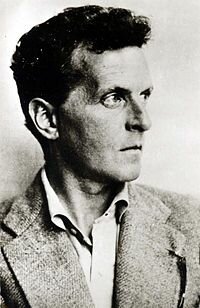
Ludwig Wittgenstein

Ludwig Wittgenstein Source: The Austrian Ludwig Wittgenstein Society (ALWS), Austrian National Library, call numbers NB 515.982 B and Pf 42805 C1. Taken circa 1930 in Vienna. Author: Moritz Nähr (Naehr) (died June 29, 1945).Ludwig Josef Johann Wittgenstein (26 April, 1889 – 29 April, 1951) was an Austrian philosopher who worked primarily in logic, the philosophy of mathematics, the philosophy of mind, and the philosophy of language. As one of the twentieth century's most important philosophers, his influence has been wide-ranging.

Before his death at the age of 62, the only book-length work Wittgenstein had published was Tractatus Logico-Philosophicus. He worked on Philosophical Investigations in his later years, and it was published shortly after he died. Both of these works are regarded as highly influential in analytic philosophy.

Ludwig Wittgenstein was born in Vienna on 26 April 1889, to Karl and Leopoldine Wittgenstein. He was the youngest of eight children, born into one of the most prominent and wealthy families in the Austro-Hungarian empire. His father's parents, Hermann Christian and Fanny Wittgenstein, were born into Jewish families but later converted to Protestantism, and after they moved from Saxony to Vienna in the 1850s, assimilated into the Viennese Protestant professional classes. Ludwig's father, Karl Wittgenstein, became an industrialist and went on to make a fortune in iron and steel. Ludwig's mother Leopoldine, born Kalmus, was an aunt of the Nobel Prize laureate Friedrich von Hayek. Despite Karl's Protestantism, and the fact that Leopoldine's father was Jewish, the Wittgenstein children were baptized as Roman Catholics—the faith of their maternal grandmother—and Ludwig was given a Roman Catholic burial upon his death.


His notebook entries during the war reflect his contempt for the baseness, as he saw it, of his fellow soldiers. Throughout the war, Wittgenstein kept notebooks in which he frequently wrote philosophical and religious reflections alongside personal remarks. The notebooks reflect a profound change in his religious life: a militant atheist during his stint at Cambridge, Wittgenstein discovered Leo Tolstoy's The Gospel in Brief at a bookshop in Galicia. He devoured Tolstoy's commentary and became an evangelist of sorts; he carried the book everywhere he went and recommended it to anyone in distress (to the point that he became known to his fellow soldiers as "the man with the gospels"). Monk notes that at the end of his life, Wittgenstein still firmly believed in the Resurrection of Jesus. Wittgenstein's other religious influences include Saint Augustine, Fyodor Dostoevsky and, most notably, SØren Kierkegaard, whom Wittgenstein referred to as "a saint".


More...

Friday, October 10, 2008

Embryonic stem cells

Embryonic Stem Cells. (A) shows hESCs (Human embryonic stem cells).Embryonic stem cells (ES cells) are stem cells derived from the inner cell mass of an early stage embryo known as a blastocyst. Human embryos reach the blastocyst stage 4-5 days post fertilization, at which time they consist of 50-150 cells.

Embryonic Stem (ES) cells are pluripotent. This means they are able to differentiate into all derivatives of the three primary germ layers: ectoderm, endoderm, and mesoderm. These include each of the more than 220 cell types in the adult body. Pluripotency distinguishes ES cells from multipotent progenitor cells found in the adult; these only form a limited number of cell types. When given no stimuli for differentiation, (i.e. when grown in vitro), ES cells maintain pluripotency through multiple cell divisions.

The presence of pluripotent adult stem cells remains a subject of scientific debate, however, research has demonstrated that pluripotent stem cells can be directly generated from adult fibroblast cultures.

Because of their plasticity and potentially unlimited capacity for self-renewal, ES cell therapies have been proposed for regenerative medicine and tissue replacement after injury or disease. However, to date, no approved medical treatments have been derived from embryonic stem cell research (ESCR). Adult stem cells and cord blood stems cells have thus far been the only stem cells used to successfully treat any diseases. Diseases treated by these non-embryonic stem cells include a number of blood and immune-system related genetic diseases, cancers, and disorders; juvenile diabetes; Parkinson's; blindness and spinal cord injuries. Besides the ethical problems of stem cell therapy (see stem cell controversy), there is a technical problem of graft-versus-host disease associated with allogeneic stem cell transplantation. However, these problems associated with histocompatibility may be solved using autologous donor adult stem cells or via therapeutic cloning.

Stem cell controversy is the ethical debate centered around research involving the creation, usage and destruction of human embryonic stem cells. Some opponents of the research argue that this practice is a slippery slope to reproductive cloning and fundamentally devalues the worth of a human being. Contrarily, medical researchers in the field argue that it is necessary to pursue embryonic stem cell research because the resultant technologies could have significant medical potential, and that excess embryos created for in vitro fertilisation could be donated with consent and used for the research. This in turn, conflicts with opponents in the pro-life movement, who advocate for the protection of human embryos. The ensuing debate has prompted authorities around the world to seek regulatory frameworks and highlighted the fact that embryonic stem cell research represents a social and ethical challenge.

In his article Embryonic Stem Cell Research: Humane for Whom?, president and chairman of the board of the North Carolina-based Christian Research Institute Hank Hanegraaff says:

" Two years ago in this column I reiterated the truth that the only thing necessary for evil to triumph was for good men to do nothing. This was evident already in 1973 when Christians quietly passed by a major battle in the war against abortion. Two and a half decades later, the far-reaching impact of this silence is being felt in a raging debate over human cloning. Now my worst fears are beginning to be realized, for Great Britain has become the first nation to legalize human cloning. The House of Lords approved a law allowing embryos to be created for the harvesting of stem cells. Thankfully, there are some good men doing something. Chuck Colson, for instance, has spoken out eloquently against misguided citizens and celebrities who are pleading with Congress to endorse government-sponsored research involving the use of human embryos. His insights are so significant that I asked him to reiterate them in my Practical Apologetics column. Pandora’s box is already open, and Christians must do all that is permissible to prevent a human clone from emerging. "

—Hank Hanegraaff, STATEMENT DE444
Embryonic Stem Cell Research: Humane for Whom?,
http://www.equip.org


More...

Wednesday, October 08, 2008

deconstructionism

Jacques DerridaDeconstruction is a term in contemporary philosophy, literary criticism, and the social sciences, denoting a process by which the texts and languages of Western philosophy (in particular) appear to shift and complicate in meaning when read in light of the assumptions and absences they reveal within themselves. Jacques Derrida coined the term in the 1960s, and proved more forthcoming with negative, rather than pined-for positive, analyses of the school.

Subjects relevant to deconstruction include the philosophy of meaning in Western thought, and the ways that meaning is constructed by Western writers, texts, and readers and understood by readers. Though Derrida himself denied deconstruction was a method or school of philosophy, or indeed anything outside of reading the text itself, the term has been used by others to describe Derrida's particular methods of textual criticism, which involved discovering, recognizing, and understanding the underlying—and unspoken and implicit—assumptions, ideas, and frameworks that form the basis for thought and belief, for example, in complicating the ordinary division made between nature and culture. Derrida's deconstruction was drawn mainly from the work of Martin Heidegger and his notion of Destruktion but also from Levinas and his ideas upon the Other.

Edmund Husserl is one of the major influences on the development of Derrida's thought and Husserl is both mentor and foil to the development of deconstruction. In Derrida's "two polemics which placed him [Husserl] in opposition to those philosophies of structure called Diltheyism and Gestaltism". These two polemics by Husserl are forerunners of Derrida's own deconstruction. Derrida notes admiringly that Husserl:

“ ceaselessly attempts to reconcile the structuralist demand (which leads to the comprehensive description of a totality, of a form or a function organized according to an internal legality in which elements have meaning only in the solidarity of their correlation or their opposition), with the genetic demand (that is the search for the origin and foundation of the structure). ”


More...

Tuesday, October 07, 2008

Biblical archaeology

Hezekiah’s tunnel is a tunnel that was dug underneath Ophel in Jerusalem about 701 BC during the reign of King Hezekiah.Biblical archaeology involves the recovery and scientific investigation of the material remains of past cultures that can illuminate the periods and descriptions in the Bible. As with the historical records from any other civilization, the manuscripts must be compared to other accounts from contemporary societies in Europe, Mesopotamia, and Africa; additionally, records from neighbors must be compared with them. The scientific techniques employed are those of archaeology in general including excavations as well as chance discoveries.

By contrast Near Eastern archaeology is simply the archaeology of the Ancient Near East without any particular consideration of how its discoveries relate to the Bible.

Biblical archaeology is a controversial subject with differing opinions on what its purpose and goals are or should be.

Biblical Archaeology began after publication by Edward Robinson (American professor of Biblical literature; 1794-1863) of his travels through Palestine during the first half of the 19th century (a time when the oldest complete Hebrew scripture only dated to the Middle Ages), which highlighted similarities between modern Arabic place-names and Biblical city names.

The Palestine Exploration Fund sponsored detailed surveys led by Charles Warren during the late 1860s (initially financed by Angela Georgina Burdett-Coutts in 1864 to improve Jerusalem's sanitary conditions), which culminated with the formal publication of "The Survey of Western Palestine" from 1871-1877.

More...

Saturday, October 04, 2008

cosmological argument

Modern thinkers sometimes cite evidence for the Big Bang to support the claim that the universe began (Gen.1:1) to exist a finite time ago.The cosmological argument is a metaphysical argument for the existence of God, or a first mover of the cosmos. It is traditionally known as an "argument from universal causation," an "argument from first cause," and also as an "uncaused cause" argument and sometimes referred to as the Kalam cosmological argument. Whichever term is used, there are three basic variants of this argument, each with subtle but important distinctions: the argument from causation in esse, the argument from causation in fieri, and the argument from contingency. The cosmological argument does not attempt to prove anything about the first cause or about God, except to argue that such a cause must exist. This cause is known in Latin as "causa sui."

Plato and Aristotle both posited first cause arguments, though each had certain notable caveats. Plato (c. 427–c. 347 BCE) posited a basic cosmological argument in The Laws (Book X).

He argued that motion in the world and in the cosmos was "imparted motion" that would have required some kind of "self-originated motion" to set it in motion and to maintain the motion. Plato also posited a "Demiurge" of supreme wisdom and intelligence as the creator of the cosmos in his work Timaeus.

For Plato, the demiurge lacked the supernatural ability to create ex nihilo or out of nothing. The demiurge was only able to organize the "anake." The anake was the only other co-existent element or presence in Plato's cosmogony.

Aristotle (c. 384–322 BCE) also put forth the idea of a first cause, often referred to as the "Prime Mover" or "Unmoved Mover" (the πρῶτον κινοῦν ἀκίνητον or primus motor) in his work Metaphysics. For Aristotle too, as for Plato, the underlying "stuff" of the universe always was in existence and always would be (which in turn follows Parmenides' famous statement that "nothing can come from nothing"). Aristotle posited an underlying ousia (an essence or substance) of which the universe is composed, and it is the ousia that the Prime Mover organized and set into motion. The Prime Mover did not organize matter physically, but is instead a Being who constantly thinks about thinking itself, and who organized the cosmos by making matter the object of "aspiration or desire". The Prime Mover was, to Aristotle, a "thinking on thinking," an eternal process of pure thought.

More...

Friday, October 03, 2008

The death of Jesus

The death of Jesus is an event described by the New Testament, as occurring after the Passion of Jesus, as a result of his crucifixion. In Christianity the quasi-annual day of commemoration of the event is a highly important feast day, known as Good Friday.

In the accounts, as Jesus is dying, a darkness appears over the land. The Gospel of Mark states it was at the sixth hour (noon). Some have interpreted the darkness as a solar eclipse, but this is astronomically impossible, since Jesus is described as dying around the time of the Passover, a date on the Hebrew calendar fixed to a full moon, while solar eclipses can only occur at a new moon. It is clearly phrased for dramatic effect, but it could simply mean that the day was overcast.

Both Matthew and Mark state that Jesus cried out his last words - My God, My God, why have you forsaken me, Mark indicating that it was the ninth hour (3 PM). John states that Jesus just said "I thirst." (John 19:28)

A passer is described by both the synoptics and John as then wetting a sponge with vinegar and offering it to Jesus via a stick, but the crowd is described as saying that they should wait to see if Elijah will come to save Jesus. John states that Jesus drank what was offered. Elijah fails to arrive, and shortly after the sponge is offered, Jesus [gives] up the ghost, crying out wordlessly (according to Matthew and Mark), or crying his last words according to Luke and John, and dying.

Luke and Mark report that the veil of the temple split at this point, but Matthew claims that there were earthquakes, splitting rocks, and that dead saints were resurrected. The synoptics report that the immediate events after Jesus' death led a centurion to say Truly this man is [a/the] Son of God (there is no article in the original Greek, so this could as equally be a Son of God as the Son of God), which might be considered a vindication of Jesus (Brown 147), or might be sarcastic (Miller 51). John makes no such supernatural claims, and doesn't mention the centurion.

More...

Thursday, October 02, 2008

Summa Theologiae

Summa theologiae, Pars secunda, prima pars. (copy by Peter Schöffer, 1471)The Summa Theologiae (also sometimes referred to as the Summa Theologica) is the most famous work of Thomas Aquinas (c. 1225 – 7 March 1274). It was intended as a manual for beginners as a compilation of all of the main theological teachings of that time. It is not designed or ordered as an apologetic work, to convince non-Catholics, but it does contain a summary of the reasonings for almost all points of the Catholic Faith. It became so reputed that at the Council of Trent, it was consulted after the Bible itself on religious questions.

The Summa Theologiae is a more mature and structured version of an earlier work of Aquinas, the Summa Contra Gentiles. This former work was more apologetic in nature, and each article was a refutation of a specific belief of different heresies and other religions. The Summa Theologiae is famous for its quinquae viae which literally means "five streets," i.e. five ways to prove the existence of God. Some have called the Summa Theologiae the greatest theological statement of the Middle Ages.

The Summa has a standard format for each article. A question or a topic is given, such as "Whether it was fitting for Jesus to be poor". Then, a series of objections to the viewpoint presented are given. One objection could be, for example, "The Philosopher (Aristotle) says that the best life is being in the middle, between poor and rich." A short counter statement is then given, such as, "The Bible says that God always does the right thing, but Jesus was God, and he was poor, so it must have been the right thing." The actual truth is then presented, generally a clarification of the issue rather than simply pointing out which "side" is correct. For example, this could read, "Although it's true that the best way of life is a middle ground between being poor and rich, the reason for this is that this allows a person to be not distracted from his goal by either want or luxury. But the goal of Jesus was to spread his message as far as possible, and so to be the most mobile, it was better to have nothing." Individual counters to the first objection are then given, if necessary.

More...

Wednesday, October 01, 2008

Constantine the Great

Right hand of the colossal statue of Constantine I, Musei Capitolini, Rome. Marble, Roman artwork, 313–324 CE. Gaius Flavius Valerius Aurelius Constantinus (Latin: IMP CÆSAR FLAVIVS CONSTANTINVS PIVS FELIX INVICTVS AVGVSTVS) (February 27, 272–May 22, 337), commonly known as Constantine I, Constantine the Great, or (among Orthodox Christians) Saint Constantine, was proclaimed Augustus by his troops on July 25, 306 and ruled an ever-growing portion of the Roman Empire until his death. Constantine is famed for his refounding of Byzantium (modern Istanbul) as "Nova Roma" (New Rome) or Constantinople (Constantine's City).

Constantine is best remembered in modern times for the Edict of Milan in 313 and the Council of Nicaea in 325, which fully legalized Christianity in the Empire for the first time.

These actions are considered major factors in that religion's spread, and his reputation as the "first Christian Emperor" has been promulgated by historians from Lactantius and Eusebius of Caesarea to the present day, though he himself was baptized only on his death bed.

Constantine was born at Naissus in Upper Moesia (today's Niš, Serbia) on 27 February 272 or 273, to Greek general, Constantius I Chlorus, and his first wife Helena, an innkeeper's daughter who at the time was only sixteen years old. Theodora would give birth to six half-siblings of Constantine, including Julius Constantius.

More...

 

Subscribe


LifeNews.com

Desiring God Blog

Youth for Christ International