Showing posts with label Trinity. Show all posts

Wednesday, July 13, 2011

Trinity

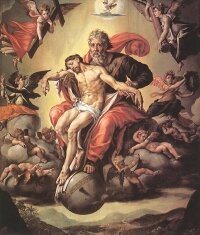
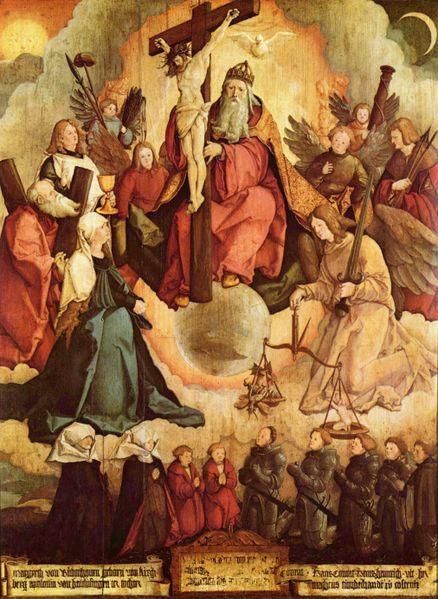
Within Christianity, the doctrine of the Trinity states that God is a single "Being" who exists, simultaneously and eternally, as a communion of three persons (personae, prosopa): Father (the Source, the Eternal Majesty); the Son (the eternal Logos or Word, incarnate as Jesus of Nazareth); and the Holy Spirit. Since the 4th Century AD, in both Eastern and Western Christianity, this doctrine has been stated as "One God in Three Persons," all three of whom, as distinct and co-eternal "persons" or "hypostases," share a single Divine essence, being, or nature.

The word Trinity comes from the Latin noun Trinitas, meaning the state or condition of being three, or a group of three persons or things. The first recorded application of this Latin word to Father, Son and Holy Spirit was by Tertullian in about 200 where he probably combined Latin words for three and one. Although the word Trinity is not found in Scripture, the principle is:
19 Therefore go and make disciples of all nations, baptizing them in the name of the Father and of the Son and of the Holy Spirit (Matt. 28:19)

The Greek term with the same meaning, Τρίας, has given the English word triad. The Sanskrit word, Trimurti, has a similar meaning.

In view of what is stated about Tertullian, it would be vain to look for the word "Τρίας" (Trinity) in the New Testament, which only speaks of God (often called "the Father"), of Jesus Christ (often called "the Son"), and of the Holy Spirit, and of the relationships between these.

The earliest Christians were noted for their insistence on the existence of one true God, in contrast to the polytheism of the prevailing culture. While maintaining strict monotheism, they developed awareness also that the man Jesus was at the same time something more than a man (an awareness believed to be reflected, for instance, in the opening verses of the Letter to the Hebrews, which describe him as the reflection of God's glory and bearing the impress of God's own being, and, yet more explicitly, in the prologue of the gospel of John) and also with the implications of the presence and power of God that they believed was among them and that they referred to as the Holy Spirit.

More...


In the Beginning Was the Word - John Piper

Sunday, April 18, 2010

Trinity

Within Christianity, the doctrine of the Trinity states that God is a single "Being" who exists, simultaneously and eternally, as a communion of three persons (personae, prosopa): Father (the Source, the Eternal Majesty); the Son (the eternal Logos or Word, incarnate as Jesus of Nazareth); and the Holy Spirit. Since the 4th Century AD, in both Eastern and Western Christianity, this doctrine has been stated as "One God in Three Persons," all three of whom, as distinct and co-eternal "persons" or "hypostases," share a single Divine essence, being, or nature.

The word Trinity comes from the Latin noun Trinitas, meaning the state or condition of being three, or a group of three persons or things. The first recorded application of this Latin word to Father, Son and Holy Spirit was by Tertullian in about 200 where he probably combined Latin words for three and one. Although the word Trinity is not found in Scripture, the principle is:
19 Therefore go and make disciples of all nations, baptizing them in the name of the Father and of the Son and of the Holy Spirit (Matt. 28:19)

More...

Wednesday, February 17, 2010

Historical Jesus

Who was the historical Jesus?
This article is about Jesus the man, based upon historical methods to reconstruct a biography of his life and times. For disputes related to the existence of Jesus, theological perspectives about Jesus, and reliability of ancient texts relating to him, see:The historical Jesus is Jesus of Nazareth as reconstructed by historians (i.e. not necessarily and usually not Christian historians) using historical methods. These historical methods use critical literary analysis of Gospel texts as the primary source for the biography of Jesus, along with non-biblical sources to reconstruct the historical context of first-century Judea. These methods do not include theological or religious axioms, such as biblical inerrancy. Though the reconstructions vary, they generally agree on these basic points:
  • Jesus was a Jewish teacher who attracted a small following of Galileans and,
  • after a period of ministry, was crucified by the Romans in the Iudaea Province during the governorship of Pontius Pilate.
Eusebius of Caesarea (~275-339) is an example of an early Christian historian and Flavius Josephus is an example of a 1st-century Jewish historian.

More...

Thursday, December 06, 2007

Trinity

Within Christianity, the doctrine of the Trinity states that God is a single "Being" who exists, simultaneously and eternally, as a communion of three persons (personae, prosopa): Father (the Source, the Eternal Majesty); the Son (the eternal Logos or Word, incarnate as Jesus of Nazareth); and the Holy Spirit. Since the 4th Century AD, in both Eastern and Western Christianity, this doctrine has been stated as "One God in Three Persons," all three of whom, as distinct and co-eternal "persons" or "hypostases," share a single Divine essence, being, or nature.

The word Trinity comes from the Latin noun Trinitas, meaning the state or condition of being three, or a group of three persons or things. The first recorded application of this Latin word to Father, Son and Holy Spirit was by Tertullian in about 200 where he probably combined Latin words for three and one. Although the word Trinity is not found in Scripture, the principle is:

19Therefore go and make disciples of all nations, baptizing them in the name of the Father and of the Son and of the Holy Spirit (Matt. 28:19)
The Greek term with the same meaning, Τρίας, has given the English word triad. The Sanskrit word, Trimurti, has a similar meaning.

In view of what is stated about Tertullian, it would be vain to look for the word "Τρίας" (Trinity) in the New Testament, which only speaks of God (often called "the Father"), of Jesus Christ (often called "the Son"), and of the Holy Spirit, and of the relationships between these.


More...

Tuesday, December 04, 2007

Book of Kells

This page (folio 292r) contains the lavishly decorated text that opens the Gospel of JohnThe Book of Kells (Dublin, Trinity College Library, MS A. I. (58), less widely known as the Book of Columba) is an ornately illustrated manuscript, produced by Celtic monks around AD 800 in the style known as Insular art. It is one of the more lavishly illuminated manuscripts to survive from the Middle Ages and has been described as the zenith of Western calligraphy and illumination. It contains the four gospels of the Bible in Latin, along with prefatory and explanatory matter decorated with numerous colourful illustrations and illuminations. Today it is on permanent display at the Trinity College Library in Dublin, Ireland.

history


Origin

The Book of Kells is the high point of a group of manuscripts in what is known as the Insular style produced from the late 6th through the early 9th centuries in monasteries in Ireland, Scotland and northern England and in continental monasteries with Irish or English foundations.

These manuscripts include the Cathach of St. Columba, the Ambrosiana Orosius, a fragmentary gospel in the Durham cathedral library (all from the early 7th century), and the Book of Durrow (from the second half of the 7th century). From the early 8th century come the Durham Gospels, the Echternach Gospels, the Lindisfarne Gospels (see illustration at right), and the Lichfield Gospels. The St. Gall Gospel Book and the Macregal Gospels come from the late 8th century. The Book of Armagh (dated to 807–809), the Turin Gospel Book Fragment, the Leiden Priscian, the St. Gall Priscian and the Macdurnan Gospel all date from the early 9th century. Scholars place these manuscripts together based on similarities in artistic style, script, and textual traditions. The fully developed style of the ornamentation of the Book of Kells places it late in this series, either from the late eighth or early ninth century. The Book of Kells follows many of the iconographic and stylistic traditions found in these earlier manuscripts. For example, the form of the decorated letters found in the incipit pages for the Gospels is surprisingly consistent in Insular Gospels. Compare, for example, the incipit pages of the Gospel of Matthew in the Lindisfarne Gospels and in the Book of Kells both of which feature intricate decorative knotwork inside the outlines formed by the enlarged initial letters of the text. (For a more complete list of related manuscripts see: List of Hiberno-Saxon illustrated manuscripts.)

More...

Saturday, November 17, 2007

Ravi Zacharias

Ravi ZachariasRavi Zacharias (full name Frederick Antony Ravi Kumar Zacharias, born 1946) is an Indian-born, Canadian-American evangelical Christian philosopher, apologist and evangelist. Zacharias is a descendant of two rich religious traditions, first Hindu priests (of the Nambudiri Brahmin caste), and later as Christian ministers. In one of his lectures, Zacharias asserts that a Swiss-German priest spoke to one of his ancestors about Christianity, and thereafter that branch of the family was converted and the family name was changed from Nambudiri to Zacharias. The biography Zacharias offers about himself is that he grew up in a nominally Anglican household, and was an atheist until the age of 17, when he unsuccessfully tried to commit suicide by swallowing poison. According to one of his books (Cries of the Heart), someone instructed his mother to read out the Gospel of John to him as he lay on a hospital bed in Delhi. Following that, he made the decision to become a Christian. He began preaching while still in his teens, and in 1974, shortly before the Khmer Rouge took over Cambodia, he was sent there to minister to the people in the country. He was also sent to Vietnam during the Vietnam War to minister to U.S. soldiers.

Biography

Zacharias was born near Madras, India and grew up in Delhi. In 1966, he and his family emigrated to Toronto; he is currently based outside Atlanta, Georgia. He holds dual U.S. and Canadian citizenship.

He briefly attended the University of Delhi as a pre-med student before transferring to the Institute of Hotel Management in Delhi. After moving to Canada, he worked in the hotel management business before enrolling in the Ontario Bible College in Toronto. Following that, he completed his Master of Divinity degree at the Trinity Evangelical Divinity School near Chicago. He was a visiting scholar at Cambridge University when he wrote his first book, A Shattered Visage: the Real Face of Atheism. Zacharias received honorary Doctor of Divinity degrees from Houghton College, NY, and from Tyndale University College and Seminary (the renamed Ontario Bible College). He also received an honorary Doctor of Laws degree from Asbury College in Kentucky. He is presently a Visiting Professor at Wycliffe Hall, Oxford University in Oxford, England (see also: The Oxford Centre for Christian Apologetics.


More...

Monday, October 01, 2007

Doctrine of the Trinity

depiction of The Holy TrinityGod is a single being existing simultaneously as three distinct persons: The Father, The Son, and the Holy Spirit. The doctrine of the trinity is a reference to the "tri-unity" of God. There is only one God, but this God is a unity of one (Deuteronomy 6:4; Isaiah 44:6-8; 45:5-6; 1 Tim 2:5; 1 Cor 8:4). This God is also a complexity within unity (Gen. 2:24; 11:6; 1 Cor 3:6-8).

Scripture and tradition

The word "Trinity" comes from "Trinitas", a Latin abstract noun that most literally means "three-ness" (or "the property of occurring three at once"). Or, simply put, "three are one". The first recorded use of this Latin word was by Tertullian in about 200, to refer to Father, Son and Holy Spirit, or, in general, to any set of three things.

The Greek term used for the Christian Trinity, "Τριάς" (a set of three or the number three), has given the English word triad. The Sanskrit word, "Trimurti," has a similar meaning, as has "Dreifaltigkeit" in German, and many other words in other languages.

The New Testament does not use the word "Τριάς" (Trinity), but only speaks of God (often called "the Father"), of Jesus Christ (often called "the Son"), and of the Holy Spirit, and of the relationships between them. The word "Trinity" began to be applied to them only in the course of later theological reflection.

The earliest Christians were noted for their insistence on the existence of one true God, in contrast to the polytheism of the prevailing culture. While maintaining strict monotheism, they believed also that the man Jesus Christ was at the same time something more than a man (a belief reflected, for instance, in the opening verses of the Letter to the Hebrews, which describe him as the reflection of God's glory and bearing the impress of God's own being, and, yet more explicitly, in the prologue of the Gospel according to John) and also with the implications of the presence and power of God that they believed was among them and that they referred to as the Holy Spirit. St Paul even goes so far as to state that "in [Jesus] lives all the fullness of Deity bodily" (Colossians 2:9).

More...

Tuesday, June 26, 2007

resurrection of Jesus

The resurrection of Jesus as depicted by Matthias GrünewaldAccording to the Trinitarian (the Trinity) interpretation of the New Testament, Jesus was both human and God, so he had the power to lay his life down and to take it up again; thus after Jesus died, he came back to life. This event is referred to in Christian terminology as the resurrection of Jesus Christ, and is commemorated and celebrated by most Christians annually on Easter Sunday.

Most Christians, even those who do not interpret other parts of the Bible literally, accept the New Testament story as an historical account of an actual event central to their faith, though some do not accept a literal bodily resurrection, sometimes arguing for docetism. But it so seems that in the past, a large group of Christians known as the Gnostics, who were later declared heretics and partially exterminated, argued against its singular importance, and claimed that the New Testament supported their claims. Non-Christians generally view the story as legend or as allegory.

Resurrection accounts
The New Testament

The primary accounts of the resurrection are in the last chapters of the Canonical Gospels:


  • Matthew 28,
  • Mark 16,
  • Luke 24,
  • John 20-21


More...

Saturday, March 17, 2007

Jesus

Jesus Christ being nailed to the crossThe name of Jesus, meaning "Savior" in Christian usage, derived from the Aramaic and Hebrew Yeshua and Joshua, meaning Yahweh is salvation (see: YHVH). Jesus is the incarnate Son of God, the second person of the Trinity, and the prophesied Hebrew Messiah (Anointed One, deliverer of Israel). Also known as "Jesus Christ", "Jesus of Nazareth", and "Jesus the Nazarene".

Christian views of Jesus (known as Christology) are both diverse and complex. Most Christians are Trinitarian and affirm the Nicene Creed, believing that Jesus is both the Son of God and God made incarnate1, sent to provide salvation and reconciliation with God by atoning for the sins of humanity.

Other Christians, however, do not believe that the Nicene Creed correctly interprets Scripture (see also Christian worldview). The most detailed accounts of Jesus' birth are contained in the Gospel of Matthew (probably written between 60 and 85 AD/CE) and the Gospel of Luke (probably written between 60 and 100 AD/CE).

There is considerable debate about the details of Jesus' birth even among Christian scholars, and few scholars claim to know either the year or the date of his birth or of his death.

More...

Tuesday, December 26, 2006

Tertullian

Tertullian ca. 160 ACQuintus Septimius Florens Tertullianus, anglicized as Tertullian, (ca. 155–230) was a church leader and prolific author during the early years of Christianity. He was born, lived, and died in Carthage, in what is today Tunisia.

Tertullian denounced Christian doctrines he considered heretical, but later in life adopted views that came to be regarded as heretical themselves. He was the first great writer of Latin Christianity, thus sometimes known as the "father of the Latin Church".


He introduced the term Trinity, as the Latin trinitas, to the Christian vocabulary and also probably of the formula "three Persons, one Substance" as the Latin "tres Personae, una Substantia" (itself from the Koine Greek "treis Hypostases, Homoousios") and also the terms vetus testamentum ("old testament") and novum testamentum ("new testament").

More...

Friday, December 22, 2006

Childhood of Jesus

Madonna and Child Blessing depicts the infant Jesus in the act of blessing the viewer, Jacopo BelliniThe Child Jesus is a religious symbol based on the activities of Jesus as an infant up to the age of twelve that recurs throughout history, starting from around the third or fourth century. It includes religious figurines and icons of the infant Jesus, usually with his mother, Mary, and his legal father Joseph.


Holy Family
This "original nuclear family" symbolized the Holy Trinity to many early Christian believers. They solidified the family unit with such deep spiritual significance that the Holy Family eventually became an integral part of Roman Catholic religious dogma.


The Scriptures and many apocryphal works were passed down either by word of mouth or through song, and later in works of art. The symbolism of the Child Jesus in art reached its apex during the Renaissance: the holy family was a central theme in the works of Leonardo Da Vinci and many other masters.

More...

Monday, November 13, 2006

Jesus

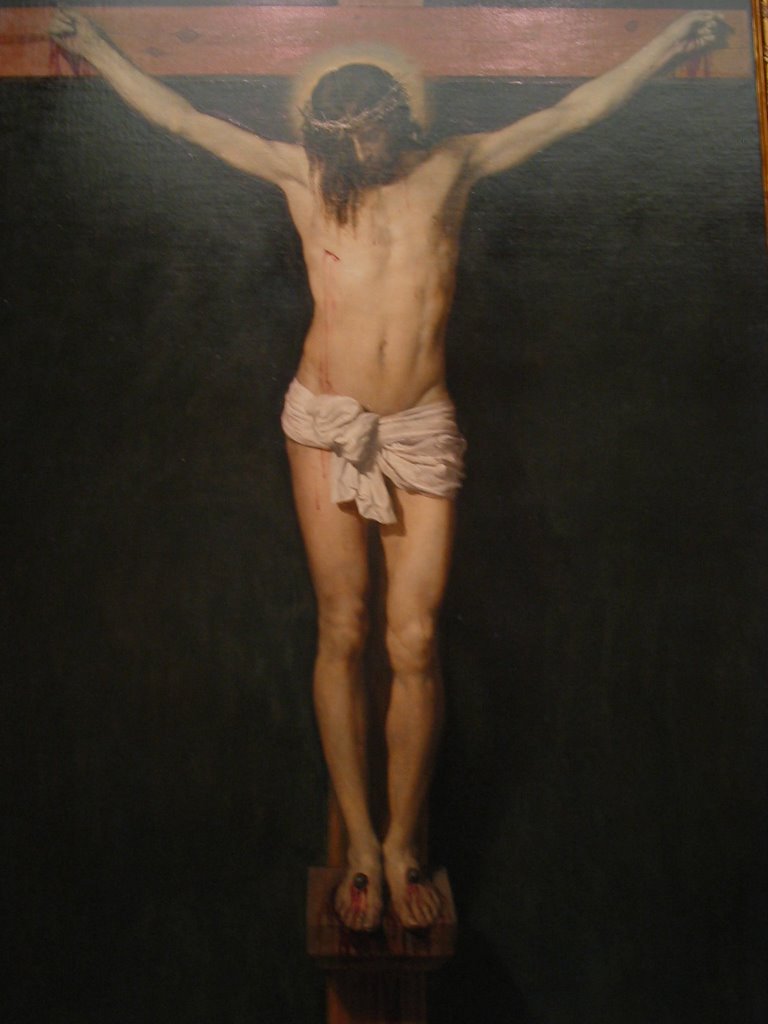
the crucifixion of Jesus as portrayed by Diego VelázquezThe name of Jesus, meaning "Savior" in Christian usage, derived from the Aramaic and Hebrew Yeshua and Joshua, meaning Yahweh is salvation. Jesus is the incarnate Son of God, the second person of the Trinity, and the prophesied Hebrew Messiah (Anointed One, deliverer of Israel). Also known as "Jesus Christ", "Jesus of Nazareth", and "Jesus the Nazarene".

Christian views of Jesus (known as Christology) are both diverse and complex. Most Christians are Trinitarian and affirm the Nicene Creed, believing that Jesus is both the Son of God and God made incarnate, sent to provide salvation and reconciliation with God by atoning for the sins of humanity.

Other Christians, however, do not believe that the Nicene Creed correctly interprets Scripture.


More...

Wednesday, June 28, 2006

Jesus

Jesus' crucifixion as portrayed by Diego VelázquezThe name of Jesus, meaning "Savior" in Christian usage, derived from the Aramaic and Hebrew Yeshua and Joshua, meaning Yahweh is salvation. Jesus is the incarnate Son of God, the second person of the Trinity, and the prophesied Hebrew Messiah (Anointed One, deliverer of Israel). Also known as "Jesus Christ", "Jesus of Nazareth", and "Jesus the Nazarene".

Christian views of Jesus (known as Christology) are both diverse and complex. Most Christians are Trinitarian and affirm the Nicene Creed, believing that Jesus is both the Son of God and God made incarnate, sent to provide salvation and reconciliation with God by atoning for the sins of humanity.

Other Christians, however, do not believe that the Nicene Creed correctly interprets Scripture.


More...

Thursday, May 25, 2006

Doctrine of the Trinity


God is a single being existing simultaneously as three distinct persons: The Father, The Son, and the Holy Spirit. The doctrine of the trinity is a reference to the "tri-unity" of God. There is only one God, but this God is a unity of one (Deuteronomy 6:4; Isaiah 44:6-8; 45:5-6; 1 Tim 2:5; 1 Cor 8:4). This God is also a complexity within unity (Gen. 2:24; 11:6; 1 Cor 3:6-8).

Scripture and tradition
The word "Trinity" comes from "Trinitas", a Latin abstract noun that most literally means "three-ness" (or "the property of occurring three at once"). Or, simply put, "three are one". The first recorded use of this Latin word was by Tertullian in about 200, to refer to Father, Son and Holy Spirit, or, in general, to any set of three things.


More...

Saturday, May 20, 2006

Billy Graham

The Rev. Dr. William Franklin Graham, Jr. KBE (born November 7, 1918 in Charlotte, North Carolina), commonly known as Billy Graham, is an American Christian evangelist. He has often advised U.S. presidents and continues to be listed as one of the "Ten Most Admired Men in the World" in Gallup Polls. He is of Scottish descent.

Raised as a Presbyterian, Billy Graham switched denominations to Southern Baptist in 1934 during a Christian revival meeting conducted by Mordecai Ham. Graham was ordained a Southern Baptist minister in 1939.

After graduating from Sharon High School in May 1936, Graham attended Bob Jones College (now Bob Jones University) but found it to be extremely fundamentalist and, considering this disobliging, he transferred to the Florida Bible Institute, now Trinity College of Florida, in 1937 and graduated from Wheaton College in 1943. It was during his time at Wheaton that Graham decided to take the Bible as the infallible word of God. Henrietta Mears of the First Presbyterian Church of Hollywood was instrumental in helping Graham wrestle with the infallibility issue, which was settled at Forest Home Christian camp (now called Forest Home Ministries) southeast of the Big Bear area in Southern California. A simple memorial there still marks the site of Graham's decision. He also married Ruth Bell, whose parents were Christian missionary doctors in China. He and his wife have three daughters, two sons (including Franklin Graham, who now administers his organization), 20 grandchildren and 25 great grandchildren.

More...
 

Subscribe


LifeNews.com

Desiring God Blog

Youth for Christ International