Monday, September 27, 2010
Gospel of John
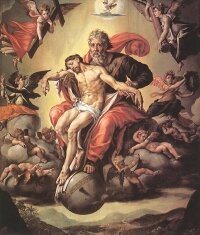
According to Trinitarianism, of the four gospels, John presents the highest christology, implicitly declaring Jesus to be God (see The Word).
Compared to the synoptics, John focuses on Jesus' cosmic mission to redeem humanity. Only in John does Jesus talk at length about himself, and John includes a substantial amount of material that Jesus shared with the disciples only. Certain elements of the synoptics (such as the parables of Jesus, exorcisms, and the Second Coming of Christ) are not found in John.
Since the "higher criticism" of the 19th century, historians have largely rejected the gospel of John as a reliable source of information about the historical Jesus. "Some commentators regard the work as anonymous."
More...
Wednesday, February 10, 2010
General Epistles
There has been considerable speculation as to the authorship of these works. All but the most conservative scholars tend to believe 2 Peter to be a pseudonymous forgery, but these scholars are adamant in their defense of its authenticity and place in the Biblical canon. Protestant Conservatives tend to attribute the books of James and Jude to Jesus' younger half-brothers, while Roman Catholics and others who hold to the doctrine of the perpetual virginity of Mary see this, obviously, as heretical.
Listed in order of their appearance in the New Testament, the General Epistles are:
More...
Sunday, July 05, 2009
Codex Bezae
Codex contents
The manuscript presents the gospels in the unusual order Matthew, John, Luke and Mark, of which only Luke is complete; after some missing pages the MS picks up with the Third Epistle of John and contains part of the Acts of the Apostles. Written with one column per page it has 406 leaves, out of perhaps an original 534, and the Greek pages on the left face Latin ones on the right. The first three lines of each book are in red letters, and black and red ink alternate lines towards the end of books. As many as nine correctors have worked on the manuscript between the sixth and twelfth century.
Thursday, March 06, 2008
The Serpent
Hebrew Bible
In the Hebrew Bible (the Tanakh) of Judaism, the speaking Serpent (nachash) in the Garden of Eden brought forbidden knowledge, but was not identified with Satan in the Book of Genesis. Nor is there any indication there in Genesis that the Serpent was a deity in his own right, aside from the fact that the Pentateuch is not teeming with talking animals.1"Now the serpent was more cunning than any beast of the field which the Lord God has made," (Genesis 3:1)Moses lifts up the brass snake, curing the Isrealites from Snake Bites. Hezekiah called the snake Nehushtan though he was cursed for his role in the Garden, this was not the end of the Serpent, who continued to be venerated in the folk religion of Judah and was tolerated by official religion until the in time of king Hezekiah. The Book of Numbers provides an origin for an archaic bronze serpent associated with Moses, with the following narrative:
More...
0 comments
Monday, February 18, 2008
temple
A temple (from the Latin word templum) is a structure reserved for religious or spiritual activities, such as prayer and sacrifice, or analogous rites. A ‘’templum’’ constituted a sacred precinct as defined by a priest, or augur. It has the same root as the word “ template,’’ a plan in preparation of the building that was marked out on the ground by the augur. Though a templum, technically speaking, is not a “house of the gods” but a diagram that for the Romans linked the geometries of heaven and earth, it was also indicative of a dwelling place of a god or gods. This tradition, of course, dates back to prehistoric times. For the ancient Egyptians, the word pr could refer not only to a house, but also to a sacred structure since it was believed that the gods resided in houses. The word ‘temple’ (which dates to about the 6th century BCE), despite the specific set of meanings associated with the religion of the ancient Rome, has now become quite widely used to describe a house of worship for any number of religions and is even used for time periods prior to the Romans. Stated differently, temple was once a species of sacred structures; today it is, in the English language, often used as a genus.
More...
Thursday, February 07, 2008
Parable of the Good Samaritan
"You have answered correctly," Jesus replied. "Do this and you will live." But he wanted to justify himself, so he asked Jesus, "And who is my neighbor?" In reply Jesus said: "A man was going down from Jerusalem to Jericho, when he fell into the hands of robbers. They stripped him of his clothes, beat him and went away, leaving him half dead. A priest happened to be going down the same road, and when he saw the man, he passed by on the other side. So too, a Levite, when he came to the place and saw him, passed by on the other side. But a Samaritan, as he traveled, came where the man was; and when he saw him, he took pity on him. He went to him and bandaged his wounds, pouring on oil and wine. Then he put the man on his own donkey, took him to an inn in Jericho and took care of him. The next day he took out two silver coins and gave them to the innkeeper.'Look after him,' he said, 'and when I return, I will reimburse you for any extra expense you may have.'
"Which of these three do you think was a neighbor to the man who fell into the hands of robbers?" The expert in the law replied, "The one who had mercy on him." Jesus told him, "Go and do likewise."
(Luke 10:25-37)
More...
Tuesday, February 05, 2008
The seven churches of Asia
"Write in a book what you see and send it to the seven churches, to Ephesus, to Smyrna, to Pergamum, to Thyatira, to Sardis, to Philadelphia, and to Laodicea."(Revelation 1:11)
It should be understood that "churches," in this context, refers to the community of Christians living in each city, and not merely to the building or buildings in which they gathered for worship. This letter should also apply to the community of Christians today (the Christian Church).
The seven churches are located in...
More...
Tuesday, January 22, 2008
Joseph of Arimathea
Pontius Pilate, who was reassured by a centurion that the death had really taken place, allowed Joseph's request. Joseph immediately purchased fine linen (Mark 15:46) and proceeded to Golgotha to take the body down from the cross. There, assisted by Nicodemus, he took the body and wrapped it in the fine linen, sprinkling it with the myrrh and aloes which Nicodemus had brought (John 19:39).
The body was then conveyed to a new tomb that had been hewn for Joseph himself out of a rock in his garden nearby. There they laid it, in the presence of Mary Magdalene, Mary, the mother of Jesus, and other women, and rolled a great stone to the entrance, and departed (Luke 23:53, 55). This was done speedily, "for the Sabbath was drawing on".
Joseph of Arimathea is venerated as a saint by the Catholic and Eastern Orthodox Churches. His feast-day is March 17 among Latins, and July 31 in the East. He appears in some early New Testament apocrypha, and a series of legends grew around him during the Middle Ages, which tied him to Britain and the Holy Grail.
More...
Friday, January 18, 2008
Early Christianity
Early Christianity, which began within Judaism, became clearly distinct from Rabbinic Judaism. It continued to revere the Jewish Bible, generally using the Septuagint translation that was in general use among Greek-speaking Jews and Gentile Godfearers, and added to it the writings that would become the New Testament, thus developing the first Christian biblical canons. It defended Christian beliefs against criticism by non-believing Jews and followers of other Roman religions, survived various persecutions, consisted of divisions that accused each other of heresy, and developed church hierarchy. What started as a religious movement within Second Temple Judaism became, by the end of this period, the favored religion of the Roman Empire under Constantine the Great (leading later to the rise of Christendom), and a significant religion also outside of the empire. The First Council of Nicaea marks the end of this era and the beginning of the period of the first Seven Ecumenical Councils (325 - 787).
Origin of Christianity as a distinct religion
The followers of Jesus composed an apocalyptic Jewish sect during the late Second Temple period of the 1st century. Some groups (collectively called Jewish Christians) that followed Jesus were strictly Jewish, or those strongly attracted to Jewish practice, including the church leaders in Jerusalem. Traditionally the Roman Centurion Cornelius is considered the first Gentile (non-Jewish) convert. Paul of Tarsus, after his legendary incident on the Road to Damascus, had success in proselytizing among the Gentiles. He started the division from Judaism by his Theology and Gentile Mission, and persuaded the leaders of the Jerusalem Church to allow Gentile converts exemption from full Jewish law against the position of the Judaizers. Jews who did not convert to Christianity and the growing Christian community gradually became more hostile toward each other. After the Destruction of the Second Temple in 70, Jerusalem ceased to be the center of Jewish religious life, and probably Christian religious life as well. Rabbinic Judaism developed as mainstream Jewish practice, first in Yavne, where the Great Sanhedrin was first reconstituted. Christianity established itself as a predominantly Gentile religion that spanned the Roman Empire and beyond. Scholar James D. G. Dunn has proposed that Peter was the bridge-man (i.e. the pontifex maximus) between the two other "prominent leading figures": Paul and James the Just.More...
Tuesday, January 01, 2008
Acts
An alternative name for the book is Acts of the Holy Spirit. It describes many of the journeys and actions taken by the apostles, meaning "those who have been sent" by God, to be His witnesses.
This was originally applied exclusively to those who had personally seen and/or lived with Jesus of Nazareth. The book of Acts contains many descriptions of miraculous events (which were given as signs from God to validate the apostles' teachings), which were performed by the Holy Spirit through the apostles. These included miraculous healings, casting out evil spirits, the raising of the dead, and also historical descriptions of everyday life in The Roman Empire and in ancient Jerusalem.
Acts describes the beginning of the Jewish-Christian church on the Day of Pentecost, explains and describes the growth and spread of the Church despite (and because of) official persecution, narrates the inclusion of the gentile Greeks, Romans and other pagans of the Near East into the Church (and explains how this became possible), and focuses on the lives of the apostles, specifically Simon, called "Peter" of Galilee (who followed and lived with Jesus for probably three years) and Saul Paulus of Tarsus (who began as a Pharisee and a persecutor of the Church and was converted later on the Road to Damascus).
More...
Saturday, December 29, 2007
Yeshua
Etymology
Among the Jews of the Second Temple Period, the Biblical Aramaic/Hebrew name יֵשׁוּעַ "Yeshua`" was common: the Hebrew Bible mentions several individuals with this name. This name is a feature of biblical books written in the post-Exilic period like Ezra and Daniel and was found in the Dead Sea Scrolls. Strong's Concordance identifies the name יֵשׁוּעַ Yeshua`, in the English form Jeshua (as used in multiple instances in Ezra, Nehemiah, and 1 and 2 Chronicles), with the meaning "he will save" -- Hebrew word number 3442 and the same lettering in its Aramaic form -- Heb. 3443. "The New Strong's Exhaustive Concordance of the Bible (Nashville: Thomas Nelson Publishers 1990). This comports with the Hebrew rendition of Matthew 1:21: "She will bear a Son; and you shall call His name Jesus [Yeshua` means "he will save"], for He will save His people from their sins" (NASB).The name יֵשׁוּעַ "Yeshua" (translated into English Old Testament as Jeshua) is a late form of the Biblical Hebrew name יְהוֹשֻׁעַ Yehoshua (Joshua), spelled יְהוֹשׁוּעַ. The Late Biblical Hebrew spellings for earlier names often contracted the theophoric element Yeho-. Thus יהוחנן Yehochanan contracted to יוחנן Yochanan.
More...
Thursday, December 20, 2007
Gospel of Matthew
The Gospel of Matthew is written in Greek, not in Aramaic. That is to say, no copy of an Aramaic original has yet to be found. The Greek of the gospel of Matthew cannot easily be translated back to Aramiac. This is very suggestive that Matthew is not a Greek translation of an Aramiac original. It is also generally agreed that the Gospel of Mark is actually the earliest of the four gospels and that the author of Matthew substantially used the gospel of Mark in writing this gospel.
Overview
For convenience, the book can be divided into its four structurally distinct sections: Two introductory sections; the main section, which can be further broken into five sections, each with a narrative component followed by a long discourse of Jesus; and finally, the Passion and Resurrection section.- Containing the genealogy, the birth, and the infancy of Jesus (Matthew 1; Matthew 2). The discourses and actions of John the Baptist preparatory to Christ's public ministry (Matthew 3; Matthew 4:11).
- The discourses and actions of Christ in Galilee (4:12–26:1).
- The Sermon on the Mount, concerning morality (Matthew 5–7)
- The Missionary Discourse, concerning the mission Jesus gave his Twelve Apostles. (Matthew 10–11:1)
- The Parable Discourse, stories that teach about the Kingdom of Heaven (Matthew 13).
- The "Church Order" Discourse, concerning relationships among Christians (Matthew 18–19:1).
- The Eschatological Discourse, which includes the Olivet Discourse and Judgement of the Nations, concerning his Second Coming and the Signs of the End of the Age (Matthew 24–25).
- The sufferings, death and Resurrection of Jesus, the Great Commission (Matthew 28:16–20).
More...
Tuesday, December 18, 2007
Nazareth
Etymology
The etymology of Nazareth from as early as Eusebius up until the 20th century has been said to derive from netser, a "shoot" or "sprout", while the apocryphal Gospel of Phillip derives the name from Nazara meaning "truth". "Nazarene," meaning "of the village of Nazareth," should not be confused with "Nazirite," meaning a "separated" Jew.Geography and Population
Modern-day Nazareth is nestled in a hollow plateau some 1,200 feet (350m) above sea level, located between 1,600 foot high hills that form the most southerly points of the Lebanon mountain range. It is about 25 km from the Sea of Galilee and about 9 km west from Mount Tabor. The modern city lies lower down upon the hill than did the ancient one. The main road for traffic between Egypt and the interior of Asia passes by Nazareth near the foot of Tabor, and thence northward to Damascus.Nazareth has an estimated population of 60,000. The majority of residents are Israeli Arabs, about 35-40% of whom are Christians and the rest Muslims.
More...
Saturday, December 15, 2007
Joseph of Nazareth
Spiritual Significance of Luke 3:23
The spitirtual significance of the comment in Luke 3:23 "as was supposed" (in some translations "so it was thought") (of Joseph's fatherhood) is in the fact that God is letting us know that Jewish society did NOT understand the real paternity of Jesus...that of the Holy Spirit... thus was incapable of understanding His ministry... as was certainly exhibited by the actions and attitudes of the scribes, Pharisees, lawyers, etc. to whom parentage and ancestry had become a cumbersome and burdensome legalism that blighted New Testament Judaism. They completely missed the Messianic note in the lists of both Matthew and Luke... except for a very small minority like Nicodemus and Joseph of Arimathea, eventually...or Simeon or Anna of Luke 2.More...
Thursday, December 13, 2007
Augustinian hypothesis
The Augustinian hypothesis addresses certain fundamental points of contention surrounding the synoptic problem, such as how reliable the early Christian tradition is, which gospel was written first, whether there were other unknown sources behind the gospels, to what extent, if any, the gospels were redacted, and to what extent the gospels were altered between the time they were originally written and the time the first surviving manuscripts appear. These and other matters are raised and alternate resolutions proposed by proponents of competing hypotheses, such as the Two-source hypothesis, its related Q hypothesis, the Farrer hypothesis, and others.
More...
Thursday, December 06, 2007
Trinity
The word Trinity comes from the Latin noun Trinitas, meaning the state or condition of being three, or a group of three persons or things. The first recorded application of this Latin word to Father, Son and Holy Spirit was by Tertullian in about 200 where he probably combined Latin words for three and one. Although the word Trinity is not found in Scripture, the principle is:
19Therefore go and make disciples of all nations, baptizing them in the name of the Father and of the Son and of the Holy Spirit (Matt. 28:19)The Greek term with the same meaning, Τρίας, has given the English word triad. The Sanskrit word, Trimurti, has a similar meaning.
In view of what is stated about Tertullian, it would be vain to look for the word "Τρίας" (Trinity) in the New Testament, which only speaks of God (often called "the Father"), of Jesus Christ (often called "the Son"), and of the Holy Spirit, and of the relationships between these.
More...
0 comments
Monday, December 03, 2007
Aramaic of Jesus
This article explores Aramaic reconstructions of phrases in the New Testament as attributed to Jesus (Hebrew-Aramaic ישוע Yeshua, meaning "YHVH is salvation") and New Testament figures
Cultural and linguistic background
It is generally accepted that Jesus was born a Jew, and grew up in a Jewish family in Roman-controlled Palestine. For over a half-millennium, the colloquial language for Palestinian Jews was Aramaic, stemming from the Babylonian captivity and invading Assyrian empire. For some Jews Hebrew remained a colloquial language, until the end of the 3rd century AD. Nearly all of the Jewish scriptures were written in Hebrew, making it likely that a Jew who knew the Jewish scriptures also knew at least some Hebrew (especially as Hebrew and Aramaic are fairly cognate).More...
Monday, November 12, 2007
Epistle to the Hebrews
The letter has carried its traditional title since Tertullian described it as Barnabae titulus ad Hebraeos in De Pudicitia chapter 20 ("Barnabas's Letter to the Hebrews".)
This letter consists of two strands:
- an expositional or doctrinal strand:
(Hebrews 1:1–14; 2:5–18; 5:1–14; 6:13–9:28; 13:18–25), - an hortatory or ethical strand which punctuates the exposition parenthetically at key points as warnings to the readers:
(Hebrews 2:1–4; 3:1–4:16; 6:1–12; 10:1–13:17)
Hebrews does not fit the form of a traditional Hellenistic epistle, lacking a proper closing and prescript. Modern scholars generally believe this book was originally a sermon or homily, although possibly modified after it was delivered to include the travel plans, greetings and closing (13:20-25).
More...
Tuesday, November 06, 2007
Pauline Epistles
- Romans
- 1 Corinthians
- 2 Corinthians
- Galatians
- Ephesians
- Philippians
- Colossians
- 1 Thessalonians
- 2 Thessalonians
- 1 Timothy
- 2 Timothy
- Titus
- Philemon
The Epistle to the Romans
The Epistle to the Romans is one of the letters of the New Testament canon of the Christian Bible. When it is clear that the Bible is being discussed, it is often referred to as simply "Romans". Romans is one of the seven currently (as of 2004) undisputed letters of Paul and even among the four letters accepted as authentically his (in German scholarship, the Hauptbriefe) by F. C. Baur and the Tübingen School of historical criticism of texts in the 19th century.History
It was probably written at Corinth or possibly in nearby Cenchrea, transcribed by Tertius. Phoebe (Romans 16:1) of Cenchrea, the Aegean port of Corinth, conveyed it to Rome, and Gaius of Corinth entertained the apostle Paul at the time of his writing it (Romans 16:23; 1 Cor 1:14), and Erastus was chamberlain of the city, that is, of Corinth (2 Tim 4:20).The precise time at which it was written is not mentioned in the epistle, but it was obviously written when the collection for Jerusalem had been assembled and Paul was about to "go unto Jerusalem to minister unto the saints", that is, at the close of his second visit to Greece, during the winter preceding his last visit to that city (Rom. 15:25; cf. Acts 19:21; 20:2, 3, 16; 1 Cor 16:1–4) early in 58.
More...
Friday, November 02, 2007
Gehenna
The word traces to Greek, ultimately from Hebrew: גי(א)-הינום Gêhinnôm (also Guy ben-Hinnom (Hebrew: גיא בן הינום) meaning the Valley of Hinnom's son. The valley forms the southern border of ancient Jerusalem and stretches from the foot of Mt. Zion, eastward, to the Kidron Valley. It is first mentioned in Joshua 15:8. Originally it referred to a garbage dump in a deep narrow valley right outside the walls of Jerusalem (in modern-day Israel) where fires were kept burning to consume the refuse and keep down the stench. It is also the location where bodies of executed criminals, or individuals denied a proper burial, would be dumped. In addition, this valley was frequently not controlled by the Jewish authority within the city walls; it is traditionally held that this valley was used as a place of religious child-sacrifice to Moloch by the Canaanites outside the city.
Like Sheol, Gehenna is sometimes translated as Hell.
More...
LifeNews.com
Desiring God Blog
Youth for Christ International
related
- Follow Jesus
- Timothy Ministries News
- Dallas Willard
- Christian Resources
- Missional Church dot Org
- Between Two Worlds
- GinkWorld
- New Tribes Mission
- Prime Time Jesus
- All Things Aramaic
- Blogging the New Testament
- Campus Crusade for Christ International
- Bible.org
- Vineyard South Africa
- AnswersInGenesis
- Allelon Movement of Missional Churches
- Billy Graham
- Christian Classics Ethereal Library
- Christian answers
- Christian Worldview
- Historical Jesus Studies
- Monergism
- Christians Unite