Showing posts with label Egypt. Show all posts

Tuesday, December 20, 2011

Alexandria

click image for full map
With a population of 3.5 to 5 million), Alexandria (Greek: Αλεξάνδρεια), is the second-largest city in Egypt, and its largest seaport. Alexandria extends about 20 miles (32 km) along the coast of the Mediterranean sea in the northwest of Egypt. It is home to the Bibliotheca Alexandrina, the New Library of Alexandria, and is an important industrial centre because of its natural gas and oil pipelines from Suez.

In ancient times, the city was known for the Lighthouse of Alexandria (one of the Seven Wonders of the Ancient World) and the Library of Alexandria (the largest library in the ancient world). Ongoing maritime archaeology in the harbour of Alexandria (which began in 1994) is revealing details of Alexandria both before the arrival of Alexander, when a city named Rhacotis existed there, and during the Ptolemaic dynasty.

The city of Alexandria was named after its founder, Alexander the Great and as the seat of the Ptolemaic rulers of Egypt, quickly became one of the greatest cities of the Hellenistic civilization — second only to Rome in size and wealth.

However, upon the founding of Cairo by Egypt's mediæval Islamic rulers, its status as the country's capital ended, and fell into a long decline, which by the late Ottoman period, had seen it reduced to little more than a small fishing village. The current city is Egypt's leading port, a commercial and transportation center, and the heart of a major industrial area where refined petroleum, asphalt, cotton textiles, processed food, paper, and plastics are produced.

It was the residence of the kings of Egypt for 200 years. It is not mentioned in the Old Testament, and only incidentally in the New Testament (Acts 18:24; 27:6; 28:11). It was for a long period the greatest of existing cities, for both Nineveh and Babylon had been destroyed, and Rome had not yet risen to greatness.

More...

Friday, November 25, 2011

Joseph

In the Hebrew Bible (Old Testament), Joseph appears in the Book of Genesis (Hebrew: יוסף Yowceph means "The Lord increases", or "Jehovah has added") later called Zaphnathpaaneah by Pharaoh (Hebrew: פנת פענח Tsophnath Pa`neach Gen 41:45 "treasury of the glorious rest" of Egyptian origin), the eleventh son of Jacob, born of Rachel.

Joseph is one of the best-known figures in the Hebrew Bible, famous for his coat of many colours and his God-given ability to interpret dreams. Owing to jealousy from his brothers, he was sold as a slave, eventually working under the Egyptian Potiphar (Hebrew: פוטיפר Powtiyphar "belonging to the sun," of Egyptian derivation), but was later freed, and became the chief adviser (vizier) to the Egyptian Pharaoh around 1600 BC.

According to Genesis, Joseph was the elder of the two sons of Jacob by Rachel (Gen. 30:23, 24), who, on the occasion of his birth, said, "The Lord shall add [Heb. yoseph] to me another son" (Gen. 30:24). He was born in Padan-Aram when Jacob was about ninety years old. He was probably six years old when his father returned from Haran to Canaan and took up his residence in the town of Hebron.

Joseph was a favorite son of his father's, who made him a multi-colored coat, and was envied by his half-brothers, who saw the special coat as indicating that Joseph would assume family leadership. Their suspicion grew when Joseph told them of his two dreams (Gen. 37:11) in which all the brothers bowed down to him.

The narrative tells that his brothers plotted against him one day when he was seventeen, and would have killed him had not Reuben interposed. He persuaded them to instead throw Joseph into a pit and secretly planned to rescue him later. However, while Reuben was absent, the others planned to sell him to a company of Ishmaelites, also merchants.
More...

Joseph — Full Movie

Friday, June 17, 2011

The Six-Day War


The Six-Day War (Hebrew: מלחמת ששת הימים), also known as the 1967 Arab-Israeli War, Six Days' War, or June War, was fought between Israel and its Arab neighbors Egypt, Jordan, and Syria. It began when Israel launched what it described as a pre-emptive attack against Egypt, following the latter's closure of the Straits of Tiran to Israeli shipping and the deployment of troops in the Sinai near the Israeli border, and after months of increasingly tense border incidents and diplomatic crises. At its end, Israel controlled the Gaza Strip, the Sinai Peninsula, the West Bank, and the Golan Heights. The results of the war affect the geopolitics of the region to this day.

For Egypt, the 1956 Suez War was a military defeat but a political victory.

Heavy diplomatic pressure forced Israel to withdraw its military from the Sinai Peninsula and the Gaza Strip. After the 1956 war, Egypt, although not Israel, agreed to the stationing of a UN peacekeeping force in the Sinai, UNEF, to keep that border region demilitarized, and prevent guerrillas from crossing the border into Israel. As a result the border between Egypt and Israel quieted for a while.

Summary of events leading to war

The Origins of the Six-Day War, which was fought between June 5 and June 10, 1967, by Israel and the neighboring states of Egypt [known then as the United Arab Republic (UAR)], Jordan, and Syria, lay in both longer term and immediate issues. The foundation of Israel itself and its participation in the invasion of Egypt during the Suez crisis of 1956 continued to be a significant grievance for the Arab world. Arab nationalists, led by Egyptian President Gamal Abdel Nasser, continued to be hostile to Israel's existence. By the mid-1960s, relations between Israel and its Arab neighbors had deteriorated to the extent that a number of border clashes had taken place. In 1967, Egypt expelled UN peacekeepers, stationed in the Sinai Peninsula since the Suez conflict, and announced a partial blockade of Israel's access to the Red Sea. Israel claimed this as a casus belli for a surprise strike which began the Six-Day War.

Suez Crisis aftermath

The Suez Crisis of 1956 represented a military defeat but a political victory for Egypt, and set the stage leading to the Six-Day War. In a speech delivered to the Knesset, David Ben-Gurion said that the 1949 armistice agreement with Egypt was dead and buried, and that the armistice lines were no longer valid and could not be restored. Under no circumstances would Israel agree to the stationing of UN forces on its territory or in any area it occupied.  Heavy diplomatic pressure from both the United States and the Soviet Union forced Israel into a conditional withdrawal of its military from the Sinai Peninsula,only after satisfactory arrangements had been made with the international force that was about to enter the canal zone.

More

Saturday, January 22, 2011

Hyksos

The Hyksos (Egyptian heka khasewet meaning "foreign rulers") were an ethnically mixed group of Southwest Asiatic or Semitic people who appeared in the eastern Nile Delta during the Second Intermediate Period. They rose to power during the Second Intermediate Period, and ruled Lower and Middle Egypt for over one hundred years, forming the Fifteenth and Sixteenth Dynasties of Egypt, (ca. 1674-1548 B.C.E.).

Traditionally, only the six Fifteenth Dynasty rulers are called "Hyksos."

The Hyksos had names that bear strong similarities to Canaanite names, especially those which contain the names of Canaanite deities such as Anath or Ba'al. Archaeologists think of the Canaanites as being indistinguishable from the Phoenicians. The Hyksos introduced new tools of warfare into Egypt, most notably the composite bow and the horse-drawn chariot.

The numerous Sixteenth Dynasty princes are believed to be a mixed collection of "Hyksos", Asiatic Semites, and local native Egyptian princes. The names of the Fifteenth Dynasty Hyksos are known from Egyptian monuments, scarabs and other small objects, and Manetho's history of Egypt, written during the time of Ptolemy II.

Some scholars controversially associate the Hyksos to the ancient Hebrews, seeing their departure from Egypt as the story retold in the Exodus.

It is significant that the Hyksos departure as such is not currently known from any Levantine literature contemporary with the event, while the Exodus is told in the Bible as the formative event of Jewish culture.

The Hyksos kingdom was centered in the eastern Nile Delta and Middle Egypt and was limited in size, never extending south into Upper Egypt, which was under control by Theban-based rulers. Hyksos relations with the south seem to have been mainly of a commercial nature, although Theban princes appear to have recognized the Hyksos rulers and may possibly have provided them with tribute for a period. The Hyksos Fifteenth Dynasty rulers established their capital and seat of government at Memphis and their summer residence at Avaris.

More

Sunday, November 28, 2010

Fertile Crescent

The Fertile Crescent is a historical region in the Middle East incorporating Ancient Egypt, the Levant, and Mesopotamia. The term "Fertile Crescent" was coined by University of Chicago archaeologist James Henry Breasted.

Watered by the Nile, Jordan, Euphrates and Tigris rivers and covering some 400-500,000 square kilometers, the region extends from the eastern shore of the Mediterranean Sea around the north of the Syrian Desert and through the Jazirah and Mesopotamia to the Persian Gulf. These areas correspond to the present-day Egypt, Israel, West Bank, Gaza strip, and Lebanon and parts of Jordan, Syria, Iraq, south-eastern Turkey and south-western Iran.

The population of the Nile River Basin is about 70 million, the Jordan River Basin about 20 million, and the Tigris and Euphrates Basins about 30 million, giving the present-day Fertile Crescent a total population of approximately 120 million, or at least a third of the population of the Middle East.

More...

Sunday, September 12, 2010

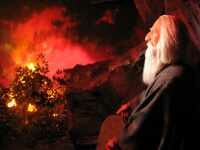
Moses

According to the Hebrew Bible, Moses (Hebrew: משה Mosheh "to draw out, pull out") led the Israelites out of Egypt, and received the Torah of Judaism from God on Mount Sinai. The Torah contains the life story of Moses and his people until his death at the age of 120 years, according to some calculations in the year 2488, or 1272 BC. Consequently, "may you live to 120" has become a common blessing among Jews.

Moses's greatest legacy was probably expounding the doctrine of monotheism, which was not widely accepted at the time, codifying it in Jewish religion with the 1st Commandment, and punishing polytheists. He is revered as a prophet in Judaism, Christianity, and Islam.

The birth of Moses occurred at a time when the current Egyptian monarch had commanded that all male children born to Hebrew captives should be killed by drowning in the Nile River.
22 And Pharaoh charged all his people, saying, Every son that is born ye shall cast into the river, and every daughter ye shall save alive. –Exodus 1:22

1. Exodus 1:22 Samaritan, Septuagint, Targum; Hebrew lacks to the Hebrews

The Torah leaves the identity of this Pharaoh unstated, but he is widely believed to be Ramses II; other, earlier pharaohs have also been suggested including a Hyksos pharaoh or one shortly after the Hyksos had been expelled.

More...

Wednesday, August 25, 2010

Desert Fathers

The Desert Fathers were Hermits, Ascetics and Monks who lived mainly in the Scetes desert of Egypt, beginning around the third century. They were the first Christian hermits, who abandoned the cities of the pagan world to live in solitude. These original desert hermits were Christians fleeing the chaos and persecution of the Roman Empire's Crisis of the Third Century. They were men who did not believe in letting themselves be passively guided and ruled by a decadent state. Christians were often scapegoated during these times of unrest, and near the end of the century, the Diocletianic Persecution (or Great Persecution was the last and most severe Persecution by Diocletian and his colleagues Maximian, Galerius, and Constantius in the Roman empire) was more severe and systematic. In Egypt , refugee communities formed at the edges of population centers, far enough away to be safe from Imperial scrutiny.

In 313, when Christianity was made legal in Egypt by Diocletian's successor Constantine I, a trickle of individuals, many of them young men, continued to live in these marginal areas. The solitude of these places attracted them because the privations of the desert were a means of learning stoic self-discipline. Such self-discipline was modelled after the examples of Jesus' fasting in the desert and of his cousin John the Baptist (himself a desert hermit). These individuals believed that desert life would teach them to eschew the things of this world and allow them to follow God's call in a more deliberate and individual way.

More...

Sunday, August 08, 2010

Nile

The Great Bend of
the Nilein Sudan, looking
north across the Sahara
Desert towards Northern
Sudan and Southern Egypt.
Courtesy NASA.
The Nile (Hebrew: יאור y@`or, Arabic: النيل an-nīl) of Egyptian origin, meaning river, stream, canal, Nile, Nile-canal. The Nile is one of the two longest rivers on Earth.
After two whole years, Pharaoh dreamed that he was standing by the Nile –Gen. 41:1
In Greek, the word "Nile" ('nIl) comes from the word Neilos (Νειλος), a Greek name for the Nile River. Another Greek name for the Nile was Aigyptos (Αιγυπτος), which itself is the source of the name "Egypt."
1 Then the LORD said to Moses, "Go in to Pharaoh and say to him, 'Thus says the LORD, "Let my people go, that they may serve me. 2 But if you refuse to let them go, behold, I will plague all your country with frogs. 3 The Nile shall swarm with frogs that shall come up into your house and into your bedroom and on your bed and into the houses of your servants and your people, and into your ovens and your kneading bowls. Exodus 8:1-3

Among the Hebrews יאור (A River) signified:

a ditch, canal, channel. Is. 33:21, where it is the fosse of a fortified city ; Sept. SmqvI. So of the canals of the Nile.
  • 22 Then Pharaoh gave this order to all his people: "Every boy that is born you must throw into the Nile, but let every girl live." –Exodus 1:22

  • 3 But when she could hide him no longer, she got a papyrus basket for him and coated it with tar and pitch. Then she placed the child in it and put it among the reeds along the bank of the Nile. Exodus 2:3

  • 15 Go to Pharaoh in the morning as he goes out to the water. Wait on the bank of the Nile to meet him, and take in your hand the staff that was changed into a snake.–Exodus 7:15

  • 5 Then I, Daniel, looked, and behold, two others stood, one on this bank of the stream and one on that bank of the stream. 6 And someone said to the man clothed in linen, who was above the waters of the stream, "How long shall it be till the end of these wonders?" 7 And I heard the man clothed in linen, who was above the waters of the stream; he raised his right hand and his left hand toward heaven and swore by him who lives forever that it would be for a time, times, and half a time, and that when the shattering of the power of the holy people comes to an end all these things would be finished.–Dan 12:5-7

More...

Friday, July 23, 2010

Philo of Alexandria

Philo (20 BCE - 40 CE), known also as Philo of Alexandria and as Philo Judeaus, was a Hellenized Jewish philosopher born in Alexandria, Egypt. The few biographical details concerning him are found in his own works, especially in Legatio ad Caium, ("embassy to Caius") and in Flavius Josephus.

The only event that can be determined chronologically is his participation in the embassy which the Alexandrian Jews sent to the emperor Caligula at Rome for the purpose of asking protection against the attacks of the Alexandrian Greeks. This occurred in the year 40 CE.

Philo included in his philosophy both Greek wisdom and Judaism, which he sought to fuse and harmonize by means of the art of allegory that he had learned as much from Jewish exegesis as from the Stoics. His work was not widely accepted. "The sophists of literalness," as he calls them (De Somniis, i. 16-17), "opened their eyes superciliously" when he explained to them the marvels of his exegesis. Philo's works were enthusiastically received by the early Christians, some of whom saw in him a Christian. Eusebius speculated that the Therapeutae, the Jewish group of ascetic hermits in the Egyptian desert that Philo describes in De vita contemplativa ("Contemplative Life") was in fact a Christian group.

We have a brief reference to Philo by the first century Jewish historian Josephus. In Antiquities of the Jews, Josephus tells of Philo's selection by the Alexandrian Jewish community as their principal representative before the Roman emperor Gaius Caligula. He says that Philo was sent to represent the Alexandrian Jews in regard to civil disorder that had arisen between the Jews and the Greeks in Alexandria (in Egypt). Josephus tells us also that Philo was skilled in philosophy, and that he was brother to an official called Alexander the alabarch. According to Josephus, Philo and the larger Jewish community refused to treat the emperor as a god, to erect statues in honor of the emperor, and to build altars and temples to the emperor. Josephus says Philo believed that God actively supports this refusal. This portrait of Philo matches the character of Philo that is expressed in his own writings, as discussed below.

More...

Thursday, June 24, 2010

Achaemenid Empire

The Achaemenid (uh-kee-muh-nid) Empire (Old Persian: Hakhāmanishiya) was a dynasty in the ancient Persian Empire with high cultural and economical achievements during its highest power [After Achaemenes, legendary ancestor of Cyrus II the Great, founder of the dynasty.] At the height of their power, around 500 BC, the Achaemenid rulers of Persia ruled over territories roughly encompassing today's Iran, Iraq, Armenia, Afghanistan, Turkey, Bulgaria, eastern parts of Greece, Egypt, Syria, much of what is now Pakistan, Jordan, Israel, Palestine, Lebanon, Caucasia, Central Asia, Libya, and northern parts of Arabia. The empire ruled by Persia eventually became the largest empire of the ancient world.

Darius I was the first to speak of Achaemenes, who he claimed was an ancestor of Cyrus the Great, (ca. 576 - 529 BC) and therefore the progenitor of the entire line of Achaemenid rulers. However, some scholars hold that Achaemenes was a fictional character used to legitimize Darius' rule, and that Darius the Great usurped the Persian throne.

More...

Monday, February 08, 2010

Pharaoh

Pharaoh is a title used to refer to any ruler, usually male, of the Egyptian kingdom in the pre-Christian, pre-Islamic period. An absolute, all powerful, all providing ruler. Such rulers were believed to be the reincarnation of Horus.

From the Twelfth Dynasty onwards the word appears in a wish formula 'Great House, may it live, prosper and be in health', but only with reference to the buildings of the court rather than the king himself.

10So Moses and Aaron went to Pharaoh and did just as the LORD commanded. Aaron threw his staff down in front of Pharaoh and his officials, and it became a snake. — Exodus 7:10


However, the earliest certain instance where pr-`3 is used specifically to address the king is in a letter to Amenhotep IV (Akhenaten) in the mid-Eighteenth Dynasty (1539-1292 BC) which is addressed to 'Pharaoh, given life, prosperity and health, the Master'.

More...

Sunday, February 07, 2010

History of Jerusalem

The earliest traces of human occupation in Jerusalem go back to the late Chalcolithic Period and Early Bronze Age (c. 3000 BC). The Egyptian Execration Texts (c. 1900-1800 BC) and the Amarna letters (14th century BCE) show that the city was under the power of ancient Egypt. In one of the Amarna letters the city's governor, Abdi-Heba, asks for help from Egypt to fight the Habiru (possibly identical to the Hebrews).

This city has known many wars, and various periods of occupation. According to Genesis 14:18-20, the city (named as Salem) was ruled by king Melchizedek, a priest of God. According to one Jewish tradition reported by the midrash, it was founded by Abraham's forefathers Shem and Eber.

Later, according to the Biblical narrative of the Books of Samuel, it was controlled by the Jebusites, a group that scholars generally believe to have been Hittite.

It is probable that Melchizedek was himself a Jebusite; the -zedek part of the name occurring in other rulers such as Adonizedek, and in some biblical references to Jerusalem itself, such as neweh zedek (Jeremiah 31:23, where it is often translated as home of righteousness).

More...

Saturday, January 16, 2010

The Exodus

The Exodus, more fully The Exodus of Israel out of Egypt, was the departure of the Hebrew slaves from Egypt under the leadership of Moses and Aaron as described in the biblical Book of Exodus. It forms the basis of the Jewish holiday of Passover.

Although we cannot be 100% certain, we have a general idea how many people were among the Israelites during the Exodus because
1 The LORD spoke to Moses in the Tent of Meeting in the Desert of Sinai on the first day of the second month of the second year after the Israelites came out of Egypt. He said: 2 "Take a census of the whole Israelite community by their clans and families, listing every man by name, one by one. 3 You and Aaron are to number by their divisions all the men in Israel twenty years old or more who are able to serve in the army. -Num 1:1-3
And Moses and Aaron and one man from each tribe proceeded to count them:

Numbers from each of the tribes
(note: the alotment of the tribes happened after the Exodus.)
  • Reuben: ראובן
    —46,500 men
  • Simeon: שמעון
    —59,300 men
  • Gad: גד
    —45,650 men
  • Judah: יהודה
    —74,600 men
  • Issachar: יששכר —54,400 men
  • Zebulun: זבולן
    —57,400 men
  • Ephraim: אפרים
    —40,500 men
  • Manasseh: מנשה —32,200 men
  • Benjamin: בנימין —35,400 men
  • Dan: דן —62,700 men
  • Asher: אשר —41,500 men
  • Naphtali: נפתלי —53,400 men
  • Levi: לוי —not counted

More...

Wednesday, August 19, 2009

Nile

After Lake Albert, the Victoria Nile turns into the Albert Nile.The Nile (Arabic: النيل an-nīl), in Africa, is one of the two longest rivers on Earth.

The word "Nile" ('nIl) comes from the word Neilos (Νειλος), a Greek name for the Nile. Another Greek name for the Nile was Aigyptos (Αιγυπτος), which itself is the source of the name "Egypt."
1 Now a man of the house of Levi married a Levite woman, 2 and she became pregnant and gave birth to a son. When she saw that he was a fine child, she hid him for three months. 3 But when she could hide him no longer, she got a papyrus basket for him and coated it with tar and pitch. Then she placed the child in it and put it among the reeds along the bank of the Nile. 4 His sister stood at a distance to see what would happen to him.

5 Then Pharaoh's daughter went down to the Nile to bathe, and her attendants were walking along the river bank. She saw the basket among the reeds and sent her slave girl to get it.
6 She opened it and saw the baby. He was crying, and she felt sorry for him. "This is one of the Hebrew babies," she said.

7 Then his sister asked Pharaoh's daughter, "Shall I go and get one of the Hebrew women to nurse the baby for you?"

8 "Yes, go," she answered. And the girl went and got the baby's mother. 9 Pharaoh's daughter said to her, "Take this baby and nurse him for me, and I will pay you." So the woman took the baby and nursed him. 10 When the child grew older, she took him to Pharaoh's daughter and he became her son. She named him Moses, saying, "I drew him out of the water." -Exodus 2:1-10

More...

Saturday, March 29, 2008

The Middle East

Political & transportation map of the Middle East today. Turkey, Syria, Lebanon, Israel, Iraq, Iran, Jordan, Egypt, Saudi Arabia. Oman, Yeman, Ethiopia and SudanThe Middle East is a historical and political region of Africa-Eurasia with no clear definition. The term "Middle East" was popularized around 1900 by the British, and has been criticized for its loose definition. The Middle East traditionally includes countries or regions in Southwest Asia and parts of North Africa. The corresponding adjective to Middle East is Middle-Eastern and the derived noun is Middle-Easterner.

Etymology

The term "Middle East" may have originated in the 1850s in the British India Office, and became more widely known when American naval strategist Alfred Thayer Mahan used the term.

The history of the Middle East dates back to ancient times, and throughout its history the Middle East has been a major center of world affairs. The Middle East is also the geographic origin of the the Abrahamic religions - Christianity, Islam, Judaism - comprising approximately one half of the world's religions. The Middle East generally has an arid and hot climate, with several major rivers providing for irrigation to support agriculture in limited areas. Many countries located around the Persian Gulf have large quantities of crude oil. In modern times, the Middle East remains a strategically, economically, politically, culturally, and religiously sensitive region.

More...


Subscribe


LifeNews.com

Desiring God Blog

Youth for Christ International